
How field hockey betting actually works: a guide for punters
 Available in US
Current as of 27 October 2026 and checked against the Gambling Commission’s public register.
Every week, somebody posts a “lock of the week” for a sport that has perhaps eight fixtures worth watching. Field hockey fits that shape: tournaments come and go, the men and women’s calendars peak twice a year around the Pro League and the World Cup cycle, and the rest of the time there are streams of domestic games that most bookmakers barely price. A reader looking for “tips” is usually looking for four things at once: which side is going to win, whether the price is worth the risk, how much of the bank to stake, and what to ignore. None of those four questions is answered by a tip alone. The shape of a working answer is what follows.

What follows is a guide, not a tip sheet. It shows how a field hockey tip is built from the underlying form and the bookmaker’s own odds, what value means once the margin has been stripped out, how a stake is sized so a bad week does not end the bank, and why every tip carries a margin against it that nobody removes. It treats each licensed bookmaker on its own merits, names the Commission’s public register as the test of a real licence, and finishes on the safety tools a UK-licensed operator is required to offer. Numbers come from the Commission’s register and from each operator’s own terms page. The conclusions are the writer’s.
Why safer gambling comes first in a tipster’s guide
A reader looking for tips is, by definition, a reader who intends to bet. The first thing a guide to betting owes them is what the betting is costing, on the days it goes wrong, and what controls exist before that day arrives. Tips that ignore this are sales copy that knows your name.

A bookmaker licensed by the Gambling Commission operates inside a framework built by the Gambling Act 2005, with checks that landed in stages across the last decade. The headline changes any reader feels at the betting slip are these.
GAMSTOP is the national self-exclusion register. Enrolment is free, takes about five minutes, and covers every online operator a UK customer can reach in one stroke. Periods are six months, one year, five years, or five years with auto-renewal, and after the minimum term the exclusion stays in place for a further seven years unless the customer asks GAMSTOP to remove it. Once enrolled, a player cannot deposit, place a bet or claim a free bet at any participating site for the chosen period. Every GB-licensed online bookmaker is a member, including every brand this page goes on to name.
Deposit limits sit on the operator’s side. Under the Commission’s Remote Technical Standards the customer can set a gross deposit cap on a fixed time frame from day one. The first phase of tighter rules took effect on 31 October 2025; a second phase was postponed to 30 September 2026, and whether it is live in the form the Commission first published is not established. Players can also lower a limit immediately but cannot raise it without a cooling-off period, so a decision made at the end of a bad day cannot be undone before the morning.
Identity checks at the first deposit are not optional. Since 7 May 2019 every licensed operator has had to verify name, address and date of birth before a customer can deposit or place a bet, and that includes using a free bet or bonus. A punt exists only after this check has cleared. The customer-protection payoff is that there is no anonymous play at a licensed site; the cost is that anyone who set up an account to dodge a previous self-exclusion cannot do it again.
Financial vulnerability checks are a separate, more recent layer. Since 30 August 2024 licensed remote operators have had to run a public-record check when a customer’s net deposits cross £150 in any rolling 30 days, and since 28 February 2025 that threshold has applied in practice. The check looks at public records (bankruptcy and county court judgments, for instance), not income or credit history. The Commission announced on 7 July 2026 a staged plan for fuller financial risk assessments — the press’s “affordability checks” — with no start date set.
Help exists outside the operator. GamCare runs the National Gambling Helpline, GambleAware signposts services, and the NHS runs gambling clinics in several regions. Gamblers Anonymous runs meetings. The brands reviewed on this page link to these services from the safer-gambling pages of their own sites.
Bonuses, free bets and the rollover behind the headline
Field hockey sits in the long tail of most welcome offers, so the bonus the page is judged on is usually a football or horse-racing bonus where field hockey is named in a generic “other sports” line. That framing matters. A “free bet” is rarely free; the price of it is in the rollover attached to the bonus that put it in the account, in the cap on winnings, and in the stake-not-returned rule that turns a £10 free bet into a smaller payout than the same stake in cash.
The rules in force from 19 January 2026 put a ceiling on what bonus conditions can ask. Wagering requirements on bonuses are capped at 10x: a £10 bonus cannot demand more than £100 of qualifying bets before the bonus and any winnings from it are withdrawable. Mixed-product promotions — “bet on football to get free spins”, “deposit for bingo, casino and sports” — are banned, so a bonus cannot pin its clearing to a product the customer never intended to touch.
Take a single concrete shape from the brands on this page to show how the rule reads in practice. Sky Bet credits three £10 free bet tokens for a £5 deposit and a first single or each-way bet of 5p at odds of 1/1 or greater. The headline is “£30 in free bets”; the actual economics depend on what the customer does with each token. A free bet of £10 at odds of 5/1 returns £60 gross — £50 profit on top of the stake — but most free bets do not return the stake itself, so the cash pocketed from that one token is £50, not £60. The same £10 in cash at the same price would have pocketed £60. That £10 difference, repeated across three tokens, is the cost of the “free”.
Spreadex works in a parallel shape. A £60 bundle of free bets is unlocked by a £10 fixed-odds bet, with the qualifying bet to be placed within 28 days of opening the account. The free bets cross product boundaries and can be used on fixed-odds or spread betting. The 28-day window on the qualifying bet is the condition most likely to bite a reader who set the offer aside; a £10 bet at any qualifying price within four weeks of opening, then a chance to deploy the £60 across the book on whatever sports the account allows.
BoyleSports shows another way bonuses keep charging. Its Acca Insurance is opt-in, with a minimum stake of £5, minimum odds of 1/2 and a maximum refund of £20 paid as a free bet that expires in 7 days. The mechanics: an accumulator with one losing leg still settles a £20 free bet if the rest had won, and that free bet itself has to clear inside the week. Used three times in a quarter, the offer is a small cushion; claimed once a year after a bad Saturday, the refund is largely wasted because of the seven-day life.
Two plain cautions against the marketing language: a “free bet” almost never refunds the stake, a “risk-free” refund is usually paid as another free bet rather than cash, and a “boosted price” is still a price from which the margin has not been removed. The page returns to this last point in the section on bookmaker margin.
Live betting and cash out on a sixty-minute sport
Field hockey’s changed format makes it unusually friendly to in-play betting. Since 2017 the men’s and women’s games have been played in four 15-minute periods with a two-minute break between periods and a longer interval at half-time, totalling 60 minutes of play. Each break is a natural pause to read the scoreboard and the shot count; the quarters break the game into four short blocks where momentum can flip and the price can move twice before the final whistle.
Live betting, however, depends on what the bookmaker actually offers. Field hockey is not a top-five sport on most UK books, so the in-play menu is uneven: a small tournament might price only the winner market; a Pro League fixture might offer totals, handicaps, next goal and quarter winner alongside the match result. Where the in-play menu is thin, the temptation is to take whatever price the bookmaker posts and skip the search for value.
The deeper tool in this category is cash out. A cash-out button settles the bet mid-match at a price the bookmaker sets, and that price sits inside the same margin as the pre-match price: it is the bookmaker’s own read of the live probability with its overround attached. A green cash-out button is not a sign the bet is in the customer’s favour; it is the bookmaker offering to release a stake mid-event at a discount to fair value.
Cash out is offered by brands such as 10bet and bet365 alongside in-play betting and live streaming. The combination matters in field hockey because the sport is decided in short bursts, and an account with several operators can compare an in-play price at one bookmaker with a pre-match line at another for the same outcome. bet365 layers live tools on top of the feed — Match Live plus event-specific trackers — which is the texture a serious in-play punter looks for.
The honest summary: in-play works on field hockey when there is a feed, when the bookmaker offers enough markets to make a price comparison possible, and when the punter understands the margin does not disappear at the quarter break. Where any of those is missing, the price is the bookmaker’s price and nothing else.
How a field hockey tip is built and why no tip is certain
A tip is a prediction with a price. To be useful it has to clear three tests: the prediction has to be grounded in something — form, head-to-head record, line-up news, the weather if the game is outdoors — the price has to beat the bookmaker’s margin, and the stake has to fit a staking plan the reader can survive.
Form covers recent results. A national side that has won seven of its last eight Pro League fixtures, with four of those wins against sides in the current top ten, is in form whether the tournament table says so or not; a side that has lost three of its last four against lower-ranked opponents is in a wobble the league table can take months to admit. Form is never the whole story, but form alone often explains a price that looked “wrong” once the result came in.
Head-to-head record matters more in field hockey than in sports with deeper squad rotation. International sides play each other in the same tournaments year after year, and certainties persist: India won the men’s Olympic tournament in 1928 without conceding a goal and kept the gold in 1932–1956, 1964 and 1980, a streak that reflects a depth most opponents have never matched. That history is not a prediction; it is one of the inputs to a price.
Line-up and venue news is the third input. A side missing its first-choice goalkeeper, or playing an Olympic final a day after a semi-final that ran into a shoot-out, is a different proposition to the same side at full strength and fresh. For club hockey, schedule density matters as well: the Dutch Hoofdklasse plays Friday-Sunday-Sunday weeks that catch teams from warmer climates on tired legs.
The price is the second half of every tip. A genuine value bet is one whose decimal odds are higher than the decimal conversion of the true probability: a side with a 50% chance of winning is value at anything above 2.00, fair at exactly 2.00, and bad at anything below. The bookmaker does not price at the true probability; the bookmaker prices at the true probability with a margin added so the book balances. Stripping out the margin to recover the true probability is the skill that separates a tip from a guess.
Staking is the part the tip itself never reaches. A punter who backs every “value” bet at 10% of the bank loses the bank on a normal bad week; the same picks at 2% of the bank survive long enough to let variance work. The Kelly criterion in its full form is a useful formula for sizing stakes against known edges and is harsh on the edges that turn out to be wrong; a fraction of Kelly is the usual compromise. A reader who cannot state their edge in percentage terms should bet a flat small unit of the bank, not a percentage of it.
Why no tip is certain. Even at prices that genuinely beat the margin, a value bet loses most of the time when the true probability is below 50%. A side with a 60% chance of winning loses four of every ten times on average; a stake that does not survive those four losses is the wrong stake. The bookmaker’s margin is paid on every bet, win or lose, and is the one number a tip cannot beat in a single bet — only across many.
Bet types, odds and what a price actually means
The match result market is the easiest field hockey market to read: a home win, a draw or an away win. Tied games are not always draws in the betting sense. Depending on the competition a tied match may stand (a draw), go to extra time (a draw in regulation, a home or away win at full time), or settle directly by a shoot-out (since March 2013, FIH rules send tied classification matches to a shoot-out without extra time). The price on each market depends on which of these the bookmaker is settling on, and that detail matters when the punter is comparing prices between brands.
Totals, handicaps and quarter markets are the live-betting core. A total asks whether the combined goals finish above or below a line — typically 2.5 for a men’s match, occasionally lower for a women’s — set by the bookmaker. A handicap gives one side a head start or deficit in goals; a -1.5 handicap on the favourite only pays if it wins by two or more. Quarter markets treat the four 15-minute periods as mini-matches, which is useful when one team starts fast and another finishes well.
Each-way betting is more often a horse-racing term than a field hockey one, but the structure — two bets at equal stake, one to win and one to place — appears in outright tournament markets where place terms vary by bookmaker and event. Read the place terms on the betting slip before staking: a place payout of one-third of the win price on a four-runner field is not generous.
Accumulators combine several selections into one bet at multiplied odds. A four-fold at legs of 1.80, 2.10, 1.95 and 1.70 multiplies to roughly 12.50, so a £1 stake returns £12.50 gross. Acca insurance, in the form BoyleSports offers, refunds a portion of the stake if one leg loses; the refund is a free bet with its own conditions, not cash.
Bet builders and same-game multis let a punter combine several markets from a single match into one price. The convenience is real; the cost is invisible unless the punter checks the price against the individual lines. A bet builder at 6.00 built from two outcomes that would each be 3.00 alone is fair; at 5.50 it is a discount to fair value.
Odds come in two forms in Britain. Fractional odds state the profit against the stake: 5/1 pays £5 profit per £1 staked, evens (1/1) pays £1 profit per £1 staked. Decimal odds state the total return per £1 staked: 6.00 pays £6 gross per £1 staked, of which £5 is profit. The conversion is one step: 5/1 fractional is 6.00 decimal, 11/4 fractional is 3.75 decimal. evens equals 2.00.
The bookmaker’s margin is what makes a price worse than the truth. Take an illustrative two-way market priced at 1.90 against 1.90 (9/10 against 9/10 in fractional form). The implied probabilities add to 1 ÷ 1.90 plus 1 ÷ 1.90, which is 0.5263 plus 0.5263, totalling 1.0526. The payout share is the reciprocal, roughly 0.9500; the margin is the balance, roughly 0.0500 or 5.0%. In other words, out of every unit staked across that market the bookmaker expects to keep about 5 pence in the pound. The exact figure for any given two-way market at symmetrical 1.90 prices is between 4.5% and 5.5% once rounding is allowed for, and that band is the cost a value punter has to beat before staking. A three-way market on a match result sits higher: a tight 2.20 / 3.40 / 3.40 line implies a margin near 7%.
The fixtures, the tournaments and the calendar that drives the prices
The biggest field hockey calendar is the FIH Pro League across both genders, played between October and June with a finals weekend near the end of the season. National sides play each other home and away; the matches are available on broadcast streams that licensed UK bookmakers usually carry in-play. Pricing depth on a Pro League fixture is the closest field hockey comes to club football pricing.
The Olympic tournament runs every four years and the next edition on the calendar shaped this article. Men’s and women’s Olympic hockey have been on the Games programme since 1928 (men) and 1980 (women), so a tournament this size is always priced outright months in advance; ante-post markets price the medal round, the group winners and the top-four finish. These are the markets where each-way structure matters and where place terms vary most between bookmakers.
Continental championships sit one tier below the World Cup and the Olympics. The European Championship for men and women, the Asia Cup, the Africa Cup of Nations Hockey, the Pan American Games field hockey tournament and the Oceania Cup each generate outright markets. National leagues — the Dutch Hoofdklasse, the German Bundesliga, England’s Premier League Hockey, India’s Hockey India League — price on match result, sometimes on totals, and rarely on player props.
A reader pricing field hockey should know that a sport can be priced in three layers. At the top is the international tournament: most bookmakers offer match result, sometimes totals and outrights. In the middle is the domestic league season: most UK books offer match result on the bigger leagues and not much else. At the bottom is the youth and second-tier club game: this is where field hockey often drops off the menu entirely. A weekend of international fixtures looks one way; a Tuesday night in the Bundesliga looks another; the pricing depth is what separates a value bet from a guess.
The ten UK-licensed bookmakers for field hockey, by offer shape
The ten brands below all carry a Gambling Commission remote licence, each verified against the Commission’s public register at the snapshot for this article. The list is ordered by the shape of the offer each brand brings, not by an overall ranking: a Best Odds Guaranteed offer is irrelevant to a field hockey punter, and a deep in-play menu is exactly what matters for a sport with four short periods. The reader picks the brand whose shape matches their habit.
BetGoodwin: best odds guaranteed on the racing calendar
BetGoodwin operates under licence 002927-R-327985-008 (Commission account 2927), held by Goodwin Racing Limited. The brand’s anchor offer is Best Odds Guaranteed on all UK and Irish horse and greyhound racing, up to £1,000 per race. The offer is paid as an addition to the winning return rather than as a free bet, and it does not extend to field hockey markets.
For a field hockey punter the brand is a side bet, not a main one. The deeper question is what the rest of the sportsbook looks like beyond the racing offer. A reader’s check is the field hockey menu itself: how many Pro League and Bundesliga lines show up on a Saturday, and whether in-play is offered at all. The racing edge does not translate into a different shape on a hockey fixture.
The verdict: BetGoodwin suits a punter whose habit is split between racing and the longer-tail sports and who would rather hold one account than three. A field hockey-only punter should look further down this list before settling.
Sky Bet: three free bet tokens against a £5 first bet
Sky Bet operates under licence 067370-R-341330-005 (Commission account 67370), held by SBG Sports Limited. New customers receive three £10 free bet tokens after a deposit of at least £5 and a first single or each-way bet of 5p at odds of 1/1 (2.00 decimal) or greater. Each token is a free bet on the next sports event, not on racing alone.
The cost of the offer is in what each token does not do. A free bet does not return its own stake on a win, so a £10 token at 5/1 returns £50 profit, not £60; the £10 difference on each of three tokens is the price of the bonus, and the first bet at minimum odds of 1/1 is the qualifying hurdle. Outside the bonus, the sportsbook is a generalist UK product with football and racing at its core.
The verdict: Sky Bet’s shape is right for a reader who can already name the bets they want to place first — the qualifying bet at 1/1 has to be a bet the customer makes anyway, not a bet made solely to chase the bonus. A punt made for the bonus alone is a punt made on a price that probably was not value.
10bet: cash out, bet builder and live streaming in one stack
10bet operates under licence 043173-R-322899-023 (Commission account 43173), held by Blue Star Planet Limited. The sportsbook covers football, tennis and horse racing at the surface, with Cash out, Bet Builder and Live Streaming layered on top — exactly the stack a field hockey punter needs at an in-play match.
Live streaming on a long-tail sport is not automatic; a reader should check whether 10bet actually streams the Pro League fixtures they want to follow. Where the stream is there, the combination of cash out and a live picture lets the customer close a position at the end of a quarter rather than wait for the final whistle. Where it is not, the bet builder is still useful for combining totals and match result on a single game.
The verdict: 10bet fits the punter whose habit is in-play on the second-tier sports and who has stopped expecting the first-tier apps to price them well. A reader who only bets once a week before kick-off will not get full value out of the live stack.
bet365: the deepest live feed on a UK screen
bet365 operates under licence 055148-R-331498-002 (Commission account 55148), held by Hillside (UK Sports) ENC. The brand’s pitch is in-play betting and live streaming of events worldwide, plus event-specific visualisations such as Match Live and Bet Track. The depth of the live feed is what most readers notice first; the menu underneath it is the second thing to look at.
Field hockey on bet365 varies by tournament. Pro League fixtures usually carry match result, often totals, sometimes a handicap. The smaller international fixtures sometimes drop to match result alone. The “Live Golf Tracker” name suggests golf because most readers meet it there; the same visualisation engine runs on other in-play sports, and field hockey is one of them on a good weekend.
The verdict: bet365 is the safer hold for a punter who wants one account that prices almost every sport at some depth and never charges extra for the live stream. A reader whose field hockey menu is shallow elsewhere will find bet365 prices the same fixture at a tighter margin, and tight margins are what value hunting lives on.
Copybet: best odds guaranteed on racing, with first-past-the-post cover
Copybet operates under licence 053774-R-330743-010 (Commission account 53774), held by Copybet UK Limited. The brand offers Best Odds Guaranteed all day, every day on UK and Irish racing, and pays first past the post on horse racing even when the winner is later disqualified. Two racing-specific terms: first past the post is the result the jockey crosses the line first, so the bet pays on the visible result regardless of any stewards’ enquiry.
Field hockey sits on Copybet’s sportsbook the way it sits on most UK books: match result on the bigger tournaments, narrower menus elsewhere. A punter whose habit is splits between racing and field hockey has the same problem as the Sky Bet punter — the racing offer does not transfer to the second sport.
The verdict: Copybet fits a racing-led punter who follows the sport closely and reads the stewards’ reports; for a field hockey-only reader the offer shape is irrelevant.
BoyleSports: acca insurance with a seven-day clock
BoyleSports operates under licence 039469-R-319383-025 (Commission account 39469), held by Boylesports Enterprise. The signature offer is Acca Insurance, opt-in, on accumulators with a minimum stake of £5, minimum odds of 1/2 (1.50 decimal) per leg. A losing leg refunds up to £20 as a free bet that expires in 7 days, with the bet placed and settled on the same day.
The seven-day expiry is the operative detail. A free bet that does not see a fixture inside a week is a free bet wasted. An accumulator on a weekend’s fixtures has until the next Friday night; an accumulator built midweek on Champions League and mid-table league games has until the following Sunday; an accumulator on a Tuesday night cup tie has until the following Monday evening. The reader who tracks this calendar gets the offer.
The verdict: BoyleSports fits a punter whose habit is weekend accumulators and who already plans what to back up with the free bet. The seven-day window is too tight for a casual punter and too generous to leave on the table.
Betmaster: the GB-facing skin of a Malta-registered operator
Betmaster operates under licence 065699-R-339929-002 (Commission account 65699), held by BM Solutions GB Ltd. The company is registered in Malta; the GB-facing site runs under the UK licence. The shopper sees a sportsbook familiar in shape — match result, totals, in-play on the bigger leagues — and the field hockey menu sits in the same long-tail slot it does on every other UK book.
What matters is the GAMSTOP and verification layer rather than the licence jurisdiction. A Malta-registered company is exactly what the Commission’s “point of consumption” rule was written for: a remote operator needs a Commission licence wherever it is based if its facilities reach customers in Great Britain. The licence is what gives a customer deposit limits, identity verification at the first bet, and a route into alternative dispute resolution if the bookmaker withholds funds.
The verdict: Betmaster is one of the shapes to look at when the menu a punter needs is offered at a competitive price. It is the alternative-dispute-resolution and complaint route that makes the licence worth holding; without that, the brand is just another sportsbook.
VBet: bet builder, in-play and a live results calendar
VBet operates under licence 044662-R-324273-022 (Commission account 44662), held by SCGO Limited. The app offers Bet Builder, pre-match and in-play betting, live streaming and a live calendar that shows results and stats — a single page that tracks fixtures and outcomes in real time.
The live calendar is the underrated feature for a field hockey punter. Field hockey tournaments rarely have a single dominant feed, and a page that lists scores across the leagues makes it possible to spot a side in form at a smaller event before the price catches up. Used with the Bet Builder for combining totals and match result, VBet becomes a hunting tool rather than a betting slip.
The verdict: VBet fits the punter who treats form-checking as part of the bet, and who wants the live picture to do some of the work. A reader who only opens the app to place a single pre-match line will not use the calendar.
BetVictor: BOG, live racing streams and Smart Stats
BetVictor operates under licence 039576-R-319370-028 (Commission account 39576), held by BV Gaming Limited. The offer runs Best Odds Guaranteed on UK and Irish horse racing, an enhanced live race streaming product, a BetFinder feature and Smart Stats for racing punters. The racing core is strong; the field hockey offering sits within the general sportsbook.
A punter who wants every sport in one tab and who does not need a deep field hockey menu will find BetVictor competent rather than special. The racing term (each-way terms and place payouts) varies by bookmaker, and BetVictor’s racing margin is competitive enough that the racing punter need not look elsewhere.
The verdict: BetVictor suits a multi-sport punter whose racing interest is large enough to justify the account. A field hockey-only customer should look at bet365 or VBet first.
Spreadex: free bets usable across fixed odds and spread betting
Spreadex operates under licence 008835-R-104580-022 (Commission account 8835), held by Spreadex Limited. The brand spans fixed-odds betting and financial spread betting, with the FCA regulating the spread side and the Commission regulating the fixed-odds side. Spread betting losses can exceed the deposit, which is the headline risk that any reader considering the spread side should understand before staking.
The new customer offer is £60 in free bets for a £10 fixed-odds bet, with the free bets usable across fixed odds and spread betting. The qualifying bet must be placed within 28 days of opening the account, and the rest of the structure sits inside the standard free-bet rules: stake not returned, free bet usable once, expiry on the standard cadence.
The verdict: Spreadex fits a punter whose habit already crosses fixed odds and spread and who wants one account that holds both. A punter who only wants fixed odds should look elsewhere — the spread side carries a risk that is not present in a single fixed-odds book.
| Bookmaker | Licence | Own terms on offers and the offer shape |
|---|---|---|
| BetGoodwin | 002927-R-327985-008 — Goodwin Racing Limited | Best Odds Guaranteed on UK and Irish racing up to £1,000; offer does not extend to field hockey |
| Sky Bet | 067370-R-341330-005 — SBG Sports Limited | Three £10 free bet tokens for a 5p first bet at minimum odds of 1/1 (2.00) |
| 10bet | 043173-R-322899-023 — Blue Star Planet Limited | Cash out, Bet Builder and Live Streaming on a general sportsbook |
| bet365 | 055148-R-331498-002 — Hillside (UK Sports) ENC | In-play, live streaming and event trackers across world events |
| Copybet | 053774-R-330743-010 — Copybet UK Limited | Best Odds Guaranteed all day every day on UK and Irish racing; pays first past the post |
| BoyleSports | 039469-R-319383-025 — Boylesports Enterprise | Acca Insurance; £5 minimum, 1/2 minimum odds, £20 maximum as a free bet, 7-day expiry |
| Betmaster | 065699-R-339929-002 — BM Solutions GB Ltd | Standard sportsbook running under the GB licence; full safer-gambling suite |
| VBet | 044662-R-324273-022 — SCGO Limited | Bet Builder, pre-match, in-play, live streaming and a live calendar |
| BetVictor | 039576-R-319370-028 — BV Gaming Limited | Best Odds Guaranteed on UK and Irish racing; Smart Stats and BetFinder |
| Spreadex | 008835-R-104580-022 — Spreadex Limited | £60 free bets on a £10 qualifying fixed-odds bet within 28 days; spreads side FCA-regulated |
What field hockey is, in one minute
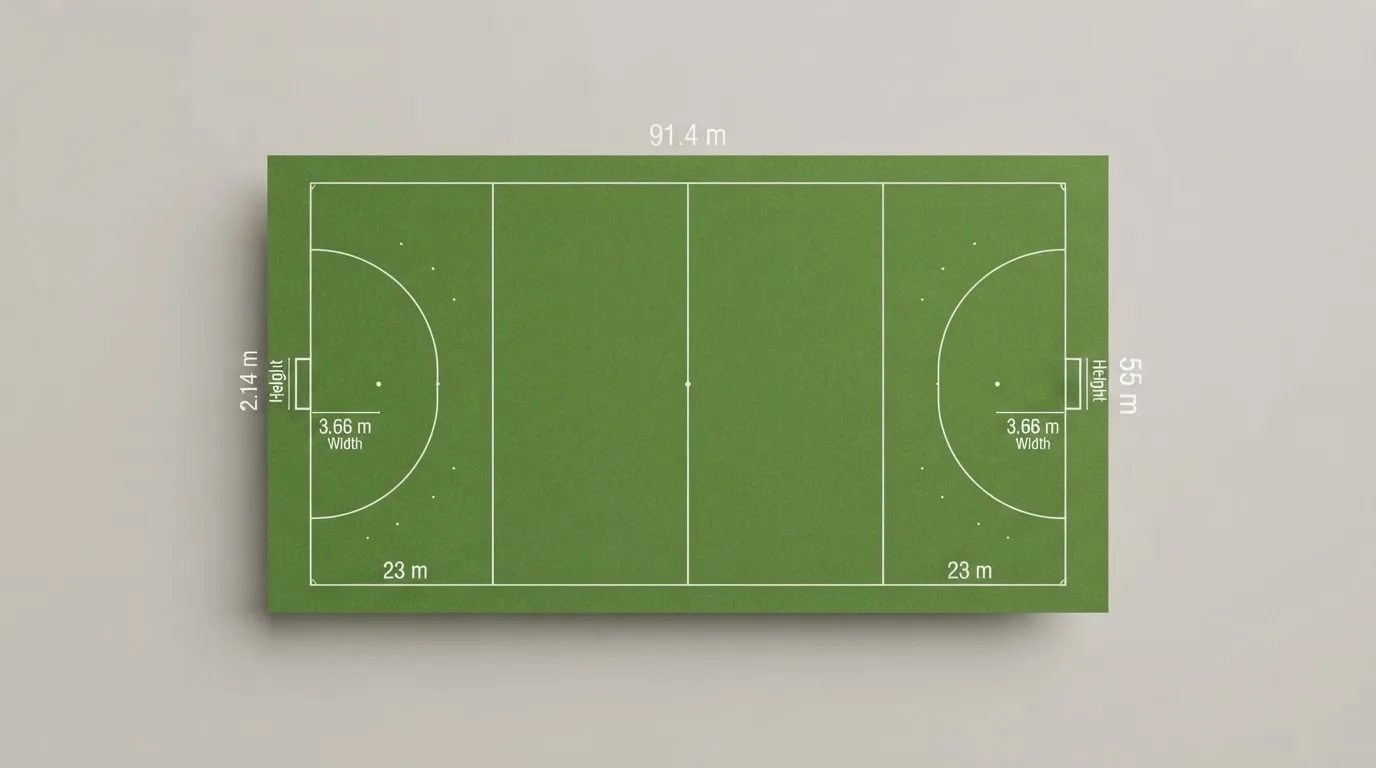
The game’s shape sets the betting shape. A field hockey side fields 10 outfield players and one goalkeeper, so each team has eleven on the pitch. The pitch itself is 91.4 m × 55 m, with each goal 2.14 m high and 3.66 m wide — larger than a football goal on a slightly smaller playing area. Since 2017 matches have been played in four 15-minute periods with two-minute breaks and a fifteen-minute half-time, totalling sixty minutes; the team with more goals after sixty minutes wins. Ties are settled according to the competition: a draw, extra time, or — for tied classification matches — a penalty shoot-out decided directly since March 2013.
The Olympic history frames the international side of the sport. Men’s hockey was on the Olympic programme in 1908 and 1920, dropped in 1924 and reinstated in 1928; women’s hockey was added in 1980. India won the men’s Olympic tournament in 1928 without conceding a goal and won men’s gold in 1932–1956, 1964 and 1980. That history shapes outright markets: an Olympic men’s field hockey outright on India is rarely a value bet at the kind of short price the bookmakers offer.
Why the licence matters, and what to do with it
Field hockey is the kind of sport a casual searcher reaches by accident — through the Olympics, through an article on a player, through a stream on a quiet week. That is also the kind of reader who is most likely to miss the licence. The reason the licence matters is what it carries: identity verification, GAMSTOP membership, dispute resolution, the bonus cap and the financial vulnerability checks described earlier.
Verification is the cost of the licence. A deposit or a bet at a licensed operator requires a verified name, address and date of birth. From the punter’s side this looks like friction; from the Commission’s side it is the only honest way to enforce self-exclusion across brands.
The Commission’s public register is the test. Searchable by business name, trading name, domain or account number, it shows every operator holding a current licence and the categories of licence they hold. For the brands reviewed here every licence was verified against the register at the snapshot for this article.
A brand that holds a GB licence can be on .com as well as .co.uk; the domain does not prove a licence. The licence is what proves the licence. Several of the names above are well-known international brands running on UK licences at the GB-facing site; the international brand is not the licence, the Commission’s account number is.
The honest warning is the offshore alternative. A bookmaker without a GB licence takes deposits from UK customers and pays out from those deposits when it chooses. The punter loses the GAMSTOP coverage, the Commission’s complaints route, the approved alternative dispute resolution service, the bonus cap, and the financial vulnerability check. A punt that goes wrong on an unlicensed book is a punt the punter has no British consumer redress to recover. The page does not name unlicensed brands; the register is the test of whether to use one.
The arithmetic that decides whether a price is worth taking
The margin calculation is one number, not two. Take an illustrative two-way market priced at 1.90 against 1.90 (9/10 against 9/10 in fractional form). The implied probability of each side is 1 ÷ 1.90, which is roughly 0.5263, so the two probabilities add to about 1.0526. The payout share is the reciprocal, 0.9500; the margin is 1 minus the payout share, 0.0500. Out of every pound staked across both outcomes at this price, the bookmaker keeps around 5 pence. Symmetrical pricing of 1.90 gives a margin in the 5% band — typically between 4.5% and 5.5% after the small rounding the bookmakers’ displayed prices carry.
A three-way match result on a tight 2.20 / 3.40 / 3.40 line has a higher margin. The implied probabilities are 0.4545 plus 0.2941 plus 0.2941, adding to 1.0427. The payout share is 0.9588; the margin is 0.0412, around 4.1%. A wider match result at 2.60 / 3.20 / 2.80 lifts the implied sum to about 1.0588 and the margin into the 5.5% to 6% band. Whatever the price, the rule reads the same way: the larger the gap between the implied sum and 1.00, the larger the cut the bookmaker keeps on every unit staked.
This is why a value bet has to clear more than the punter’s own estimate of the probability. A punter who thinks India has a 60% chance of beating Australia needs to find 2.00 or better to call the bet value. The actual market price on India might be 1.83, which is 54.6% implied — a 5.4% margin on a market at 1.83 / 3.60 / 5.50 — and the bet is not value until the price clears 60% in implied terms. A punt at 1.83 is the punter paying the bookmaker for the privilege of being wrong more often than the true probability suggests.
Frequently asked questions
What is a value bet and why is no tip ever certain?
A value bet is one whose decimal odds are higher than the decimal conversion of the true probability. A side with a 60% chance of winning is value at 2.00 or above, fair at 1.67, and bad at anything below. Even a value bet loses around 40% of the time when the true probability is 60%, and bookmaker margins eat further into long-run returns, which is why no tip is ever certain regardless of how strong the form looks on paper.
What is the bookmaker’s margin and how can it be seen in the odds?
The margin is the slice of every pound staked that the bookmaker expects to keep. On a two-way market priced symmetrically at 1.90 the margin is around 5%; on a three-way match result it can rise into the 5% to 7% band. The implied probability is 1 divided by the decimal odds; the sum of implied probabilities across all outcomes is the overround, and 1 minus the reciprocal of that sum is the margin.
How is the return on a bet worked out from the stake and the odds?
In decimal odds the return equals the stake multiplied by the odds. A £10 stake at 6.00 returns £60 gross, of which £50 is profit. In fractional odds the profit equals the stake multiplied by the fraction, so a £10 stake at 5/1 returns £50 profit plus the £10 stake. A combination bet’s odds are the legs multiplied together; a four-fold at 1.80, 2.10, 1.95 and 1.70 multiplies to about 12.50.
How can it be checked that a bookmaker holds a Gambling Commission licence?
The Commission’s public register is searchable by business name, trading name, domain or account number and lists every licensed operator and the categories of licence they hold. The licence number for each brand on this page is in the table above; the reader can confirm each one against the register at the Commission’s own site before opening an account. No printed address from this page substitutes for that check.
Which tools for controlling play does a licensed bookmaker have to offer?
Every GB-licensed online bookmaker is a member of GAMSTOP, which is the national self-exclusion scheme covering all participating operators in one enrolment. Operators also offer deposit limits, time-out periods and product restrictions; the customer can self-exclude with a single operator as well as through GAMSTOP. Help outside the operator is available through GamCare, the National Gambling Helpline, GambleAware, the NHS gambling clinics and Gamblers Anonymous.
US & other team sports – Fast Payout
Content created by the «Fast Payout» team
