
Chess Betting Odds in 2026 — What the Board Looks Like and What a Price Really Costs
 Available in US
Current as of 27 October 2026. Operator terms and Gambling Commission licence details were checked against each operator’s own site and the Commission’s register on the same date.
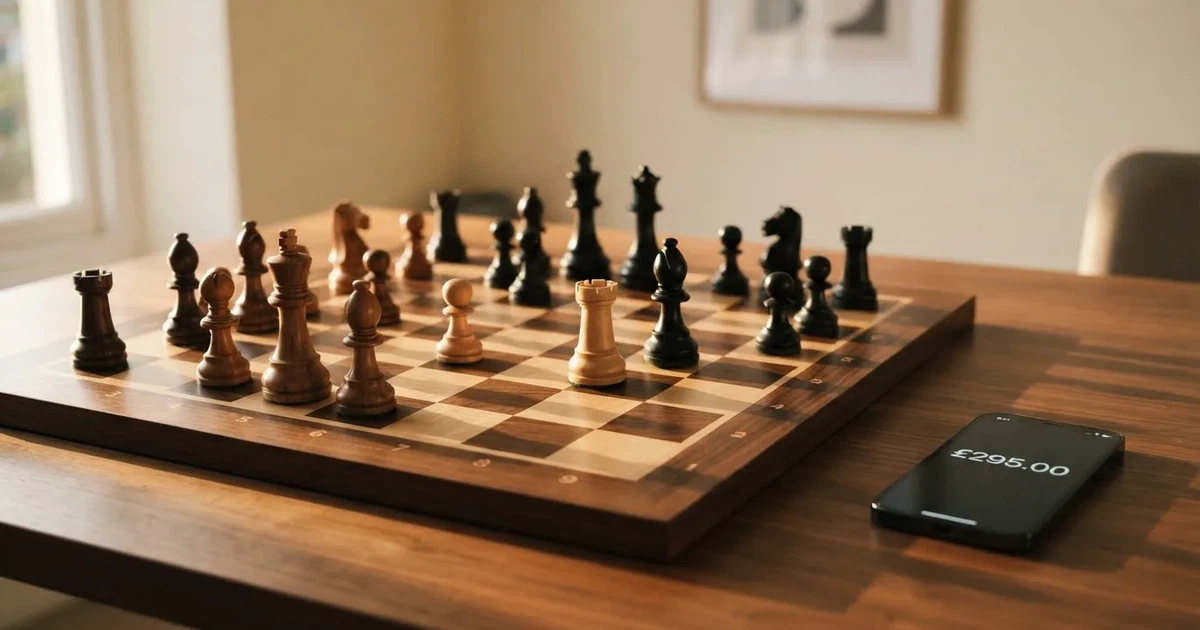
A line on chess sits inside the same machinery as a line on a Saturday football coupon: a bookmaker quotes a price on each outcome, builds a margin into the spread, and pays the winning stake at those odds. The sport itself, though, behaves differently from a ninety-minute game. A chess match has no clock the punter watches tick down, no half-time market, no goals to settle a dead-rubber debate. It is also a smaller market at most UK bookmakers than a Premier League fixture, and the depth of the in-play offering varies far more than the headline app description suggests. The page below sets out what a chess line looks like at a licensed UK operator, what the published odds are actually saying, and what the rest of the betting — the wagering rules, the verification before the first deposit, the self-exclusion register — costs in time and money when the betting slip is finally in front of the punter.
Safer Gambling Around Chess Bets
Chess is a niche market at most UK bookmakers, and niche markets are exactly where a bettor who is in a hurry can mistake a thin offer for a strong one. The single biggest protection available to a UK-resident punter is GAMSTOP, the national multi-operator self-exclusion register. Every operator reviewed on this page is a GAMSTOP member, and self-exclusion can be set for six months, one year, five years, or five years with auto-renewal; after the minimum period the exclusion stays in place for a further seven years unless the customer asks GAMSTOP to remove it. GAMSTOP covers online sites and apps; the high-street bookmakers run a separate in-shop self-exclusion scheme.
The second protection is the deposit limit. Since the Remote Technical Standards came into force the licensed remote operators have offered a gross deposit limit on a fixed time frame, and the first phase of the new limit regime has applied since 31 October 2025. A second phase was postponed to 30 September 2026, and whether it is live on the day a punter opens an account should be checked at the operator’s safer-gambling page. There is no state-set ceiling: the limit is the customer’s choice, and the operator must honour it.
Third, the financial-vulnerability check applies once a customer’s deposits minus withdrawals exceed £150 in a rolling 30-day window. This is a public-record check (bankruptcy, county court judgments), not an income check and not a credit reference check. It can pause a withdrawal or a deposit until the check is closed. Betting on chess is not exempt from it.
For help, GamCare runs the National Gambling Helpline; GambleAware publishes guidance for friends and family; the NHS gambling clinics offer treatment; Gamblers Anonymous runs peer-support meetings. The point of these pages is not to nudge the reader toward any of them, but to set out plainly what each operator offers so the reader can decide, before signing up, what guard rails they want on their account.
Betting on Chess From a Phone or Tablet
Chess betting on a handset is, at the licensed UK operators reviewed here, a browser job or a native app job. The two are not interchangeable, and what they offer a chess punter is not the same. Native apps tend to push notifications, settle bets before a browser session would, and bundle live-streaming and statistics in a tab layout; the browser version tends to be the first place a new market shows up, and the only place some smaller markets appear at all.

The market reality is that the official App Store descriptions for UK-facing sports betting apps name a broad set of sports, and chess is not always one of them. Where the App Store copy lists football, horse racing, tennis, darts, snooker, golf, rugby, boxing and Formula 1, it usually lists an in-play product, a bet builder, and some form of price boost, but rarely names chess by name. The shape of the chess product is therefore read on the operator’s own site, not on the App Store preview. Bet Builder+ — combining several markets from one event into a single bet — exists at bet365 in pre-match and in-play form, with Winnings Boosts on Bet Builders and selected singles and daily Bet Boosts on top. Midnite lists an acca builder, popular accas and price boosts with maximum-stake limits. NetBet offers Daily Boosts, Profit Boosts and free bet offers, a Bet Builder with instant dynamic odds, and sports statistics for the major leagues. 10bet lists Cash out, Bet Builder and Live Streaming alongside its core sports. DragonBet’s app is published by the operator itself, and lists Welsh football and rugby markets alongside racing, American football, in-play betting and bet builder markets. Fitzwilliam Sports describes itself as a Dublin bookmaker with capped membership, offers instant deposits, fast withdrawals, timeouts and deposit limits, and links to GambleAware, GamStop and Gamblers Anonymous.
For chess specifically, what the punter checks is whether the operator’s pre-match board for a Candidates or World Chess Championship match carries outright winner, individual game, handicap and total games markets. That is the shelf on which everything else is built.
Live Betting and Cash Out on a Chess Match
Live chess betting is a narrower product than live football betting. A football in-play tab changes every few seconds; a chess in-play tab, if it exists at all, can sit at the same set of prices for the length of a game that can run three hours, draw by the fifty-move rule, or end inside twenty moves on a blunder. The reason this matters at the betting slip is that live markets that do not move offer no in-play price — they offer the same price with a clock running, and the punter’s edge is the read of the position, not the second-by-second tick of the odds.
bet365 lists in-play betting and live streaming of events worldwide, alongside Match Live, Bet Track and a Live Golf Tracker for following bets in play. The structure is there; the depth of chess coverage inside it is the question for that operator’s site, not for the App Store page. Midnite’s site lists in-play events. The other reviewed operators describe their in-play products in general terms — Cash out, in-play betting, bet builder markets — without naming chess, and the punter finds the live board only by opening the sport at the event level.
Cash out works on chess the same way it works on every other sport: the operator offers a settlement value before the event is over, and the punter can lock in profit or cut a loss by accepting it. Whether cash out is offered on the specific chess market the punter is in is a per-market, per-operator detail. The audit the punter does at the slip is to look for the cash-out icon on the bet, not to assume it from the homepage. Where no icon is shown, the bet runs to the operator’s settlement and there is no early exit.
Chess in-play has another feature football in-play does not: the draw is a real outcome in almost every line. A 1X2 board that pays 1.80 / 3.40 / 4.50 on a Premier League match is offering a draw price; a chess match-outright board that pays 1.85 / 4.00 / 2.10 on a Candidates game is doing the same, and the draw price is closer to the favourite’s price than in football because the chance of a drawn classical game is genuinely higher. The punter’s read of whether to back White, take the draw, or back Black is part of the bet, not part of the slip.
Chess Predictions, Strategy and What a Forecast Is Worth
The phrases “chess betting tips”, “chess analysis betting” and “chess betting strategies” describe the same thing from three angles: the punter who arrives at a chess market is asking what the position says about the result. There is no shortcut to that answer. A chess engine can run a position to a numerical evaluation (White is +1.3, Black is +0.4, the position is equal), and that number translates into a probability of a win, a loss or a draw only when paired with a model of how that evaluation translates to a result over the rest of the game. Different models give different prices; the punter’s edge, if there is one, is the difference between the model’s price and the bookmaker’s price.
Two practical consequences follow. First, the only forecast a punter can use is the one that can be re-stated as a price — a probability, a decimal odds figure, a line against the bookmaker. Anything that arrives as a name (“Gukesh”, “Nakamura”, “Firouzja”) without a number behind it is a tip, not an analysis, and a tip that does not survive contact with the betting slip is wasted stake. Second, the forecast changes between events. A World Chess Championship match between the same two players one year apart carries different prices at the start of each game, and the punter who locked in a forecast for the match is not locked in for game seven.
Bankroll discipline matters more in chess than in football because the sample is smaller — a punter who places two bets a weekend on the Premier League is placing six bets on a Candidates double-round-robin. The punter who sizes a chess stake at the same unit as a Premier League stake is, on average, overbetting chess. The fraction of bankroll a punter should stake on a single chess bet is the same fraction they would stake on a football bet at the same price, but the variance is higher per event, and a losing streak of three events at a sport that runs a tournament a year is the same psychological hit as a losing streak of twenty bets on the Premier League.
The published odds on a chess match are the bookmaker’s translation of an internal model into prices; the punter’s translation of their own model into a stake is the other side of the same trade. The two do not need to agree. They need to disagree by enough that the punter’s expected value is positive after the margin the bookmaker keeps, and that calculation is what the next section turns to.
Bet Types, Odds and the Margin Inside the Price
A chess betting market is settled by result. The standard market is the outright winner of a single game (1–0 White, 0–1 Black, ½–½ draw), with 1–0, 0–1 and ½–½ the three possible outcomes in decimal odds. The tournament outright is the same structure, but for the winner of a multi-game event. The handicap market and the total-games market are settled on the score at the end of the event. A bet builder combines markets from one event into a single bet; at bet365 this is offered pre-match and in-play under the Bet Builder+ brand.
How a winning bet pays back is the same arithmetic on every sport. For a single bet at decimal odds *o* and stake *s*, the return is *s × o* and the net profit is *s × (o − 1)*. A combination bet multiplies the odds of its legs into one price. The punter who backs White at 1.85 and Draw at 4.00 in an each-way fashion is placing two bets of the same stake, so the stake doubles and the return is calculated on each leg independently.
The bookmaker’s margin is the slice of every pound bet that the operator keeps, on average. For a market with outcomes *o₁*, *o₂*, …, *oₙ* and decimal odds, the payout share is the reciprocal of the sum of the reciprocals of the odds — 1 ÷ (1/o₁ + 1/o₂ + … + 1/oₙ) — and the margin is 1 minus the payout share. To see how the arithmetic reads on a clean two-way market, take a price of 1.90 on each side: the payout share is 1 ÷ (1/1.90 + 1/1.90) ≈ 0.9524, and the margin is roughly 4.76 %, sitting in a band of about 4 % to 6 % at the typical licensed UK bookmaker on a chess match with reasonable liquidity. The same 1.90 / 1.90 price on a market with a third outcome — a draw at 4.00 — gives a payout share of about 0.8792 and a margin of about 12.08 %, because the extra outcome is a thinner-priced line the operator protects more heavily.
This is what the margin costs the punter in practice. On the two-way 1.90 / 1.90 line above, the punter who bets £10 on one outcome and wins gets back £19 (£10 × 1.90), a profit of £9 against a stake of £10. Over many bets at that margin, the punter who prices every bet at fair will lose about £0.476 for every £10 staked across both sides — the operator’s edge. The punter who can find a price at 2.00 on a bet they have priced at 1.90 has an edge, but only after the margin is taken out: a 2.00 decimal price on a fair 1.90 price implies a 5.26 % expected edge before commission, and the margin is what decides whether that edge survives the bet.
The margin is also why the same fixture has different prices at different operators. Two bookmakers pricing the same Candidates game can quote 1.85 / 4.00 / 2.10 and 1.90 / 3.80 / 2.05; the second bookmaker is paying more on the favourite and less on the underdog, and the punter who backs the favourite takes the second bookmaker and the punter who backs the underdog takes the first. The arb-free price band is the spread between the two books’ margins.
For free bets whose stake is not paid back on a win, the value of the free bet is the free-bet amount multiplied by the odds minus one, divided by the odds, multiplied by the payout share of the market — a smaller number than the headline amount, and a number that depends on the market the free bet is staked on. A £10 free bet at decimal odds of 4.00 on a market with a 90 % payout share is worth about £6.75; at odds of 2.00 on the same market it is worth about £4.50. The free bet is not a refund, and the stake is not paid back with the win; this is the difference between a free bet and a cash bonus.
Chess Tournaments the Punter Actually Bets On
Chess is governed by FIDE, the International Chess Federation, which publishes the rules in its Handbook. A chess game is played on an 8×8 board of 64 squares, with each player controlling 16 pieces. Results are recorded as 1–0 for a White win, 0–1 for a Black win and ½–½ for a draw. Under FIDE rules a chess game is drawn by stalemate, by agreement, or by claim of threefold repetition or the fifty-move rule; since 2014 fivefold repetition and a 75-move rule end the game automatically without a claim. Wilhelm Steinitz, the first universally recognised World Chess Champion, claimed the title in 1886; Gukesh Dommaraju won the title in 2024. The current cycle is built around the World Chess Championship match, the Candidates Tournament, the Grand Prix series and the FIDE World Cup, with classical, rapid and blitz formats each carrying their own events.
What the punter bets on in 2026 is the next event on that calendar with a betting market. The World Chess Championship match sits at the top: long-format classical games, settled by result, and priced as outright winner and correct score. The Candidates Tournament is the qualifier, played as a double round-robin of eight players, with each pair of games settled individually. Below that the Grand Tour events — the Grand Prix, the Norway Chess tournament, the Sinquefield Cup, the Tata Steel Masters — carry outright and individual-game markets at the larger operators. The club scene is smaller, but team events such as the Champions Chess Tour carry outright and match markets at specialist operators.
The punter’s read of the calendar is what decides whether a market is open. A match that has not been announced does not have a price; a match that has been announced but not yet started is priced in the ante-post market, where the price can move as the form of the players changes; a match in progress is priced in-play, where the price moves with the position. The punter who wants to back White in game one of the World Chess Championship match buys at the ante-post market if they have an opinion weeks in advance, or at the in-play market once the position has settled.
How the Ten Reviewed Bookmakers Cover Chess
The table below sets out the Gambling Commission remote licence number for each reviewed operator, the licence holder named on the register, and what the operator’s own site or app store page states about its chess coverage and the products that matter to a chess punter. The “terms” column captures the products the operator’s own marketing names — bet builder, live streaming, cash out, best-odds-guaranteed — and the column is honest about gaps: a reviewed operator that names football, horse racing, tennis and darts in its app description and does not name chess is recorded that way, not as “covers chess”.
| Brand | Gambling Commission remote licence (licence holder) | What the operator’s own terms state on the chess market and related products |
|---|---|---|
| Betfred | 039544-R-319290-010 — Petfre (Gibraltar) Limited | Done Brothers publishes the Betfred Sports, Casino & Games app covering 21 sports and over 2,000 casino-style games; the operator does not name chess in its app-store copy and the chess board is the question for the operator’s own site. |
| BetMGM | 039198-R-319450-029 — LeoVegas Gaming PLC | Sports welcome offer: four £10 free bets (two football accumulators of 4+ selections and two sports multiples of 2+) for new UK customers who deposit £10 or more and place a sports bet within 7 days; valid 7 days, minimum odds, opt-in required. Chess is not named in the operator’s app-store copy. |
| Bet600 | 044731-R-323941-016 — Tyche Tech Limited | Best Odds Guaranteed on horse racing: if the starting price is bigger than the early or show price taken, the bet is paid at the SP. The operator does not name chess in its app-store copy; BOG applies to racing, not chess. |
| 10bet | 043173-R-322899-023 — Blue Star Planet Limited | Sportsbook covers football, tennis and horse racing, with Cash out, Bet Builder and Live Streaming. Chess is not named in the operator’s app-store copy. |
| DragonBet | 064908-R-339041-003 — DragonBet Ltd | Published by dragonbet ltd, featuring Welsh football and rugby markets, racing, American football, in-play betting and bet builder markets. Chess is not named in the operator’s app-store copy. |
| Fitzwilliam Sports | 048760-R-335434-009 — SBKI Limited | Dublin bookmaker with capped membership; “High Stakes Welcome” subject to compliance criteria; instant deposits, fast withdrawals, timeouts and deposit limits, links to GambleAware, GamStop and Gamblers Anonymous. Chess is not named in the operator’s app-store copy. |
| Bar One Racing | 056516-R-332750-007 — Bar-One Racing Limited | Irish independent bookmaker with shops across Ireland, rebranded as BAR 1 Betting; horse racing sponsorships at Dundalk, Fairyhouse, Navan, The Curragh, Curraheen Park and Cork. Chess is not named in the operator’s app-store copy. |
| Midnite | 101839-R-342850-001 — Midnite Limited | Sports welcome offer: new customers who bet £5 or more on pre-match odds of EVS (2.0) or greater within 14 days of sign-up receive £25 in free bets and 50 free spins, valid 7 days; site cites Gambling Commission licence 101839 and shows in-play events, an acca builder, popular accas and price boosts with maximum-stake limits. Chess coverage is the question for the operator’s own site. |
| Paddy Power | 039439-R-319330-013 — PPB Counterparty Services Limited | Paddy Power Sports Betting app covers football, horse racing, boxing, rugby, tennis, golf, darts, snooker and F1. Chess is not named in the operator’s app-store copy; the chess market sits inside the operator’s “Specials” or “Other Sports” tab. |
| NetBet | 039170-R-319343-032 — Netbet Enterprises Limited | Daily Boosts, Profit Boosts and free bet offers; Bet Builder with instant dynamic odds; sports stats for major leagues. Chess is not named in the operator’s app-store copy. |
The pattern the table sets out, and the rest of this section reads, is that the UK-facing sports betting app market names a core set of sports — football, horse racing, tennis, boxing, darts, snooker, golf, rugby, American football — and treats chess as a smaller-market sport that lives on the site, not on the App Store description. The punter who wants to bet on chess does not read the App Store page; the punter reads the operator’s site at the sport level and checks the board.
Betfred
Betfred is one of the larger UK-facing bookmakers and operates a Done Brothers (Cash Betting) Ltd sports and casino product across 21 sports plus over 2,000 casino-style games. The Gambling Commission remote licence 039544-R-319290-010 sits with Petfre (Gibraltar) Limited as licence holder. The app-store copy does not name chess, and the chess board is on the operator’s own site; a punter who wants to bet on the Candidates or a Grand Prix event opens Betfred’s site at the sport level and checks whether the outright, individual game, handicap and total games markets are listed. Betfred’s wider products — Cash out, in-play, price boosts on selected markets — apply where the market exists. The verdict: Betfred targets the punter who prioritises a deep, traditional sportsbook over a niche-specific chess app experience.
BetMGM
BetMGM’s UK product is published under LeoVegas Gaming PLC as the Gambling Commission licence holder (account 39198), and the operator’s sports welcome offer is a four-£10-free-bet package: two football accumulators of four or more selections and two sports multiples of two or more, valid for seven days, minimum odds, opt-in required, with a £10 deposit and a sports bet within seven days of sign-up. Chess is not named in the operator’s app-store copy, and the chess market is on the operator’s own site. The wagering terms on the free bet — if any — are read at the operator’s promo page before claiming, and the cap on free-bet winnings and the qualifying minimum odds for each free bet are checked at the slip. The verdict: BetMGM is built for the casino-oriented bettor who occasionally explores chess markets on the main desktop site.
Bet600
Bet600 is published by Tyche Tech Limited under Gambling Commission account 44731. The operator pays Best Odds Guaranteed on horse racing — the starting price is paid if it is bigger than the price taken at the time of bet — and the BOG rule applies to racing, not chess. Chess coverage is not named in the operator’s app-store copy. The wider product — in-play, bet builder — sits where the operator lists it. The verdict: Bet600 is fundamentally a racing platform; for the chess punter, it offers a functional site presence without the specialized focus found elsewhere.
10bet
10bet is published by Blue Star Planet Limited under Gambling Commission account 43173. The sportsbook covers football, tennis and horse racing, with Cash out, Bet Builder and Live Streaming named in the App Store description. Chess is not named in the App Store copy, and the chess board is read on the operator’s own site. Live Streaming on a chess match is unusual — the operator’s live stream list is checked at the in-play tab — and Cash out and Bet Builder apply where the chess market exists. The verdict: 10bet is for the bet-builder enthusiast who appreciates having live streaming options alongside standard market coverage.
DragonBet
DragonBet is published by DragonBet Ltd under Gambling Commission account 64908. The operator’s app-store description lists Welsh football and rugby markets, racing, American football, in-play betting and bet builder markets; chess is not named. Details for chess can be located by browsing the operator’s site directly. DragonBet’s niche — Welsh football and rugby — is the market the operator pushes hardest, and a chess punter looking at DragonBet is checking the operator’s chess product because the operator’s strength is elsewhere.
Fitzwilliam Sports
Fitzwilliam Sports is a Dublin bookmaker with capped membership, published by SBKI Limited under Gambling Commission account 48760. The operator offers instant deposits, fast withdrawals, timeouts and deposit limits, links to GambleAware, GamStop and Gamblers Anonymous, and runs a “High Stakes Welcome” subject to compliance criteria. Chess is not named in the operator’s own home page copy, and a chess punter reading the operator’s site for the chess product is checking whether the operator lists chess at all, given that the operator’s positioning is high-stakes racing and capped accounts. The verdict: Fitzwilliam Sports suits a punter who wants a capped-membership bookmaker with Irish racing around the bet; the chess product is read on the operator’s site, not assumed.
Bar One Racing
Bar One Racing has rebranded as BAR 1 Betting, an Irish independent bookmaker with shops across Ireland, published by Bar-One Racing Limited under Gambling Commission account 56516. The operator sponsors racing at Dundalk, Fairyhouse, Navan, The Curragh, Curraheen Park and Cork. The product is racing-led and the chess board is not named in the operator’s app-store copy. A chess punter reading the operator’s site for a chess market is checking whether the operator carries the sport at all, given that the operator’s strength is on-course and off-course racing.
Midnite
Midnite is published by Midnite Limited under Gambling Commission account 101839. The operator’s site shows in-play events, an acca builder, popular accas and price boosts with maximum-stake limits. The sports welcome offer — £5 or more on pre-match odds of EVS (2.0) or greater within 14 days of sign-up for £25 in free bets and 50 free spins, valid seven days — is the headline offer; the qualifying minimum odds (EVS, 2.0) is the price floor the punter’s qualifying bet must meet, and the seven-day validity is the deadline on the free bet. Chess coverage is not named in the App Store description and the chess board is on the operator’s own site. The verdict: Midnite serves the bettor who values welcome-offer mechanics and is comfortable confirming chess availability directly on the desktop platform.
Paddy Power
Paddy Power is published by PPB Counterparty Services Limited under Gambling Commission account 39439. The Paddy Power Sports Betting app covers football, horse racing, boxing, rugby, tennis, golf, darts, snooker and F1, and the operator’s product on chess sits inside the “Specials” or “Other Sports” tab rather than the front-page sports list. The wider product — Cash out, in-play, acca insurance, price boosts — applies where the chess market exists. The verdict: Paddy Power is designed for the user who wants broad market access and does not mind locating the chess offering within the secondary sports menus.
NetBet
NetBet is published by Netbet Enterprises Limited under Gambling Commission account 39170. The operator offers Daily Boosts, Profit Boosts and free bet offers, a Bet Builder with instant dynamic odds, and sports statistics for the major leagues. Chess is not named in the App Store description and the chess board is on the operator’s own site. The wager terms used on each boost and free bet — minimum odds, qualifying market, expiry — are read at the operator’s promo page before claiming. The verdict: NetBet is an option for the boost-oriented player, provided they are prepared to verify the specific chess listings independently.
What Chess Betting Actually Looks Like at a Licensed UK Bookmaker
Chess is one of the smaller markets at the average UK-facing licensed bookmaker, and the punter who arrives at a chess line is doing three things at once: pricing the position, sizing the stake against the variance of a low-frequency event, and reading the operator’s terms on the specific market. The first is the punter’s job. The second is a function of the bookmaker’s market — the smaller the market, the higher the variance per bet. The third is the operator’s job and is where the rest of this page lives.
A chess match is settled by result, and the result is published by FIDE in standard form (1–0 White, 0–1 Black, ½–½ draw). The bookmaker settles to FIDE’s published result; a player who resigns loses on the result, not on the move of resignation; a draw by agreement is settled as a draw, regardless of the position on the board at the time. The punter who has a chess-engine read of the position at move forty has a different probability of the result than at move one, and the operator’s in-play price, where it is offered, reflects the operator’s read of that probability.
For an event with the depth of the World Chess Championship match, the markets at the larger licensed UK operators typically include outright winner (the result of the match, settled on the official FIDE result), individual game winner (the result of a single game, settled on the official FIDE result), correct score (the number of wins, draws and losses for one player across the match), total games over/under (the number of games played across the match, settled at the moment the match result is reached) and handicap (one player given a virtual game lead or deficit). For an event with less depth — a club event, a rapid online tournament — the outright winner is the only market on offer, and the punter who wants a handicap market moves to a different operator or accepts the smaller market.
The punter’s read of the chess product at a licensed UK bookmaker is therefore a three-step check: first, does the operator carry the event at all; second, which markets does the operator carry on the event; third, what is the margin inside the operator’s prices on the markets offered. The first two are read on the operator’s site at the sport level. The third is the arithmetic of the price band above, and a price at one operator at 1.85 / 4.20 / 2.00 versus another operator at 1.90 / 4.00 / 2.05 is a £10 swing on the favourite and a £20 swing on the underdog over a £100 stake, enough to make the difference between a punter placing the bet and walking away.
The wider product — Cash out, Bet Builder, Live Streaming, Best Odds Guaranteed — is on top of the chess market, where the operator offers it. Cash out on chess exists where the operator offers an in-play price; Bet Builder on chess exists where the operator builds a same-event multi from chess markets, which is rare and most often seen at the larger operators. Best Odds Guaranteed is a horse-racing product; chess does not have a starting price, and the BOG rule does not apply to chess bets.
Legality, Regulation and What a GB Licence Means for a Chess Punter
The Gambling Commission is the regulator for the commercial betting market in Great Britain, and operates as a non-departmental public body sponsored by the Department for Culture, Media and Sport. The framework is the Gambling Act 2005, which covers England, Scotland and Wales; Northern Ireland is outside the Act and has its own older law, so a “GB licence” regulates Great Britain and not Northern Ireland. Since the Gambling (Licensing and Advertising) Act 2014 an operator whose remote facilities are used in Great Britain needs a Commission licence wherever it is based; sections 33 and 36 of the 2005 Act, as amended, are the test. A Curaçao, Maltese or Gibraltar licence is not a substitute.
The licences the Commission issues for online betting are: remote general betting standard (real events), remote general betting standard (virtual events), remote general betting limited, remote pool betting, and remote betting intermediary (the licence for betting exchanges). All ten operators reviewed on this page hold a remote general betting standard (real events) licence and are listed on the Commission’s public register. The register can be searched by business name, trading name, domain or account number and is the whole test of whether a brand holds a licence. There is no state monopoly, no statutory list of permitted sports, and no statutory cap on the number of licences.
What may be bet on is set by the operator under its licence and the Licence Conditions and Codes of Practice. In-play betting is offered by GB bookmakers and the controls are the operator’s licence conditions and customer-protection duties; no statutory restriction on in-play betting was found. Esports are treated like any other event; virtual events are a separate licence category. No statutory cap on stakes in sports betting was found: operators set their own maximum stakes and may restrict customers.
Player protection has four pillars. Identity verification — name, address and date of birth — is required before a customer can deposit or gamble, in place since 7 May 2019, including with a free bet or bonus. GAMSTOP is mandatory for online operators since 31 March 2020. The financial-vulnerability check (LCCP condition 3.4.4) has been in force since 30 August 2024 and applies once deposits minus withdrawals exceed £150 in a rolling 30-day window; from 28 February 2025 the threshold has been the £150 figure. Financial risk assessments (the “affordability checks” of the press) are announced in a staged plan, with no start date. The Commission’s deposit-limit regime (RTS 12) had its first changes apply from 31 October 2025, with a second phase postponed to 30 September 2026.
Bonuses are capped. Wagering requirements on bonuses are capped at 10x — a £10 bonus at 50x needs £500 of bets; under the cap no more than £100 of bets are needed to clear a £10 bonus. Mixed-product promotions, where an offer requires gambling on two or more product types, are banned. Whether the cap applies to free bets with no wagering condition, and any cap on the money value of a bonus, are not established and are read at each operator’s promo page. Advertising is not licensed by the Commission; it runs through the CAP Code (non-broadcast) and BCAP Code (broadcast), enforced by the ASA, alongside the LCCP marketing conditions.
The tax that touches the punter directly is zero. The player pays no tax on betting winnings in Great Britain; General Betting Duty is the operator’s tax on gross profits, currently 15% under the headline rate, with a new remote betting rate of 25% applying from 1 April 2027 within the duty. The rate applies to remote operators; the headline 15% remains for remote bets on UK horse racing, self-service betting terminals in licensed premises, pool betting and in-person betting. Until 1 April 2027 the remote rate stays at 15%. Whether operators pass duty on through odds is not established, and a punter should never be told they are charged duty.
The offshore question matters. A GB licence is compulsory at the point of consumption. Providing gambling facilities in Great Britain without the licence the Act requires is an offence under section 33 of the Gambling Act 2005 — on summary conviction up to 51 weeks’ imprisonment, a fine up to level 5, or both; six months in Scotland — aimed at the operator. No offence aimed at a customer who merely bets on an unlicensed site was found. The loss of protection on an unlicensed site is the point: no GAMSTOP coverage, no Commission complaints route, no approved dispute-resolution body, no British consumer redress if funds are withheld, not bound by the 10x bonus cap or the £150 vulnerability check. Enforcement against unlicensed operators is disruption, not blocking — cease-and-desist notices, search-engine referrals, work with registrars, hosts and payment providers — and the Commission has been given, or is about to receive, court-order DNS blocking powers. ISP blocking is not in operation.
The honest framing is that a GB-licensed bookmaker offers the verification before the first bet, the £150 vulnerability check at higher spend, the GAMSTOP coverage, the 10x bonus cap and the Commission’s complaints route. An unlicensed bookmaker offers none of those protections and the additional risk that funds are withheld in a dispute the punter cannot escalate. Neither is the safe choice by default; the licensed choice is the punter’s choice with the protections of British law attached.
Frequently Asked Questions
Where to bet on chess?
At a Gambling Commission-licensed UK bookmaker: Betfred, BetMGM, Bet600, 10bet, DragonBet, Fitzwilliam Sports, Bar One Racing, Midnite, Paddy Power and NetBet all hold remote general betting standard (real events) licences. The chess board is read on each operator’s site at the sport level rather than the App Store description; check the outright, individual game, handicap and total games markets before staking.
Can you bet on chess?
Yes, at any UK-facing bookmaker that lists chess under its event menu. There is no statutory list of permitted sports, so a licensed operator can carry chess under its general betting licence. Minimum age is 18, and identity verification — name, address and date of birth — happens before the first deposit or bet, including with a free bet or bonus.
How to bet on chess?
Open an account at a licensed UK bookmaker, verify identity, deposit by debit card or bank-based payment (credit cards are banned for gambling in Great Britain since 14 April 2020), open the chess event, choose the market — outright winner, individual game, correct score, total games or handicap — and place the bet. The stake × decimal odds is the return; the stake × (decimal odds − 1) is the profit.
How can it be checked that a bookmaker holds a Gambling Commission licence?
Open the Commission’s public register and search by business name, trading name, domain or account number. The register lists the licence categories (remote general betting standard, remote pool betting, remote betting intermediary) and the licence holder. The register is the whole test of whether a brand holds a licence; a domain is not proof, because licensed operators use .com as well as .co.uk.
How is the return on a bet worked out from the stake and the odds?
For a single bet at decimal odds *o* and stake *s*, return = *s × o* and net profit = *s × (o − 1)*. A combination bet multiplies the odds of its legs into one price. For a free bet whose stake is not paid back, value ≈ free-bet amount × (odds − 1) ÷ odds × payout share of the market; a £10 free bet at odds 4.00 on a market with a 90% payout share is worth about £6.75.
What is the bookmaker’s margin and how can it be seen in the odds?
The margin is the slice of every pound bet the operator keeps, on average. For a market with outcomes at decimal odds *o₁*, *o₂*, …, *oₙ*, the payout share is 1 ÷ (1/o₁ + 1/o₂ + … + 1/oₙ) and the margin is 1 minus the payout share. A two-way line at 1.90 / 1.90 gives a payout share of about 0.9524 and a margin of about 4.76%; a three-way line at 1.85 / 4.00 / 2.10 gives a payout share of about 0.879 and a margin of about 12.1%.
Tennis, darts & cue sports – Fast Payout
Content created by the «Fast Payout» team
