
Reading horse racing odds in Great Britain
 Available in US
Current as of 27 October 2026 · Operator licence status verified against the Gambling Commission’s public register
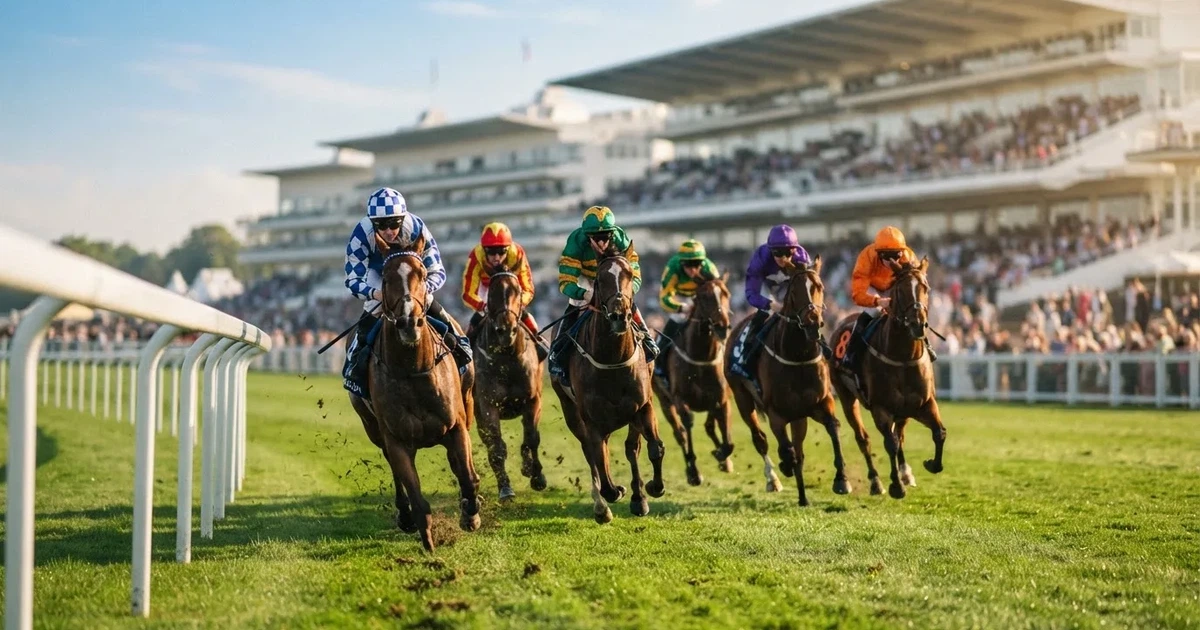
Horse racing is the sport where British betting vocabulary still does most of the work. Punters talk about prices, not odds, and a bookmaker’s margin lives inside those prices whether the conversation notices it or not. The page below works through what those numbers represent on a betting slip, where the bookmaker’s cut sits, what each-way really doubles, and how to tell whether a brand offering prices in Great Britain holds the licence the Gambling Act 2005 requires. Ten reviewed operators sit alongside the explanation, each described for what its own terms state and what its public licence record shows.
Where horse racing sits in the British betting calendar
Horse racing is the sport whose fixture list the rest of the British betting market quietly schedules itself around. Flat racing runs directly between two points around a straight or oval track, while jump racing (steeplechasing and hurdling) is called National Hunt in Great Britain and Ireland. The two codes share most betting vocabulary but diverge on calendar: the Flat runs from spring through autumn, the National Hunt takes over when the leaves fall and stays through to the spring.
Flat distances run from around 440 yards to more than four miles, with five to twelve furlongs the band most betting markets price. National Hunt racing turns on stamina at longer distances, with hurdles and fences changing the kind of effort a horse has to give. Handicaps assign each horse a different weight to carry based on its assessed ability, while conditions races give horses the same weight with allowances for younger and female horses. The weights turn a race into a public form-of-art contest as much as a contest of horses, and betting markets price them in.
The British Triple Crown — the 2000 Guineas, the Derby and the St Leger — anchors the summer Flat programme. Cheltenham, Aintree and the Punchestown festival anchor the National Hunt spring. Around them sit daily meetings at courses such as Ascot, Newmarket, Haydock, Kempton and Plumpton, with racing on most days of the year at some British or Irish track. That density is why horse racing sits at the centre of most British bookmakers’ pre-match offer, and why the in-play product is built to handle a race every few minutes through the afternoon.
For someone comparing bookmakers, the practical meaning is straightforward. A site that prices horse racing in depth shows it across hundreds of meetings a week, with ante-post markets weeks in advance, place markets for each race, and in-running prices from around a minute before the off. A site that does not show much beyond football and tennis tends to thin out on racing, with fewer each-way places and less Best Odds Guaranteed coverage. The rest of this page works through what to look at when the markets do appear.
The reviewed set: ten licensed bookmakers side by side
A side-by-side reading of the ten operators reviewed below sits below, in the form of a comparison table covering licence numbers, licence holders and what each operator’s own published terms say on a key subject. The table is the starting reference; the ten reviews that follow it work through each brand in more detail. Operators are listed in the order they appear on this page, which is not a ranking — a place in the comparison is not an endorsement.
What every operator in this set shares is a Gambling Commission remote licence for Great Britain and GAMSTOP membership. What they differ on is the shape of their racing product: how early ante-post prices go up, how many places each-way bets pay on big-field handicaps, whether Best Odds Guaranteed applies, whether the in-play product takes bets from a moving race, and which payment routes the terms allow.
The column matters vary across the ten, and a reader comparing should treat the table as a snapshot of what each operator states today and check the brand’s own terms before staking. Licence status is verified against the Commission’s public register, which can change.
How odds become built for a horse race
What a price on a horse actually says
A price on a horse says two things at once. It is the return a winning stake multiplies into, and it is the implied probability the bookmaker has assigned to that horse winning. A horse at 5/1 (fractional) or 6.00 (decimal) returns six pounds for every pound staked, including the pound returned, and the implied probability is roughly one in six. A horse at 1/1 (evens, 2.00 decimal) returns two pounds for every pound staked and is priced as a coin-toss.
Reading the two at once is the skill. A short price (odds-on, shorter than evens) says the bookmaker expects this horse to win more often than it loses. A long price says the opposite. Punters who take a short price are paying for safety, and a long shot for a chance at a larger return. The bookmaker’s cut is the same on both sides of that trade.
Fractional, decimal and starting price
Britain still publishes most racing prices in fractions (5/1, 11/4, evens) and decimal odds (6.00, 3.75) sit beside them. The conversion is a/b → a ÷ b + 1: 5/1 → 1.25 + 1 → 2.25? No. 5/1 → 5 ÷ 1 + 1 → 6.00 decimal, returning £6 for a £1 stake. 11/4 → 11 ÷ 4 + 1 → 3.75 decimal, returning £3.75 for a £1 stake. Evens shows as 1/1 in fractions and 2.00 in decimals, doubling the stake.
A starting price (SP) is the price a horse starts the race at, set by the pool of on-course bookmakers and published by the settling authority. When a punter takes SP rather than an early price, the bet settles at that race-day price regardless of what the betting shop or website quoted earlier. SP is the default on most ante-post bets settled on-course and on many bets taken before the race in shop.
Best Odds Guaranteed and when it kicks in
Best Odds Guaranteed (BOG) is the rule bookmakers publish to refund the difference when the starting price is bigger than the price the punter took. William Hill, for instance, pays BOG on UK and Irish horse racing from 8 AM on the day of the race, on both single and multiple bets. The rule does not apply to ante-post bets, tote or pari-mutuel bets. Different operators set their own cut-off — some start at 9 AM, others at 10 AM — and a reader comparing should check each site’s BOG page before staking on a morning price.
BOG is most useful on horses taken early whose price drifts by the off. A punter who took 5/1 at 9 AM and the SP is 8/1 gets paid at 8/1. A punter who took a horse whose price shortens gets paid at the opening price — there is no clawback for drift in the other direction.
How a margin sits inside a market
The bookmaker’s margin is the share of every pound staked that the book keeps regardless of which horse wins. On a two-horse market priced at 1.90 / 1.90 (decimal, fractional 9/10 each), the implied probabilities sum to 1 ÷ 1.90 + 1 ÷ 1.90 ≈ 0.5263 + 0.5263 = 1.0526. The 1.0526 figure overstates 100% of stake by 0.0526, so the payout share is 1 ÷ 1.0526 ≈ 0.9500, and the margin is 1 − 0.9500 = 0.0500, or 5.00%. The margin on a real horse race with twelve runners sits higher, often between 10% and 30%, because each outcome carries an additional implied probability slice.
The same market written as a band rather than a single figure: at 1.90 / 1.90 the margin sits at about 5.0%; at 1.95 / 1.95 it sits at about 2.6% (payout share 97.4%); at 1.80 / 1.80 it sits at about 11.1% (payout share 88.9%). The band tightens as the two prices move closer to evens and widens as they shorten. Most horse-race markets live in the band between 8% and 20%, with the biggest fields (twenty-runner handicaps on a Saturday) at the wide end and the shortest-price favourites at the tight end. The reader’s take-away: a market is not “fair” because both sides look even — it is fair only if both sides price at 2.00 (evens) and the bookmaker does not take a margin, which no real bookmaker does.
The margin is the only number on the page that quantifies what the bookmaker keeps. It is invisible until the prices are turned into implied probabilities and summed. Most punters never do the sum, which is why most punters never know how much of their stake is, in effect, given to the bookmaker before a horse runs.
Legality and the British licence regime
The Gambling Commission and the public register
The Gambling Commission (UKGC) licenses the whole commercial market under the Gambling Act 2005. The Act covers Great Britain — England, Scotland and Wales. Northern Ireland sits outside the Act and runs under its own older law, so any reference to a “GB licence” or “GB-licensed” brand covers Great Britain and excludes Northern Ireland. The Gambling (Licensing and Advertising) Act 2014 made a Commission licence compulsory for any operator whose remote facilities are used in Great Britain, wherever the operator is based. A Curaçao, Maltese or Gibraltar licence is not a substitute; the test is the Commission’s licence, full stop.
The Commission’s public register can be searched by business name, trading name, domain or account number and is the whole test of whether a brand holds a licence. No other list is definitive, and the register is what a comparison page should be checked against. Licensed operators use .com as well as .co.uk, so the domain extension proves nothing — Tote runs on its own site, Bet365 on its platform, and both hold licences. The register is also where a brand with multiple trading names (for example Ladbrokes and Coral, both under the same licensee) appears in a single entry: never present sister brands as independent operators when they share a licence.
No operator in the reviewed set is the only licensed brand. The register lists far more operators than any article features, and “the only licensed one” is a claim no comparison page can back.
What may be bet on
No statutory list of permitted bets or markets exists in Great Britain. An operator holds a licence for a category — remote general betting standard (real events), remote general betting standard (virtual events), remote general betting limited, remote pool betting, or remote betting intermediary (the licence for betting exchanges) — and offers markets under its own rules and the Licence Conditions and Codes of Practice (LCCP). Esports are treated like any other event; virtual events carry a separate licence category. Politics, TV shows and novelty markets are offered by GB bookmakers and no statutory prohibition was found.
In-play betting is offered by GB bookmakers and is controlled by the operator’s licence conditions and customer-protection duties, not by a statute that allows or forbids it. The honest summary: in-play exists, is licensed, and the controls around it are licence-driven rather than statute-driven. The page below never says in-play is “unrestricted” as a legal conclusion, because no statute governs the level of restriction.
Spread betting: a different regime
Spread betting is regulated differently depending on whether the underlying market is a financial instrument. Spreadex, for instance, is regulated by the Financial Conduct Authority for spread betting and by the Gambling Commission for fixed-odds betting, and the spread side of the business carries losses that can exceed the deposit — a feature the FCA regime exists to police, and a reason spread betting is not the same product as fixed-odds racing. A punter comparing spread and fixed-odds markets should treat them as different beasts with different rules and different redress routes.
Tax on winnings
A British punter pays no tax on betting winnings. General Betting Duty is the operator’s tax on gross profits, currently 15% (with a remote betting rate of 25% taking effect for parts of the market on 1 April 2027 while UK horse racing, self-service terminals, pool betting and in-person betting stay at 15%). Whether operators pass duty through into odds is not established, and no comparison page should write that the punter is charged duty — the duty sits with the operator, and the punter sees only the published price.
General information, not tax advice: a professional gambler, defined by HMRC by reference to whether betting is their main source of income and whether they keep records in a businesslike way, should ask HMRC or a tax adviser.
What changes from 2026 onward
Two regulatory shifts already on the rule book affect the comparison. Wagering requirements on bonuses are capped at 10x since 19 January 2026 (a £10 bonus at 50x needs £500 of bets; under the cap, no more than £100 of bonus turnover), and mixed-product promotions — an offer that requires gambling on two or more product types such as betting, casino, bingo and lottery — are banned. Credit cards have been banned for gambling in Great Britain since 14 April 2020, including credit-card-funded payments through an e-wallet. The Premier League clubs’ voluntary withdrawal of gambling sponsorship from the front of matchday shirts (from 2026/27) is voluntary, not law.
Deposit limits (RTS 12) are operator-set on a fixed time frame, with the first changes in force since 31 October 2025 and a second phase postponed to 30 September 2026. The financial vulnerability check (LCCP condition 3.4.4) applies to licensed remote betting when a customer’s deposits minus withdrawals exceed £150 in a rolling 30 days (since 28 February 2025): it is a public-record check (for example bankruptcy or county court judgments), not an income check and not a credit reference check. Financial risk assessments have been announced in a staged plan (Commission article of 7 July 2026), with no start date — write “announced, staged, no start date”, never “in force”.
Offshore and what an unlicensed site costs the punter
A GB licence is compulsory at the point of consumption. Providing gambling facilities in Great Britain without the licence the Act requires is an offence under section 33 of the Gambling Act 2005 (on summary conviction up to 51 weeks’ imprisonment, a fine up to level 5, or both; six months in Scotland). The offence is aimed at the operator, not at the punter who bets on an unlicensed site. No offence aimed at a customer who merely bets was found. That asymmetry is the legal frame, and the practical cost of betting unlicensed is loss of protection rather than loss of liberty.
A punter on an unlicensed site has no GAMSTOP coverage (so self-exclusion does not work across the brand), no Commission complaints route, no approved dispute-resolution body, and no British consumer redress if funds are withheld. The site is not bound by the 10x bonus cap, so wagering requirements can run higher. It is not bound by the £150 vulnerability check. Verification before the first bet is not required, which is the unlicensed site’s pitch to anonymity — and the price of that anonymity is no recourse if the site keeps a withdrawal. Enforcement is disruption rather than blocking: cease-and-desist notices, search-engine referrals, work with registrars, hosts and payment providers; the Commission has been given, or is about to receive, court-order DNS blocking powers — but ISP blocking is not in operation today.
Honest framing for a reader weighing licensed against unlicensed: licensed means identity checks, deposit limits, GAMSTOP, a 10x bonus cap, and a Commission complaints route if the operator withholds a withdrawal. Unlicensed means none of those protections and possible loss of funds. Neither is “the safe choice” by default — the licensed route is the one the Gambling Act 2005 makes the default for a reason, and the unlicensed route is the one the same Act makes illegal at the operator’s end. The page describes what is licensed and what is not. It does not encourage either route.
Responsible gambling: the British safety net
GAMSTOP and self-exclusion
GAMSTOP is the national multi-operator online self-exclusion scheme and a mandatory licence condition for online operators since 31 March 2020. Every operator in the reviewed set is a GAMSTOP member, which is the law. Exclusion periods are six months, one year, five years, or five years with auto-renewal, and after the minimum period the exclusion stays in place for a further seven years unless the customer asks GAMSTOP to remove it. GAMSTOP covers online sites and apps; betting shops use a separate multi-operator self-exclusion scheme.
Financial checks
Identity verification runs before the first deposit, so no anonymous play exists at a licensed site. Since 7 May 2019 a customer’s name, address and date of birth are verified before they can deposit or gamble, including with a free bet or bonus. Since 28 February 2025 the financial vulnerability check (LCCP 3.4.4) runs on a rolling 30-day basis once deposits minus withdrawals exceed £150: it is a public-record check, not an income check and not a credit reference check. Financial risk assessments have been announced in stages, with no start date.
Help
GamCare runs the National Gambling Helpline. GambleAware funds treatment and education. NHS gambling clinics run in several regions. Gamblers Anonymous runs peer-support meetings. A punt who feels their betting is past what they want it to be should know those four names before they need them, and a comparison page should not have to repeat them in every section.
Crypto and anonymity at the licensed end
Crypto is offered as a payment method by some licensed brands and not by others, and the comparison below names the cases research could verify. The licensed route is not anonymous: identity verification runs before the first deposit, source-of-funds questions are routine at higher spend, and crypto-funded accounts are not exempt from either check. The honest summary: a licensed brand that accepts crypto still verifies the punter, and the punter’s protection runs through the Commission regardless of the funding rail. A crypto-native site that does not verify and does not hold a Commission licence is offshore, and the section above applies in full.
A British named-account rule, a state list of permitted payment methods and any rule for or against cryptocurrency deposits at licensed operators are not established. The page describes payments only from each operator’s published terms.
Bonuses and free bets: what the headline really takes
The 10x cap
Since 19 January 2026 wagering requirements on bonuses at GB-licensed operators are capped at 10x. A £10 bonus at 50x needed £500 of qualifying bets before the rule; under the cap, no more than £100 of bonus turnover. The cap is one of the most consequential pieces of consumer protection to land on the British market, and it is the reason a £10 free bet advertised as “£10 free” does not actually cost £100 to clear.
Free bet, free bet stake and what gets paid back
A free bet’s stake is usually not paid back with a win. A punter with a £10 free bet at 5/1 (6.00 decimal) wins £50 in profit but does not get the £10 stake back — the free bet was the stake, and the win returns only the profit. That distinction is the difference between a £10 free bet “worth” £10 and a £10 free bet “worth” closer to £8 once the stake is excluded.
The worth of a free bet whose stake is not paid back is calculated as free-bet amount × (odds − 1) ÷ odds × payout share of that market. A £10 free bet at 4.00 decimal on a market with a 95% payout share (5% margin) is worth 10 × (4 − 1) ÷ 4 × 0.95 = 10 × 0.75 × 0.95 = £7.13. The £10 headline is not the £7.13 worth — and the difference is what the punter never sees unless the arithmetic runs through the offer.
Mixed-product promotions
Mixed-product promotions — an offer that requires gambling on two or more product types (betting, casino, bingo, lottery), for example “bet on football to get free spins” — are banned since 19 January 2026. A reader comparing offers should look for any condition that asks for play across two product types; if one is present, the offer is not compliant at a licensed site and the brand has either missed the rule or is offshore.
How to read a welcome offer without being sold to
The headline number on a welcome offer (“Bet £10, Get £15 in Free Bets”) is the headline, not the cost. The cost sits in the wagering requirement, the minimum odds, the expiry, the cap on free-bet winnings, and which markets the free bet will settle on. The ten reviews below name each of these for each brand where the terms are published, and a punter comparing should add the time-cost of meeting the wagering requirement (if any) and the days of betting before the expiry, not just the headline.
Mobile and app: how racing sits on a phone
Most GB bookmakers’ racing product is built for mobile first and desktop second. The reason is the calendar: a busy Saturday has 50+ meetings and 600+ races, and a punter scrolling on the sofa wants the next race from Wolverhampton in two taps, not a desktop dropdown. The ten apps below vary in how racing sits inside them — Racing tab at the top, or buried under A-Z — and a reader comparing should check each on their own phone.
Live streaming on horse racing sits behind an account in good standing, and the in-play product sits behind the same wall. Cash-out sits behind the same wall. A punter who only bets on horse racing and never on football has no reason to take a brand’s full app: the racing tab is what matters. A punter who bets across sports has more reason to look at a brand whose app is full-spectrum.
Live betting and cash out on a race
In-play on a horse race
In-play on a horse race is harder than in-play on a football match because the race is short. A two-mile flat race takes under three minutes; a hurdle race under four; the in-play market runs for the duration of the race and closes before the photo finishes. LiveScore Bet’s Bet Builder covers football and runs up to ten selections; Midnite’s site shows in-play events and price boosts with maximum-stake limits; 10bet’s sportsbook covers Cash out, Bet Builder and Live Streaming on its horse racing markets. Not every operator runs in-play on racing, and a reader comparing should check whether the brand’s racing page goes in-running or stops at the off.
Cash out on racing
Cash out lets the punter settle a bet before the outcome. On a horse race, the cash-out price is most generous during the race and least generous at the off, and the offer to cash out depends on the operator’s liquidity and risk team. Sporting Index’s app shows auto cash-out; Betfred’s app shows it across 21 sports; several operators show it on racing, with limits. The reduced visibility on racing in-running means the cash-out price often lags the true in-running price, which is the operator’s margin of safety and the punter’s slippage.
Predictions and strategy: what tips can and cannot do
A tip is a prediction, not a certainty, and the comparison page never names a tipster or a system that “wins”. The market sets prices that reflect the form of every horse in the field, and the punter’s job is to spot a price that pays more than the chance justifies. The shape of the search is the same shape that tips live in: “today’s horse racing betting”, “horse racing betting tips”, “today’s horse racing betting odds”, and a tipster who claims a strike rate above 60% over a sample of 200 bets is claiming a return the market price rarely supports.
The honest framing for a reader weighing tips: a tip that names a horse and a price is a tip that pays when both are right. A tip that names a horse without a price is advice about form. A system that “wins” over 200 bets is a system the market would price out if it worked. The arithmetic of the bookmaker’s margin already takes a slice of every stake; the only way to beat it across the long run is to spot mispricings the market has not yet absorbed, and most tipsters are paid for content rather than for returns.
Bet types and odds: the bets the British market prices
Win and place
A win bet pays out only if the horse wins. A place bet pays out if the horse finishes in the places the operator has set (typically first, second or third in a race, or first four in a big-field handicap). The single bet is the simplest racing product.
Each-way
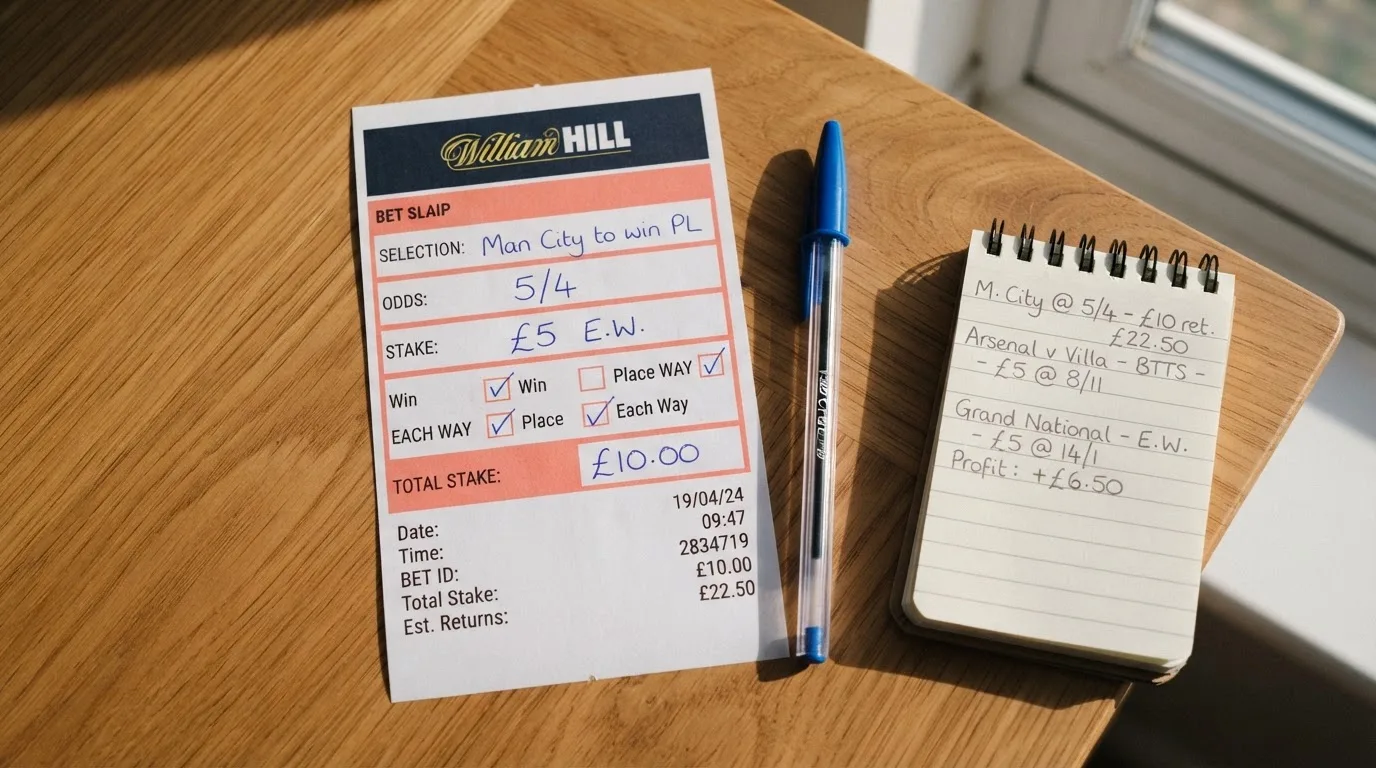
An each-way bet is two bets of equal stake: a win bet and a place bet. A £5 each-way bet costs £10 in total. The win half pays out at the price taken; the place half pays out at a fraction of that price, set by the place terms the operator publishes.
UK place terms in the public reference: handicaps with more than 15 runners pay 1/4 odds for 4 places; 12–15 runners 1/4 for 3 places; other races with more than 7 runners 1/5 for 3 places; 5–7 runners 1/4 for 2 places; fewer than 5 runners win only. The worked example from the public reference: a £10 each-way bet on a 10-1 horse at 1/4 place terms (3 places) costs £20, returns £110 for the win part and £35 for the place part, £145 in total if it wins. If the horse places but does not win, only the place part pays (£35 plus the £10 place stake).
Forecasts and tricasts
A forecast names the first two finishers in order; a tricast names the first three. Both pay better than a single bet because they ask the punter to call more than one outcome, and both are harder to win. The straight forecast is one of the standard racing products at every GB bookmaker; the tricast is restricted to races with enough runners and is sometimes replaced by a combination tricast (any order).
Accumulator
An accumulator (“acca”) is a bet whose legs multiply into one price: a 2/1, a 3/1 and a 4/1 combined give a 35/1 accumulator (the three prices multiply, with the stake returned as part of the price). The acca’s edge is the bigger payout; its cost is that every leg has to win. A Lucky 15 (15 bets across 4 selections), a Heinz (57 bets across 6), a Goliath (247 bets across 8) are the multi-leg versions, and total stake is unit stake × number of bets.
Spread betting on racing
A spread bet on a race quotes a range (a sell price and a buy price) and pays out per unit of the spread between the result and the quoted range. Sporting Index lets customers switch between fixed odds and spread betting, with in-play, Bet Builder for football, auto cash-out and Multi-Markets. Spread betting on racing has its own vocabulary and its own risk: the loss can exceed the deposit, which is the FCA regime’s reason for existing.
Bet Builder and same-race multiples
A bet builder combines two or more markets from a single event into one price. LiveScore Bet’s Bet Builder allows up to 10 selections and covers match result, both teams to score, corners, total goals, player scoring and card markets — a football-shaped builder. On horse racing, the equivalent is a same-race multiple (win and place, or a combination forecast). Bet Builder+ from Bet365 combines markets from one event into a single bet, available pre-match and in-play, with Super Boosts, Winnings Boosts on Bet Builders and selected singles, and daily Bet Boosts.
Rule 4 and non-runner
Rule 4 is a deduction the bookmaker applies when a horse is withdrawn from a race after the betting market has formed: the deduction is taken from the winning returns of every other horse. Non-runner is the formal withdrawal before the race begins. A punt who has taken a price on a horse that becomes a non-runner has the bet voided, with the stake returned.
Betting exchange
A betting exchange runs under a betting intermediary licence, lets punters back and lay horses against each other, and pays out from the backer’s stake rather than from a bookmaker’s book. Rates and rules specific to exchanges come from each exchange’s terms and are not a generic British product. An exchange price tends to sit lower-margin than a bookmaker’s because the exchange does not take a margin across the whole book, but the punter pays commission on winning bets.
The ten bookmakers reviewed
The ten operators below are not listed as a ranking. Each card covers what the brand’s own terms state on its racing product, what its public licence record shows, and the verdict that comes from reading the two together. The brands are licensed bookmakers; the descriptions are descriptive, not promotional.
Tote — the pool-betting pioneer
Tote operates under Gambling Commission account 54779 (licence 054779-R-331321-008), with TDCO Limited holding the licence. The Tote is the British pool-betting operator: instead of betting against a bookmaker, the punter bets into a pool with other punters, and the pool pays out at prices set by the pool’s stake-weighted outcome (less a take for the operator). The local model is different from a fixed-odds book, and the punter is competing against other punters rather than against the operator’s margin.
The racing product on tote.co.uk is built for the pool model: win and place pools, a placepot, a jackpot, a quadpot and a scoop6. Tote prices differ from bookmaker prices because they reflect the pool rather than a margin. The verdict: Tote suits a punter who prefers the pool model and the chance to land a placepot or a quadpot, less so a punter who wants Best Odds Guaranteed or an in-play market. It appears as a licensed entity on the Commission’s site.
BetGoodwin — racing-shaped welcome
BetGoodwin holds a remote licence from the Gambling Commission (account 2927, licence 002927-R-327985-008), with Goodwin Racing Limited as the licence holder. The brand’s sports welcome offer is “Bet £10 & Get £15 in Free Bets”, made up of a £5 sports bet, a £5 acca and a £5 Sub-Cover bet. The £5 Sub-Cover bet is the racing-shaped piece: it refunds part of a stake on a selected race under conditions published on the offer page. Each component is a token that has to be checked in the operator’s terms before staking.
The verdict: BetGoodwin’s racing product is a single welcome shape rather than a deep in-running book, and a punter who wants a bookmaker with full Best Odds Guaranteed coverage and a deep ante-post market may find the brand lighter than a bigger operator. This operator is GB-licensed, with its details held on the Gambling Commission’s public register.
Geoff Banks — racing-focused bookmaker
Geoff Banks runs on Geoff Banks and is licensed under Gambling Commission account 54095 (licence 054095-R-330366-010), with GB Sports Advisors Limited as licence holder. The brand’s app is published by GB Sports advisors Ltd and offers live in-play prices and ante-post prices on future events. The product is built around horse racing more than around football, and the racing menu runs deeper than most multi-sport books.
The verdict: Geoff Banks suits a racing-first punter who wants ante-post and in-play on UK and Irish meetings. Geoff Banks holds a remote licence from the Gambling Commission, verifiable through its public register database.
VBet — multi-sport book with racing coverage
VBet operates on its own platform under Gambling Commission account 44662 (licence 044662-R-324273-022), with SCGO Limited as the licence holder. The brand’s sports welcome offer is a £10 free bet if a new, verified customer stakes £10 or more on a first-ever bet that loses. The free bet’s stake is not paid back with a win (the standard free-bet shape), and a punter weighing the offer should read the operator’s full terms before staking.
The verdict: VBet is a multi-sport book whose racing product is one of several, and a punter looking for a racing-shaped book will find VBet lighter than a racing-first operator.
Sporting Index — fixed-odds and spread betting
Sporting Index runs on Sporting Index and is licensed under Gambling Commission account 27343 (licence 027343-R-308898-011), with Sporting Index Limited as licence holder. The brand lets customers switch between fixed odds and spread betting, with in-play betting, Bet Builder for football, auto cash-out and Multi-Markets. The split product is the brand’s identity: a punter can take fixed odds on a horse race or take a spread position on the same race.
The verdict: Sporting Index suits a punter who wants both fixed-odds and spread betting under one licence. Spread betting on racing carries losses that can exceed the deposit, and the FCA-regulated side of the business is the regime that polices that risk.
Kalooki Sportsbook — racing-led bookmaker
Kalooki Sportsbook runs on kalookisportsbook.co.uk and is licensed under Gambling Commission account 57730 (licence 057730-R-333396-005), with Kalooki Sports Book Ltd (company number 12938274) as licence holder. The brand is a GAMSTOP member. The product is racing-led, with the operator’s published terms covering horse racing markets more deeply than the multi-sport books.
The verdict: Kalooki Sportsbook suits a racing-first punter who wants a brand whose menu is built around racing rather than around football.
LiveScore Bet — bet builder and accumulator focus
LiveScore Bet runs on LiveScore Bet and is licensed under Gambling Commission account 56859 (licence 056859-R-332720-005), with LiveScore Betting and Gaming (Gibraltar) Limited as licence holder. The brand’s Bet Builder allows up to 10 selections and covers match result, both teams to score, corners, total goals, player scoring and card markets — a football-shaped builder rather than a horse-racing builder. The in-play product covers football more deeply than racing, and a punter comparing should check the racing menu.
The verdict: LiveScore Bet suits a punter whose accumulator habit sits across football and whose racing interest is secondary.
Dabble — social-betting app
Dabble runs on dabble.co.uk and is licensed under Gambling Commission account 65677 (licence 065677-R-340363-005), with Dabble Sports UK Ltd as licence holder. The brand’s welcome offer is “Bet £10, Get £10 in Free Bets” on a first deposit for new customers, with minimum odds applying, a 7-day free bet expiry and the stake not returned. The 7-day expiry is short: a punter who takes the offer has a week to use the free bet, and the minimum odds rule disqualifies short-priced favourites.
The verdict: Dabble’s social-betting shape (chat-driven app, copy-bet functionality) suits a punter who wants community alongside the betting slip. The short expiry on the free bet and the minimum odds are the conditions that cost a careless reader. Dabble carries a Gambling Commission licence, and its current status appears on the public register.
10bet — multi-sport with live streaming
10bet runs on 10bet.co.uk and is licensed under Gambling Commission account 43173 (licence 043173-R-322899-023), with Blue Star Planet Limited as licence holder. The brand’s sportsbook covers football, tennis and horse racing, with Cash out, Bet Builder and Live Streaming. The racing product is one of three, with the football product typically deeper.
The verdict: 10bet suits a punter who wants live streaming and cash-out across horse racing and football. 10bet’s status as a licensed operator is maintained on the Gambling Commission’s official list.
Betfred — full-spectrum bookmaker
Betfred runs on its betting platform and is licensed under Gambling Commission account 39544 (licence 039544-R-319290-010), with Petfre (Gibraltar) Limited as licence holder. The brand’s Betfred Sports, Casino & Games app is published by Done Brothers (Cash Betting) Ltd and covers 21 sports plus over 2,000 casino-style games. The product is full-spectrum, with the racing menu among the deepest at any GB bookmaker.
The verdict: Betfred suits a punter who wants one licence across sports and casino, and a deep racing product on top. Betfred holds a remote licence from the Gambling Commission, with its details current on the regulator’s register.
Comparison across the ten
| Brand | Gambling Commission licence number | Licence holder | What the operator’s terms state on the key subject |
|---|---|---|---|
| Tote | 054779-R-331321-008 (account 54779) | TDCO Limited | Pool betting on UK and Irish racing; pool-paid dividends, no fixed-odds margin |
| BetGoodwin | 002927-R-327985-008 (account 2927) | Goodwin Racing Limited | Welcome: Bet £10, Get £15 in Free Bets (£5 sports, £5 acca, £5 Sub-Cover) |
| Geoff Banks | 054095-R-330366-010 (account 54095) | GB Sports Advisors Limited | App offers live in-play and ante-post prices on racing |
| VBet | 044662-R-324273-022 (account 44662) | SCGO Limited | Welcome: £10 free bet if first £10+ stake loses |
| Sporting Index | 027343-R-308898-011 (account 27343) | Sporting Index Limited | Switches between fixed odds and spread betting; FCA-regulated on the spread side |
| Kalooki Sportsbook | 057730-R-333396-005 (account 57730) | Kalooki Sports Book Ltd (12938274) | Racing-led product; GAMSTOP member |
| LiveScore Bet | 056859-R-332720-005 (account 56859) | LiveScore Betting and Gaming (Gibraltar) Limited | Bet Builder up to 10 selections (football-shaped) |
| Dabble | 065677-R-340363-005 (account 65677) | Dabble Sports UK Ltd | Welcome: Bet £10, Get £10 in Free Bets; 7-day expiry; stake not returned |
| 10bet | 043173-R-322899-023 (account 43173) | Blue Star Planet Limited | Covers football, tennis, horse racing; cash out, bet builder, live streaming |
| Betfred | 039544-R-319290-010 (account 39544) | Petfre (Gibraltar) Limited | 21 sports plus 2,000+ casino-style games |
Pre-Market Implied Probability and Margins
The price a bookmaker shows carries the margin of the whole market inside it. The arithmetic is straightforward: turn each price into an implied probability, sum them, and the amount over 100% is the bookmaker’s cut. On a two-way book at 1.90 / 1.90 (decimal, 9/10 fractional each side), the implied probabilities sum to 1 ÷ 1.90 + 1 ÷ 1.90 ≈ 1.0526, so the payout share is 1 ÷ 1.0526 ≈ 95.00% and the margin sits at about 5.00%. On the same market at 1.95 / 1.95, the implied probabilities sum to 1.0256, the payout share is about 97.50%, and the margin is about 2.50%. At 1.80 / 1.80, the implied probabilities sum to 1.1111, the payout share is about 90.00%, and the margin is about 10.00%.
The band tightens as both prices move towards evens and widens as they shorten. On a real horse race with twelve runners priced between 3.00 and 51.00, the summed implied probabilities typically land between 1.10 and 1.30, putting the margin between 10% and 30%. The biggest fields (twenty-runner handicaps on a Saturday) sit at the wide end; the shortest-price favourites sit at the tight end. The take-away: a market is not “fair” because both sides look even — it is fair only when both sides price at 2.00 (evens) and the bookmaker does not take a margin, which no real bookmaker does.
The licence check that should run before any stake
A punter comparing ten brands has one question that does not change from year to year: does this brand hold a Gambling Commission remote licence? The Commission’s public register is the test. The search can run by business name, trading name, domain or account number. The register entry shows the licence number, the categories the licence covers, the trading names licensed under that entry, and the date the licence took effect. A brand not on the register is not licensed for Great Britain, regardless of where it is based.
The review cards above name the licence number and account for every reviewed operator. The register is the verification; the cards are the snapshot. The register changes, and a brand licensed today may have a licence suspended or revoked tomorrow. The honest check is the register, run today.
Choosing a bookmaker from the reviewed set
The ten operators cover most of the British racing shape. Tote is the pool-betting route; Geoff Banks and Kalooki Sportsbook are the racing-first books; Betfred, 10bet and LiveScore Bet are the full-spectrum books; VBet, Sporting Index and Dabble are the brands with a distinctive feature (multi-sport, spread betting, social betting respectively); BetGoodwin sits at the racing-shaped welcome end. No single brand is “the only” licensed one, and no single brand is the answer for every punter.
The choice that fits a particular punter depends on what they bet on, how they bet, and how much they want a bookmaker’s margin to take from their stake. A punter who bets accas across sports finds LiveScore Bet or Betfred a natural fit. A punter who bets racing and only racing finds Geoff Banks or Kalooki Sportsbook a more natural fit. A punter who likes the pool model finds Tote a natural fit. A punter who wants spread betting on racing finds Sporting Index the natural fit. The shape of the punter’s book points to one or two brands in the set, and the rest of the comparison runs from there.
Frequently asked questions
How do I bet on horse racing?
Pick a licensed bookmaker from the comparison above, open an account, complete the verification (name, address, date of birth) before the first deposit, deposit by debit card or bank transfer, then open the racing menu and choose a race, a horse and a stake. A win bet pays only if the horse wins; an each-way bet pays on both win and place parts; the total stake is twice your unit stake on each-way.
How do I work out a horse racing bet?
Take the price (decimal or fractional), multiply the stake by the price to get the return on a win, and subtract the stake to get the profit. Each-way: the win half pays at the full price, the place half pays at the place-fraction of the price (typically 1/4 or 1/5 depending on race type and number of runners), and the total stake is twice the unit stake.
How do betting odds work on horse racing?
A price is the multiplier between stake and return on a win, and it carries the implied probability the bookmaker has set for that horse. Shorter prices (odds-on, below 2.00 decimal) say the bookmaker expects the horse to win more often than it loses; longer prices say the opposite. The bookmaker’s margin is the amount by which all the implied probabilities in a race sum to more than 100%.
How can I check that a bookmaker holds a Gambling Commission licence?
Use the Commission’s public register. Search by business name, trading name, domain or account number, then check the licence number, the categories covered, the trading names licensed under that entry, and the date the licence took effect. The register is the whole test. The cards above name the licence number and account for every reviewed operator; the register is the verification.
How is the return on a bet worked out from the stake and the odds?
Return = stake × odds. Profit = stake × (odds − 1). For a combination bet the odds of the legs multiply into one price. A £10 stake at 5.00 decimal returns £50 (£40 profit); a £10 stake at 1.50 decimal returns £15 (£5 profit); a £10 each-way stake at 5.00 an £20 total stake, with the win half returning £50 and the place half returning £15 at 1/4 place terms.
What is the bookmaker’s margin and how can I see it in the odds?
The margin is the share of every pound staked that the book keeps regardless of which horse wins. Turn each price into an implied probability (1 ÷ decimal odds), sum the implied probabilities across all runners, and the amount over 100% is the margin. On a 1.90 / 1.90 two-way market the margin sits at about 5%; on a 12-runner race with prices from 3.00 to 51.00, the margin typically sits between 10% and 30%. The margin is the only number on a betting slip that quantifies what the book keeps.
Horse racing & greyhounds – Fast Payout
Content created by the «Fast Payout» team
