
What Snooker Betting Odds Actually Mean in 2026
 Available in US
Snooker is one of the quieter sports on a British bookmaker’s site until April arrives, then the Crucible takes over. The World Snooker Championship at the Crucible Theatre, Sheffield has run since 1977, with frame counts ranging from best of 19 in the first round to best of 35 in the final. Whatever the tournament, the odds a punter sees are built the same way every other sport’s odds are built: a margin over what a perfect book would pay, expressed through the prices each outcome carries. That margin is the bookmaker’s wage, it sits inside every quote, and it is the only number on the page that quietly determines whether a season ends up or down.

This guide covers how snooker betting odds are formed and what they hide, which markets a licensed UK bookmaker actually lists during the calendar, what the in-play and cash-out experience feels like when frames stretch into long tactical exchanges, which promotions around the World Championship, UK Championship and Masters are the ones worth reading twice, and how the same stake on two events produces two returns. The angle is consequence — what follows from a price, an offer or a rule once the tournament is on the telly.
As of 27 October 2026, every operator reviewed here has been cross-checked against the Gambling Commission’s public register for a current remote betting licence.
The basics of snooker and why the sport shapes the odds
Snooker is played with 22 balls: a white cue ball, 15 reds and six colours worth yellow 2, green 3, brown 4, blue 5, pink 6 and black 7. The maximum break in snooker is 147, made by potting all 15 reds with blacks and then all six colours. A full-size snooker table is 12 ft by 6 ft with six pockets, and most professional matches are best of 7, 9 or 11 frames. The professional game is run by the WPBSA, with the IBSF governing the amateur ranks.
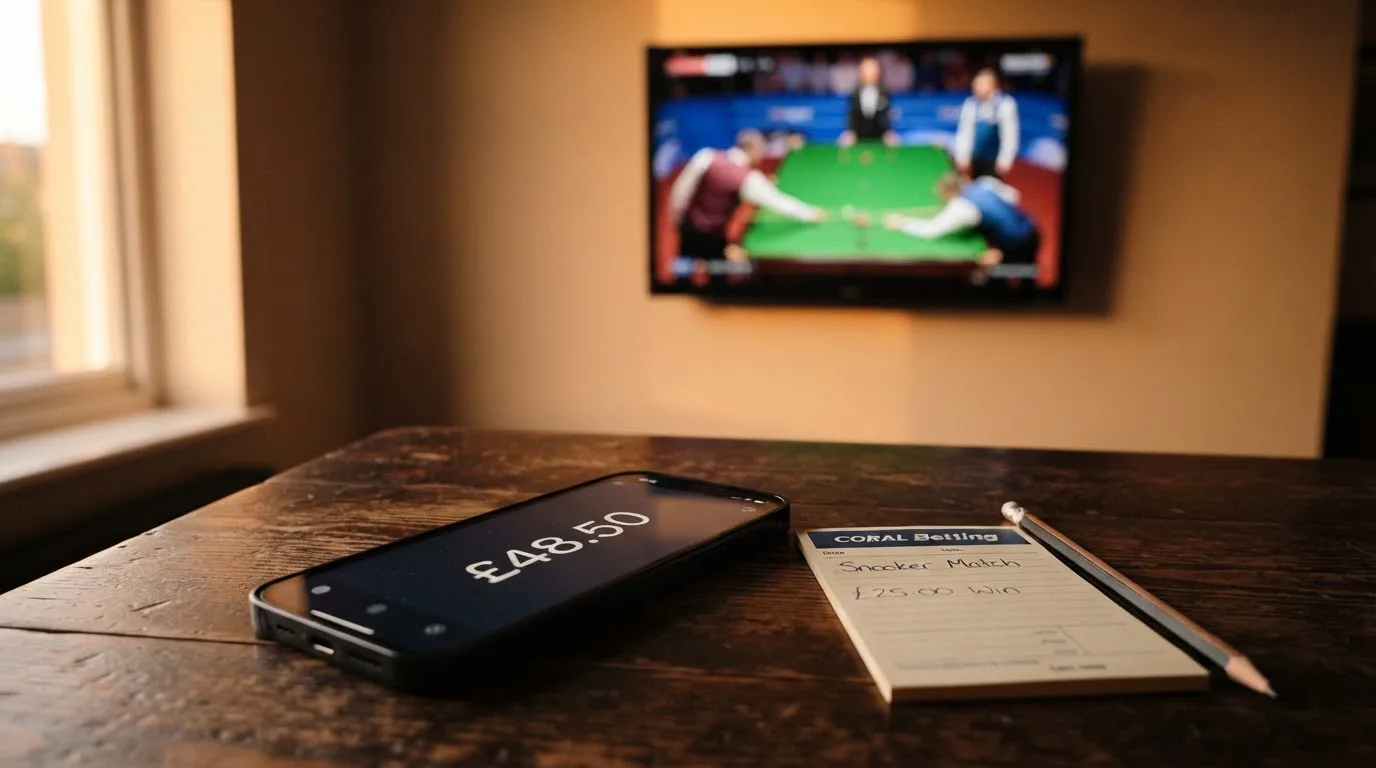
Those numbers matter for odds-building because snooker is a frames-based sport with a long tail of partial results. Unlike a 90-minute football match, a snooker frame can swing around a single missed long pot, so a player two frames up is not halfway to winning a best-of-25 match. Bookmakers reflect that by pricing each frame inside a match independently when they run in-play markets, and by leaning on head-to-head history, ranking points and recent form when setting outright winner prices weeks ahead of a tournament. A punter laying a price on the World Champion before the draw is made is paying for uncertainty the bookmaker has already priced in.
The 2026 World Snooker Championship is a useful anchor: Wu Yize beat Shaun Murphy 18-17 in the final (18 April to 4 May 2026, Crucible Theatre), with a £500,000 winner’s share from a £2,395,000 prize fund. That kind of prize spread widens the outright market — long shots do not need to be freak results to clear the book — and most of the value in the outright market lives in the names below the top two or three in the betting. In snooker specifically, naming who wins is the hard part; reading whether a price is fair once the draw is out is the easier one. No page that promises the first without evidence the second is one to trust.
How snooker odds are built — and what the margin actually is
A snooker betting market is a list of outcomes, each given a decimal price. The bookmaker’s margin is the slice of every pound staked that the firm keeps on average, no matter which outcome wins. The natural place to see it is in a two-way market with two similarly fancied players: take an illustrative price of 1.90 on each side. The arithmetic is straightforward — for every outcome, divide 1 by the price and add the reciprocals, then take that result away from 1.

For a match at decimal odds 1.90 / 1.90:
- 1 / 1.90 = 0.5263 for each side
- 0.5263 + 0.5263 = 1.0526
- 1 − 1.0526 = roughly −0.05
In other words the bookmaker would pay out about 95 pence for every pound staked if it were a perfectly priced book, and keeps around 5 pence from every pound. That is the margin. A 5% margin is a competitive number for a snooker match market — closely fought matches priced through a sharp book sit around 4 to 6%. The price changes once the favourite-shortens, and as the prices drift apart the implied margin can fall below 2% on a heavy favourite but the average across the day stays closer to 5%.
Most pre-match snooker markets sit in that band. Outright tournament winner markets can run higher — ten pence on the pound or more, because the field of contenders at a World Championship is wider than a single match and the longshots carry proportionally larger margins. In-play markets follow their own tempo: the longer a frame is in play, the more the bookmaker has to forecast momentum swings, and margins tend to widen briefly when the outcome is most in doubt.
The practical lesson is dull but real: pick the event whose margin is lowest where the punter has the strongest opinion. Laying a couple of pounds on a single frame price with a margin of 5% costs the punter less per pound than backing a 14-name outright market at 12%. The price is the price either way; the wage paid to the bookmaker is different.
Bet types on snooker — from match winner to frame handicaps
Snooker betting mirrors other sports at the top and gets more specialist a layer down. At the base sits the match winner — who wins the match outright, settled once the required number of frames is reached. Frame betting is a step up: the punter chooses a scoreline (e.g. 6-3 in a best-of-11), and the price reflects how often each combination actually shows up in the records. With players tightly matched, 6-3 and 6-4 score lines dominate the data; heavy mismatches produce shorter scoreline prices and more frames.
Handicaps work as they do elsewhere. If a top-16 player meets a qualifier in a best-of-11, the favourite might be given a −3.5 frame handicap — meaning the favourite must win by four frames or more for the bet to land. The handicap widens the price on the favourite and shortens the underdog, and the margin sits across both sides of the line.
Going beyond the match, bookmakers offer the outright tournament winner, reach the final, reach the semi-finals, total centuries, highest break in a match, total centuries in the tournament and first-frame winner. Player-specific markets — first century scored by, match-winning break categories — show up around majors. Each carries its own margin, and the headline price the punter sees on the betting slip already covers a margin somewhere between 3 and 12 percent depending on how exotic the market is.
Combination bets stack pre-match snooker markets into accumulators, and the more legs a bet carries the higher the multiplied margin becomes. An accumulator is a bet in which all chosen selections must win for the bet to pay out; the decimal prices of each leg multiply into a single combined price. A four-leg snooker acca at 1.90, 1.80, 2.00 and 1.70 produces a combined price of 11.62, but the margin inside that combined price is closer to 16 percent than 5. That is the trade-off: combinations pay well precisely because the margin load has compounded. Multiples are not bad bets in themselves; they are a specific kind of bet.
Bet builder tools let the punter combine match winner, total frames, highest break and the like into a same-game multi from a single snooker match. The advantage is one match with multiple things to read; the cost is a margin that tends to be wider than the same selections priced separately.
In-play and cash out — how snooker behaves live
In-play betting is betting after a match has started, with prices updated frame by frame. Snooker suits in-play better than most sports once the framing becomes clear, because the match is a sequence of discrete events: a frame ends, the colours are re-racked, a new frame starts, and the betting market reprices. Coral, 888sport and the rest of the major UK-licensed brands carry pre-match and in-play markets on professional snooker, with 888sport’s offering running alongside Cash Out, Bet Builder, racing streams, BetFinder form tools, a live bet feed and daily boosted odds.
The mechanics of an in-play snooker market deserve a paragraph because the timing matters. Prices update between frames; mid-frame prices move slower because the book is reacting to a moving picture but cannot reset the line every ball. A punter chasing value during a frame pays the wider margin that comes with uncertainty. A punter who waits for the colours and bets into the next frame accepts a smaller edge but pays the tighter margin.
Cash out is a function that closes a bet early at a price the bookmaker offers, locking in a profit or limiting a loss before the selection has actually settled. In a snooker match, the cash-out price moves as the in-play prices do, so a punter who backed a 2-0 down player can settle the bet at a smaller profit when the player takes the next two frames rather than waiting out the full match. The price the bookmaker offers is its price, not the market’s; the cash-out margin is on top of the in-play margin, so a punter using cash out twice during a match is paying the margin twice. Whether that is worth the certainty is a personal cost-benefit, not a thing the page can settle.
Where snooker fits in the British calendar
The professional snooker calendar runs almost continuously through the season, but three tournaments carry the heaviest betting turnover: the World Championship at the Crucible in April and May, the UK Championship in late November and December, and the Masters in January, an invitational event for the top 16. Outside the majors, the ranking events cycle through Wuhan, the English Open, the Scottish Open and a long tail of one-off events in cities from Sheffield to Shanghai.
In the modern era, Stephen Hendry and Ronnie O’Sullivan have seven world championships each, and Joe Davis won 15 in a row from 1927 to 1946. Records of that length do not affect a single tournament outright market, but they shape the bracket prices — a player with that kind of Crucible record will be shorter in the outrights than recent form alone justifies. Punters who lean on rankings and forget majors-and-form pay for it once April arrives.
Two practicalities for a British punter. First, most snooker events stream free on the bookmaker’s site once a small qualifying bet is placed, though streaming rights and product features vary by operator. Second, the calendar is dominated by matches in Asian time zones during Chinese and Hong Kong ranking weeks, which shifts in-play liquidity to UK afternoon and evening — long enough for most UK accounts to keep watching.
Promotion terms around snooker — and what they actually cost
Every major bookmaker runs a welcome promotion, a tournament special or an enhanced odds offer around the World Championship, the UK Championship and the Masters. The headline reads like a giveaway; the conditions are the page. The catch sits in three places: the qualifying bet’s minimum price, the wagering requirement on any bonus and the expiry of the free bet once issued.
Three concrete examples give a feel for the spread. BetMGM’s sports welcome offer for new UK customers who deposit £10 or more and place a sports bet within 7 days is four £10 free bets — two football accumulators of 4+ selections and two sports multiples of 2+ — valid for 7 days with minimum odds and opt-in required. Coral’s sports welcome offer is “Get £40 in Free Bets when you bet £20”: a deposit of £20 or more at minimum odds of 2.0 (1/1), with £40 in free bets issued within 7 days and expiring 7 days after issue, for new GB customers who opt in. Unibet’s sports welcome offer follows the same structure, with free bets expiring within 7 days for new GB customers using a debit card or instant bank transfer.
Read those terms three times before claiming. The Coral and Unibet offers look identical and they are, structurally; the precise expiry windows and payment-method eligibility drift. Snooker selection may not always count as the qualifying bet — sportsbook qualifiers frequently name football or specific accumulator formats. Each offer is on the operator’s own terms page, and what the punter actually clears is what those terms say, not what a comparison table suggests.
From 2026 a regulated bonus carries a 10x wagering cap at most. Wagering requirements on bonuses are capped at 10x — for a £10 bonus at 50x that would be £500 of bets, under the cap no more than £100 — and mixed-product promotions that ask a punter to gamble on two or more product types such as betting, casino, bingo and lottery are banned. That cap is one specific reason a regulated bookmaker behaves differently from the offshore alternative, and is detailed in the section on legality further down.
Free bets are not refunds in money. When a free bet wins, the stake is normally not returned — only the winnings — so a £10 free bet at 2.50 returns £25, not £35. That single mechanic turns many a free bet into a smaller thing than the headline suggests. A useful estimate: the value of a free bet whose stake is not paid back, on a market with a 5 percent margin, comes to roughly the free-bet amount times (odds − 1) divided by odds, scaled down by the margin — which makes a £10 free bet at evens worth around £4.50 on average, not £10.
Snooker betting — the legality frame in Great Britain
Betting on snooker is legal in Great Britain. The Gambling Commission (UKGC), a non-departmental public body sponsored by the Department for Culture, Media and Sport, licenses the whole commercial market under the Gambling Act 2005, which covers Great Britain (England, Scotland and Wales); Northern Ireland is outside the Act and has its own older law, so a GB licence does not regulate Northern Ireland. Since the Gambling (Licensing and Advertising) Act 2014 an operator whose remote facilities are used in Great Britain needs a Commission licence wherever it is based; a Curaçao, Maltese or Gibraltar licence is not a substitute.
What may be bet on: no statutory list of permitted bets or markets exists. An operator holds a licence for a category and offers markets under its own rules and the Licence Conditions and Codes of Practice (LCCP). There is no statutory cap on stakes in sports betting; operators set their own maximum stakes and may restrict customers. In-play betting is offered by GB bookmakers, and the controls are the operator’s licence conditions and customer-protection duties.
Betting licence types for the remote market are remote general betting standard (real events), remote general betting standard (virtual events), remote general betting limited, remote pool betting and remote betting intermediary (the licence for betting exchanges). A betting exchange like Smarkets runs under a remote betting intermediary licence, not a general betting standard licence — the difference matters because exchange-specific rules around rates, commission and liquidity are stated only from each exchange’s terms.
A bookmaker’s licence can be checked directly. The Commission’s public register can be searched by business name, trading name, domain or account number and is the whole test of whether a brand holds a licence. Several brands can run under one licensee — for example Ladbrokes and Coral, Paddy Power and Betfair — and they should not be presented as independent operators. No brand is “the only” licensed one; the register lists many more than any review would feature.
Financial spread betting is regulated by the Financial Conduct Authority, not the Commission. Spreadex, for instance, is regulated by the FCA for spread betting and by the Gambling Commission for fixed-odds betting, and its terms state that spread betting losses can exceed the deposit. That statement is true across spread-betting products: the liability is not capped at the deposit, and the punter can owe the bookmaker on settlement.
The minimum age is 18. Name, address and date of birth are verified before a customer can deposit or gamble (since 7 May 2019), including with a free bet or bonus. That is the practical reason no anonymous play exists at a GB-licensed site; the verification sits in the front door.
Tax is on the operator, not the punter. The player pays no tax on betting winnings in Great Britain (general information, not tax advice; a professional gambler should ask HMRC or an adviser). General Betting Duty is the operator’s tax on gross profits, currently 15%; from 1 April 2027 a new remote betting rate of 25% applies within it, while remote bets on UK horse racing, bets on self-service betting terminals in licensed premises, pool betting and in-person betting stay at 15%. Until 1 April 2027 the remote rate stays at 15%; whether operators pass duty on through odds is not established, and the player is never directly charged duty.
Offshore brands running into Great Britain are not licensed to do so, and providing gambling facilities in Great Britain without the licence the Act requires is an offence under section 33 of the Gambling Act 2005 — aimed at the operator. No offence aimed at a customer who merely bets on an unlicensed site was found; the practical loss is the bundle of protections a GB licence brings: no GAMSTOP coverage, no Commission complaints route, no approved dispute-resolution body, no British consumer redress if funds are withheld, and no 10x bonus cap. Neither side is “the safe choice” by default — a licensed site requires verification before the first deposit; an unlicensed site offers none of the protections above and possible loss of funds.
Safer gambling — what every licensed bookmaker is required to do
Every GB-licensed remote operator takes part in GAMSTOP, the national multi-operator online self-exclusion scheme. GAMSTOP is a mandatory licence condition for online operators since 31 March 2020; periods are six months, one year, five years, or five years with auto-renewal, and after the minimum period the exclusion stays in place for a further seven years unless the customer asks GAMSTOP to remove it. It covers online sites and apps; betting shops use a separate service.
A financial vulnerability check (LCCP condition 3.4.4, in force since 30 August 2024) applies to licensed remote betting when a customer’s deposits minus withdrawals exceed £150 in a rolling 30 days (since 28 February 2025): it is a public-record check (for example bankruptcy or county court judgments), not an income check and not a credit reference check. Financial risk assessments — the affordability checks reported in the press — are announced in a staged plan (Commission article of 7 July 2026), with no start date. Deposit limits apply: operators must offer a gross deposit limit on a fixed time frame, with the first changes in force since 31 October 2025 and a second phase postponed to 30 September 2026. Limits are the customer’s choice; there is no state-set deposit or loss ceiling for betting.
A useful intermediate step before GAMSTOP is a deposit limit and a reality check on the same operator. Most bookmakers, including BetMGM, Coral and Unibet among the brands reviewed below, surface these directly in the safer-gambling section of the account. Fitzwilliam Sports, for instance, offers instant deposits, fast withdrawals, timeouts and deposit limits, and links to GambleAware, GamStop and Gamblers Anonymous.
Help is free, confidential and outside the betting account. GamCare runs the National Gambling Helpline. GambleAware funds treatment and education across Great Britain. The NHS runs gambling clinics in several cities. Gamblers Anonymous runs peer-support meetings. The links above are the first port of call; a GP is the right next step if the betting has begun to affect sleep, mood or finances.
Crypto, e-wallets and payment methods on snooker betting sites
No statutory rule for or against cryptocurrency deposits at licensed operators was established, and there is no British named-account rule or state list of permitted payment methods. Each operator’s terms describe what it accepts. What is established is what the ban covers: credit cards are banned for gambling in Great Britain (since 14 April 2020, LCCP condition 6.1.2), including credit-card-funded payments through an e-wallet; debit cards and bank-based payments are not covered by that ban. Identity verification before the first deposit means no anonymous play at a licensed site, and source-of-funds questions at higher spend are normal under the money-laundering rules. Crypto deposits are likely to require enhanced checks before the first withdrawal at any brand that accepts them.
Smarkets UK is a useful case for the payments picture: deposits by open bank transfer are instant from £10 up to £10,000, and withdrawals are processed within 6 hours from £10 up to £100,000; UK debit card deposits are instant from £10 up to £15,000. That is the snooker-friendly end of the payment spectrum — instant in, fast out, no fee on either side. Other brands in this pack sit somewhere along that range; if fast withdrawals matter, check the operator’s payment-methods page before placing the first bet.
How a winning snooker bet pays — the math a punter can run in their head
For a single bet, return = stake × odds; net profit = stake × (odds − 1). A £10 stake at 2.50 returns £25 with a £15 profit. For a combination bet the odds of the legs multiply into one price, and a £10 stake at 6.00 returns £60 with a £50 profit if the four legs land. Decimal odds also convert from fractions using the simple rule of a/b → (a ÷ b) + 1 — so 5/1 becomes 6.00, 11/4 becomes 3.75, and evens becomes 2.00. Fractional prices still dominate racing coverage in the UK; on snooker the bookmaker’s slip is usually presented in both formats.
The combination has the higher return on paper, and the higher load built in. A four-leg snooker acca at 1.90, 1.80, 2.00 and 1.70 produces a combined price of 11.62, but the margin inside that combined price is closer to 16 percent than the 5% on a single match market. The punter is paying for the chance of the long price; the bookmaker’s margin is part of what the punter is buying.
The ten licensed bookmakers — what each brings to snooker
The ten brands below hold a current Gambling Commission remote licence as of 27 October 2026 and were confirmed against the Commission’s public register. Each write-up closes on the one feature that decides which punter it suits. None of these are recommendations to sign up; they are descriptions of what the licence, the markets and the terms page say.
BetMGM — game-show polish and a snooker-light welcome offer
BetMGM’s UK site runs under Gambling Commission remote licence 039198-R-319450-029, licence holder LeoVegas Gaming PLC, with remote general betting standard (real events) on the register. The sports welcome offer for new UK customers who deposit £10 or more and place a sports bet within 7 days is four £10 free bets — two football accumulators of 4+ selections and two sports multiples of 2+ — valid for 7 days with minimum odds and opt-in required.
Snooker coverage on BetMGM tends to cluster around majors and ranking events on the Asian swing, with the full match-winner and frame-betting menu during the World Championship and UK Championship. The snooker welcome bonus is, structurally, an accumulator-led offer: two of the four free bets require accas of 4+ selections, the other two require multiples of 2+. A snooker punter looking for singles-only value will lean on the £10 sports-multiples segment and pair them with snooker match-winner or player markets, then read the minimum odds and expiry before staking. Where BetMGM suits a snooker punter: majors with a large match list, anyone who likes to combine other sports with snooker on the same slip. Where it does not: punters who only want snooker single bets on tournament outrights. Eight of every nine betting days do not run a World Championship; BetMGM is a polished operator that earns its place on the major-week lineup.
Bar One Racing — Irish racing heritage and snooker as part of the wider shop
Bar One Racing has rebranded as BAR 1 Betting, an Irish independent bookmaker with shops across Ireland and horse racing sponsorships at Dundalk, Fairyhouse, Navan, The Curragh, Curraheen Park and Cork. The UK remote operation runs under Gambling Commission remote licence 056516-R-332750-007, licence holder Bar-One Racing Limited.
The brand’s strengths sit in racing form, Irish tracks and horse racing markets. On snooker, BAR 1 Betting lists the major events alongside its broader sportsbook, with match-winner and outright tournament markets during the World Championship and UK Championship. For a snooker punter, BAR 1 Betting is the kind of brand that arrives on a punter’s list through curiosity rather than design: the welcome offer is horse-racing-shaped, the form tools are racing-shaped, and the in-play snooker menu is narrower than at a sports-first brand. Where BAR 1 Betting suits a snooker punter: a punter whose betting portfolio crosses racing and snooker and who values a smaller brand with a shop heritage. BAR 1 Betting is less optimal for a snooker specialist needing comprehensive in-play frame coverage on minor events.
QuinnBet — best-odds-guaranteed backbone and snooker price alongside
QuinnBet runs under Gambling Commission remote licence 061011-R-335683-004, licence holder QuinnBet (Gibraltar) Limited, with remote general betting standard (real events) on the register. Best Odds Guaranteed applies to Irish and UK horse racing bets from 10:00am daily on singles, multiples and system bets, with a maximum benefit of £150 per customer per race.
That BOG spine is the brand’s headline feature and it shapes the rest of the offer. On snooker, QuinnBet lists match winner, frame betting and outright tournament markets on the World Championship and UK Championship; the brand’s pre-match pricing on snooker is competitive rather than headline-grabbing. For a snooker punter, QuinnBet is a brand to keep open in a price-comparison split-screen rather than the one to log into first — QuinnBet’s BOG and same-day racing specials sit alongside snooker in a way that rewards a portfolio bettor. Where QuinnBet suits a snooker punter: a multi-sport portfolio player who wants snooker and racing on the same book. Where it does not: snooker-only specialists who rarely touch racing.
Coral — a high-street anchor and a snooker-friendly free bet
Coral’s sports welcome offer is “Get £40 in Free Bets when you bet £20”: a deposit and sports bet of £20 or more at minimum odds of 2.0 (1/1), with £40 in free bets issued within 7 days and expiring 7 days after issue, for new GB customers who opt in. The UK operation runs under Gambling Commission remote licence 054743-R-330863-014, licence holder LC International Limited.
Coral carries a deep snooker menu across the calendar: match winner, frame betting, handicap, total frames, highest break, centuries, tournament outright, and same-game multi on the bigger matches. The welcome offer is sport-agnostic at the qualifying bet stage — any £20 sports bet at the stated minimum price qualifies — so snooker match winner or outright bets count toward the trigger. Coral is the high-street anchor of this list: a snooker punter who already has a Coral shop account can move from counter to app without changing the brand. Where Coral suits a snooker punter: anyone staking the £20 welcome offer on a snooker match winner and seeking long in-play frame coverage; the brand’s size keeps prices firm during the World Championship. Specialist traders seeking the thinnest margins may prefer alternative pricing.
Smarkets — exchange pricing for snooker
Smarkets UK runs under Gambling Commission remote licence 039173-R-319366-011, licence holder Smarkets (Malta) Limited, on the register under remote betting intermediary. UK deposits by open bank transfer are instant from £10 up to £10,000, and withdrawals are processed within 6 hours from £10 up to £100,000; UK debit card deposits are instant from £10 up to £15,000. That deposit and withdrawal profile is one of the fastest among British-licensed bookmakers.
A betting exchange is a marketplace where punters back and lay against each other, with the operator taking a commission on net winnings. Smarkets is an exchange, not a traditional sportsbook — there is no bookmaker margin baked into the price; the price is the market’s, with a commission on net winnings per market. For snooker, that means Smarkets tends to publish tighter prices on match winner than a traditional bookmaker during the World Championship, particularly on heavy favourites where the exchange market is deeper. The trade-off is the back-or-lay layout: a punter used to a sportsbook has to learn to read a tick-by-tick ladder and accept that unmatched bets sit there until someone takes the other side. Where Smarkets suits a snooker punter: anyone willing to back and lay on the same match; experienced exchange users; anyone who values speed of withdrawal over the gloss of a sportsbook app. Users requiring a more intuitive interface might prefer a traditional sportsbook.
Vbet — a low-stakes free bet for a snooker first
Vbet’s sports welcome offer is a £10 free bet if a new, verified customer stakes £10 or more on a first-ever bet that loses. The UK remote licence is 044662-R-324273-022, licence holder SCGO Limited.
Vbet runs a broad international sportsbook, with snooker listed across the majors and most ranking events. The free bet works as a no-risk-of-loss single — if the first sports bet loses, the equivalent stake is returned as a free bet. On snooker, the qualifying bet can be a match winner or tournament outright, but the expiry and minimum-odds terms sit on the operator’s own page. Vbet is the brand a snooker punter tries once: the welcome offer is low, the snooker menu is reasonable, and the app handles the basics without flourish. Where Vbet suits a snooker punter: anyone claiming the £10 free-bet offer and exploring snooker on a relatively unfamiliar book. Where it does not: regular punters needing daily enhanced odds.
Unibet — long-tenured bookmaker, snooker-friendly welcome
Unibet states it has operated since 1999, and its UK site is run by Platinum Gaming Limited, Gibraltar, under Gambling Commission account 45322. The sports welcome offer is “Get £40 in Free Bets when you bet £20”: a deposit and sports bet of £20 or more at minimum odds of 2.0 (1/1), with free bets expiring within 7 days of issue, for new GB customers using a debit card or instant bank transfer. The remote licence is 045322-R-324275-019.
Unibet is a veteran European bookmaker with snooker listed across the year: match winner, frame betting, handicap, total frames, highest break, tournament outright, and same-game multi for the bigger matches. The welcome offer has the same £40 headline as Coral’s, but the payment-method constraint — debit card or instant bank transfer — is the difference. A snooker punter funding the qualifying bet from an e-wallet won’t qualify under Unibet. Where Unibet suits a snooker punter: a punter with a debit card or bank transfer who wants a broad snooker menu on a long-established brand. Punters using e-wallets or pre-paid cards should consider alternative brands.
888sport — feature-rich snooker experience on a single app
888sport’s UK site runs under Gambling Commission remote licence 039028-R-319297-014, licence holder 888 UK Limited. The app offers pre-match and in-play betting, Cash Out, Bet Builder, racing streams, BetFinder form tools, a live bet feed and daily boosted odds.
That feature list is the broadest in the comparison. The same Bet Builder that combines match winner with total frames on a football match also works on a snooker match — select the match winner, the total frames over/under and the highest break band, and the app builds the price on a single game. For a snooker punter who likes same-game multis, 888sport’s Bet Builder is the practical everyday tool. The lifetime of enhanced odds is also a feature: 888sport’s daily price boosts surface selected World Championship, UK Championship and Masters outrights and match markets. Where 888sport suits a snooker punter: anyone who likes to bet-builder snooker match markets on a single app and wants the snooker experience to live alongside racing streams and Cash Out. Punters preferring simpler, less dense interfaces may find the experience cluttered.
Tote — pool betting heritage and a different angle on snooker
Tote runs under Gambling Commission remote licence 054779-R-331321-008, licence holder TDCO Limited. Tote’s pool betting on horse racing uses a pari-mutuel model, a system in which all stakes go into a pool and the payout per unit is set by the size of the pool divided by winning stakes; for snooker Tote offers fixed-odds markets alongside any pool products on its calendar.
The interesting comparison for a snooker punter is what Tote does that a fixed-odds bookmaker does not: a small-stake pool product on tournament outrights where every punter bets into the same pool and the dividend is set when the market closes. The advantage is the absence of a bookmaker’s margin layer; the disadvantage is that the dividend is only known at the off, and the early prices have to be inferred. For most snooker bets the regular match-winner or frame-betting markets sit on the fixed-odds side of Tote’s site, with the same operators’ license as anywhere else. Where Tote suits a snooker punter: a punter who likes pool-style products and the sweepstake flavour of dividing a dividend. Those needing immediate price confirmation should stick to fixed-odds markets.
Kwiff — quirky product and a small licence footprint
Kwiff is licensed by the Gambling Commission and describes itself as a trademark operated by Spryme Ltd; the app has a 17+ App Store age rating. The UK remote licence is 044448-R-323408-017, licence holder Eaton Gate Gaming Limited. Kwiff’s signature mechanic is a “supercharge” feature that randomly boosts pre-selected bets to higher prices — a structural alternative to the daily-boosted-odds that 888sport offers every day.
Kwiff is the smallest of the sports-first brands in this list, and snooker coverage reflects that: a match-winner menu on the World Championship and UK Championship, with frame betting and outrights during the majors. Where Kwiff suits a snooker punter: a punter who enjoys the random-boost mechanic and treats the brand as a price-shop supplement rather than the main account. Where it does not: a snooker specialist trading through the tournament on a single book — the menu is narrower than at Coral or BetMGM during a quiet week.
How the licensed bookmakers compare on snooker
The table below sets each operator against the four matters that matter for a snooker punter. Licence numbers and licence holders are taken from the Gambling Commission’s public register; the operator-terms column summarises what each operator’s own terms say on snooker markets. Cells where the operator’s own terms are silent or insufficient are marked with the standard no-data marker.
| Brand | Gambling Commission remote licence number and licence holder | What the operator’s own terms state on the key’s subject |
|---|---|---|
| BetMGM | 039198-R-319450-029, LeoVegas Gaming PLC | Welcome offer: four £10 free bets on qualifying £10 deposit and first sports bet; football accas and sports multiples. |
| Bar One Racing | 056516-R-332750-007, Bar-One Racing Limited | Welcome offer shaped around horse racing; Irish independent bookmaker rebranded as BAR 1 Betting. |
| QuinnBet | 061011-R-335683-004, QuinnBet (Gibraltar) Limited | Best Odds Guaranteed on UK and Irish horse racing from 10:00am, max benefit £150 per customer per race. |
| Coral | 054743-R-330863-014, LC International Limited | £40 in Free Bets when you bet £20, min odds 2.0 (1/1), 7-day expiry, opt-in required for new GB customers. |
| Smarkets | 039173-R-319366-011, Smarkets (Malta) Limited | Open bank transfers instant £10–£10,000 in and processed within 6 hours £10–£100,000 out. |
| Vbet | 044662-R-324273-022, SCGO Limited | £10 free bet if a new, verified customer stakes £10+ on a first bet that loses. |
| Unibet | 045322-R-324275-019, Platinum Gaming Limited | £40 in Free Bets when you bet £20, debit card or instant bank transfer required, free bets expire within 7 days. |
| 888sport | 039028-R-319297-014, 888 UK Limited | Pre-match and in-play markets, Cash Out, Bet Builder, racing streams, BetFinder form tools, daily boosted odds. |
| Tote | 054779-R-331321-008, TDCO Limited | Pool betting on racing alongside fixed-odds markets. |
| Kwiff | 044448-R-323408-017, Eaton Gate Gaming Limited | Random supercharge boosts on pre-selected bets; small UK-licensed footprint. |
The columns are not everything that matters, but they are the columns most punters reach for. Where the operator’s own terms say nothing on a market or feature the cell carries the no-data marker rather than a guess, and the same cell should be checked against the operator’s terms page before relying on it. None of the rows above is “the only” licensed brand; the register lists far more — and a row in this comparison is a place in a comparison, not a licence.
Reading snooker odds without being caught out
A few habits save more money than they cost. First, treat the margin as the first number to read, not the headline price. Second, prefer snooker matches over outrights if margin is the deciding factor. Third, wait for the in-play price to settle between frames rather than betting mid-rally. Fourth, read each promotion’s qualifying terms twice before claiming, especially payment-method eligibility and minimum-price thresholds. Fifth, settle bets rather than letting them ride when the cash-out price is acceptable, but accept that the cash-out price is the bookmaker’s not the market’s — cash-out margin is on top of in-play margin.
The single best tool for a price-shopper is two or three accounts open simultaneously, a betting slip loaded with the same selection at two or three books and a quick comparison of the decimal prices in the same row. A two-tick difference on a 2.00 price is the difference between a 0% margin and a 5% margin — the wage of a small account can shift over a year of small bets. Keep the comparison snooker-only when snooker is on, racing-only when racing is on. Mixing them across a working day is how comparison slips drift into guesswork.
Frequently asked questions
How do I bet on snooker?
Pick a licensed UK bookmaker from the Commission’s public register, complete the account verification (name, address and date of birth), deposit using a debit card or bank transfer, find the snooker section, choose a market — match winner, frame betting, outright — and add the selection to the betting slip. Confirm the stake, check the decimal price, place the bet. In-play betting follows the same flow with prices updated frame by frame.
Can I bet on snooker?
Yes — snooker is offered by every major UK-licensed bookmaker, with the World Championship at the Crucible, the UK Championship and the Masters running the heaviest menus. There is no statutory restriction on betting on snooker, and the broader list of permitted events is set by each operator under its own licence conditions.
How can I check that a bookmaker holds a Gambling Commission licence?
Use the Commission’s public register, searchable by business name, trading name, domain or account number. The register is the whole test of whether a brand holds a current remote betting licence. Several brands can run under one licensee — never present them as independent operators.
How is the return on a bet worked out from the stake and the odds?
Return = stake × decimal odds; net profit = stake × (odds − 1). For a combination bet the decimal prices of each leg multiply into a single combined price, and a £10 stake at a combined price of 11.62 returns £116.20 with a £106.20 profit if every leg lands.
What is the bookmaker’s margin and how can it be seen in the odds?
The margin is the slice of every pound staked that the bookmaker keeps on average. In a two-way market at 1.90 / 1.90 the reciprocal sum is 1.0526 — the book would pay out roughly 95 pence per pound — and the margin is about 5%. Higher margins sit on outrights and same-game multis; lower margins on heavy favourites.
How do fractional odds such as 5/1 convert to decimal odds such as 6.00?
Convert by dividing the numerator by the denominator and adding 1: 5/1 → 5 ÷ 1 + 1 = 6.00; 11/4 → 11 ÷ 4 + 1 = 3.75; 1/1 (evens) → 1 ÷ 1 + 1 = 2.00. Decimal odds show the full return including stake, so a £10 stake at 6.00 returns £60.
Tennis, darts & cue sports – Fast Payout
Content created by the «Fast Payout» team
