
Best UK Betting Sites With Acca Bets — 2026 Shortlist
 Available in US
An accumulator is the bet most people first meet through an advert — a six-fold of Premier League fixtures where the price on the screen reads “247/1” and the headline is the figure nobody will ever collect. The bookmaker’s margin sits inside every leg of that six-fold, and the longer the line of selections, the larger the slice the book keeps of every pound staked. This page is built around that fact. The ten bookmakers below each hold a remote licence from the Gambling Commission for fixed-odds betting in Great Britain. What differs is how they handle the mechanics — Bet Builder+ on a single match, a supercharged multi on a five-fold, the cashier’s deadline on a free bet, the margin baked into the odds on a Premier League acca — and which reader each one fits. The numbers in this article were checked against the operator’s own published terms on 27 October 2026.
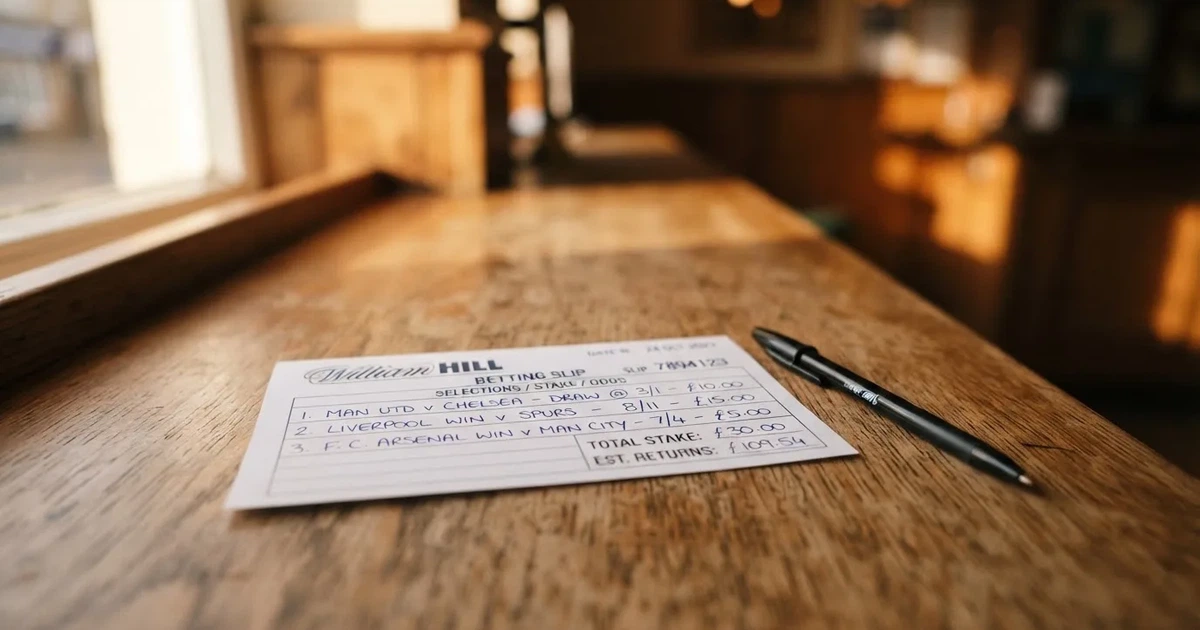
The Acca Shortlist at a Glance
Ten operators enter this comparison; each one was checked against the Gambling Commission’s public register for a remote general betting standard (real events) licence. The columns below are the three things a reader comparing acca bookmakers most often wants on one page: the licence (with the operator named on the register, which may differ from the trading name the punter sees), and what each operator’s own terms state about accumulator betting. The licence is a yes/no check — every row carries one — but the operator named on the licence, and what the small print says about accas, is what separates one licensed brand from the next.
| Brand | Gambling Commission remote licence | Acca policy in the operator’s own terms |
|---|---|---|
| bet365 | 055148-R-331498-002 (55148), Hillside (UK Sports) ENC | Bet Builder+ on one match, Super Boosts and Winnings Boosts on Bet Builders and singles |
| Geoff Banks | 054095-R-330366-010 (54095), GB Sports Advisors | Live in-play and ante-post prices on future events |
| Kwiff | 044448-R-323408-017 (44448), Eaton Gate Gaming Limited | Supercharge boosts odds instantly on singles and multis |
| Fitzwilliam Sports | 048760-R-335434-009 (48760), SBKI Limited | Prices set against Oddschecker averages per selection |
| Dabble | 065677-R-340363-005 (65677), Dabble Sports UK Ltd | Welcome offer settles as a free bet, 7-day expiry, stake not returned |
| Swifty Sports | 058957-R-334734-006 (58957), Swifty Global (UK) Ltd | Cash Out on football and racing, daily price boosts, Bet Builder listed as coming soon |
| Octobet | 062545-R-337248-006 (62545), Octopus Game Limited | Best Odds Guaranteed on UK and Irish racing, £150 per customer per race |
| BetGoodwin | 002927-R-327985-008 (2927), Goodwin Racing Limited | Welcome splits a £15 free-bet bundle into a £5 acca and two singles |
| Betfred | 039544-R-319290-010 (39544), Petfre (Gibraltar) Limited | Bet Builder and Sub Switch on singles and multis |
| BetUK | 039198-R-319450-029 (39198), LeoVegas Gaming PLC | Free-bet markets exclude virtual sports, esports and non-UK/IE racing |
Ten sites on one register, ten different ways of handling an accumulator. A reader who wants the deepest in-play multi-product on a single fixture lands on bet365; a reader whose selection comes from a tipster and wants the bookmaker’s price set against an external average lands on Fitzwilliam Sports. BetGoodwin’s £15 welcome bundle is the only one in this list that breaks the free bet into a £5 acca token by design. The rest of this article is the case for those choices — the licence picture, what an accumulator actually is, the rules a punt reads in the small print, and how a winning multi pays out.
How an Accumulator Works — and What It Costs
An accumulator is a single bet that strings two or more selections together. Every leg has to win for the bet to win. One leg loses, the whole stake goes. That’s the first rule, and it is the rule every marketing line about “247/1” leaves out. The second rule is what makes the price so big: the odds of every leg multiply into one figure. Three legs at 2.00, 1.50 and 2.50 each become a single accumulator priced at 7.50 — and that 7.50 is the decimal price, not the fraction shown on screen.

Fractional odds are the British format: 2.00 in decimal is evens/1, 1.50 is 1/2, 2.50 is 6/4. The arithmetic of a multi works the same way under either label; the difference is whether the reader reads “7.50” or reads “13/2” for a treble of those three prices. Converting a fraction to decimal is a ÷ b + 1, so 6/4 becomes 1.5 + 1 = 2.50, 5/1 becomes 5 + 1 = 6.00.
A push, or a void leg, behaves differently from a loss. A leg that ties is removed from the accumulator, and the price of the bet is recalculated against the legs that remain. A four-fold with one void drops to a treble, and the punter is paid at the price of those three selections multiplied together. A loss anywhere in the line kills the bet — there is no partial payout, no “two out of four wins £X” option, no insurance on the accumulator unless the operator offers it as a separate product.
The combined price is where the margin lives. Every leg carries the bookmaker’s overround, and a six-fold carries six times that overround in series. A 5% margin on a single match becomes a much larger cumulative keep on a six-leg multi, because each price is below its “fair” value and the compounding shortfall lands on the punter. The longer the line, the larger the bookmaker’s expected take per pound staked. That is why a price of 247/1 on a six-fold reads like a windfall and pays, on average, far less than the headline figure suggests.
A full-cover bet is the family of bets that share the same “all selections must win” rule, but cover the combinations of a small number of selections across more than one line. The punter pays for each line separately. The standard names in British usage are:
- Trixie. Three selections, four bets — three doubles and a treble.
- Patent. Three selections, seven bets — three singles, three doubles and a treble.
- Yankee. Four selections, eleven bets — six doubles, four trebles and a four-fold.
- Lucky 15. Four selections, fifteen bets — four singles, six doubles, four trebles and a four-fold.
- Super Yankee / Canadian. Five selections, twenty-six bets — ten doubles, ten trebles, five four-folds and a five-fold.
- Heinz. Six selections, fifty-seven bets — fifteen doubles, twenty trebles, fifteen four-folds, six five-folds and a six-fold.
- Goliath. Eight selections, two hundred and forty-seven bets — the largest in the standard set.
A Trixie on three selections covers every way those three picks can win in combination. A Yankee on four picks covers every double, treble and four-fold. The unit stake is per line, so a £2 Trixie costs £8 in total — £2 on each of the four bets — and a £1 Goliath on eight selections costs £247. The full-cover bets soften the “all-or-nothing” blow of a straight accumulator by paying out if two or three of the legs win, at the price of multiplying the stake across many lines. They are not a free hedge: every additional line carries the bookmaker’s margin, and the bookmaker keeps its slice on each line settled.
Worked example: what a winning accumulator pays back
A £10 stake on three selections at decimal odds of 1.50, 2.00 and 2.50 pays out at the combined price of 7.50 — the product of the three legs. The return, including the original £10 stake, is £10 × 7.50 = £75. The net profit is £75 − £10 = £65. Replace the £10 straight-line stake with a £2-per-line Trixie on the same three selections, and the punter staked £2 across the four bets of the Trixie — £8 in total — for the right to be paid on any winning double plus the treble. The maximum return, when all three legs win, is the four bets each settled at their combined price.

This is the formula the rest of the article reaches for: return = stake × combined odds, profit = stake × (combined odds − 1). A reader who treats the formula as a budget tool, not a tip, knows in advance what a winning multi is worth. That number is the answer to one question — how much a winning bet pays — and never the answer to a different one, how likely the bet is to win.
The Gambling Commission, the Licence, and What It Means
Every operator on this page holds a remote general betting standard (real events) licence issued by the Gambling Commission, the regulator of commercial gambling in Great Britain under the Gambling Act 2005. The Commission’s public register is the place a reader checks a brand’s licence, by business name, trading name, domain or account number, and is the whole test of who holds one. A licence held by a parent company in Malta or Gibraltar is not, by itself, a substitute: under the Gambling (Licensing and Advertising) Act 2014 an operator whose remote facilities are used in Great Britain needs a Commission licence wherever it is based.
The licence categories relevant to a punter comparing accumulator bookmakers are:
- Remote general betting standard (real events). The standard sports-betting licence, covering pre-match and in-play markets on real sporting events. Every brand on this page holds one.
- Remote general betting standard (virtual events). A separate category for computer-generated events. Virtual sports betting at a UK site runs under this category, not the real-events licence.
- Remote betting intermediary. The licence held by a betting exchange. Lay bets and the back-and-lay structure of an exchange are settled under this category.
- Remote pool betting. A separate licence for pool-style bets on horse and dog racing, distinct from fixed-odds betting.
Several brands in this comparison run under one licensee — Ladbrokes and Coral, Paddy Power and Betfair, in markets outside this list — and the same pattern is common in the wider UK market. A licence holder and a trading name are not always the same company. Hillside (UK Sports) ENC is the licence holder named on the Commission’s register for bet365; the brand the punter meets on the site is bet365. Petfre (Gibraltar) Limited is the Betfred licence holder. LeoVegas Gaming PLC is the BetUK licence holder. That is normal: the trading name and the registered company are routinely different, and the register names the registered company. The fact that one parent holds several brands is the reason no punter should read “the only licensed brand” anywhere — the register lists far more operators than any comparison can feature.
A GB licence carries obligations that an offshore brand does not face:
- Identity verification before the first deposit. Since 7 May 2019, every licensed remote operator must verify a customer’s name, address and date of birth before the customer can deposit or gamble, including with a free bet or bonus. There is no anonymous play on a licensed site.
- GAMSTOP membership. The national multi-operator self-exclusion scheme is a mandatory licence condition for online operators since 31 March 2020. Exclusion periods are six months, one year, five years, or five years with auto-renewal. The minimum period is followed by a further seven years unless the customer asks GAMSTOP to remove the record. Online sites and apps are covered; betting shops run a separate scheme.
- The credit-card ban. Credit cards have been banned for gambling in Great Britain since 14 April 2020, including credit-card-funded payments through an e-wallet. Debit cards and bank-based payments are not covered by the ban.
- The bonus wagering cap. Wagering requirements on bonuses are capped at 10x, in force since 19 January 2026. A £10 bonus at 50x wagering, which would have needed £500 of qualifying bets, is no longer permitted; under the cap, no more than £100 of qualifying bets can be required on a £10 bonus.
- The mixed-product ban. A promotion that requires gambling on two or more product types — for example “bet on football to get free spins” — has been banned since 19 January 2026.
- Financial vulnerability checks. Since 28 February 2025, a public-record check (bankruptcy, county court judgments and similar) applies once a customer’s deposits minus withdrawals exceed £150 in a rolling 30 days. It is not an income check and not a credit reference check.
- Financial risk assessments. Announced in a staged plan (Commission publication of 7 July 2026), with no start date as of 27 October 2026 — write “announced, staged, no start date”, not “in force”.
- Deposit limits. A gross deposit limit on a fixed time frame is required, with the first changes applied since 31 October 2025 and a second phase postponed to 30 September 2026. Whether the second phase is live is not established.
These are the consumer protections the licence funds, and they are also the conditions that mean a licensed site does not feel quite as frictionless as an offshore one. Verification before the first bet is the price of the GAMSTOP membership, the £150 vulnerability check and the bonus cap. The offshore alternative is none of those protections, no British route to dispute a withheld payout, no Commission complaints procedure, no approved alternative-dispute-resolution body, and the loss of any redress if the operator declines to pay. “Unlicensed” is not a synonym for “easy”; it is a synonym for “no British safety net”.
A punter who values frictionless play above the British safety net, and accepts the loss of any local protection, will find unlicensed sites. A punter who values the British safety net will not. Neither is “the safe choice” by default.
The reader checks a licence in three steps. First, the Commission’s public register, by business name, trading name, domain or account number. Second, the licence categories listed against the licence holder — “remote general betting standard (real events)” is the relevant one for sports accumulators, and the date of the order tells the reader when it was last renewed. Third, the licence holder named on the register, which may differ from the brand name on the website. A licence check takes a minute; it is the only test of who holds a Commission licence that the Commission itself recognises. No count of licensed brands is quoted in this article without its access date, because the register is updated weekly and a count from one month is stale the next.
Staying in Control — Safer Gambling on a UK Site
The licensed market has a structure for keeping a punter in control of their own betting, and the structure is layered: a customer-set deposit limit, the operator’s safer-gambling tools, GAMSTOP for self-exclusion, and a network of free help services.
A deposit limit is the customer’s choice, set on the licensed site. There is no state-set deposit ceiling and no state-set loss ceiling for betting in Great Britain — limits are the customer’s. Operators must offer a gross deposit limit on a fixed time frame, and the customer’s choice is the figure that holds. The first changes to deposit limits have applied since 31 October 2025, a second phase was postponed to 30 September 2026, and whether the second phase is live is not established.
Time-out, reality checks and product blocking are the operator’s safer-gambling tools. Time-out is a short break, days or weeks, set by the customer. Reality checks are on-screen reminders of how long the session has run. Product blocking closes one or more product types (casino, sports, exchange) on the customer’s account. A licensed operator offers these; the exact toolset and the wording vary by site, and the reader checks the site’s safer-gambling page for what is on offer.
GAMSTOP is the multi-operator exclusion. Once registered, the customer is excluded from every licensed online operator for the chosen period — six months, one year, five years, or five years with auto-renewal. The exclusion cannot be lifted by the operator, only by GAMSTOP itself after the minimum period. The minimum period is followed by a further seven years unless the customer asks GAMSTOP to remove it. Online sites and apps are covered; betting shops use a separate service, and an online exclusion does not automatically cover a betting shop.
The free help services are public, independent of any operator, and reachable without an account:
- GamCare. Runs the National Gambling Helpline, a free and confidential service.
- GambleAware. Funds research, education and treatment, and routes callers to support.
- Gamblers Anonymous. A peer-support fellowship modelled on the Twelve Steps.
- NHS gambling clinics. Specialist NHS clinics for problem gambling in several regions.
The licence is the route into these tools; the offshore alternative is none of them. The boundary is exactly that: a licensed site is the place where GAMSTOP, the £150 vulnerability check and the bonus cap apply. An unlicensed site is the place where none of them apply, where any self-exclusion the customer has set up does not bind the operator, and where the loss of a dispute is the punter’s loss.
Bonuses and Free Bets on Accas — What the Headline Costs
An accumulator welcome offer is a free bet, and a free bet is not a free win. The stake is not returned with the winnings on the standard free-bet format; what the punter keeps is the profit above the stake at the price the bet settled at. A £10 free bet on a winning accumulator at decimal odds of 7.50 pays £10 × (7.50 − 1) = £65 in profit, with the £10 stake not returned. The headline “Bet £10, Get £10 in Free Bets” is a stake-matching offer, not a stake-and-profit-matching one.
The arithmetic of a free bet is the rule the marketing line leaves out. The formula is value = free-bet amount × (odds − 1) ÷ odds × payout share of the market. The free bet’s expected value is the profit, multiplied by the chance the bet wins, scaled by the market’s margin. On a market with a 5% margin the payout share is 95%, and a £10 free bet at decimal odds of 7.50 has an expected value of £10 × 6.50 ÷ 7.50 × 0.95 ≈ £8.23. That is what the free bet is worth on average. It is not what it wins on any one bet; a winning free bet pays the headline profit, a losing one pays nothing.
The 10x wagering cap on bonuses, in force since 19 January 2026, governs how much a bonus must be turned over before it withdraws. A £10 bonus at 50x wagering, which would once have required £500 of qualifying bets, is no longer permitted; the cap is £100 of qualifying bets on a £10 bonus. The cap does not extend to free bets with no wagering condition, and any cap on the money value of a bonus is not established. Mixed-product promotions — a bonus that requires the punter to bet on football to claim free spins, for example — are banned, also since 19 January 2026.
The minimum price on a qualifying bet is the rule that turns a “free” offer into a calculated cost. The free bet has to be placed on a selection at or above a stated decimal price, typically 1.50 (1/2) or 2.00 (evens), and the qualifying bet to unlock the free bet has its own minimum-price rule. Bets below the minimum price do not count. The deadline is the rule that turns an unused free bet into a forfeit — Dabble’s free bet expires after 7 days, and the punter who has not placed it by then loses it.
An acca insurance is the operator’s product on a losing multi: if one leg of an accumulator fails, the stake is refunded, usually as a free bet and usually up to a stated cap. It is not insurance in the regulated sense; it is the operator’s own marketing line, paid under its own terms, and the reader checks the small print for the cap, the minimum number of legs and the minimum price per leg before claiming.
The same words recur across the welcome offers, and they read as different offers only because the underlying mechanic differs:
- Stake not returned. The default on a free bet. The punter keeps the profit above the free-bet amount, not the amount itself.
- 7-day expiry. Dabble’s published expiry on its free bets. Other operators publish 7, 14 or 30 days.
- Minimum odds. A qualifying bet below the minimum price does not unlock the free bet. The price varies by operator.
- Markets excluded. BetUK’s free bets exclude virtual sports, esports and non-UK/IE horse racing. Other operators exclude other markets.
- Best Odds Guaranteed. A horse-racing concession, settled at the starting price if the SP is higher than the price taken. Octobet publishes the cap at £150 per customer per race.
The headline on a welcome offer is the price of entry, not the price of profit. A punter who treats it as the latter has already paid for it.
Predictions, Forecasts and Tipsters — the Cautious Read
A football acca prediction is a forecast: a tipster’s view on a set of fixtures, with the tipster’s reasoning, the tipster’s track record and the tipster’s tip. The track record is the part the marketing line never leads with. A tipster who has posted 100 tips and got 60 of them right at average decimal odds of 1.80 has a long-run yield below zero, because the bookmaker’s margin has eaten the edge. The yield is the average profit per unit staked; a positive yield, sustained over thousands of tips, is the only signal that a tipster’s method is doing more than guessing. A pitch with no track record, or a short one, is no signal at all.
An accumulator (acca) bet is a sum of forecasts, and the sum is harder than its parts. Three tipsters’ best bets combined into one multi do not become three times as likely; they become harder to win than any one of them individually, because each leg has to win. A tipster’s strike rate on singles is no guide to the strike rate on the multi the tipster assembles. The price on the screen is the product of the prices, and the chance of every leg winning is the product of the chances — which falls fast as more legs are added. A six-fold of 1.50 shots has a combined price of 11.39 and a combined win probability of 1 ÷ 11.39 ≈ 8.8%, before margin. A six-fold of 2.00 shots pays in the same arithmetic and is harder to win, because each leg has to come in.
The acca of the day is the operator’s curated multi, and it is curated for what sells. The operator picks the fixtures, the price and the marketing line; the punter picks whether to back it. The punter who treats it as a tip rather than as a marketing product is reading the wrong document. The same goes for “acca tips” pushed by social channels. A tip without a track record is a guess with a logo.
The accumulator bet in football is the bet most exposed to the compounding of margin, because most football accumulators are five-fold or longer, and each leg carries the overround. The bookmaker’s edge on a six-fold of 5%-margin prices is well into double digits of expected take per pound staked. The shorter the line, the closer the multi comes to the margin of a single match; the longer the line, the more the bookmaker keeps. The “best acca bets today” are the accas with the shortest lines at the smallest margins. That is rarely the line the marketing pushes.
The edge case is a tipster with a published, sustained track record at a yield above the margin of the markets they tip on, and a punter who stakes in proportion to the edge. The proportion is the rule that turns a positive expected value into a positive bankroll over time, and the bankroll is the rule that lets the punter survive the losing runs that an edge produces even when the edge is real. A punter who stakes more than the edge supports is paying the bookmaker to keep their money; the edge is not the stake, it is the relation between the stake and the bankroll.
Bet Types, Settling and Staking
An accumulator is one of several bet types in British usage. The set runs from singles to full-cover bets, with each-way bets as a separate pattern on horse and dog racing:
- Single. One selection, one bet. Wins if the selection wins; loses if it does not.
- Double. Two selections, one bet. Wins if both selections win.
- Treble. Three selections, one bet. Wins if all three win.
- Accumulator (acca). Four or more selections, one bet. Wins if every leg wins.
- Each-way. Two bets of equal stake — one on the selection to win, one on the selection to place. The stake doubles. Place terms vary by race and operator, and the place payoff is a fraction of the win odds (typically 1/4 or 1/5 the odds for the place).
- Full-cover bets. Trixie (4 bets), Patent (7), Yankee (11), Lucky 15, Super Yankee / Canadian (26), Heinz (57), Goliath (247). The unit stake is per line, so a £1 Lucky 15 costs £15 in total.
- Bet Builder / Same-game multi. A single bet combining markets from one match — typically result, both teams to score, total goals, player markets. The combined price is the product of the leg prices. bet365’s Bet Builder+ is one of the larger examples, available pre-match and in-play. Betfred lists Bet Builder alongside Sub Switch.
- Cash out. Settling a bet before the event has finished, at a price the bookmaker offers. The cash-out price is the bookmaker’s own valuation and carries its margin; it is not the “true” price of the position. Swifty Sports lists Cash Out on horse racing and football markets.
- Price boost / enhanced odds. An operator-offered improvement on a price, usually on a featured market. Supercharge on Kwiff can instantly boost the odds on a bet, for example from 2/1 to 20/1, on singles or multis.
- Best Odds Guaranteed (BOG). A horse-racing concession: bets placed before the race are settled at the starting price if the SP is higher than the price taken. Octobet publishes the cap at £150 per customer per race.
- Ante-post. A bet on a future event, placed before the final field is known. Geoff Banks lists ante-post prices on future events.
- Spread betting (financial). A bet on the price movement of a financial product, regulated by the Financial Conduct Authority. Spreadex is regulated by the FCA for spread betting and by the Gambling Commission for fixed-odds betting.
The settlement of an accumulator follows three rules. A winning leg adds its price to the running product; a losing leg ends the bet with no payout; a void leg is removed and the price is recalculated against the legs that remain. The cash-out value of an accumulator follows the running product, marked to the bookmaker’s live price, and the cash-out price carries the same margin the original prices carried. A punter who cashes out an accumulator has, in effect, taken the bookmaker’s price for the remaining legs at the bookmaker’s margin.
The stake is the punter’s risk. The combined price is the punter’s reward on a winning bet. The bookmaker’s margin is the punter’s expected cost, per pound staked, over many bets. The settlement rule that turns a void leg into a recalculation rather than a loss is the rule that distinguishes a multi from a series of independent bets: the multi is one bet on every leg, and the leg that does not run is the leg the punter is not betting on.
The minimum stake on a UK site is set by the operator, and the maximum stake is set by the operator too — there is no statutory cap on stakes in sports betting. A bookmaker may restrict a customer’s stake on a particular market, and the restriction is the operator’s commercial decision, not a regulatory one. A punter who wants to know the stake ceiling on a particular market checks the bet slip before placing the bet, not the regulator’s rules.
The Ten Brands, Reviewed
The reviews below cover every operator named in the comparison table. Each one holds a remote general betting standard (real events) licence on the Commission’s public register, and each one is described in the punter’s own language — what the licence is, what the operator’s own terms state on the subject of accumulators and free bets, and the verdict for the reader who is comparing options. The order is the order of the table at the top of the page.
bet365
The licence is 055148-R-331498-002, account 55148, held by Hillside (UK Sports) ENC, on the Commission’s register for remote general betting standard (real events). The brand the punter meets is bet365. The Bet Builder+ product combines markets from one event into a single bet, available pre-match and in-play, and the operator’s app lists Super Boosts, Winnings Boosts on Bet Builders and selected singles, and daily Bet Boosts. The brand is the deepest in-play multi-product on a single fixture in this list, and the punter who lives on same-game multis during a Premier League Saturday lands here first. The verdict: the strongest single-fixture multi in this comparison, with a deep in-play book, and a licence that has been on the register for years.
Geoff Banks
The licence is 054095-R-330366-010, account 54095, held by GB Sports Advisors Limited. The trading name is Geoff Banks, and the app is published by GB Sports advisors Ltd. The operator offers live in-play prices and ante-post prices on future events, and the bet type the operator lists is the standard accumulator. The brand is small relative to the major names in this list, and the ante-post book on horse racing is the part of the offer most worth comparing. The verdict: a smaller licensed book with an ante-post tilt, and the kind of price depth a punter checks against a major before committing.
Kwiff
The licence is 044448-R-323408-017, account 44448, held by Eaton Gate Gaming Limited. The app carries a 17+ age rating in the GB App Store. The Supercharge feature can instantly boost the odds on a bet — for example from 2/1 to 20/1 — and it can apply to single or multi bets on any sport. The mechanic is the operator’s marketing line, and the headline is “supercharged” rather than “fairer margin”. A punter who likes the boosted-odds product on multis lands here; a punter who reads the margin on the underlying prices will want to know what Kwiff’s margin looks like on a non-boosted multi. The verdict: the strongest instant-price-boost product in this list, with the same licence category as every other brand here, and a margin check on the underlying price the punter does before placing the bet.
Fitzwilliam Sports
The licence is 048760-R-335434-009, account 48760, held by SBKI Limited. The operator’s pricing is set against Oddschecker’s average price for each selection, with Apple and Google mobile apps. The mechanic is unusual in this comparison: the price is not the bookmaker’s own price but the average price from an external aggregator, and the punter who watches Oddschecker sees what the operator sees. The verdict: a bookmaker whose prices track an external average, and the strongest price-comparison product in this list for the punter who wants the book to do the comparison.
Dabble
The licence is 065677-R-340363-005, account 65677, held by Dabble Sports UK Ltd. The welcome offer is “Bet £10, Get £10 in Free Bets” on a first deposit for new customers, with minimum odds applying, a 7-day free-bet expiry and the stake not returned. The free bet is a stake-not-returned credit, with the value the formula gives, not the headline figure. The verdict: a stake-matching welcome with the standard free-bet mechanics, and the punter who plans to use the free bet within the 7-day window has already met the deadline condition.
Swifty Sports
The licence is 058957-R-334734-006, account 58957, held by Swifty Global (UK) Ltd. The app includes Best Odds Guaranteed, Cash Out on horse racing and football, daily price boosts, live streaming and in-play betting; Bet Builder is listed as coming soon. The product mix is the standard bookmaker set with the Bet Builder still under development, and the punter who plans a same-game multi here will wait for the launch before staking on it. The verdict: a licensed book with the standard feature set and a Bet Builder still to come, and the punter who wants the feature now picks a brand with it live.
Octobet
The licence is 062545-R-337248-006, account 62545, held by Octopus Game Limited. Best Odds Guaranteed applies on UK and Irish horse racing, with a cap of £150 per customer per race. The cap is the rule that turns BOG from a free concession into a bounded one — the punter who backs a 100/1 outsider at the cap cannot claim above £150 of extra return. The verdict: the standard racing product with a published BOG cap, and the punter who backs short-priced fancies does not see the cap bite.
Betfred
The licence is 039544-R-319290-010, account 39544, held by Petfre (Gibraltar) Limited. The app features Bet Builder and Sub Switch, Racing Post data, Extra Places, live casino and bingo. The Bet Builder product is live, and Sub Switch is the operator’s product on a horse-racing selection. The verdict: a major high-street name with a deep in-app product set, and the punter who values the high-street pedigree and the multi-product app lands here.
BetUK
The licence is 039198-R-319450-029, account 39198, held by LeoVegas Gaming PLC. The free bets exclude virtual sports, esports and non-UK/IE horse racing, with minimum odds applying. The exclusion list is the rule that turns a free bet from a flexible credit into a credit with named markets off the menu. The verdict: a LeoVegas-operated brand with a published exclusion list on free bets, and the punter who plans to use a free bet on the named markets has already lost the credit.
BetGoodwin
The licence is 002927-R-327985-008, account 2927, held by Goodwin Racing Limited. The sports welcome offer is “Bet £10 & Get £15 in Free Bets”, split into a £5 sports bet, a £5 acca and a £5 Sub-Cover bet. The bundle is the only welcome offer in this list that breaks the free bet into three tokens, with the £5 acca token dedicated to a multi. The verdict: a racing-tilted book with a welcome offer built around a £5 acca token, and the punter who plans to use the £5 acca on a four-fold already knows what the token is worth.
Worked Example: What a Winning Multi Pays Back on This Page
A punter backs a four-fold of decimal prices 1.50, 2.00, 2.50 and 3.00 for a £10 stake. The combined price is 1.50 × 2.00 × 2.50 × 3.00 = 22.50. The return, including stake, is £10 × 22.50 = £225. The profit is £225 − £10 = £215. Replace the straight accumulator with a £1 Lucky 15 on the same four selections: the punter stakes £1 across each of the fifteen lines, for a total stake of £15. The maximum payout, when all four legs win, is the sum of the four singles, six doubles, four trebles and the four-fold, each settled at its combined price. That is the formula this page uses for an accumulator: return = stake × combined odds, profit = stake × (combined odds − 1).
The combined price is the punter’s reward on a winning bet. The chance of every leg winning is the punter’s challenge, and the challenge falls as more legs are added. A four-fold of 1.50, 2.00, 2.50 and 3.00 has a combined price of 22.50 and a combined win probability of 1 ÷ 22.50 ≈ 4.4%, before margin. The bookmaker’s margin has already been priced into every leg, and the compounded shortfall is the bookmaker’s edge on the multi. A punter who reads the formula as a budget tool reads the only honest document on the page.
The free-bet value, on a £10 stake-not-returned free bet at the same 22.50 combined price, is £10 × 21.50 ÷ 22.50 × payout share. On a market with a 5% margin the payout share is 95%, and the expected value of the free bet is £10 × 21.50 ÷ 22.50 × 0.95 ≈ £9.07. That is what the free bet is worth on average, not what it pays on any one bet. A winning free bet pays £215 in profit; a losing one pays nothing.
Frequently asked questions
What is an accumulator bet?
An accumulator is a single bet that links two or more selections together, and it wins only if every leg wins. A losing leg loses the whole bet, and a void leg is removed with the price recalculated against the legs that remain. In British usage it is shortened to acca; in North American usage it is called a parlay. The combined price is the product of every leg’s price, which is why the screen price on a six-fold reads “247/1” or a decimal figure close to it. A punter who treats the price as a forecast has already misread the document: the price is the reward on a winning bet, and the chance of every leg winning is the punter’s challenge.
How does an accumulator pay out, and how is the return worked out from the stake and the odds?
The return is stake × combined odds, where combined odds is the product of every leg’s decimal price. The profit is stake × (combined odds − 1), which is the return minus the stake. A £10 stake on three legs at decimal odds of 1.50, 2.00 and 2.50 pays out at the combined price of 7.50, for a return of £75 and a profit of £65. A void leg drops out of the product, and the price is recalculated against the legs that remain. The bookmaker’s margin is priced into every leg, and the longer the line, the larger the bookmaker’s expected keep per pound staked.
What is the bookmaker’s margin, and how can it be seen in the odds?
The bookmaker’s margin is the slice of every pound staked the book keeps on average. The payout share is 1 minus the margin, and on a 5% margin the payout share is 95%. A market’s margin can be calculated from the prices on all outcomes of one event: payout share = 1 ÷ (1 ÷ odds₁ + 1 ÷ odds₂ + … + 1 ÷ oddsₙ), and margin = 1 − payout share. On a Premier League match priced at 2.50, 3.50 and 2.80 the payout share is 1 ÷ (0.40 + 0.286 + 0.357) ≈ 95.8%, and the margin is roughly 4.2%. The margin is the figure the punter watches when comparing books on the same market: a lower margin means more of every pound is returned to the punter on average.
Can a free bet be used on an accumulator, and what is the free bet worth?
Yes. A free bet can be placed on an accumulator, and the stake is usually not returned with the winnings. The value of a free bet, on average, is free-bet amount × (odds − 1) ÷ odds × payout share. A £10 free bet at decimal odds of 7.50 on a market with a 5% margin is worth £10 × 6.50 ÷ 7.50 × 0.95 ≈ £8.23 on average. The deadline and the minimum price on the qualifying bet are the rules that turn a free bet from a credit into a forfeit; the punter reads the operator’s small print before claiming.
How is a Gambling Commission licence checked?
A punter searches the Commission’s public register by business name, trading name, domain or account number, and reads the licence categories listed against the licence holder. “Remote general betting standard (real events)” is the relevant category for sports accumulators. The licence holder named on the register may differ from the brand name on the website — Hillside (UK Sports) ENC is the licence holder for the bet365 brand, for example. The register is updated weekly, and the date of the order on the register tells the punter when the licence was last renewed. No count of licensed brands is reliable without an access date, and a count from one month is stale the next.
Bet types & in-play – Fast Payout
Content created by the «Fast Payout» team
