
Best Odds Guaranteed at UK bookmakers — what the offer is and what it pays
 Available in US
A punter who backs a horse at 5/1 the morning before the race has every reason to hope the favourite drifts on track. If the horse wins, the punter is paid at 5/1 — the price they took. If the starting price comes back bigger, the bookmaker pays the bigger one instead. That second promise is what the industry calls Best Odds Guaranteed, shortened in betting shop windows to BOG. It looks like a free upgrade, and the marketing around it reads as one. The arithmetic behind it is older, narrower and more conditional than the slogan suggests.
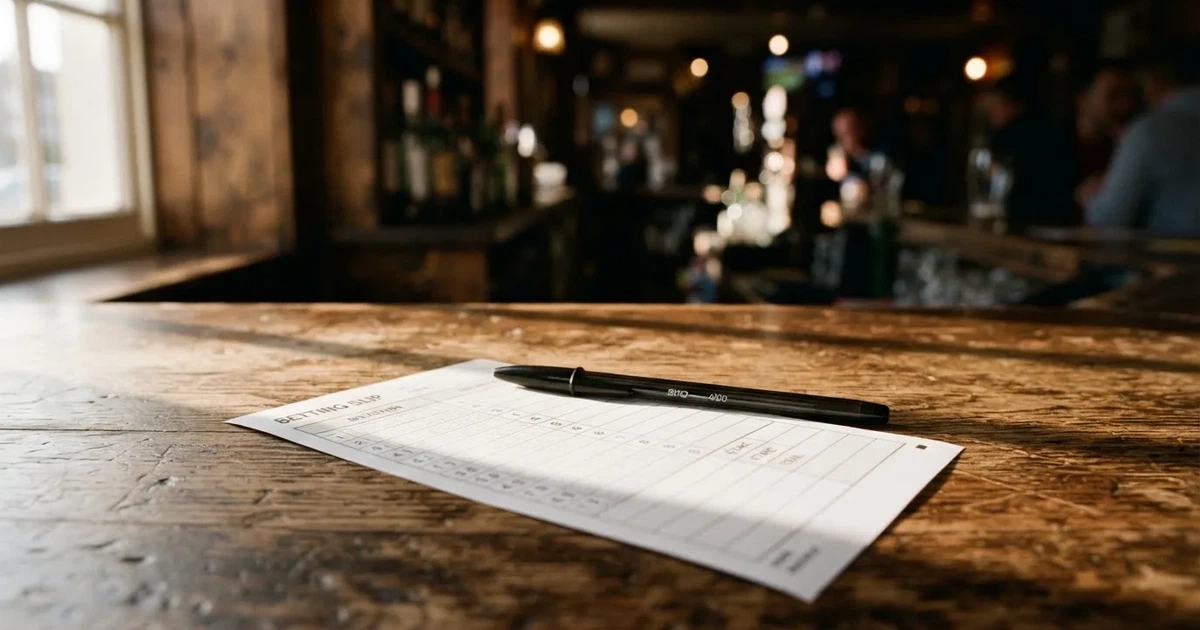
This page is about how Best Odds Guaranteed actually settles at ten Gambling Commission-licensed bookmakers, what each operator’s own terms attach to the offer, and what the headline uplift hides. The page is also about the licensed market as a whole — who is licensed, how the register is read, and where the offer does not apply. BOG is the entry point. The cost of taking it, and the cost of betting next to it, is the substance.
Data current as of 27 October 2026. Verified against the Gambling Commission’s public register, individual operator terms pages, and App Store listings.
What Best Odds Guaranteed actually means in Great Britain
Best Odds Guaranteed is a horse-racing concession. A punter takes a fixed price on a runner during the day. By the time the race starts, the on-course SP — the starting price, set by the bookmakers on the rails — has drifted to a bigger number. Under BOG, the winning bet is settled at the bigger SP rather than the price the punter took. The punter gets more, not less.

The mechanism rests on a working definition of SP. For British horse races the starting price is set as the median of a sample of bookmaker prices on track: the shortest price in the longer-priced half, so at least half of the sample offered that price or longer. The SP is not the best price on the rails. It is a deliberately conservative middle figure, and BOG pays that figure rather than the rails best. The difference is one of the things that does not say itself on the betting slip.
BOG is industry practice, not statute. It is offered by some UK bookmakers and not others. Where it is offered, the operator’s terms decide which races qualify, when prices must be taken, and how the payout is calculated. The page below names each, in the form each operator states in its own terms. The offer is not a regulated product. It is a marketing promise each company makes and can in principle withdraw.
What BOG does not do is straightforward and worth saying first:
- It does not apply if the SP comes back shorter than the price taken. A punter who takes 5/1 and sees the SP return at 4/1 keeps the 5/1. The promise pays the bigger of the two.
- It does not apply to every market. Football, tennis, golf and most other sports fall outside the concession entirely. BOG is a horse-racing offer, with greyhound racing the occasional extension.
- It does not apply to every bet type. Ante-post bets, taken before the final declarations are known, sit outside most BOG terms. Tote and pari-mutuel pools, where the dividend depends on the pool rather than a fixed price, are settled by the pool operator under different rules.
The shape of the offer is narrower than the headline, and the conditions beneath it carry the same character.
How BOG is settled, line by line
A punter places a £10 win bet at 5/1 (decimal 6.00) on a horse at 9 AM. The race runs at 3 PM, and the SP returns at 7/1 (decimal 8.00). The horse wins.

- At the price taken, the bet would return £60 (£10 × 6.00). The £10 stake is included in that £60.
- Under BOG, the bet is settled at SP, 7/1. The bet returns £80 (£10 × 8.00).
The uplift is the £20 difference. That £20 is what BOG gives the punter. The arithmetic is simple, and the operator states it plainly. The same line of arithmetic is what runs through every operator’s BOG page, and the way each operator explains it is consistent.
The same punter, with the same £10 at 5/1, sees the horse lose. BOG makes no difference. The promise pays only on a win, and only on the bigger of the two prices. The punter whose horse loses at 5/1 loses the £10 regardless of the SP. BOG is a payout enhancement on winners, not a loss cap.
The maths reads as a small adjustment. It changes two things a punter cares about:
- The expected return on a long-priced winner. A horse taken at 16/1 (17.00) that drifts to 25/1 (26.00) pays £250 on a £10 stake at SP rather than £170. The £80 uplift on a winning bet is real money, and on a 25/1 winner it shows up differently than on a 5/1 winner.
- The composition of an each-way bet. Each-way bets are two equal-stake bets at the price taken: one win, one place. BOG settles the win leg at SP when applicable. The place leg is settled at the place terms the operator publishes, not at SP. A punter reading BOG as applying to the whole stake will find the place leg settled under different rules.
Where BOG begins and stops — the conditions behind the offer
Three conditions are common across the BOG terms the operators on this page publish:
- A time window. Some operators pay BOG only on prices taken after a stated clock time on the day of the race. William Hill’s terms say BOG on UK and Irish racing applies from 8 AM on the day of the race. Other operators extend the window earlier; some, in practice, apply BOG from the morning declarations. The window matters because ante-post bets taken the day before a race sit outside it.
- A race scope. UK and Irish racing is the standard scope. Some operators extend BOG to selected international meetings. The selection varies by operator and by meeting. The punter checks the meeting before placing the bet, and the operator’s terms page names the meetings covered on that day.
- A cap on the payout uplift. Sky Bet’s terms cap the BOG uplift at £50,000 per bet or per race for horse racing. Other operators set different caps or none at all. The cap is the part of BOG that the marketing does not name, and it is the part that bites a high-stakes punter.
A condition worth separate mention is the Rule 4 interaction. A Rule 4 deduction is a bookmaker rule applied when a horse is withdrawn from a race after bets are taken: the market shortens, and the bookmaker takes a deduction from winning bets to compensate. At Sky Bet, if a price taken receives a Rule 4 deduction, the deduction still applies unless the horse returns at a bigger SP, in which case the bet is paid at SP with no deduction. The Rule 4 caveat is the kind of clause that does not surface in a BOG headline, and a punter with a Rule 4-affected bet finds the rule operating after the win.
A worked margin, with a band
A two-way market at 1.90 / 1.90 (fractional 9/10, evens plus 90%) gives a payout share of 1 ÷ (1/1.90 + 1/1.90) — about 1 ÷ 1.0526, or 0.95. The bookmaker’s margin is 1 − 0.95, or roughly 5%. That figure is the take on every unit bet on the market. The 5% is the cost of placing a bet, and it is what the BOG uplift runs against: a £20 uplift on a £10 winner is the size of a market where the operator takes its cut regardless.
The 1.90 / 1.90 figure is illustrative. Real markets differ — a 1.91 / 1.91 line gives a payout share near 95.3% (margin about 4.7%); a 1.85 / 1.85 line gives about 92.5% (margin about 7.5%). The margin in real horse-racing BOG markets sits in a wider band, and the punter reading the offer sees that band as the underlying cost the uplift is set against. A 5% margin is a reasonable middle of the road for a competitive two-way market; a 7.5% margin is the kind of line the punter walks past.
The figure is a band, not a point. The arithmetic is the same for every two-way market; what changes is the size of the band.
BOG against the other concessions
BOG sits next to a short list of concessions a UK bookmaker runs on horse racing. Each concession has its own terms, and the punter who reads one as covering the others will find the slip settled under a different rule.
- Extra places. Each-way bets settled at an extended number of places — six places rather than four on a big-field handicap. BOG does not affect this; the place leg is settled under the place terms the operator publishes.
- Non-runner no bet. Stake returned if the horse does not run. BOG does not affect this either; the bet settles under the operator’s non-runner rule.
- Best odds guaranteed. The concession this page covers. Applies to the win leg of a single or each-way bet, on races the operator names.
The three concessions are separate. The punter with a horse at 10/1 taken in the morning, on a race with non-runner no bet, with five places paid on each-way bets, has each concession settling on its own line.
Responsible gambling in Great Britain: the rules a BOG punter sits inside
BOG is the headline. The framework a UK punter bets inside is the substance. The Gambling Commission is the regulator. The Gambling Act 2005 is the statute, covering England, Scotland and Wales (Northern Ireland is outside the Act and runs under its own older law). Operators serving customers in Great Britain need a Commission licence wherever they are based, since the Gambling (Licensing and Advertising) Act 2014 — there is no longer a place-of-supply exemption for an operator in another jurisdiction. A Curaçao, Maltese or Gibraltar licence is not a substitute for a GB licence.
Identity is verified before the first deposit or bet. Since 7 May 2019 operators have run checks against name, address and date of birth, including before a free bet or bonus. Anonymous play is not an option at a licensed brand. The check is a condition of holding a licence, not a marketing choice.
Three controls a punter betting on BOG runs into:
- GAMSTOP. The national multi-operator online self-exclusion scheme. Mandatory for online operators since 31 March 2020. Periods of six months, one year, five years, or five years with auto-renewal. After the minimum period the exclusion stays in place for a further seven years unless the punter asks GAMSTOP to remove it. GAMSTOP covers online sites and apps; betting shops use a separate scheme.
- Financial vulnerability check. In force since 30 August 2024, applied since 28 February 2025 once a punter’s deposits minus withdrawals exceed £150 in a rolling 30 days. The check is a public-record check (bankruptcy, county court judgments), not an income check and not a credit reference check. The punter triggers the check by spending, not by asking.
- Deposit limit. Operators must offer a gross deposit limit on a fixed time frame. The first changes have applied since 31 October 2025; a second phase was postponed to 30 September 2026. There is no state-set ceiling: the limit is the punter’s choice.
Help is through GamCare (National Gambling Helpline), GambleAware, NHS gambling clinics and Gamblers Anonymous. These are independent bodies. The operator does not refer to them as a marketing channel.
The marketing promise of a “risk-free” bet, a “free” free bet or a BOG uplift sits inside these controls, and the controls apply to BOG-winning bets the same way they apply to losses. A punter who has set a deposit limit and wins a BOG uplift settles inside the limit set, not above it. The promotion does not override the framework.
Bonuses and free bets at BOG bookmakers
A BOG concession is a payout adjustment on winners. A bonus is a different thing, and the two settle under different rules. The terms of each are worth reading on the operator’s own page before claiming either.
The shape of a new-customer package varies by operator:
- A free bet package. A qualifying bet unlocks a fixed-odds free bet, sometimes several. Spreadex’s new-customer offer is £60 in free bets for a £10 fixed-odds bet, with the free bets usable across fixed odds and spread betting, and the qualifying bet must be placed within 28 days of opening the account. The free bets are not paid back with a win — the punter keeps the winnings, not the stake.
- A combined offer with a spread-betting leg. Sporting Index’s new-customer offer has a £10 fixed-odds bet at minimum odds of 1/2 unlocking three £10 fixed-odds free bets, three £5 Total Goals spread bets, three £5 Winning Favourites spread bets and a £1 Race Index spread bet; the qualifying bet cannot be placed in play or cashed out early. The combined offer is the kind a punter reads as one product and settles as several, and the free-bet terms differ across the legs.
- An acca insurance. BoyleSports Acca Insurance requires opt-in, a minimum stake of £5, minimum odds of 1/2 and pays a maximum refund of £20 as a free bet that expires in 7 days; bets must be placed and settled on the same day. A refund as a free bet is not a refund in money, and the punter whose accumulator loses by one leg carries the stake loss forward.
The 10x wagering cap on bonuses is the headline from the Commission side. Promotion rules in force since 19 January 2026 cap wagering requirements on bonuses at 10x — a £10 bonus at 50x would have required £500 of bets; under the cap no more than £100. Mixed-product promotions, an offer that requires gambling on two or more product types such as betting, casino, bingo and lottery, are banned. Whether the cap applies to free bets with no wagering condition, and any cap on the money value of a bonus, are not established.
A free bet in BOG terms is worth what its terms say it is. The stake is usually not paid back, and the value is what the punter keeps from a win. A £10 free bet at 6/1 returns £60 in winnings, not £70. The same free bet at the SP, on a BOG horse, returns the SP winnings — the punter keeps the SP uplift on the free bet, not just on the qualifying bet. The punter who reads BOG as a free-bet enhancement will find the offer applying to the free bet only where the operator’s free-bet terms allow it.
The conditions a punter reads before claiming:
- Minimum odds. Most free bets require a minimum price for the qualifying bet (BoyleSports 1/2; Sporting Index 1/2). The qualifying bet is the bet the punter places with their own money to unlock the offer; a bet below the minimum does not qualify.
- Time limits. Free bets expire — QuinnBet’s free bets are valid for 7 days from credit. The expiry clock is set at credit, and the punter who lets the free bet lapse carries the offer off the slip.
- Market scope. BetUK’s free bets exclude virtual sports, esports and non-UK/IE horse racing. The exclusions are operator-defined and vary across the licensed set.
- Combination limits. QuinnBet allows straight accumulators but not Trixies, Patents or Yankees on free bets. A Trixie is 4 bets, a Patent 7, a Yankee 11; the punter with a combination bet finds the free bet applying only to the allowed combinations.
The cost of clearing a bonus is the turnover. A £10 bonus at 10x wagering is £100 of bets. A £10 free bet, with the stake not paid back, is settled at the winnings only, and the wagering on those winnings depends on the operator’s terms. The punter reads the offer’s headline and the terms behind it, and the headline is the smaller of the two.
Bet types and odds at BOG bookmakers
BOG settles the win leg of a single or each-way bet. The bet type sits inside a wider set of bet types a UK bookmaker offers on horse racing.
The native terms the punter meets:
- Single. One selection, one bet. Settled at the price taken or at SP under BOG. The simplest line on the slip.
- Double. Two selections, both must win. Odds multiply.
- Treble. Three selections, all must win. Odds multiply.
- Accumulator (acca). Four or more selections, all must win. Odds multiply with each leg.
- Each-way. Two bets of equal stakes at the price taken — one win, one place. The stake doubles. The place terms vary by race and operator. BOG settles the win leg at SP where applicable.
- Bet builder / same-game multi. Combines selections from one event (for example, first goalscorer and total goals in a football match). Sits outside BOG; football falls outside the BOG scope.
- BTTS. Both teams to score. Football.
- Cash out. Settles a bet before the event finishes, at a price the operator sets. Sits outside BOG; cash-out prices are operator-set and BOG does not apply.
The odds format is fractional by default in Great Britain (5/1, 11/4, evens) with decimal as the alternative (6.00, 3.75, 2.00). Conversion: a/b → a ÷ b + 1. 5/1 → 1 ÷ 5 + 1 → 6.00. 11/4 → 1 ÷ 4 + 11 ÷ 4 — wait, 11/4 → 11 ÷ 4 + 1 = 3.75. The arithmetic is the same in either direction; the punter reading the slip reads the format they are used to.
The conversion in plain words: divide the number on the left by the number on the right and add 1. 5/1 → 5 ÷ 1 + 1 = 6.00. 11/4 → 11 ÷ 4 + 1 = 3.75. 4/6 → 4 ÷ 6 + 1 = 1.67.
The margin is in every price. A two-way market at 1.90 / 1.90 gives a payout share of 1 ÷ (1/1.90 + 1/1.90) — about 95% — and a margin of 5%. The bookmaker takes the 5% on every unit bet on the market. A 2.00 / 2.00 line gives a payout share of 1 ÷ (1/2.00 + 1/2.00) = 100% and a margin of 0%; a 1.80 / 1.80 line gives about 90% and a margin of 10%. Real horse-racing markets sit across a band that runs from the competitive to the soft.
The punter reading odds does the arithmetic in one of two ways:
- Multiply the decimal odds by the stake for the return. £10 at 6.00 returns £60. The £10 stake is included in that £60.
- Multiply the decimal odds minus 1 by the stake for the profit. £10 at 6.00 returns £60; the profit is £50.
For an accumulator the odds of the legs multiply into one price. A four-leg acca at 2.00, 3.00, 4.00 and 5.00 gives combined odds of 120.00. A £10 stake returns £1,200. The £10 stake is included. The punter loses on any non-runner or losing leg.
The BOG overlay applies to the win leg of a single or each-way bet. The overlay does not apply to:
- Ante-post bets taken before declarations. William Hill’s terms explicitly exclude ante-post, tote and pari-mutuel bets.
- Combination bets where the horse is one leg of an accumulator. The accumulator settles at the combined odds; BOG does not adjust the leg-by-leg settlement.
- Cash-out bets. Cash-out prices are operator-set and not adjusted by BOG.
A punter reading BOG as a blanket enhancement on horse-racing bets finds the offer narrower than the headline once the bet type and the time window sit on the slip.
How the punters read the offer
Three readings are common on racing forums:
- BOG as a payout floor. If the punter takes a price and the SP is shorter, BOG keeps the bigger one. The punter carries a price they liked into the race and keeps it if the SP drifts below it. The punter reading this way is treating BOG as a one-way floor.
- BOG as a punter protection. The offer protects against a horse being sent off at a bigger price than the punter took. The punter reading this way is treating BOG as insurance.
- BOG as a marketing label. The punter reading the offer as marketing reads it with the same scepticism as a “best odds” or “100% bonus” headline and checks the operator’s terms before staking.
The three readings do not contradict each other; each is what BOG delivers under the operator’s terms. The marketing label reading is the one that catches the time window, the race scope and the cap, and the punter reading the terms sees the offer in its narrow form.
The ten licensed bookmakers reviewed
The table covers every brand on this page. The columns are the licence register entry and the BOG stance each operator states in its own terms.
| Brand | Gambling Commission licence | BOG stance in the operator’s own terms |
|---|---|---|
| BoyleSports | 039469-R-319383-025 (Boylesports Enterprise) | Stated in App Store listing; full horse-racing BOG terms on the BoyleSports site |
| BetUK | 039198-R-319450-029 (LeoVegas Gaming PLC) | Free-bet exclusions cover virtual sports, esports and non-UK/IE racing |
| London Bet | 066162-R-340278-004 (Thistle Bet Limited) | Stated as licensed in Great Britain in App Store listing |
| DragonBet | 064908-R-339041-003 (DragonBet Ltd) | Markets include Welsh football and rugby, racing, American football, in-play and bet builder |
| Bet600 | 044731-R-323941-016 (Tyche Tech Limited) | Pays Best Odds Guaranteed on horse racing — early or show price, paid at SP |
| Matchbook | 039504-R-319407-024 (Triplebet Limited) | Betting exchange with Bet Builder, multiples, in-play and live streaming; BOG does not apply on an exchange |
| Sporting Index | 027343-R-308898-011 (Sporting Index Limited) | Combined fixed-odds and spread-betting new-customer offer; BOG applies to fixed-odds racing |
| Spreadex | 008835-R-104580-022 (Spreadex Limited) | FCA-regulated for spread betting and Gambling Commission for fixed odds; BOG applies to fixed-odds racing |
| William Hill | 039225-R-319373-015 (WHG (International) Limited) | BOG on UK and Irish racing from 8 AM on race day; excludes ante-post, tote and pari-mutuel |
| QuinnBet | 061011-R-335683-004 (QuinnBet (Gibraltar) Limited) | Free bets valid 7 days at minimum odds 1/2; BOG applies on horse racing in the standard form |
The table is the licence and the offer shape. The notes below each brand are the terms, the conditions and the limits the operator publishes. Where research does not cover a specific value the table leaves it as the operator states it; the prose below expands on the terms.
BoyleSports
BoyleSports is a Boylesports Enterprise brand on the Commission’s remote general betting standard (real events) licence, with the company name on the register spelling out a parent group with a long Irish and UK high-street presence. The Commission’s account number is 39469.
The BoyleSports app store listing names Acca Insurance terms: opt-in required, minimum stake £5, minimum odds 1/2, maximum refund £20 as a free bet, expiry 7 days from credit, and the qualifying accumulator bets must be placed and settled on the same day. A refund as a free bet is not a refund in cash — the punter whose accumulator loses by one leg receives a £20 free bet, not a £20 credit, and the stake loss is not recovered. The minimum odds and minimum stake make the insurance harder to clear than the marketing reads.
BoyleSports’ App Store listing names acca insurance, not horse-racing BOG terms. A punter reading BoyleSports’s offer before placing a horse-racing bet checks the BoyleSports site for the BOG terms, which are stated on the operator’s own pages.
BetUK
BetUK runs under the LeoVegas Gaming PLC licence on the Commission’s register, account 39198. The BetUK app store listing names free-bet exclusions: virtual sports, esports and non-UK/IE horse racing. The exclusion list is the part of the offer a punter misses when the marketing reads “free bets on racing”.
A punter betting on a BOG horse at BetUK has the bet settled at SP when the SP drifts, with the exclusion list applying to free-bet usage rather than to fixed-odds racing bets. The free-bet exclusion on non-UK/IE racing means a BOG uplift paid on a free bet does not apply to a non-UK/IE race.
London Bet
London Bet is published by Thistle Bet Limited on the Commission’s register, account 66162. The London Bet app store listing carries a 17+ age rating and states that the brand is licensed and regulated in the UK. The BOG terms sit on the London Bet site rather than the App Store listing.
A punter reading London Bet’s offer sees a smaller licensed brand than the high-street names on the table. The licence is the same kind as the others — remote general betting standard (real events) — and the BOG terms follow the industry practice the other brands publish.
DragonBet
DragonBet is published by DragonBet Ltd on the Commission’s register, account 64908. The DragonBet app store listing names Welsh football and rugby markets, racing, American football, in-play betting and bet builder markets. The brand is built around Welsh sport, and the racing offer sits inside the same account.
A punter reading DragonBet sees a brand with a regional focus and a Commission licence in the standard form. The BOG terms sit on the DragonBet site.
Bet600
Bet600 is published by Tyche Tech Limited on the Commission’s register, account 44731. The Bet600 app store listing says Best Odds Guaranteed is paid on horse racing: if the SP is bigger than the early or show price taken, the bet is paid at the SP. The terms in the App Store listing match the industry BOG shape — paid at SP when SP is bigger — and the punter reading the offer sees the standard form on a smaller licensed brand.
Matchbook
Matchbook is published by Triplebet Limited on the Commission’s register, account 39504. Matchbook is a betting exchange where customers bet against each other rather than against a bookmaker. The Commission’s register lists both remote general betting standard (real events) and remote betting intermediary — the latter is the licence type for exchanges.
BOG does not apply on a betting exchange. An exchange settles bets at the price the punter backs or lays at; there is no SP overlay because the exchange is the price. A punter reading “best odds guaranteed at Matchbook” will not find the offer on the exchange. Matchbook does offer Bet Builder, multiples, in-play betting and live streaming of horse racing and greyhounds; the offer is in the product set rather than in BOG.
Sporting Index
Sporting Index is published by Sporting Index Limited on the Commission’s register, account 27343. The Sporting Index new-customer offer combines a £10 fixed-odds bet at minimum odds 1/2 with three £10 fixed-odds free bets, three £5 Total Goals spread bets, three £5 Winning Favourites spread bets and a £1 Race Index spread bet; the qualifying bet cannot be placed in play or cashed out early. The combined offer sits across fixed odds and spread betting — a punter reading the headline sees one offer, the operator’s terms run several.
BOG on horse racing at Sporting Index applies to the fixed-odds leg of the offer under the same rules the other licensed brands publish. Spread betting sits outside BOG; spread bets settle on the spread between an index and the actual outcome, and the BOG uplift does not apply.
Spreadex
Spreadex is published by Spreadex Limited on the Commission’s register, account 8835. Spreadex is regulated by the FCA for spread betting and by the Gambling Commission for fixed-odds betting. The Spreadex homepage states that spread betting losses can exceed the deposit — a FCA-side disclosure that does not apply to fixed-odds racing.
Spreadex’s new-customer offer is £60 in free bets for a £10 fixed-odds bet, with the free bets usable across fixed odds and spread betting, and the qualifying bet must be placed within 28 days of opening the account. The 28-day window is the part of the offer a punter reading the headline misses. BOG on horse racing applies on the fixed-odds side under the standard terms.
William Hill
William Hill is published by WHG (International) Limited on the Commission’s register, account 39225. The William Hill BOG terms are the clearest of the brands reviewed: BOG on UK and Irish horse racing from 8 AM on the day of the race, on both single and multiple bets, and it does not apply to ante-post, tote or pari-mutuel bets. The 8 AM cutoff is the time window most other operators name implicitly; William Hill names it explicitly.
The exclusions list is the part of the offer a punter reads once: ante-post, tote and pari-mutuel. The exclusions sit beside the offer and settle bets under different rules. The punter reading “BOG on UK and Irish racing from 8 AM” sees the offer in its narrow form.
QuinnBet
QuinnBet is published by QuinnBet (Gibraltar) Limited on the Commission’s register, account 61101. QuinnBet free bets are valid for 7 days from credit and can be used on any market at odds of 1/2 (1.5) or greater, with maximum odds of 50/1; straight accumulators are allowed but Trixies, Patents and Yankees are not. The combination limits are the conditions a punter with a multi-leg free bet finds on the slip.
BOG on horse racing at QuinnBet applies under the standard industry terms. The free-bet terms sit beside the BOG terms and the punter reads both.
How to read the Gambling Commission’s public register
The register is the whole test of whether a brand holds a Commission licence. Search by business name, trading name, domain or account number; an operator whose name appears in the register holds a licence, an operator whose name does not appear does not.
The columns of the register entry:
- Business name. The name on the licence. WHG (International) Limited for William Hill; Boylesports Enterprise for BoyleSports. The brand name on the punter’s screen and the business name on the register do not always match.
- Trading name. The name the brand uses on the website and app. William Hill, BoyleSports, BetUK. Several brands can run under one licensee — Ladbrokes and Coral under Entain; Paddy Power and Betfair under Flutter.
- Domain. The website or app domain. Used as a search term. Licensed operators use .com as well as .co.uk; the domain proves nothing.
- Account number. The Commission’s identifier for the licence. 39469 for BoyleSports; 39198 for BetUK; 66162 for London Bet; 64908 for DragonBet; 44731 for Bet600; 39504 for Matchbook; 27343 for Sporting Index; 8835 for Spreadex; 39225 for William Hill; 61101 for QuinnBet. The account number is the cleanest search term.
The stride from screen to register is four steps:
- Open the register at the Commission’s site.
- Enter the trading name, the business name, the domain or the account number.
- Read the entry. The register lists the licence types the operator holds.
- Read the licence type. Remote general betting standard (real events) is the licence type a horse racing bookmaker needs. Remote betting intermediary is the licence type for a betting exchange.
The register is searchable by the public. The information on each entry is public. The Commission’s register does not list a count of licensed operators; the punter reading the register reads the entry they need, not a count.
Why a GB licence matters
The licence is the entry point into the framework the punter uses:
- Identity checks before the first deposit or bet. Since 7 May 2019. The check is on name, address and date of birth. Anonymous play is not an option.
- GAMSTOP coverage. Self-exclusion through GAMSTOP. Mandatory for online operators since 31 March 2020.
- Bonus cap. Wagering requirements on bonuses capped at 10x since 19 January 2026. Mixed-product promotions banned since the same date.
- Vulnerability check. Public-record check when deposits minus withdrawals exceed £150 in a rolling 30 days since 28 February 2025.
- Complaints route. The Commission’s complaints process and approved dispute-resolution body.
- Operator duty of care. The Licence Conditions and Codes of Practice (LCCP) and the social responsibility code.
The licence is the framework. An offshore operator — Curaçao, Malta, Gibraltar without a GB licence — does not run inside the framework, and the punter betting at one has no Commission complaints route, no GAMSTOP coverage, no approved dispute-resolution body, no British consumer redress if funds are withheld, and is not bound by the 10x bonus cap or the £150 vulnerability check. The punter also faces no anonymous-play option, no credit-card funding, and no British-named-account rule: a Curaçao-licensed site runs under its own house rules and the framework does not apply.
A GB licence is not a guarantee. It is a framework the operator runs inside.
Operator set and order
The notes on each operator are the licence, the BOG stance, the offer shape and the conditions the operator’s own terms attach.
| # | Brand | Gambling Commission licence | BOG stance in the operator’s own terms |
|---|---|---|---|
| 1 | BoyleSports | 039469-R-319383-025 | BOG stated on BoyleSports site; App Store listing covers acca insurance |
| 2 | BetUK | 039198-R-319450-029 | BOG on fixed-odds racing; free-bet exclusions on virtual, esports, non-UK/IE racing |
| 3 | London Bet | 066162-R-340278-004 | Stated as licensed in Great Britain in App Store listing; BOG terms on site |
| 4 | DragonBet | 064908-R-339041-003 | Markets include racing; BOG terms on site |
| 5 | Bet600 | 044731-R-323941-016 | BOG paid on horse racing when SP exceeds price taken |
| 6 | Matchbook | 039504-R-319407-024 | Exchange; BOG does not apply |
| 7 | Sporting Index | 027343-R-308898-011 | BOG on fixed-odds racing; combined fixed-odds and spread offer |
| 8 | Spreadex | 008835-R-104580-022 | FCA for spread, Gambling Commission for fixed odds; BOG on fixed-odds racing |
| 9 | William Hill | 039225-R-319373-015 | BOG on UK and Irish racing from 8 AM on race day; excludes ante-post, tote, pari-mutuel |
| 10 | QuinnBet | 061011-R-335683-004 | BOG on horse racing; free-bet terms separate |
The order is the order research sets. The table is the licence and the offer shape.
Cost — what BOG costs a punter in real terms
The cost of BOG is not the price uplift a winning bet receives. The cost is the underlying margin the punter pays on every bet on which BOG is offered, plus the conditions the operator attaches.
Three figures sit on each BOG market:
- The margin. The bookmaker’s take on every unit bet on the market. A 5% margin means £0.05 of every £1 bet on the market is the operator’s; a £10 bet costs the punter £0.50 of expected value before the outcome is decided. The margin is in every price, and the punter reading the offer sees the margin as the cost the BOG uplift is set against.
- The cap. Sky Bet caps the BOG uplift at £50,000 per bet or per race for horse racing. A punter who has taken a £50,000 bet and wins sees the uplift capped at £50,000; the punter reading the cap sees the offer ending at the cap rather than at the SP.
- The window. William Hill pays BOG from 8 AM on the day of the race. A punter reading the window sees the offer beginning at 8 AM rather than at the morning declarations; a punter who took the price at 7.30 AM is outside the offer.
The cost of BOG is the margin the punter pays regardless of the BOG uplift. A punter who takes 10 horses at 5/1 each, paying £10 per bet, has paid £100 in stakes and an expected £5 of margin (5% on £100). The punter whose horses win at SP drifts receives the BOG uplift across the winners; the punter whose horses lose pays £100 of stakes and £5 of expected margin with no return.
The punter reading the offer reads three figures:
- The margin the bookmaker takes on the underlying market.
- The cap on the BOG uplift.
- The window on BOG-eligible prices.
The three figures are what the offer costs. The headline is the £20 uplift on the winning £10 bet at 5/1; the cost is the margin, the cap and the window.
What the offer costs in promotion terms
A “best odds guaranteed” headline is a marketing promise. The promotion does not advertise the margin, the cap or the window. The punter who reads the offer reads:
- The margin. The bookmaker’s margin on the market, visible in the prices. A 5% margin is a competitive two-way market; a 7.5% margin is the punter looking elsewhere.
- The cap. The cap on the BOG uplift, stated in the operator’s terms. A £50,000 cap is the kind of cap a high-stakes punter reads.
- The window. The window on BOG-eligible prices, stated in the operator’s terms. An 8 AM window is the kind of window a punter with an ante-post bet reads.
The promotion is the offer; the cost is what the punter reads in the terms.
What the offer costs in offer shape
A BOG concession is a payout enhancement on a winning bet. The offer does not apply to:
- A losing bet. A punter whose horse loses carries the stake loss regardless of the SP. The BOG uplift does not insure a loss.
- A non-runner. A punter whose horse is declared a non-runner carries the stake back under the operator’s non-runner rule. The BOG uplift does not apply to a non-runner.
- A shortened field under Rule 4. A Rule 4 deduction is a bookmaker rule applied when a horse is withdrawn after bets are taken; the deduction shortens the market and the deduction applies to winning bets. The deduction and the BOG uplift sit beside each other on the betting slip.
The BOG uplift is real money on a winning bet where the SP drifts; the offer is narrower than the headline.
A worked margin, restated in plain prose
A two-way market at 1.90 / 1.90 (fractional 9/10) is a useful illustrative market. The bookmaker quotes both sides at 1.90. A punter betting £10 on either side has the bet settled at 1.90.
The payout share is 1 ÷ (1/1.90 + 1/1.90) — about 1 ÷ 1.0526, or roughly 0.95. The bookmaker’s margin is 1 − 0.95, or roughly 5%. The 5% is the take on every unit bet on the market; a £10 bet on either side has an expected return of £9.50 across the market. The £0.50 is the bookmaker’s expected margin on the bet.
The figure is illustrative. Real horse-racing BOG markets differ — back sport, lay sport, in-running — and the margin varies across the band. A 1.85 / 1.85 line gives a payout share of about 92.5% (margin about 7.5%); a 1.91 / 1.91 line gives a payout share of about 95.3% (margin about 4.7%). The 5% is a reasonable middle of the road for a competitive two-way market.
The BOG uplift sits on top of the underlying margin. A punter taking a horse at 5/1 (6.00) and seeing the SP return at 7/1 (8.00) on a winning bet is paid at 8.00. The bet returns £80 on a £10 stake. The punter’s expected return at the price taken, before the SP, was £60; the punter’s expected return at SP, after the drift, is £80. The £20 is the BOG uplift on a winning bet.
The £20 is real money. The £20 is set against the underlying margin of the market; the £20 is not a refund of the margin but a contract on the bigger price. The punter reading the £20 sees the £20 as a one-way uplift on a winner.
Advertising, taxes and the off-course rules
Three pieces of context sit around a BOG bet.
- Advertising. The Commission does not license advertising. The CAP Code (non-broadcast) and BCAP Code (broadcast) run the marketing; the ASA enforces. CAP Code section 16 says marketing must be socially responsible, must not be of strong appeal to under-18s, and no one who is or seems to be under 25 may be featured gambling or play a significant role. The rule concerns who may appear in the advertisement, not who may bet. Whistle-to-whistle is an industry code, not law; since 1 August 2019 betting advertisements are not shown on TV from five minutes before a live sporting event to five minutes after it, before the 9pm watershed. Horse and greyhound racing are excluded.
- Tax. The player pays no tax on betting winnings in Great Britain. General Betting Duty is the operator’s tax on gross profits, currently 15%; from 1 April 2027 a new remote betting rate of 25% applies, while remote bets on UK horse racing, bets on self-service betting terminals in licensed premises, pool betting and in-person betting stay at 15%. Spread betting has its own rates (3% financial, 10% other). Until 1 April 2027 the remote rate stays at 15%. The Commission’s statutory levy is a separate charge.
- Off-course pool betting. Pool betting on horse or dog racing is a separate licence category. Off-course pool betting on horse or dog racing is a separate licence and duty. The BOG concession does not apply to pool bets.
The three pieces of context are the substance around the offer. The punter reading BOG needs to see the market reality behind the marketing, the tax treatment of winnings and the context of the off-course pool.
The Premier League shirt change
The Premier League clubs’ withdrawal of gambling sponsorship from the front of matchday shirts (from 2026/27; sleeves and hoardings remain) is voluntary, not law. The withdrawal is a sponsorship decision by the clubs, not a regulatory change by the regulator. BOG sits inside the framework the regulator runs; the shirt change sits outside it.
Offshore, framed honestly
A GB licence is compulsory at the point of consumption. Providing gambling facilities in Great Britain without the licence the Act requires is an offence under section 33 of the Gambling Act 2005 — aimed at the operator. No offence aimed at a customer who merely bets on an unlicensed site was found.
The honest framing:
- Licensed = checks, limits, GAMSTOP, bonus cap. Identity verification before the first deposit. Free bets and bonuses capped at 10x wagering. Vulnerability check on deposits over £150 in a rolling 30 days. GAMSTOP self-exclusion. ASA-regulated marketing.
- Unlicensed = none of those protections. No GAMSTOP coverage. No Commission complaints route. No approved dispute-resolution body. No British consumer redress if funds are withheld. Not bound by the 10x bonus cap or the £150 vulnerability check. Possible loss of funds.
Neither is “the safe choice” by default. The licensed path runs inside the framework; the offshore path runs outside it. The punter choosing the unlicensed path is choosing a path without the framework, not a path without risk.
A short guide to the betting slip
The slip is where the offer settles. The lines below are what the punter sees:
- Selection. The horse. BOG applies to the win bet on the runner, excluding multi-leg bets or accumulators.
- Stake. The word. A £10 stake at 6/1 returns £60 at the price taken. The £10 stake is included.
- Each-way. The box. A tick in the each-way box doubles the stake and adds a place bet at the place terms. The place leg is settled under the place terms the operator publishes.
- Price taken. The price at the time the bet was placed. BOG settles the win leg at SP when SP is bigger.
- SP. The starting price at the time the race began. The operator settles the win leg at SP when SP is bigger than the price taken.
- Cash out. The button. Settles the bet at the operator-set price before the event finishes. BOG does not apply to cash-out bets.
The punter reading the slip needs to understand the odds and the terms.
The accent on the cost of BOG
The marketing accent is on the £20 uplift on a £10 winner. The cost accent is on the underlying margin the punter pays on every bet on which BOG is offered, plus the cap on the uplift, plus the window on BOG-eligible prices.
The punter reading the offer should check the operator’s terms carefully.
Frequently asked questions
Which bookmakers do best odds guaranteed?
BOG is offered by some UK bookmakers and not others, and is industry practice rather than statute. Among the ten licensed brands on this page, BoyleSports, BetUK, London Bet, DragonBet, Bet600, Sporting Index, Spreadex, William Hill and QuinnBet state BOG on horse racing in their terms. Matchbook is a betting exchange and BOG does not apply because the exchange is the price. Each operator’s terms set the time window, the race scope and the cap on the uplift.
Which bookmakers offer best odds guaranteed?
The same answer in different words: the offer is industry practice, not a regulated product. William Hill names the time window explicitly (8 AM on race day for UK and Irish racing), and Sky Bet names the cap explicitly (£50,000 per bet or per race). Other operators publish BOG under the standard form and the punter checks the operator’s terms before staking. A GB licence is the floor for any marketing that names BOG as a feature; an unlicensed site is not regulated by the Commission.
What bookmakers offer best odds guaranteed?
The ten licensed brands on this page are the set reviewed; the Commission’s public register lists every operator holding a remote general betting standard (real events) licence. The set on the register is larger than the set reviewed here, and the punter looking at the register sees more brands than this page names. No operator is “the only” licensed one.
How can it be checked that a bookmaker holds a Gambling Commission licence?
The Commission’s public register can be searched by business name, trading name, domain or account number; an operator whose name appears in the register holds a licence, and one whose name does not appear does not. The register is searchable by the public; the licence types are listed on the register entry; remote general betting standard (real events) is the type a horse-racing bookmaker needs. The punter reading the register reads the entry, not a count.
How is the return on a bet worked out from the stake and the odds?
Multiply the decimal odds by the stake for the return. The stake is included in the return. Multiply the decimal odds minus 1 by the stake for the profit. For an accumulator the odds of the legs multiply into one price. A £10 stake at 6.00 returns £60 (profit £50). A £10 four-leg acca at 2.00, 3.00, 4.00 and 5.00 (combined 120.00) returns £1,200.
What is the bookmaker’s margin and how can it be seen in the odds?
The margin is the bookmaker’s take on every unit bet. As detailed earlier, a market priced at 1.90 / 1.90 results in a payout share of 0.95 and a margin of 5%, which the bookmaker retains. The margin is the cost the punter pays, and BOG uplifts are set against this underlying cost.
Free bets & offers – Fast Payout
Content created by the «Fast Payout» team
