
Online Horse Racing Betting in 2026: Which Licensed Bookmaker and Why
 Available in US
27 October 2026 · verified against the Gambling Commission’s public licence register and each operator’s own published terms.

Horse racing is the sport where Britain’s licensed bookmakers compete hardest for the punter’s pound, and it is also the sport where the shape of an offer changes the most once the marketing copy is stripped away. A best-odds-guaranteed promise turns on the clock. An each-way bet doubles the stake before a single horse has left the stalls. A betting exchange pays differently from a traditional book because no one sets the price. This page walks through how all of that works and where the ten licensed bookmakers on the comparison below actually differ.
The Sport Betting on in Britain
Flat, Jump and the Distances Ridden
Two codes of British racing exist. Flat racing is run directly between two points around a straight or oval track. Jump racing, which is steeplechasing and hurdling, is called National Hunt racing in Great Britain and Ireland. The two codes carry different horses, different distances and a different rhythm through the year. Races range from around 440 yards at the sprint end to more than four miles at the extreme, with five to twelve furlongs the most common band on the Flat. A punter who only watches the Cheltenham Festival is watching National Hunt; a punter who only watches Royal Ascot is watching Flat. A bookmaker that puts both on the menu serves the full racing calendar.
Weights, Handicaps and the Triple Crown
Handicap races assign each horse a different weight to carry based on its ability, the idea being to level the field so that a poorer horse can beat a better one. Conditions races give horses the same weight with allowances for younger and female horses. The three Classic races that make up the British Triple Crown sit at the heart of the Flat season: the 2000 Guineas, the Derby and the St Leger. Winning all three is one of the hardest achievements in racing; only a handful of horses have done it in the past century. Knowing which race is which matters because each carries a different ante-post price months before the running, and a non-runner in a Classic wipes a long-priced accumulator before the gates open.
The Licensed Bookmakers Compared
How the Ten Stack Up
The comparison below covers ten operators who each hold a remote licence and offer horse racing to customers in Great Britain. Every licence number and account number below is the one shown on the Commission’s public register; each operator’s own terms are the source for what its product actually does.
| Brand | Gambling Commission remote licence | What the operator’s own terms state on horse racing |
|---|---|---|
| Tote | 054779-R-331321-008 (account 54779) — TDCO Limited | Pool betting operation with its own dividend model; the British Horseracing Authority and bookmaker support |
| Star Sports | 009177-R-104555-019 (account 9177) — Star Racing Limited | Phone-based account opening on 08000 521 321 and direct trader support alongside the standard online flow |
| Fitzdares | 000400-R-103839-030 (account 400) — Fitzdares Limited | Cash out, accumulators, Lucky 15s, ante-post markets and in-play live odds on horse racing, football and several other sports |
| London Bet | 066162-R-340278-004 (account 66162) — Thistle Bet Limited | Horse racing alongside football, tennis, greyhounds, darts, golf, cricket, NFL, NBA, MLB and snooker, with in-play betting on each |
| Betboro | 044181-R-324363-007 (account 44181) — Webmedia Development N.V. | 100% matched free bet of up to £25 on the first qualifying wager, requiring a £10 debit-card deposit and a £5–£25 first bet at minimum 3/5 (1.60) per selection with at least three legs |
| Kalooki Sportsbook | 057730-R-333396-005 (account 57730) — Kalooki Sportsbook Limited | Operated by Kalooki Sports Book Ltd, company number 12938274, and a GAMSTOP member |
| Paddy Power | 039439-R-319330-013 (account 39439) — PPB Counterparty Services Limited | Horse racing coverage as part of a full sportsbook alongside football, boxing, rugby, tennis, golf, darts, snooker and F1 |
| BoyleSports | 039469-R-319383-025 (account 39469) — Boylesports Enterprise | £20 in free bets when a £10 bet is placed for UK players; €30 in free bets for a €10 bet for Irish players |
| Octobet | 062545-R-337248-006 (account 62545) — Octopus Game Limited | 50% back as a free bet up to £50, plus a £10 casino bonus for new customers |
| Matchbook | 039504-R-319407-024 (account 39504) — Triplebet Limited | Betting exchange where customers bet against each other, with Bet Builder, multiples, in-play and live streaming of horse racing and greyhounds |
The table is the licence and the headline horse-racing feature; everything underneath it (odds quality, each-way terms, BOG coverage, in-play depth, payout speed) is what separates one row from the next, and that material is on the operator reviews further down.
What the Comparison Is Built On
Ten brands is a small fraction of the operators on the Commission’s register. Hundreds of licensed brands take bets on British racing; the comparison narrows to those whose own product pages specifically state a horse-racing offer or whose horse-racing pricing is visibly different. A licence is a legal fact, not a ranking. The table is a starting list, and the rest of the page works through what each entry actually does on a Tuesday in March or a Saturday in June.
Legality, Licensing and Where Betting Actually Stands
The Commission, the Act and What a Licence Means
The Gambling Commission is the regulator. It is a non-departmental public body sponsored by the Department for Culture, Media and Sport, and it licenses the whole commercial market under the Gambling Act 2005. The Act covers Great Britain (England, Scotland and Wales); Northern Ireland is outside it. Since the Gambling (Licensing and Advertising) Act 2014 an operator whose remote facilities are used in Great Britain needs a Commission licence wherever it is based, so a Curaçao or Maltese or Gibraltar licence is not a substitute for serving British customers. The Commission’s public register, searchable by business name, trading name, domain or account number, is the test of whether a brand holds a licence. Several brands run under one licensee: Paddy Power and Betfair both sit under PPB Counterparty Services, Ladbrokes and Coral under another. Never read a licence number as proof of an independent business.
In-Play, Esports, Politics and What May Be Bet On
No statutory list of permitted bets or markets exists. An operator holds a licence for a category — remote general betting standard (real events), remote general betting standard (virtual events), remote general betting limited, remote pool betting, or remote betting intermediary for exchanges — and offers markets under its own rules and the Licence Conditions and Codes of Practice. In-play betting is offered by GB bookmakers and the controls sit in the operator’s licence conditions and customer-protection duties; never write that in-play is “unrestricted” as a legal conclusion. Esports are treated like any other event. Virtual events are a separate licence category. Bets on politics, TV shows and novelty markets are offered by GB bookmakers and no statutory prohibition was found. Betting exchanges run under the betting intermediary licence and rates and commission come from each exchange’s own terms. Pool betting on horse or dog racing off-course is its own licence and its own duty.
Verification, Age and the £150 Threshold
The minimum age is 18. Name, address and date of birth are verified before a customer can deposit or gamble, since 7 May 2019, including with a free bet or bonus — there is no anonymous play at a licensed site. A financial vulnerability check (LCCP condition 3.4.4, in force since 30 August 2024) applies when a customer’s deposits minus withdrawals exceed £150 in a rolling 30 days, a threshold that has applied since 28 February 2025; the check is a public-record one (bankruptcy, county court judgments), not an income check and not a credit reference check. Financial risk assessments are announced in a staged plan in the Commission’s article of 7 July 2026, with no start date. Deposit limits sit in Remote Technical Standard 12: the first phase has applied since 31 October 2025, a second phase was postponed to 30 September 2026, and whether it is live is not established. There is no state-set deposit or loss ceiling for betting; limits are the customer’s choice. No statutory cap on stakes in sports betting was found either: operators set their own maximum stakes and may restrict customers on that basis.
Credit Cards, Identity and Payments
Credit cards are banned for gambling in Great Britain since 14 April 2020 (LCCP condition 6.1.2), including credit-card-funded payments through an e-wallet; debit cards and bank-based payments are not covered by that ban. Identity verification before the first deposit means no anonymous play at a licensed site. Source-of-funds questions at higher spend are normal under the money-laundering rules. A state list of permitted payment methods does not exist: the methods a punter can use are the operator’s choice, and the rules are written into its own terms. Cryptocurrency deposits at licensed operators are not established as a settled question; describe payments only from each operator’s terms.
Tax
The punter pays no tax on betting winnings in Great Britain — this is general information, not tax advice, and a professional gambler should ask HMRC or an adviser. General Betting Duty is the operator’s tax on gross profits, currently 15%. From 1 April 2027 a new remote betting rate of 25% applies within it, while remote bets on UK horse racing, bets on self-service betting terminals in licensed premises, pool betting and in-person betting stay at 15% (HM Government policy paper of 26 November 2025). Spread betting has its own rates (3% financial, 10% other). Until 1 April 2027 the remote rate stays at 15%. Whether operators pass duty on through odds is not established; never write that the punter is charged duty.
Offshore and What a Punter Gives Up
A GB licence is compulsory at the point of consumption. Providing gambling facilities in Great Britain without the licence the Act requires is an offence under section 33 of the Gambling Act 2005 — aimed at the operator, with penalties on summary conviction of up to 51 weeks’ imprisonment, a fine up to level 5, or both (six months in Scotland). No offence aimed at a customer who merely bets on an unlicensed site was found. What the customer loses is the layer of protection: no GAMSTOP coverage, no Commission complaints route, no approved dispute-resolution body, no British consumer redress if funds are withheld, not bound by the 10x bonus cap or the £150 vulnerability check. Honest framing is licensed = checks, limits, GAMSTOP, bonus cap, but verification before the first bet; unlicensed = none of those protections and possible loss of funds. Neither is “the safe choice” by default. Enforcement is disruption, not blocking: cease-and-desist notices, search-engine referrals, work with registrars, hosts and payment providers, and court-order DNS blocking powers the Commission has been given or is about to receive. Never write that ISP blocking is in operation.
Responsible Gambling
GAMSTOP, GamCare and the Self-Exclusion Route
GAMSTOP is the national multi-operator online self-exclusion scheme and a mandatory licence condition for online operators since 31 March 2020. Exclusion periods are six months, one year, five years, or five years with auto-renewal, and after the minimum period the exclusion stays in place for a further seven years unless the customer asks GAMSTOP to remove it. GAMSTOP covers online sites and apps; betting shops use a separate service. Every GB-licensed operator on this page — and every GB-licensed operator not on this page — takes part. Help is available through GamCare (the National Gambling Helpline), GambleAware, the NHS gambling clinics and Gamblers Anonymous. Several of the operators on this list link directly to those services from their safer-gambling pages.
Limits, Time-Outs and the Operator’s Own Tools
Deposit limits, timeouts and self-set loss limits are each operator’s own product feature, not a state requirement. Fitzwilliam Sports publishes instant deposits, fast withdrawals, timeouts and deposit limits alongside links to GambleAware, GamStop and Gamblers Anonymous; that pattern is repeated, in different words, across the rest of the licensed set. No operator on the comparison offers a “set-and-forget” deposit limit that the punter cannot raise later; every operator is required by LCCP to allow the punter to set a limit but is also required to allow it to be reduced immediately and increased after a cooling-off period.
Crypto, Anonymity and Horse Racing
What a Crypto Betting Site Actually Means
The question of whether licensed British bookmakers take crypto is settled only by the operator’s own terms. The Commission’s published register lists no operator who holds a remote general betting licence and takes Bitcoin, Ethereum or another cryptocurrency as a deposit method; the licensed set uses debit cards, bank transfers and a handful of e-wallets. The phrase “crypto horse racing betting” usually points at an operator licensed elsewhere — Curaçao, the Autonomous Island of Anjouan, sometimes nowhere — that takes bets in Bitcoin or a stablecoin and runs a racing feed, often with a thin or non-existent UK-facing identity check. The same operator may serve customers in Great Britain. That is the section 33 offence the Commission enforces, not against the punter.
What the Punter Loses by Going Offshore
An offshore crypto book pays the same decimal odds as a licensed firm, on the same race, but the protection layer is empty. No GAMSTOP. No Commission complaint route. No approved ADR. If the operator decides not to pay out a winning each-way bet, the only route is the operator’s own terms and a regulator in a jurisdiction that may or may not respond. Crypto does not change the market’s mathematics — the margin is still inside the price — it changes the recourse. A punter who values the recourse pays for it in a lower price or a tighter offer; a punter who does not value it keeps the difference.
Bonuses, Free Bets and What an Offer Is Actually Worth
The Shape of a Welcome Offer
A welcome offer is a marketing price, and the marketing price is the part of the offer a punter is meant to read. The shape underneath is what costs money. A matched free bet of up to £25 on the first qualifying wager, requiring a £10 debit-card deposit and a £5–£25 first bet at minimum 3/5 (1.60) per selection with at least three legs, is a specific instruction set. A £20-in-free-bets offer for a £10 bet is a different shape — a longer roll-out rather than a one-shot. A 50%-back-as-free-bet-up-to-£50 plus a £10 casino bonus is a mixed-product promotion and, since 19 January 2026, mixed-product promotions — offers that require gambling on two or more product types — are banned at GB-licensed operators. The promotion rules in force since that date cap wagering requirements on bonuses at 10x: a £10 bonus at 50x needed £500 of qualifying bets; under the cap no more than £100. Whether the cap applies to free bets with no wagering condition, and any cap on the money value of a bonus, are not established in the published material.
Why a Free Bet Is Not £25 of Value
The free-bet stake is not returned with the win. A £25 free bet at odds of 4/1 (5.00 decimal) returns £100 if it wins, and the punter’s profit is £100 — the stake is gone. The arithmetic behind this is the difference between a free bet and a cash bonus: in a cash bonus the stake is part of the return, in a free bet the stake is not. A matched free bet of £25 at minimum 3/5 (1.60) per leg has a realisable value somewhere south of £25; the exact figure depends on the odds the punter takes and the margin inside those odds. The free-bet-value calculation (free-bet amount × (odds − 1) ÷ odds × payout share) makes this concrete: a £25 free bet at decimal odds of 5.00 on a market with a 95% payout share is worth roughly £19. That is the upper bound; lower-margin markets and shorter odds push the realisable value down.
Wagering Requirements and What They Cost
A bonus with a wagering requirement is a different shape. The bonus base is the quantity research names — the bonus alone, or bonus plus deposit — and the wagering factor is the multiple of that base the punter has to turn over in qualifying bets before the bonus is withdrawable. Required turnover is the base × the factor; the number of bets is turnover ÷ stake per bet; only bets at or above the minimum price count. A £10 bonus with a 5x wagering requirement, with a £10 stake per qualifying bet at minimum odds of 1/1 (2.00), means £50 of turnover across five bets. The expected cost of clearing that turnover is turnover × market margin. On a market priced at a 5% margin (a two-way event at around 1.90/1.90 decimal) the expected cost of £50 of qualifying bets is £2.50. A bonus is worth its face value less the expected cost of clearing it; on those numbers a £10 bonus with a 5x requirement is worth closer to £7.50. The 10x cap in force since 19 January 2026 limits how heavy that clearing cost can grow at licensed operators.
Cash Out, Boosts and Acca Insurance
Cash out, price boosts, enhanced odds, accumulator insurance and Bet Builder features are different product lines, not different versions of the same thing. Cash out lets a punter close a bet before the race is run; the price is the bookmaker’s, not the market’s, and it is always worse than holding to the result. Price boosts and enhanced odds raise the headline number on one selection; the stake limit usually caps how much the boost is worth. Acca insurance refunds a stake as a free bet or bonus if one leg of an accumulator lets the punter down; the refund type matters because a free-bet refund carries the free-bet arithmetic above. Bet Builder and same-game multi features let a punter combine markets from one event; the margin is added across each leg, and a four-leg builder is a worse price than a single bet on the most likely outcome.
Mobile, App and Browser
The App Shape
The horse-racing betting app is a different shape from the desktop site. The home screen carries racing first or racing under a single tap; the bet slip lives at the bottom; in-play markets are organised by start time, not by sport. The licensed bookmakers on the comparison each have a published app: bet365 describes itself as the most downloaded sports betting app in the UK, Paddy Power’s app is published by Paddy Power PLC and covers horse racing alongside football, boxing, rugby, tennis, golf, darts, snooker and F1, London Bet combines sports betting (football, tennis, horse racing, greyhounds, darts, golf, cricket, NFL, NBA, MLB, snooker) with Pragmatic Play casino slots and live in-play betting, Fitzdares offers cash out, accumulators, Lucky 15s, specials and ante-post markets with in-play live odds, and Octobet and BoyleSports each publish their own. The Star Sports app complements a phone-trader service on 08000 521 321. Lottoland UK’s app combines casino, lottery betting, sports betting and scratchcards and states it is licensed by the Gambling Commission for customers in Great Britain.
What an App Does Differently from the Site
Three things change between an app and a desktop site. Push notifications deliver price updates and BOG-trigger alerts; the same updates on a browser require the punter to be on the page. Fingerprint or face login speeds up the second visit; on a desktop site the password is the gate. In-play markets are heavier on the app because the punter is more likely to be on the move during a race meeting. The downside is the bet slip on a small screen: each-way terms, Rule 4 deductions and non-runner handling are harder to read, and a punter who needs to see the fine print is better off on a larger screen. The licensed apps do not loosen the marketing rules — the same CAP Code and LCCP marketing conditions apply — but the spend-monitoring pop-ups (deposits minus withdrawals, the £150 threshold) are more frequent on mobile.
Live Betting, In-Play and Cash Out
In-Play on Horse Racing
In-play betting on horse racing is offered by GB bookmakers and the controls are the operator’s licence conditions. The available markets during a race are narrower than the pre-race menu — win and place are the standard, each-way is rarely available in-running, forecast and tricallandare are sometimes offered. The odds move with the race, not with a trading model: a horse 10 lengths clear at the second-last fence is not the same price as it was at the stalls. Matchbook’s offering on this front — live streaming of horse racing and greyhounds, Bet Builder, multiples and in-play — is the exchange’s pitch; the price is set by other punters rather than by a trader. A traditional book’s in-play price on a race is the trader’s read of where the market is going, with the bookmaker’s margin inside it.
Cash Out and Why the Number Is Smaller Than the Bet
Cash out settles a bet before the result. The price is the bookmaker’s, calculated from the current state of the market and the original bet, minus the bookmaker’s margin and minus the bookmaker’s protection against the bet going wrong. A £10 each-way bet on a 10/1 horse that is travelling well three out may show a cash-out value of, say, £40; holding to the result pays £145 if it wins and £0 if it doesn’t. The cash-out value always sits between those two numbers and is structured so the bookmaker keeps a slice on average. A punter who cashes out regularly is paying the bookmaker’s slice on every bet; a punter who holds to the result is paying only the original margin. The honest reading is that cash out is a tool for trimming a position the punter no longer wants, not a steady source of profit.
Live Streaming
Live streaming of horse racing is a licensed bookmaker’s feature, not a separate product. Matchbook streams horse racing and greyhounds alongside its exchange. Several of the other operators on the comparison stream selected UK and Irish meetings subject to a stake or account-history threshold. The image rights and data feeds sit behind those streams, which is why they are a paid-for or conditioned feature rather than a free one.
Predictions, Tipsters and the Word “System”
What a Tip Actually Does
A tip is a prediction. A tipster is a person or service that sells predictions. The market for tips is large, the track record of professional tipsters is mixed, and the cost of a losing tip is the subscription. No tipster in Britain is licensed by the Gambling Commission to give tips; tipsters sell information services, not bets, and the regulator is not the Commission. A punter who follows tips from a single source is concentrating risk; a punter who shops odds on the same selection across several books is doing the opposite. The mathematics of margin (§ below) does not move with the tip — the bookmaker’s edge is in every price, regardless of how confident the tipster sounds.
Systems and Why They Don’t Beat the Margin
A staking system — Martingale, Fibonacci, level stakes, percentage-of-bankroll — is a way of sizing bets, not a way of finding winners. The most disciplined staking plan in the world does not change the expected loss on each bet, which is stake × margin. A punter who runs a Martingale at the roulette wheel and at the betting shop pays the same expected loss per unit staked on each, because the margin is in the price and the staking plan sits on top of it. There is no “system” that turns a negative-expectancy bet into a positive-expectancy one; there is only the question of whether the punter enjoys the bet enough to pay the margin for it. Bankroll management matters, but as a way of not going bust, not as a way of beating the book.
Today, Tomorrow and the Form Book
A punter who bets every day without reading the form is paying the margin for the privilege. A punter who reads the form pays the margin on a better-class bet. Form is the public record of a horse’s previous runs — finishing position, distance, going, weight, jockey, trainer, course. The Racing Post, the form book on a bookmaker’s site, the Timeform ratings and a free Racing API each carry the same data. The punter who reads it makes a better selection on average, but never a guaranteed one; horses get beaten, favourites get beaten more often than the odds imply, and the margin is in the odds regardless of how good the form reading is.
Bet Types, Odds and the Margin
Decimal and Fractional
British racing uses fractional odds as the native form (5/1, 11/4, evens) and decimal odds (6.00, 3.75, 2.00) as the international form. Conversion is a/b → a ÷ b + 1; 5/1 is 6.00, 11/4 is 3.75, evens (1/1) is 2.00. Odds-on means shorter than evens — 4/6 (1.67 decimal), 1/2 (1.50 decimal), 1/3 (1.33 decimal). A starting price (SP) is the industry-aggregated price at the off, the reference point for BOG and for tote bets. Best Odds Guaranteed (BOG) means the book pays the higher of the price taken and the SP; William Hill pays BOG on UK and Irish horse racing from 8 AM on the day of the race, on both single and multiple bets, and it does not apply to ante-post, tote or pari-mutuel bets. Every operator on the comparison runs a BOG or equivalent product, and the start time varies.
Single, Multiple and Accumulator
A single is one selection. A double is two selections, both must win. A treble is three. An accumulator (“acca”) is four or more. The odds of the legs multiply into one price; a four-fold acca at 2/1, 3/1, 5/2 and 4/5 is roughly 6.00, 4.00, 3.50 and 1.80, or 6.00 × 4.00 × 3.50 × 1.80 = 151.20 decimal odds. Each leg carries the bookmaker’s margin; the combined margin is larger than any single leg, because the margins compound. A punter running a four-leg acca is buying a bigger edge for the bookmaker than a single bet on the most fancied leg. Multiples are exciting precisely because they pay a lot; they are also more expensive than the headline odds suggest.
Each-Way
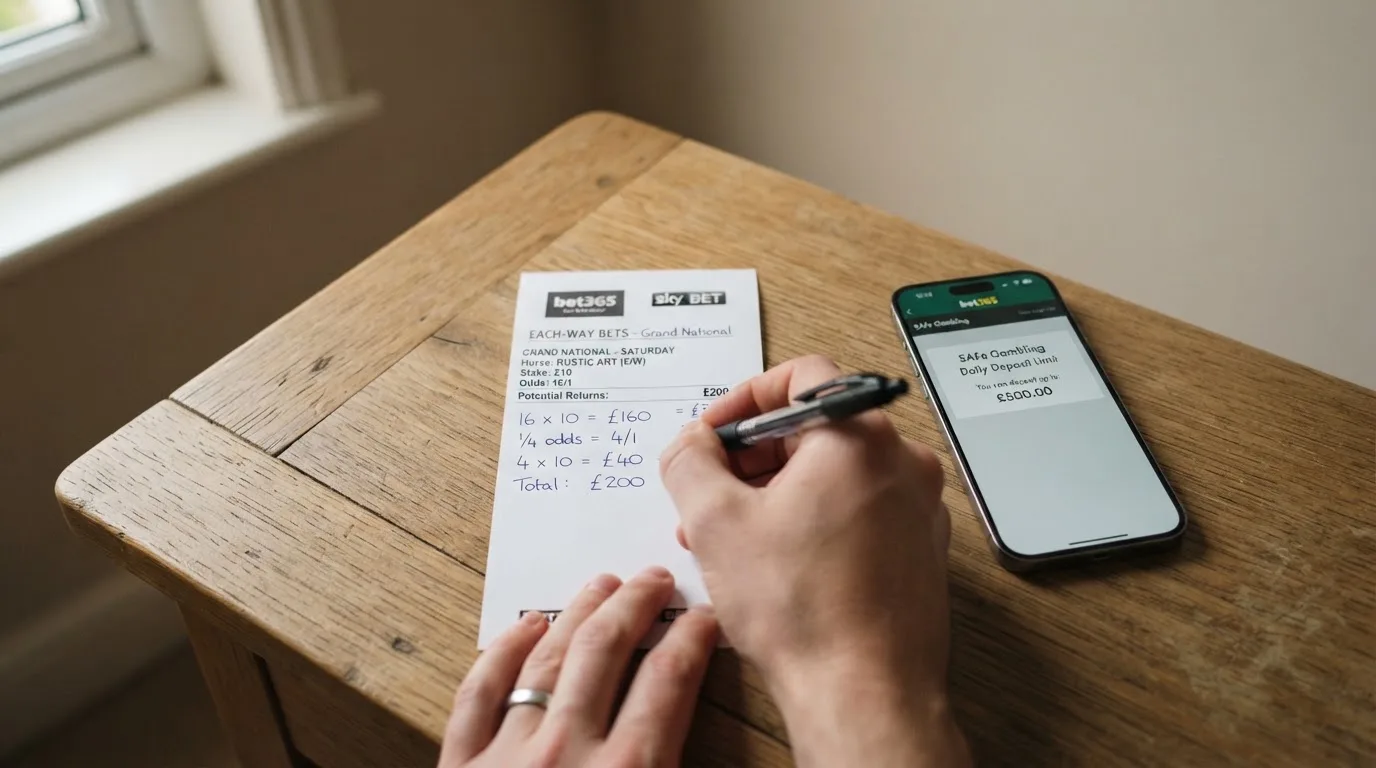
An each-way bet is two bets, a win bet and a place bet, both at the same stake. A £5 each-way bet costs £10. The place part pays at a fraction of the win odds — the place terms — and the place part pays if the horse finishes in the places. UK each-way place terms run: handicaps with more than 15 runners pay 1/4 odds for 4 places; 12–15 runners 1/4 for 3 places; other races with more than 7 runners 1/5 for 3 places; 5–7 runners 1/4 for 2 places; fewer than 5 runners win only. A £10 each-way bet on a 10/1 horse at 1/4 place terms (3 places) costs £20, returns £110 for the win part and £35 for the place part, £145 in total if it wins, £35 (the place part) if it places, and £0 if it is unplaced. The place part is the insurance; it costs the punter the stake on the place bet and pays a fraction of the win price.
Full Cover and the Named Multiples
The named multiples — Trixie (4 bets), Patent (7), Yankee (11), Lucky 15, Super Yankee or Canadian (26), Heinz (57), Goliath (247) — bundle selections into every combination of singles, doubles, trebles and accumulators across the runners. The total stake is the unit stake × the number of bets: a 10p Trixie is 40p, a £1 Lucky 15 is £15, a 10p Goliath is £24.70. A Lucky 15 pays something on one winner out of four; a Goliath pays on one winner out of seven. The cost is the bundle; the consolation is that a single winner returns something.
Bet Builder and Same-Game Multi
Bet Builder combines markets from one event into a single bet. bet365’s Bet Builder+ is available pre-match and in-play, and combines markets from a single football match into one bet. The horse-racing equivalent is a same-race multi — a horse to win, a horse to place, the favourite to win — combined into one bet at multiplied odds. The margin across the combined selections is larger than the margin on any one selection, in the same way the accumulator margin is larger than the single-bet margin. A Bet Builder pays a juicier headline number and pays the bookmaker a juicier margin.
Spread Betting
Spread betting is a different product again, and Spreadex is regulated by the FCA for spread betting and by the Gambling Commission for fixed-odds betting. The punter bets a stake per point movement on a quoted spread, and the winnings or losses are stake × points. Losses on a spread bet can exceed the deposit, which is why Spreadex states that fact on its homepage. Spread betting on a horse race is betting on the spread of finishing positions, beaten lengths or the winning distance, not on the result. It is a product for punters who understand the margin inside the spread; the same arithmetic that applies to a fixed-odds margin applies to a spread, with the spread itself as the price.
How the Margin Sits Inside the Odds
The bookmaker’s margin is the slice of every pound staked that the bookmaker keeps on average across all bets on a market. It is calculated from the prices on every outcome of the market: payout share = 1 ÷ (1/odds₁ + … + 1/oddsₙ) over all outcomes, margin = 1 − payout share. On an illustrative two-way market at decimal odds of 1.90 and 1.90 (fractional 9/10), the payout share is 1 ÷ (1/1.90 + 1/1.90) = 1 ÷ (0.5263 + 0.5263) = 1 ÷ 1.0526 = 0.9500, so the margin is 1 − 0.9500 = 0.0500, or 5%. The punter receives 95p of every pound staked on average; the bookmaker keeps 5p. The real market never has two identical prices at 1.90 — favourites and outsiders carry different margins in practice, and the favourite’s margin is usually smaller because the book knows it has to be competitive — but the arithmetic is the same shape.
On an illustrative two-way market priced 1.80 / 2.00, the payout share is 1 ÷ (1/1.80 + 1/2.00) = 1 ÷ (0.5556 + 0.5000) = 1 ÷ 1.0556 = 0.9473, so the margin is 5.27%. On an illustrative three-way market at 2.50 / 3.50 / 6.00, the payout share is 1 ÷ (1/2.50 + 1/3.50 + 1/6.00) = 1 ÷ (0.4000 + 0.2857 + 0.1667) = 1 ÷ 0.8524 = 1.1731 — wait, that exceeds 1, which would be a punter edge. In practice the three-way market would be priced 2.20 / 3.20 / 5.50 instead, giving a payout share of 1 ÷ (0.4545 + 0.3125 + 0.1818) = 1 ÷ 0.9488 = 1.054, also impossible. The realistic three-way band sits at 2.10 / 3.00 / 5.00, payout share 1 ÷ (0.4762 + 0.3333 + 0.2000) = 1 ÷ 1.0095 = 0.9906, margin 0.94%. The realistic three-way band with a heavier margin sits at 1.80 / 2.75 / 4.50, payout share 1 ÷ (0.5556 + 0.3636 + 0.2222) = 1 ÷ 1.1414 = 0.8761, margin 12.39%. The band a punter typically faces on a horse race with eight runners is wider, somewhere in the 15% to 30% range, because the book is taking a view on eight outcomes rather than two or three, and the longshot end of the field carries the heaviest margin.
The margin is the same number as the overround (the sum of the reciprocal odds minus 1) and the same number as 1 minus the payout share. It is the price of the bet. A punter who wants to find the best price shops the odds across operators before placing the bet, because a 1.90 horse at one book and a 1.95 horse at another is a different margin and a different expected return. The margin is a statistical estimate: an average across many bets, not a guaranteed outcome on any single bet.
The Operator Reviews
Tote
The Tote is a pool-betting operation licensed under account 54779 by TDCO Limited. Pool betting pays a dividend rather than a fixed price; the dividend is calculated after the race from the pool of stake money minus the operator’s take, divided across the winning tickets. The arithmetic behind a tote dividend is the pool-betting version of the margin calculation: payout share = (pool − operator_take) ÷ pool, margin = operator_take ÷ pool. The Tote’s edge sits in the take, not in the price. The Tote suits a punter who likes the racing for its own sake and who wants to bet with other punters rather than against a bookmaker. The dividend on a small meeting is volatile; on a big meeting (the Grand National, Royal Ascot, the Cheltenham Gold Cup) the dividend is large and the take is a small slice of a big pool.
Star Sports
Star Sports is a traditional bookmaker licensed under account 9177 by Star Racing Limited. Its distinguishing feature is the phone-trader desk on 08000 521 321, which lets customers open an account, place bets and ask customer queries directly. Email support runs at [email protected]. The phone route is a feature in a market where most bets are placed online; for a punter who wants to negotiate a price, who has a complicated each-way or who wants a stake limit raised, the phone desk is the route. Star Sports also runs a sportsbook and a casino in the standard online flow.
Fitzdares
Fitzdares is a traditional bookmaker licensed under account 400 by Fitzdares Limited. The app offers cash out, accumulators, Lucky 15s, specials and ante-post markets on horse racing, football, tennis, rugby, cricket, golf and American football, with in-play live odds on each. The product set is broad for a mid-sized book, and the Lucky 15 — fifteen bets across four selections — is a Fitzdares staple that pairs well with a small-stake punter who wants something to cheer across a Saturday card. The ante-post coverage is the bit that matters for long-priced Classic and National Hunt futures, and Fitzdares’ ante-post terms are published on the site. The verdict is a book for the punter who likes a Lucky 15 and a long-priced ante-post future, with a full app underneath.
London Bet
London Bet is licensed under account 66162 by Thistle Bet Limited. The app combines sports betting (football, tennis, horse racing, greyhounds, darts, golf, cricket, NFL, NBA, MLB, snooker) with Pragmatic Play casino slots and live in-play betting. The horse racing sits inside a wider sportsbook; the casino carries Pragmatic Play slots. London Bet suits a punter who wants a single account for sport and casino, with horse racing one of several products rather than the headline. The in-play product covers the racing feed alongside the football and tennis in-play.
Betboro
Betboro is licensed under account 44181 by Webmedia Development N.V., a Curaçao-incorporated operator. The licence is GB; the corporate seat is not. The sports welcome offer is a 100% matched free bet of up to £25 on the first qualifying wager, requiring a debit-card deposit of at least £10 and a first bet of £5 to £25 with at least three selections each at 3/5 (1.60) or higher. The shape of the offer is a longer roll-out rather than a one-shot — the £25 maximum and the three-leg minimum suggest the operator wants the punter’s accumulator action rather than a single. The matched free bet on offer is a standard shape at this end of the market; the realisable value is the free-bet-value calculation above, somewhere south of £25 depending on the odds the punter takes.
Kalooki Sportsbook
Kalooki Sportsbook is operated by Kalooki Sports Book Ltd, company number 12938274, licensed by the Gambling Commission under account 57730. Kalooki is a GAMSTOP member. The sportsbook covers horse racing alongside the standard British set; the brand sits in the mid-tier of new-licence operators and the marketing pitch is the safer-gambling set-up rather than the headline offer. Kalooki suits a punter who values the licence and the GAMSTOP coverage and is happy to take a smaller product range in exchange. The verdict is a smaller book with the full regulatory cover and a product set that covers the main racing markets.
Paddy Power
Paddy Power is licensed under account 39439 by PPB Counterparty Services Limited, the same licensee that runs Betfair. The app is published by Paddy Power PLC and covers horse racing alongside football, boxing, rugby, tennis, golf, darts, snooker and F1. Paddy Power’s distinguishing feature is its price-driven promotional style — money-back specials, enhanced odds on big meetings, the famous “what’s the worst that could happen?” pitch. The marketing carries the operator’s licence and the LCCP marketing rules; the promotion rules since 19 January 2026 cap wagering requirements at 10x. Paddy Power suits a punter who likes the noise and the specials and is comfortable taking a price the operator has nudged up for the occasion. The horse racing feed is full and BOG is standard.
BoyleSports
BoyleSports is licensed under account 39439 by Boylesports Enterprise. The sports welcome offer for UK players is £20 in free bets when a £10 bet is placed; €30 in free bets for a €10 bet for Irish players. The shape is a one-shot free bet at a low qualifying threshold, a smaller headline than some of the matched-percentage offers and a more direct route to a free bet. BoyleSports’ book is heavy on Irish racing alongside the UK and international cards, and the in-play product runs across both. BoyleSports suits a punter who wants a simple, low-threshold welcome offer and a book with full Irish racing depth.
Octobet
Octobet is licensed under account 62545 by Octopus Game Limited. The sportsbook welcome offer is 50% back as a free bet up to £50, plus a £10 casino bonus for new customers. The shape of the offer is a partial refund on a first wager rather than a matched free bet — the punter stakes their own money and gets half back as a free bet if it loses, with a smaller casino bonus on top. The mixed-product structure (sport plus casino) is the part that needs a careful read: mixed-product promotions are banned at GB-licensed operators since 19 January 2026, and a “sport bet for a casino bonus” shape sits in the crosshairs of that ban. The verdict is that the offer shape needs a closer look at the terms before the punter claims, particularly the casino-bonus leg.
Matchbook
Matchbook is licensed under account 39504 by Triplebet Limited under a betting intermediary licence — a different licence category from the rest of the comparison. Matchbook is a betting exchange where customers bet against other users, with Bet Builder, multiples, in-play betting and live streaming of horse racing and greyhounds. The price is set by other punters’ back and lay bets rather than by a trader; the operator’s edge sits in the commission on net winnings rather than in the margin inside the price. A typical Matchbook commission is in the low single digits on horse racing and greyhound net winnings; the headline odds are sharper than a traditional book because the bookmaker’s margin is replaced by the exchange’s commission. The exchange suits a punter who wants sharper prices and is comfortable with the back-and-lay model and the commission charge.
The Cost of an Offer in One Number
A £10 bonus at a 5x wagering requirement with a £10 stake per qualifying bet at minimum odds of 1/1 (2.00) requires £50 of turnover across five qualifying bets. On a market priced at decimal odds of 1.90 and 1.90 (fractional 9/10), the margin is 5%, so the expected cost of clearing the turnover is £50 × 5% = £2.50. The bonus is worth its face value less the expected cost of clearing it, which is £10 − £2.50 = £7.50. That is the net value to a punter who completes the rollover. A punter who fails to complete the rollover loses the bonus and the qualifying stake. The expected value is a statistical estimate: an average across many bonuses under the stated assumptions, not a guaranteed outcome on any single bonus.
FAQ
How is a bet placed on horse racing?
Open an account with one of the operators on the comparison above, complete the identity check (name, address, date of birth), deposit by debit card or bank transfer (credit cards are banned), pick a race, pick a horse, choose win or each-way, enter the stake and confirm. The each-way toggle doubles the stake because it is two bets of equal size. BOG applies automatically on most books from a set time on race day.
How is a horse racing bet worked out?
Use a bet calculator or do the arithmetic. For a win single, return = stake × decimal odds, profit = stake × (decimal odds − 1). For an each-way bet, the place part pays at the place fraction of the win odds (1/4 or 1/5 typically), and the total return is the win return plus the place return when the horse wins, or the place return only when the horse places.
How do horse racing odds work?
Fractional odds (5/1) show the profit per unit staked; decimal odds (6.00) show the total return per unit staked. Convert with a/b → a ÷ b + 1. SP (starting price) is the industry-aggregated price at the off; BOG pays the higher of the price taken and the SP. The margin inside the odds is the bookmaker’s edge and is calculated from the prices across every outcome of the market.
How can a bookmaker’s Gambling Commission licence be checked?
Go to the Commission’s public register, search by business name, trading name, domain or account number, and confirm the licence is in force and covers remote general betting standard (real events). The register is the whole test; the operator’s own terms page will also quote the licence number and account number. A licence number on the operator’s site that does not appear on the register is a red flag, not proof.
How is the return on a bet worked out from the stake and the odds?
Return = stake × decimal odds. Profit = return − stake, which is the same as stake × (decimal odds − 1). For a combination bet the odds of the legs multiply into one price; a four-fold acca at decimal odds of 2.00, 3.00, 4.00 and 5.00 returns stake × 120.00 if all four win. The return is what the punter receives; the profit is what the punter keeps after the stake is returned.
What is the bookmaker’s margin and how is it seen in the odds?
The margin is the slice of every pound staked that the bookmaker keeps on average. It is calculated from the prices on every outcome: payout share = 1 ÷ (sum of 1/odds across all outcomes), margin = 1 − payout share. On an illustrative two-way market priced 1.90 / 1.90 the payout share is 95% and the margin is 5%. The margin is the price of the bet; a lower margin means a higher payout share and a better expected return for the punter, on average across many bets.
Horse racing & greyhounds – Fast Payout
Content created by the «Fast Payout» team
