
Online Curling Betting in Great Britain: How the Markets Actually Work
 Available in US
Curling is a small sport on British bookmakers’ screens, and that is the first thing worth understanding before a single stone is thrown at the markets. It is not the volume that limits curling betting; it is the depth. Where Premier League football draws thousands of pre-match markets per match, a World Curling Championship men’s or women’s draw at a licensed UK bookmaker typically offers the match winner, the outright tournament winner, a handful of total-ends and handicap lines, and little more. The size of the in-play product in particular rarely reaches the breadth seen in football or tennis. A small punt on the sport is therefore not the same decision as a small punt on football, and the choice of bookmaker matters more than usual.

This page is built around that point. It takes a GB punter from the shape of a curling game — the rules that decide how a match actually plays out, and therefore what the markets can ask of — through the legal frame every online bet sits inside in Great Britain, and into a working comparison of ten Gambling Commission-licensed bookmakers that touch the sport. The aim throughout is practical: what to expect from the odds, what a margin costs on a winning bet, and where the limits of the licensed market actually sit.
Data is current as of 27 October 2026 against the Gambling Commission’s public register and each operator’s own terms page where stated. Where a specific price is given, it is a snapshot; where a margin is described, it is an illustrative two-way market at 1.90 / 1.90, the example explained in the section on bookmaker margins.
Why curling, and why the market looks the way it does
Curling is a niche among GB punters because the calendar is. The World Curling Championships, the European Curling Championships and the Olympic Winter Games are the windows when the sport is most visible. Outside those weeks the live calendar thins out dramatically: lower-division tour events, mixed doubles circuits, and a long domestic off-season fill the gaps. A GB punter looking at the dedicated “Curling” tab of a sportsbook in mid-July may find three fixtures, a handful of tournament outrights, and very little else. That thinness is the structural reason a curling bet reads differently from a football bet, and it shows up in the odds.
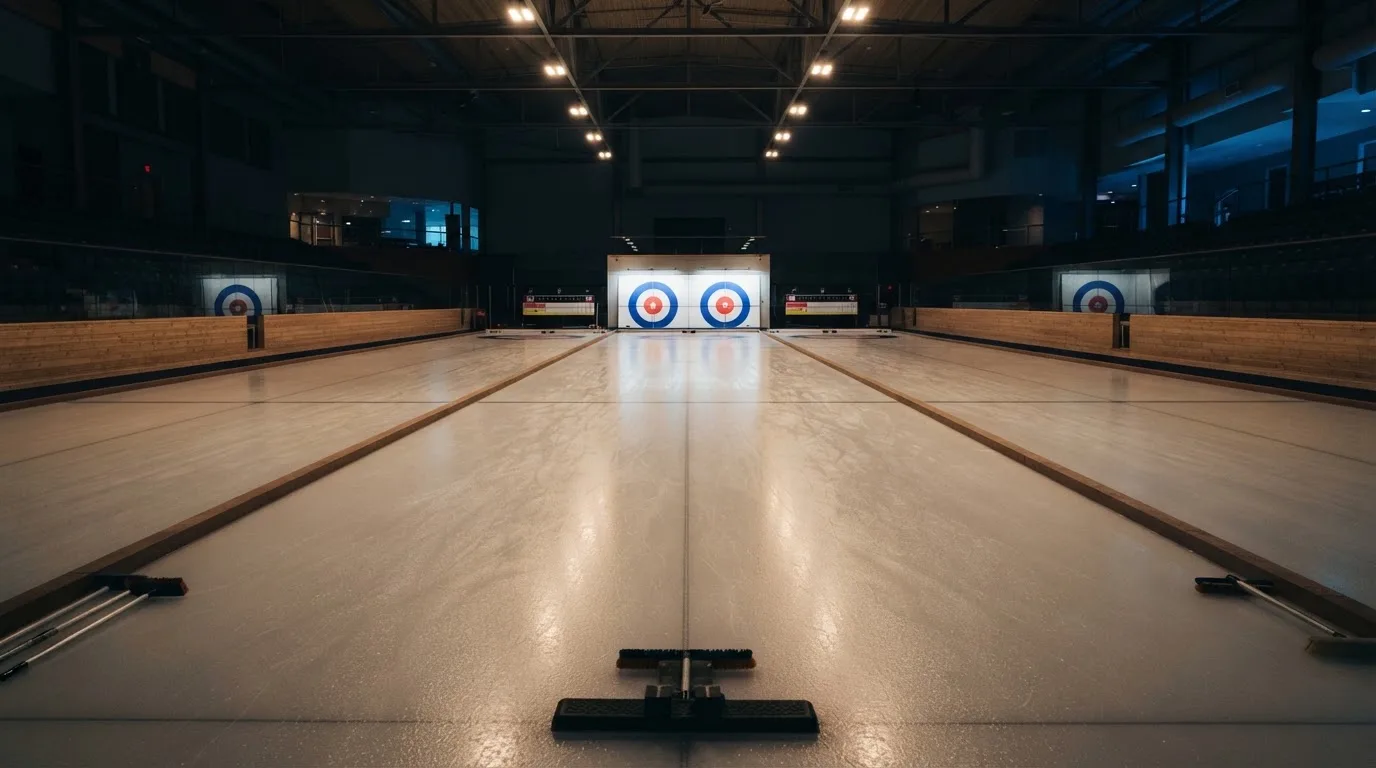
Two practical consequences follow. First, the in-play product is shallow at most licensed bookmakers: most curling matches are streamed only where a rightsholder agreement exists, and most GB-licensed sportsbooks carry no live video. Second, the outright markets — who wins the World Men’s Championship, the Olympic gold medal — are priced weeks or months ahead and move slowly, with the price spread between rival bookmakers often wider than in mainstream sports. A bettor looking to back a pre-tournament favourite pays a margin for the privilege of an early position.
The rules of the game also shape the markets in ways that are not obvious to a newcomer. A standard international match runs ten ends and ends only when all ten are complete; a tied game goes to an extra end. That structure matters because “match winner” markets are settled at the end of regulation play in most cases, and an extra end can flip the result of a market most bettors thought was already settled. A punter should know whether their book settles match-winner bets at the end of regulation or after extra ends, because the answer is not the same at every shop. The bookmaker’s own terms page will state it; the section on operators below notes where each licensed brand has stated its approach.
Curling also has one rule that is unique among the major ice sports: a team scores as many points in an end as it has stones closer to the button than the opponent’s closest stone. A single end can therefore be worth one, two, three, four, five, six, seven or eight points. Eight-point ends are rare but happen; six-point ends happen every televised tournament. That is why total-points markets in curling are structured very differently from total-goals markets in football. A 6.5 line on a curling match is not a roughly even proposition in the same way a 2.5 line on a football match is; the variance is wider.
A final point about the rules. Curling is the only Olympic sport in which one member of the team, the skip, delivers every strategic decision but throws only two of the team’s eight stones per end. The other six stones come from the lead, the second and the third, who throw two each. A mixed doubles team has two players; each throws five stones, with the alternation fixed by rule. For the bettor, none of that changes the headline markets, but it shapes which markets a bookmaker is willing to price at all — markets on which player scores, on first-stone advantage, on which team wins the hammer — usually do not exist at licensed bookmakers, because the betting volume is too low to support them.
The upshot: a punter coming to curling betting from football or tennis will find fewer markets, fewer in-play options, and a thinner outright menu. The licensed bookmakers that cover the sport do so competently, but the product is not built for in-running trading. It is built for the tournament calendar and the casual wager of a winter fortnight.
What the law actually says about curling bets in Great Britain
There is no statutory list of permitted sports or markets in Great Britain. The Gambling Act 2005 is a framework, not a register of what may be bet on. A bookmaker licensed by the Gambling Commission may offer curling markets under its remote general betting standard (real events) licence, and the question of which markets it offers within that category is a commercial decision for the operator, governed by its own licence conditions and the Commission’s Licence Conditions and Codes of Practice. Curling is treated like any other real sporting event; it is not classed as a novelty or virtual event, and it is not on any restricted list.

That answer has two practical consequences. The first is that a GB punter who wants to bet on curling looks for a bookmaker with a remote betting licence, not for a market that is “permitted” or “prohibited” in some abstract sense. The second is that the limits of what is offered are the bookmaker’s limits, not the law’s. If a bookmaker prices only the match winner and the outright, the law is not the reason; the volume is.
A GB licence is required at the point of consumption. The Gambling (Licensing and Advertising) Act 2014 amended the 2005 Act so that an operator whose remote gambling facilities are used by customers in Great Britain needs a Commission licence wherever it is based. A Curaçao, Maltese or Gibraltar corporate licence does not substitute for it. Northern Ireland sits outside the 2005 Act and has its own regime; a GB-licensed brand is licensed for Great Britain, and that is the only territory the licence covers. From the punter’s perspective the practical question is not “is this operator licensed somewhere” but “does it hold a Gambling Commission licence for Great Britain”, and the answer is checked by searching the Commission’s public register by business name, trading name, domain or account number. Every operator named in the comparison below has been checked against that register; the licence numbers and licence holders are listed in the comparison table.
The age threshold is 18. Identity, address and date of birth are verified before a customer can deposit or gamble at a licensed remote bookmaker, including with a free bet or a bonus — that rule has been in force since 7 May 2019. There is no anonymous play at a GB-licensed site. A punter who wants to use a brand without verification is using an unlicensed brand, and the section below on offshore operators covers what that costs in practice.
The credit-card ban matters for curling bettors as it does for every other GB punter: since 14 April 2020 no GB-licensed remote bookmaker accepts a credit card for gambling, and that includes credit-card-funded payments routed through an e-wallet. Debit cards, bank transfers and instant bank payments are not covered by the ban. The licensed bookmakers in the comparison below all accept debit cards, and several accept instant bank payment rails.
The 10x bonus cap that took effect on 19 January 2026 affects any promotion with a wagering requirement. A £10 bonus at 50x wagering would normally require £500 of qualifying bets; under the cap no GB-licensed operator may require more than £100 of qualifying bets to clear a £10 bonus. Mixed-product promotions — an offer that ties gambling on two or more product types together, such as a sportsbook bonus that also hands out casino free spins as part of the same wagering requirement — are banned. The cap does not apply to free bets with no wagering condition; whether it applies to a free bet that carries a turnover-style condition is not established in the public record and depends on how the offer is structured in each operator’s own terms. A punter looking at a curling-focused promo or a sportsbook welcome offer at a licensed brand should check which category it sits in, because the rule changes the arithmetic.
The 9pm watershed rule for betting advertising on television and the “whistle-to-whistle” code are broadcast rules, not betting rules, and they govern when an ad may be shown, not what may be bet on. Curling’s modest television footprint means the rule rarely bites in practice; it is a football and horse-racing story.
The tax question is the cleanest one. In Great Britain the punter pays no tax on sports betting winnings. General Betting Duty is levied on the operator’s gross profits and is currently 15% under the current rate band; from 1 April 2027 a new remote betting rate of 25% applies within it, with UK horse racing, pool betting and self-service betting terminal bets staying at 15%. Whether operators pass duty on through odds is not established, and the duty is not a charge on the customer. A punter who wants to know what their bookmaker keeps per unit bet looks at the margin, not the duty; the section below explains what that is and how it shows up in the odds.
Safer gambling and what the licensed bookmakers actually do
The licensed bookmakers covered in the comparison below all sit inside the same Commission-mandated safer-gambling framework. The differences between them are not in what they are required to do, but in how prominently those requirements sit on the page and how quickly the tools engage.
GAMSTOP is the national multi-operator online self-exclusion scheme. It has been a mandatory licence condition for GB-licensed remote operators since 31 March 2020. A punter who registers with GAMSTOP is excluded from every GB-licensed online bookmaker for six months, one year, five years, or five years with auto-renewal, and after the minimum period the exclusion stays in place for a further seven years unless the punter asks GAMSTOP to remove it. The exclusion covers online sites and apps; the high-street betting shop uses a separate service. The licensed bookmakers in the comparison all block accounts when a GAMSTOP match is found at sign-up.
The financial vulnerability check is the next layer. Under Licence Condition 36A 3.4.4, in force since 30 August 2024, a licensed remote bookmaker must run a public-record check when a customer’s deposits minus withdrawals exceed £150 in any rolling 30 days; that threshold has been the live trigger since 28 February 2025. The check is a public-record check — bankruptcy orders, county court judgments, similar adverse markers — and not an income check or a credit reference check. A punter who keeps net deposits below £150 over a rolling 30-day window does not trip it. A punter whose net deposits cross the threshold will see the check run automatically. Financial risk assessments, the so-called “affordability checks” of the press coverage, are announced by the Commission in a staged plan published on 7 July 2026 with no start date; the wording on the page here is “announced, staged, no start date”, because that is what the public record says.
Deposit limits sit under the Remote Technical Standards (RTS 12). Operators must offer a gross deposit limit on a fixed time frame; the first phase of changes applied from 31 October 2025, a second phase has been postponed to 30 September 2026, and whether it is currently live is not established in the public record. There is no state-set deposit or loss ceiling for betting; limits are the customer’s choice, set at the level the punter wants. A licensed bookmaker cannot impose a flat deposit ceiling on a customer who has not set one themselves; the operator can offer one, but cannot set it without the customer’s input.
Help lines sit beside the controls. GamCare runs the National Gambling Helpline. GambleAware funds treatment and education. The NHS gambling clinics offer specialist support. Gamblers Anonymous runs peer-led meetings. Several of the licensed bookmakers in the comparison link directly to these services from a footer on every page; some bury them. A punter who is thinking about setting a deposit limit or taking a time-out should look for the safer-gambling page before signing up, because how prominently the book surfaces those tools is itself information about how the brand treats them.
A word on what licensed does not mean. A GB-licensed bookmaker is not a guarantor of responsible gambling; it is a brand that has been checked at the licence-issuance stage and is bound by the LCCP on an ongoing basis. The customer protections are real, but they are also customer duties: a punter who sets a deposit limit and then asks the operator to raise it after a loss is asking the operator to override a tool they themselves set. Most licensed brands will do it, with a cool-off period. The framework is built on the assumption that the customer engages with it.
The curling calendar and what gets priced
The men’s and women’s World Curling Championships are the centre of the calendar. They take place once a year, in the spring, and run roughly two weeks. The European Curling Championships run alongside them in some years, in an earlier window. The Olympic Winter Games take place once every four years and last held in 2022, with the next scheduled in 2026 — that Olympic year is the largest single spike of curling betting interest a licensed bookmaker sees in a four-year cycle. Mixed doubles curling is its own discipline, was first held at the Olympics in 2018, and its World Mixed Doubles Championship runs in the same spring window.
Below those flagships the calendar thins. The Continental Cup, the World Junior Curling Championships, the senior championships and the various tour events fill the lower-volume weeks. At a licensed bookmaker these lower-tier events are more often priced outright only, with no match-winner market per game.
A punter looking at a licensed bookmaker’s curling calendar in 2026 will find the best market depth during the World Championships and during an Olympic year. Outside those windows, the outright menu is the part of the offer that survives. A bookmaker that has only an outright price on a lower-tier event is not underserving the punter; it is pricing to liquidity.
The match-level markets that appear at licensed bookmakers during a major championship vary by operator. The standard pre-match market is match winner, though the rules for settling an extra end vary. Total-ends-over/under lines and total-stones-scored-over/under lines exist at some books, and handicap lines at a smaller number still. In-play markets are limited: most books offer the in-running match winner only, and only during televised matches. The depth does not approach a Premier League or Champions League football product.
A second feature of curling outright markets is that the early prices move slowly. The favourite for the next World Men’s Championship may not see a meaningful price update until the previous year’s Grand Slam events have been played. A punter who backs a team in October for the following April’s championship is taking a long view, and the price reflects the time value of that view. Outrights are not the place to find a quick margin; they are the place to find a position when the punter has an opinion about a team that the market has not yet priced in.
A third feature is the link between schedule and viewer interest. Curling in Great Britain draws its audience during late January and February, when the European and World Championships fall. A licensed bookmaker’s marketing will peak then. The punter should not assume that the depth of a curling market in April is the depth on offer in February.
What odds, margins and returns look like in a curling bet
Three pieces of arithmetic define what a curling bet is worth: the return on a single bet, the margin the bookmaker keeps across a market, and the relationship between fractional and decimal odds. Each is worth knowing in its own right, because each is something a licensed bookmaker does not always surface on the screen.
The return on a single winning bet is straightforward. At decimal odds of 2.50 a £10 stake returns £25 — the £10 stake back plus a £15 profit — and at 1.50 a £10 stake returns £15, the £10 stake back plus a £5 profit. The formula is return = stake × odds; the net profit is stake × (odds − 1). For a combination bet — a curling treble or accumulator — the odds of the legs multiply into one price, and the stake is multiplied by that combined price. A £10 treble at combined odds of 8.00 returns £80.
A free bet that pays back only the winnings, not the stake, is a different calculation. A £10 free bet at 3.00 returns £20 of profit, not £30, because the £10 stake was never the punter’s to begin with. The headline “£30 free bet” is the same headline as “£30 free bet returns £30” only when the stake is paid back with a win — and most free bets at GB-licensed bookmakers do not pay the stake back. That distinction is the first thing to read in any promotion’s terms.
The bookmaker’s margin is the harder concept. A bookmaker offers a price on each outcome of a market; the prices imply a payout share. For a two-way market priced at 1.90 and 1.90 — both outcomes the same — the implied payout share is 1 ÷ (1/1.90 + 1/1.90), which is approximately 0.5263, or about 52.6%. The remaining 47.4% is the bookmaker’s margin, sometimes called the overround: for every £1 bet on the market, the bookmaker expects to keep about 47p as gross profit before any expense or duty, with the rest paid back to winning punters in proportion to the prices. A market priced at 1.91 and 1.91 has a margin of about 4.7%, a market priced at 2.00 and 2.00 has a margin of 0% (a toss-up with no bookmaker cut, which a real bookmaker will never offer), and a market priced at 1.80 and 1.80 has a margin of about 11.1%. The margin is therefore visible in the odds: the closer each side sits to 2.00 in an even-money market, the smaller the cut the bookmaker takes; the further each side sits below 2.00, the larger the cut.
The example used on this page — an illustrative 1.90 / 1.90 — is the realistic midpoint for a well-priced two-way curling market. It implies a margin of approximately 5.3%. The margin is a statistical estimate, not a guaranteed outcome for any single bet; it is what the bookmaker expects to keep on average across many bets on the same market. A punter who picks a market at 1.85 / 1.85 (margin about 8.1%) is paying the bookmaker roughly 3p more per £1 bet than a punter who picks a market at 1.91 / 1.91 (margin about 4.7%). That difference is invisible at the bet slip and large at the end of a season.
The marginal cost of a margin compounds. A punter who backs a 1.90 / 1.90 market across 100 £10 bets loses, on average, about £53 more than a punter who backs a 1.91 / 1.91 market across the same 100 bets — the arithmetic is 100 × 10 × (0.053 − 0.047). The difference between a 5% margin and a 6% margin sounds small, but it is the difference between losing £5 of expected value per £100 staked and losing £6 of expected value per £100 staked, on every sport including curling.
Fractional odds convert to decimal by the formula decimal = a ÷ b + 1. 5/1 becomes 5 ÷ 1 + 1 = 6.00; 11/4 becomes 11 ÷ 4 + 1 = 3.75; evens (1/1) becomes 1 ÷ 1 + 1 = 2.00. The conversion matters because most GB bookmakers display odds in fractional form by default, and the punter is most often working in decimal form when they reason about value. The two expressions are the same price stated two ways; the punter just needs to know which form they are looking at.
A final point on price. Curling outright markets and curling match markets are typically priced in the same range as football outright markets and football match markets, which is to say a margin in the 5–8% band on a competitive match and 8–15% on a quiet outright. The punter’s job is to find the licensed bookmaker whose curling margin is at the lower end of that band on the bet they want to make. A 1% difference is meaningful at the end of a season.
The licensed bookmakers that cover curling
Ten Gambling Commission-licensed bookmakers have been checked against the Commission’s public register and are included in the comparison below. Each is licensed under a remote general betting standard (real events) licence. None is presented as the only licensed operator; the register lists many more. The order below is not a ranking.
| Brand | Gambling Commission remote licence | Licence holder | Stated position on curling / niche terms |
|---|---|---|---|
| Fitzdares | 000400-R-103839-030 (account 400) | Fitzdares Limited | Premium-positioning bookmaker with cash out, accumulators, Lucky 15s, specials and antepost markets across horse racing, football, tennis, rugby, cricket, golf and American football; in-play live odds listed. Curling is not on its headline sport list, so coverage is event-driven rather than always-on. |
| BetMGM | 039198-R-319450-029 (account 39198) | LeoVegas Gaming PLC | UK sportsbook with a welcome package of four £10 free bets — two football accumulators of 4+ selections and two sports multiples of 2+ — for new customers depositing £10 or more and placing a sports bet within 7 days; free bets valid for 7 days with a minimum price and opt-in required. |
| Kwiff | 044448-R-323408-017 (account 44448) | Eaton Gate Gaming Limited | Sportsbook marketed under the kwiff trademark by Spryme Ltd; the GB App Store age rating is 17+, so the app sits one year below the gambling age of 18 in the underlying licence terms — a quirk worth flagging rather than treating as a loophole. |
| Lottoland | 038991-R-319408-020 (account 38991) | EU Lotto Limited | Hybrid product combining casino, lottery betting, sports betting and scratchcards; the GB site is the licensed product, but the brand’s centre of gravity is lottery products, and curling coverage sits inside the sportsbook. |
| Midnite | 101839-R-342850-001 (account 101839) | Midnite Limited | Sportsbook with in-play events, an acca builder, popular accas and price boosts with maximum-stake limits; the welcome offer is £25 in free bets and 50 free spins for a £5 pre-match qualifying bet at evens or greater within 14 days, valid 7 days. |
| Octobet | 062545-R-337248-006 (account 62545) | Octopus Game Limited | Sportsbook with a 50%-back-as-free-bet welcome offer up to £50 plus a £10 casino bonus for new customers; a sportsbook-centred brand, but curling coverage depth varies through the calendar. |
| Unibet | 045322-R-324275-019 (account 45322) | Platinum Gaming Limited | Long-established operator since 1999 with a £40-in-free-bets-when-you-bet-£20 welcome for new GB customers using a debit card or instant bank transfer; minimum odds 2.0, free bets expire in 7 days. |
| Fafabet | 057385-R-333191-006 (account 57385) | Taichi Tech Limited | Sportsbook paying Best Odds Guaranteed on UK and Irish horse racing win and each-way bets from 9am on race days; the racing focus is the headline feature, with curling as a tournament-window product. |
| Bet600 | 044731-R-323941-016 (account 44731) | Tyche Tech Limited | Sportsbook paying Best Odds Guaranteed on horse racing — bigger starting price paid over the early or show price taken; a small-format bookmaker with curling as a tournament-window product. |
| BetGoodwin | 002927-R-327985-008 (account 2927) | Goodwin Racing Limited | Sportsbook with a “Bet £10 & Get £15 in Free Bets” welcome made up of a £5 sports bet, a £5 acca and a £5 Sub-Cover bet; the racing-shop heritage shows in the brand structure. |
The licensed bookmakers in this set share three features: a Gambling Commission remote betting licence, a Great Britain-facing domain, and participation in GAMSTOP. They differ on the size of their product, the shape of their welcome package, and how prominently curling sits in their default sport list. None of them is described here as the only place to bet on curling, because that claim is not supportable — the public register lists several other GB-licensed sportsbooks that price curling during major championships, and any of them is a legitimate alternative for a punter who wants a different book.
Fitzdares
Fitzdares positions itself as a premium bookmaker. The Commission’s register lists it under Fitzdares Limited against account 400, with a remote general betting standard (real events) licence. The product set on the GB App Store listing names cash out, accumulators, Lucky 15s, specials and antepost markets, with in-play live odds across horse racing, football, tennis, rugby, cricket, golf and American football. Curling is not on that list. That does not mean Fitzdares does not price curling during a major championship; it means the price is event-driven rather than always-on, and the punter who wants a curling market at Fitzdares will most often find it by searching the dedicated curling tab during the World Championships or the Olympics rather than scrolling the default sports menu.
The premium positioning is the operative fact for a curling bettor. Fitzdares is the kind of book where the welcome package is structured for the punter who backs multiple sports and horses regularly; a curling-only punter will not get the most out of the package and may do better at a book that prices curling more prominently. The opposite is also worth noting: a punter who wants a single bookmaker for horse racing, football, golf and the occasional curling bet during the Olympics may find Fitzdares a sensible single-shop choice.
The verdict: worth it for a multi-sport punter who wants a premium-priced book; less compelling for a curling-only customer, who will find the calendar thin and the price discovery slow at the brand.
BetMGM
BetMGM in Great Britain is operated by LeoVegas Gaming PLC under a remote general betting standard (real events) licence, account 39198 on the Commission’s register. The welcome offer for new UK customers is four £10 free bets — two football accumulators of 4+ selections and two sports multiples of 2+ — issued on a deposit of £10 or more and a sports bet placed within 7 days; the free bets are valid for 7 days, carry a minimum price, and require opt-in. The headline is “£40 in free bets”, but a punter who reads the small print will find that two of those bets are tied to football acca structures specifically. A curling-only punter will not use the full £40.
The underlying platform is the LeoVegas sportsbook, which is a mainstream product with the usual mix of in-play, pre-match and outright markets. Curling sits inside the sportsbook like any other sport and is most often priced during the World Championships, the European Championships and the Olympics. The price level on curling has not been confirmed at the brand level, so the punter should treat it as mainstream mid-market and shop the price against the rest of the comparison set.
The verdict: a sensible mainstream choice for a punter who wants a single GB-licensed sportsbook with a familiar welcome offer, with the proviso that the headline £40 in free bets is partly tied to football acca structures that a curling-only punter will not use.
Kwiff
Kwiff in Great Britain is operated by Eaton Gate Gaming Limited under account 44448 on the Commission’s register. The GB App Store listing names the kwiff trademark and the operator Spryme Ltd, with a 17+ App Store age rating. That age rating is a one-year gap from the Gambling Act’s 18-year threshold and reflects the App Store’s age-rating framework, not a lowering of the licence requirement. Kwiff verifies age at sign-up under the same 7 May 2019 rule every GB-licensed remote bookmaker works under.
The distinctive feature of kwiff is the “supercharged” pricing model, where the operator randomly boosts the odds on settled bets. That pricing model is more visible on mainstream sports than on curling. For curling the brand behaves like a standard GB-licensed sportsbook: tournament outrights and match-winner markets during major championships, with the rest of the calendar thin.
The verdict: a reasonable mainstream book for a curling bettor, with the supercharged odds feature working best on the bigger sports; curling punters are most likely to see the same price they would see elsewhere, only settled with the occasional boost.
Lottoland
Lottoland in Great Britain is operated by EU Lotto Limited under account 38991 on the Commission’s register. The GB product combines casino, lottery betting, sports betting and scratchcards; the centre of gravity is lottery betting, not sports. A punter looking at Lottoland for curling will find a sportsbook tab and a curling menu during major championships, with the same standard match-winner and outright markets found at other GB-licensed books. Outside the major championship windows the curling menu at Lottoland is even thinner than at a mainstream sportsbook, because the operator’s product investment is in the lottery side.
The hybrid structure is worth flagging. A punter who has a Lottoland account for lottery products and wants to place a curling bet during a major championship can do so without opening a second account; a punter who is only looking for a curling sportsbook has several better-fitting choices.
The verdict: a fit for a lottery punter who wants a one-stop GB-licensed account; not the first choice for a curling-only customer, who will find a thinner sportsbook and a calendar that swings harder into lotteries than into curling.
Midnite
Midnite is operated by Midnite Limited under account 101839 on the Commission’s register — the simplest one-to-one mapping of brand to licence holder in the comparison. The GB App Store listing names in-play events, an acca builder, popular accas and price boosts with maximum-stake limits. The welcome offer is £25 in free bets and 50 free spins for a new customer who bets £5 or more on pre-match odds of 2.0 or greater within 14 days of sign-up, valid for 7 days. The headline “£25 in free bets” is the headline number, and the small print is the minimum price and the qualifying stake.
Curling at Midnite is a tournament-window product. The match-winner and outright markets appear during the World Championships and the Olympics, with the in-play product largely limited to match winner on televised matches. A punter looking for a curling bet in late spring between championships will likely find the menu empty.
The verdict: a competitive mainstream sportsbook for a curling punter who is timing bets around the major championships, with a clean welcome offer that is more straightforward to clear than the acca-tied packages at some of the other licensed books in the set.
Octobet
Octobet is operated by Octopus Game Limited under account 62545 on the Commission’s register. The welcome offer for new customers is 50% back as a free bet up to £50, plus a £10 casino bonus. The structure is “back as a free bet” rather than “matched in free bets”, which is a different shape from the headline “bet £X, get £Y in free bets” pattern at some of the other licensed books in the set; the punter loses on a winning first bet if it wins outright, and is refunded in a free bet if it loses. A curling bettor timing a qualifying bet around the World Championships can use that structure, but the size of the refund is capped at £50 and the £10 casino bonus is tied to the same promotional envelope.
Curling coverage at Octobet is mainstream sportsbook depth during major championships and thin outside them. The brand is newer in the GB market than some of the other books in the comparison, which means the product has been built around the standard licensed remote betting template and the curling menu has been added to it.
The verdict: a fit for a punter who wants a “money-back-as-free-bet” welcome structure rather than the matched-free-bets template; less compelling for a punter who wants the deepest curling menu, which sits at the more established sportsbooks in the set.
Unibet
Unibet is operated by Platinum Gaming Limited under account 45322 on the Commission’s register, with the operator stating it has been live since 1999. The welcome offer for new GB customers using a debit card or instant bank transfer is “Get £40 in Free Bets when you bet £20”: deposit and bet £20 or more at minimum odds of 2.0, with free bets expiring within 7 days. The structure is the cleanest in the comparison — one qualifying bet, one set of free bets, one minimum price — and a curling bettor who places a £20 bet at 2.0 or greater during a major championship can clear the qualifying stage without recourse to football accas or other sports.
Curling at Unibet is mainstream sportsbook depth during the major championships, with outright markets running well in advance of the World Championships and the Olympics. The in-play product is standard licensed bookmaker depth: match winner in running on televised matches, limited otherwise.
The verdict: the most curling-friendly welcome offer in the comparison set, with a single qualifying bet, a clear minimum price, and a mainstream sportsbook product behind it. The 7-day expiry on the free bets is the constraint.
Fafabet
Fafabet is operated by Taichi Tech Limited under account 57385 on the Commission’s register. The distinctive product feature is Best Odds Guaranteed on UK and Irish horse racing win and each-way bets from 9am on race days: if the starting price is bigger than the original price taken, the bigger odds are paid. That is a racing feature, and a curling punter will not benefit from it directly, but it does shape the bookmaker’s price discipline more broadly — a bookmaker that pays the bigger SP on racing is paying attention to its prices generally.
Curling coverage at Fafabet is mainstream sportsbook depth during major championships, with the racing focus of the brand meaning the headline product pages are dominated by horses. The GB site carries the full sportsbook including curling outright markets during major championships.
The verdict: a sensible mainstream book for a curling punter who also bets on horses; less compelling for a curling-only punter, who will find the product page dominated by racing and the curling menu thin outside the championship windows.
Bet600
Bet600 is operated by Tyche Tech Limited under account 44731 on the Commission’s register. Like Fafabet, the distinctive product feature is Best Odds Guaranteed on horse racing: bigger starting price paid over the early or show price taken. The book is a small-format sportsbook with curling as a tournament-window product, and the racing focus means the headline product pages lean horse-first.
A curling bettor who also bets on horses will find a familiar Best Odds Guaranteed structure and a clean GB-licensed bookmaker. A curling-only punter will find the same thin-outside-the-window coverage as the other licensed books in the comparison that lean racing-first.
The verdict: a fit for a punter who wants a small-format GB-licensed bookmaker with a racing-first product; less compelling for a curling-only customer, who will find the calendar thinnest here of any of the comparison brands.
BetGoodwin
BetGoodwin is operated by Goodwin Racing Limited under account 2927 on the Commission’s register — the longest-running account number in the comparison set. The welcome offer is “Bet £10 & Get £15 in Free Bets”, made up of a £5 sports bet, a £5 acca and a £5 Sub-Cover bet. The Sub-Cover bet is a Goodwin-specific product type that pays back a portion of the stake on selected markets as a free bet; it is a distinctive offer and a curling bettor should read its terms before assuming the £15 headline converts to a like-for-like free bet value.
The brand has a racing-shop heritage and the GB site carries the standard sportsbook. Curling coverage is mainstream during major championships, with outright markets during the World Championships and the Olympics. The in-play product is standard licensed bookmaker depth.
The verdict: a fit for a punter who wants a long-established GB-licensed bookmaker with a small-format welcome offer; less compelling for a curling-only customer, who will want to read the Sub-Cover bet terms carefully before relying on the £15 headline.
How to shop the price on a curling bet
The licensed bookmakers in the comparison all price curling during major championships. The prices differ. A punter who wants the best price on a curling bet should run a quick comparison across at least three of the ten books for the match they want to back, with a particular eye on the margin — the closer each side of a two-way market sits to 2.00, the smaller the cut the bookmaker takes.
Three practical points. First, the match-winner market on a curling fixture is most often priced 1.91 / 1.91 or thereabouts at the mainstream GB-licensed sportsbooks during a World Championship, with the favourite shorter and the underdog longer. A price of 1.85 / 1.85 implies a margin of about 8.1%, which is meaningfully worse than a price of 1.91 / 1.91, which implies about 4.7%. The 3.4% difference compounds across a season. Second, the outright market for the World Men’s or Women’s Championship is the place where rival bookmakers diverge most, because the price has been set months ahead and the underlying team form has changed. A punter who wants a position on the outright market should compare at least four licensed books before placing the bet. Third, the in-play market is the place where a price comparison is hardest to run, because the in-running price changes fast and the punter is most often watching a single book. The best mitigation is to set a price alert at the target and let the books come to the punter rather than the other way around.
A note on the 10x bonus cap. A welcome offer at a GB-licensed bookmaker that carries a wagering requirement cannot exceed 10x the bonus base. The cap does not apply to free bets with no wagering condition, and a punter who is comparing welcome offers should read the terms to see which kind of offer is on the table. A “money-back-as-free-bet” structure like Octobet’s is not a wagering-requirement bonus; it is a refund structure, and the 10x cap does not apply to it in the same way.
A note on the licensed-versus-unlicensed question
A GB punter who wants to bet on curling is best served by a GB-licensed bookmaker. The licensed framework gives a punter GAMSTOP coverage, a Commission complaints route, an approved dispute-resolution body, and the protection of the 10x bonus cap and the £150 vulnerability check. The licensed bookmaker is also bound by the identity-verification rule, which means no anonymous play — a constraint some punters dislike and some prize.
A punter who chooses an unlicensed brand gives up those protections. There is no GAMSTOP coverage on an unlicensed site; the Commission’s complaints route does not apply; there is no approved dispute-resolution body; the 10x bonus cap and the £150 vulnerability check do not apply; and British consumer redress does not apply if funds are withheld. The customer is also outside the framework that gives the licensed bookmaker its licence. From the punter’s perspective the loss of protection is the operative fact; the “legal to use” question is not the relevant one, because the relevant question is what happens when a payout is withheld or an account is closed, and the answer is that the British route does not apply.
The Commission’s enforcement is disruption, not blocking. Cease-and-desist notices, search-engine referrals, work with registrars, hosts and payment providers, and a court-order DNS blocking power the Commission has been given or is about to receive — none of those are a customer-side prosecution, and none of them are an ISP-level block today. A punter who uses an unlicensed brand is not committing an offence under the public record, but is sitting outside the protections the licensed market offers.
For curling in particular, the licensed market is sufficient. The ten GB-licensed bookmakers in the comparison cover the sport during major championships, and the punter who wants curling betting with the protections of the British framework does not need to leave the licensed set to find it.
Frequently asked questions
Is curling actually available to bet on in Great Britain?
Yes, at most major GB-licensed sportsbooks during the World Curling Championships, the European Curling Championships and the Olympic Winter Games. Outside those windows the menu thins to outright markets and a smaller number of fixture-level markets. The sport is treated like any other real sporting event under a remote general betting standard (real events) licence; there is no statutory list of permitted sports and curling is not on any restricted list.
How does a punter check that a bookmaker holds a Gambling Commission licence?
Search the Commission’s public register by business name, trading name, domain or account number. The register is the whole test; a licence number, a licence holder and the licensed categories are all listed. The brands in this page’s comparison are checked against that register, and the licence numbers and holders are listed in the table. A domain ending in .co.uk does not by itself prove a licence; licensed operators use .com as well as .co.uk.
How is the return on a bet worked out from the stake and the odds?
At decimal odds of 2.50 a £10 stake returns £25 — the £10 stake back plus £15 profit. The formula is return = stake × odds; the net profit is stake × (odds − 1). A free bet that does not pay the stake back with a win is different: a £10 free bet at 3.00 returns £20 of profit, not £30, because the £10 stake was never the punter’s to begin with.
What is a bookmaker’s margin and how does it show up in the odds?
For a two-way market priced at 1.90 and 1.90, the implied payout share is 95.0% and the margin is 5.0%. The margin is what the bookmaker expects to keep per £1 bet on the market on average, before expense and duty; the overround is 5.3%. A market at 1.85 / 1.85 implies about 8.1% — a 3p difference per £1 bet that compounds across a season. The closer each side of an even-money market sits to 2.00, the smaller the bookmaker’s cut.
How do fractional odds such as 5/1 convert to decimal odds such as 6.00?
The formula is decimal = a ÷ b + 1. 5/1 becomes 5 ÷ 1 + 1 = 6.00; 11/4 becomes 11 ÷ 4 + 1 = 3.75; evens (1/1) becomes 1 ÷ 1 + 1 = 2.00. Both forms describe the same price; a GB punter who is reasoning in decimal needs to know which form is on the page, because most GB bookmakers display fractional by default.
Why is there no “bet on curling” stat in the licensed market like there is in football?
The licensed GB market treats curling like any other real sporting event under a standard remote general betting licence. The thinness of the in-running product and the smaller market depth at most bookmakers is a function of liquidity, not a regulatory distinction. The sport does not have a separate licence category, and it is not classed as a novelty or virtual event.
Tennis, darts & cue sports – Fast Payout
Content created by the «Fast Payout» team
