
Horse Racing Betting Predictions 2026: How a Tip Is Built, Priced and What It Actually Costs
 Available in US
Updated 27 October 2026 — licence status checked against the Gambling Commission’s public register.

Searches for “horse racing betting predictions” land on three kinds of page: free tip sheets, paid tipster services and explainers. This is the third kind. No picks are printed here, no horse is named, no race result is foretold, and no system is sold as a route to steady profit. The point is to explain what a tip is — a price, expressed as odds, attached to a probability — and what the bettor pays to take it: a margin inside every price, a stake that becomes a loss when the horse loses, and a bookmaker’s own terms on top. The order of the page is the order of that argument: what horse racing actually is, what the law allows and requires in Great Britain, what a safer gambling toolkit looks like, how predictions and value are thought about by people who do it seriously, then a shortlist of ten Gambling Commission-licensed bookmakers with what each one’s own terms say about horse racing. The FAQ at the foot answers the six questions the subject raises most often.
What Horse Racing Is, in the Form Bettors Actually Use
Two codes, one sport
British and Irish horse racing splits into two codes. Flat racing is run between two points around a straight or oval course; jump racing, hurdling and steeplechasing, is called National Hunt on these islands. The two codes carry different form, different fields and different rhythms through the calendar: the Flat runs roughly from March to November, the National Hunt from October to April, with the Cheltenham Festival and the Grand National the peaks of the winter. Both codes meet at the betting shop, the app and the exchange, and the markets do not really care which code is running. The bettor who knows which code suits which kind of analysis — speed figures for the Flat, course-and-distance and jumping pedigree for the National Hunt — already has a sharper read than the bettor who treats every race the same.
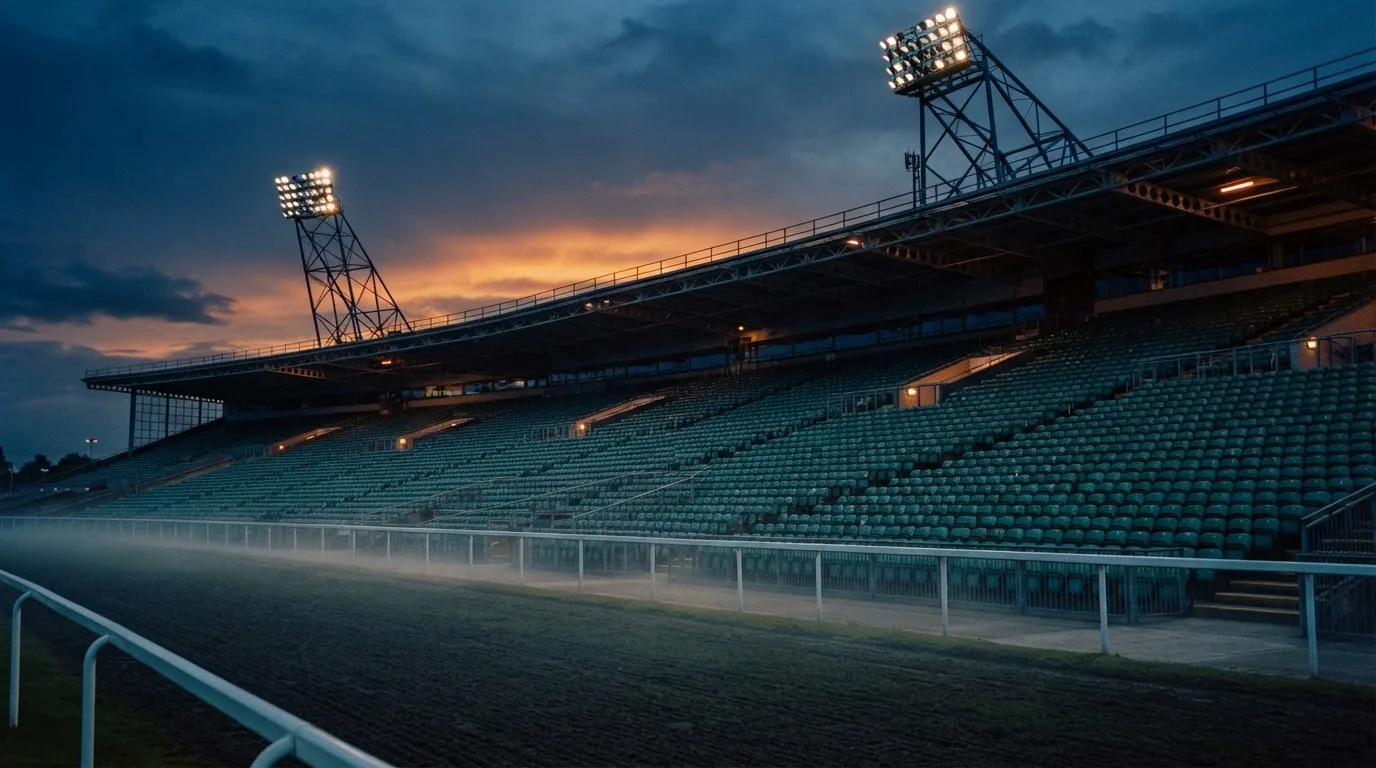
Flat races themselves range from 440 yards (about 400 m) at the sprint end to over four miles (about 6.4 km) at the staying end, with five to twelve furlongs (1.0 to 2.4 km) the most common distances. Sprint races, the five- and six-furlong events, reward raw speed and a quick break; staying races, beyond a mile and a half, reward stamina and a horse that travels through the race. The distance a horse has won at before, and the distance of the race being bet on, sit at the heart of the form study — and the form study is the raw material a prediction is built from.
Handicaps, conditions and the field
Races come in two shapes. A handicap assigns each runner a different weight to carry, with the idea of evening out ability and producing a closer finish. A conditions race gives horses the same weight, with allowances for younger and female horses, so the result is more a test of raw class than of handicapper’s craft. Handicaps are usually the larger fields, often fifteen runners or more, and they are where each-way betting starts to look like a serious option. Conditions races are usually smaller fields and often more competitive on form.

The British Flat’s three most prestigious three-year-old races are the 2000 Guineas, the Derby and the St Leger — together the British Triple Crown, though no horse has taken all three since Nijinsky in 1970. The pattern is worth knowing because “form at Pattern 5 level” or “Guineas winner” carries weight in any preview a reader meets, and a prediction anchored to one of those races carries a different kind of risk from a prediction anchored to a Tuesday-evening handicap at a smaller track.
The each-way bet and what it does to a stake
The single most common way a small-stake punter backs a horse is the each-way bet. An each-way bet is two bets of equal stake: a win bet and a place bet. A £5 each-way bet costs £10. If the horse wins, both parts pay out; if it places but does not win, the place part pays out at a fraction of the win odds; if it finishes outside the place terms, the £10 is lost. The fraction paid on the place part and how many places count as a place both depend on the type of race and the number of runners.
UK place terms, the standard the betting public uses:
| Runners | Place fraction | Number of places paid |
|---|---|---|
| 4 or fewer | — | win only (no place part pays) |
| 5 to 7 | 1/4 odds | 2 places |
| 8 or more (non-handicap) | 1/5 odds | 3 places |
| 12 to 15 | 1/4 odds | 3 places |
| 16 or more (handicap) | 1/4 odds | 4 places |
The 1/5 versus 1/4 difference is the part most casual bettors miss. A £10 each-way bet at 1/4 place terms on a 10/1 shot costs £20 and, if the horse wins, returns £110 on the win part and £35 on the place part, £145 in total. The same bet at 1/5 place terms would return £110 and £25, £135. The fraction is fixed by the race type, not by the bookmaker, but some bookmakers do offer “enhanced” place terms — extra places, or a bigger fraction — as a promotion on big-race days, and a punters’ diary lives or dies by knowing which race pays which.
The place terms matter because an each-way bet is two bets, and the unit stake doubles. A reader who thinks “a £10 each-way bet” is a £10 bet has misunderstood the product. The total stake on a Lucky 15, fifteen bets across four selections, is fifteen times the unit stake; the stake on a Goliath, 247 bets across eight selections, is 247 times the unit. The full stake hits the account whether one leg wins or none of them does.
The Legal Frame: Where the Licence Comes From and What It Covers
The Gambling Commission and the Gambling Act 2005
Betting in Great Britain is licensed under the Gambling Act 2005 by the Gambling Commission, a non-departmental public body sponsored by the Department for Culture, Media and Sport. Northern Ireland is outside the Act and runs a separate regime; a GB licence does not regulate bets placed in Northern Ireland. Since the Gambling (Licensing and Advertising) Act 2014 the rule is one of point-of-consumption: an operator whose remote facilities are used in Great Britain needs a Commission licence wherever it sits — Gibraltar, Malta, Curaçao, the Isle of Man. A non-GB licence is not a substitute for a GB one. The relevant sections of the 2005 Act are 33 and 36 as amended, and the test of whether a brand holds a licence is whether its name, trading name, domain or account number appears on the Commission’s public register. That register is searchable and free to use.
There is no state monopoly and no cap on the number of licences. The five remote betting categories are: general betting standard (real events), general betting standard (virtual events), general betting limited, pool betting, and betting intermediary — the licence a betting exchange runs under. Most of the names on the shortlist below run general betting standard (real events); Matchbook and Smarkets run the intermediary category, which is why they are exchanges rather than traditional bookmakers.
Verification, age and the absence of anonymous play
A licensed bookmaker cannot let a customer deposit or gamble until it has verified name, date of birth and address. That has been the rule since 7 May 2019 and it includes free bets and bonus funds. The minimum age is 18 across Great Britain. A reader who arrived at horse racing through a free-bet promotion, an acca-firm advert, a tipster’s paid service, or a social-media link has already crossed the verification step before placing a first bet. That is the price of the licence.
What the credit-card ban actually stops
Since 14 April 2020 credit cards have been banned for gambling in Great Britain, including credit-card-funded e-wallet deposits. Debit cards, bank transfers and bank-based payments such as open banking are not covered by the ban. A reader who only has a credit card cannot fund a licensed account; a reader who has a debit card can. The ban is enforced at the bookmaker’s end, not by the card issuer.
In-play, virtuals and the markets that exist
There is no statutory list of permitted bets or markets. An operator’s licence and the Licence Conditions and Codes of Practice (LCCP) define what it may offer under its own rules. In-play betting on real events is offered by GB bookmakers; virtual events are a separate licence category and a different product. Esports are treated like any other event under a general betting standard licence; politics, TV shows and novelty markets are offered by GB bookmakers with no statutory prohibition. Spread betting that is not on a financial instrument sits inside General Betting Duty; financial spread betting is regulated by the Financial Conduct Authority, not the Commission.
Bonuses, free bets and what the 2026 rules cap
Advertising is not licensed by the Commission. It runs through the CAP Code for non-broadcast and the BCAP Code for broadcast, both enforced by the ASA, alongside the LCCP marketing conditions. From 19 January 2026 wagering requirements on bonuses are capped at 10x: a £10 bonus at 50x wagering needed £500 of qualifying bets before withdrawal, and that is no longer allowed. Mixed-product promotions — an offer that requires gambling on two or more product types, the “bet on football to get free spins” shape — are banned. Whether the cap applies to a free bet with no wagering condition at all, and any cap on the money value of a bonus, are not established and the rule is therefore read as stated.
Tax
The punter pays no tax on betting winnings in Great Britain — that is general information, not advice, and a professional gambler is in a different position and should ask HMRC or an adviser. General Betting Duty is the operator’s tax on gross profits, currently 15%, and from 1 April 2027 a remote betting rate of 25% applies within it, while bets on UK horse racing, self-service betting terminals in licensed premises, pool betting and in-person betting stay at 15% — a policy paper from HM Government of 26 November 2025 set that out. Until April 2027 the remote rate stays at 15% and whether operators pass the change on through odds is not established. Never read duty as a charge on the player; it sits inside the price.
Offshore
A GB licence is compulsory at the point of consumption. Section 33 of the Gambling Act 2005 makes providing gambling facilities in Great Britain without the licence the Act requires an offence, aimed at the operator: on conviction up to 51 weeks’ imprisonment, a level-5 fine, or both (six months in Scotland). No offence aimed at the customer who merely bets on an unlicensed site was found; the honest framing is that an unlicensed site means no GAMSTOP coverage, no Commission complaints route, no approved dispute-resolution body and no British consumer redress if funds are withheld, and the site is not bound by the 10x bonus cap or the £150 vulnerability check. Enforcement is disruption rather than blocking: cease-and-desist notices, search-engine referrals, work with registrars, hosts and payment providers, and the Commission has been given or is about to receive court-order DNS blocking powers. ISP blocking of unlicensed sites is not in operation.
Safer Gambling: What a Licensed Bookmaker Has to Provide
GAMSTOP and the multi-operator exclusion
Every GB-licensed online operator is a GAMSTOP member, and GAMSTOP membership is a mandatory licence condition for online operators since 31 March 2020. The exclusion periods are six months, one year, five years, or five years with auto-renewal; after the minimum period the exclusion stays in place for a further seven years unless the customer asks GAMSTOP to remove it. GAMSTOP covers online sites and apps; the betting shops run a separate service. A reader who has self-excluded through GAMSTOP is excluded across every GB-licensed online bookmaker at once.
The £150 financial vulnerability check
A financial vulnerability check (LCCP condition 3.4.4, in force since 30 August 2024) applies to a licensed remote betting customer when deposits minus withdrawals exceed £150 in a rolling 30 days (since 28 February 2025). The check is a public-record check — bankruptcy, county court judgments — not an income check and not a credit reference check. It runs in the background, and a reader who has been betting in modest amounts will never notice it. A reader whose net deposits cross £150 in a rolling month may be asked to confirm something about their identity; a reader who cannot pass the check is restricted from further deposits until the matter is resolved.
Affordability checks and deposit limits, announced and staged
Financial risk assessments — the affordability check that has been in the press — are announced in a staged plan (a Commission article of 7 July 2026) with no start date. They should be read as “announced, staged, no start date”, not “in force”. Deposit limits are a separate requirement (RTS 12): operators must offer a gross deposit limit on a fixed time frame, with the first changes live since 31 October 2025 and a second phase postponed to 30 September 2026, so whether the second phase is in operation is not established. There is no state-set deposit or loss ceiling; the limits a bettor sets are the bettor’s choice. The required offer is a limit a customer can set, not a limit a customer must accept.
Help and the support lines
The standard routes are GamCare and the National Gambling Helpline, GambleAware, the NHS gambling clinics network, and Gamblers Anonymous. The licensed shortlist in the comparison below all link to these services on their safer-gambling pages. Unibet, for example, lists deposit limits, a Player Profile test, product restrictions and self-exclusion in its safer-gambling tools, with live chat support and links to BeGambleAware, GamCare, GAMSTOP, Gambling Therapy and the BGC. The BGC, the Betting and Gaming Council, is the industry body; it is not a regulator and not a complaints service.
How Predictions Are Built, How Value Is Found, and Why No Tip Is Ever Certain
Form, statistics, the market’s own odds
A prediction is a probability dressed up as a name. The cleanest way to read one is to ignore the name and look at the odds, because the odds are the market’s own probability of the horse winning, with a margin built in. From that probability a bettor asks whether the price is bigger than the horse’s true chance of winning. If a horse whose true chance of winning is 25% is on offer at 5/1 (decimal 6.00, fair odds 4.00), the price is bigger than the chance and the bet has positive expected value. If the same horse is on offer at 3/1 (decimal 4.00, fair odds 4.00), the price is fair; if the horse is on offer at 5/2 (decimal 3.50, fair odds 4.00), the price is shorter than the chance and the bet is a long-run loser.
Building the true chance is the craft. The inputs the form-reader uses are the horse’s previous runs, the going (the ground condition), the distance, the course, the class of the race, the draw (in larger fields the stall position matters), the trainer’s record at the track, the jockey’s record on the horse, and any headgear or equipment changes the connections have flagged. Statistics add layers: speed figures, sectional times, ratings from private form services, and the betting market’s own moves in the days and hours before the race. The market moves because smart money — syndicates, professional punters, the betting offices’ own risk teams — has shaped an opinion, and the price a bettor sees at post time is rarely the price that was on the board the day before.
The margin and how to see it in the odds
The bookmaker’s margin is the slice of every market that the bookmaker keeps, calculated as the difference between 100% and the payout share. On a two-way market priced 1.90 / 1.90, the implied probabilities are about 52.63% on each side, summing to 105.26%. The payout share is about 95.00%, meaning the bookmaker’s margin is about 5.00%, while the overround (the sum of implied probabilities minus 100%) is 5.26%. A five-horse race at 5.00 each has implied probabilities of 20% on each runner; the sum is 100% and the margin is zero — a bookmaker would never offer it. The bookmaker’s job is to set prices whose implied probabilities sum to more than 100%, and the bettor’s job is to find prices whose implied probability is smaller than the bettor’s own estimate of the horse’s chance.
The margin shows up in every price. It sits between a 9/4 shot and an evens chance, between a 33/1 rag and the favourite. It is the same shape on an each-way bet, on a place-only market, on a forecast (the order of the first two past the post) and on a tricast (first three). On a betting exchange, where punters back and lay against each other rather than against a bookmaker, the margin is the commission the exchange takes on winning bets — typically 2% to 5% of net profit on Matchbook and Smarkets — rather than a margin inside the price. Exchange prices tend to be sharper because there is no bookmaker’s built-in margin to inflate the overround; the bettor pays the commission on the way out.
Value: the only edge that matters
Value, in betting, is a price whose implied probability is smaller than the bettor’s own estimate of the true probability. It is not a tip. It is not a system. It is the single arithmetic condition under which a bet has positive expected value over many repetitions. A bettor who backs every 5/1 shot in a season because “5/1 is a value price” is not finding value; a bettor who backs 5/1 shots only when their own estimate of the horse’s chance is above 20% is.
Three habits make value more likely and rarer than the marketing suggests. First, the bettor bets fewer races rather than more — the long-run edge is in selectivity, not volume. Second, the bettor logs every bet with the price taken and the closing price, so that over a season the actual margin the bettor has paid can be seen. Third, the bettor reads the market’s move: a horse backed from 10/1 into 6/1 in the morning is being sharpened by someone with information the bettor does not have, and a bet at 6/1 after that move is a different bet from a bet at 10/1 before it. None of these habits turn a losing bet into a winning one. They make the long-run variance smaller.
The staking plan and the bankroll
A staking plan is the discipline of keeping bet size proportionate to bank size and to confidence. The plainest workable plan is flat staking: the same unit stake on every selection, with the unit set at 1% to 2% of the starting bank. A £1,000 bank with a 2% unit means £20 on every bet; a £500 bank with a 1% unit means £5. The point is to survive a losing streak without busting the bank, and the maths is that a 2% unit loses fifty bets in a row about one time in a quadrillion — the bettor will never see it. A 10% unit loses the bank in ten losers, which happens to anyone.
Bankroll discipline is the boring half of the work. It is also the half that turns a 53% winner at 4/1 into a session that ends the year up and a session that ends the year down, depending on how the unit was sized. The professional punter’s diary, if it ever sees the light of day, is mostly about staking and only secondarily about the horses.
Why no tip is ever certain
No tip is ever certain because no one knows the outcome. A horse with a 60% chance of winning, by the bettor’s best estimate, still loses four times in ten. A horse at 90% — a short-priced favourite on a class drop — still loses once in ten. Bookmakers, tipsters, form services and betting models all give probabilities, never certainties. The only honest framing of a prediction is as a probability, and the only honest framing of a betting bank is as money that can be lost in full. Anyone who tells a reader otherwise is selling something.
A worked margin on an illustrative market
The margin is a useful number to put a working shape on. Take a two-way market at decimal odds 1.90 / 1.90 — an illustrative example, not a quoted price. The implied probability on each side is 1 ÷ 1.90, about 52.63%; the sum of implied probabilities is about 105.26%; the payout share, the proportion of the pool that returns to bettors on a one-unit stake across both outcomes, is 100 ÷ 105.26, about 95.00%; the margin, the slice the bookmaker keeps of every unit bet on the market, is 100% − 95.00%, about 5.26%. The same calculation on a market at 1.80 / 1.80 gives implied probabilities of 55.56% per side, a sum of 111.11%, a payout share of about 90.00% and a margin of about 10.00% — a typical bookmaker margin on a major football match. On a horse race with twelve runners, the margin usually sits between 15% and 30%, sometimes higher in a field where the favourite is short. The band, not the figure, is the point: a margin in the low single digits is a sharp book; a margin in the high teens or twenties is a juiced-up field, and the value bet has to clear the bookmaker’s take as well as the bettor’s own estimation error.
The Shortlist: Ten Gambling Commission-Licensed Bookmakers and What Their Own Terms Say About Horse Racing
Every brand below appears on the Gambling Commission’s public register against a remote betting licence for Great Britain. The list is a shortlist, not a ranking; the order is editorial, and a verdict at the foot of each card is the page’s own judgement of where the brand sits for the reader who came here. Several brands run under the same licensee — that is normal and not a sign of anything else — and every GB-licensed online operator takes part in GAMSTOP.
Tote — the pool-betting original
Tote is the pool-betting brand: customers bet into a pool with each other rather than against a fixed price, and the dividend is declared after the race. The licence on the Commission’s register is 054779-R-331321-008 (account 54779), held by TDCO Limited, in the category remote general betting standard (real events). Pool betting is a different product from fixed-odds betting: the dividend is unknown until the pool closes and the take is deducted, and the place part of an each-way bet pays out at the place-pool dividend rather than at a fraction of the win price. The Tote’s appeal to a horse racing reader is the lack of a fixed-odds margin: the dividend is the pool, and what the operator takes is declared in advance as a takeout percentage, not hidden in prices. The catch is liquidity: a thin pool produces a thin dividend, and the Tote’s win dividend on a midweek handicap at a smaller track will be measurably worse than the best fixed-odds price. For a reader who likes the idea of betting against other punters rather than against a bookmaker, the Tote is the GB-licensed home of that product.
Fitzdares — the premium-service play
Fitzdares is the high-end of the GB licensed market. The Commission’s register records licence 000400-R-103839-030 (account 400) under Fitzdares Limited, in the category remote general betting standard (real events). The app offers cash out, accumulators, Lucky 15s, specials and antepost markets on horse racing, football, tennis, rugby, cricket, golf and American football, with in-play live odds. The book positions itself as a premium service — a smaller welcome package, a curated customer list, a higher-touch experience — and the licensed brand that fits a reader who wants an exchange-like experience with a traditional bookmaker’s product range. Those seeking larger unit stakes and personalised management should review the Fitzdares service model directly.
Bar One Racing — the Irish independent
Bar One Racing has rebranded as BAR 1 Betting, an Irish independent bookmaker with shops across Ireland and horse racing sponsorships at Dundalk, Fairyhouse, Navan, The Curragh, Curraheen Park and Cork. The Commission’s register lists licence 056516-R-332750-007 (account 56516) under Bar-One Racing Limited, in the category remote general betting standard (real events). The brand sits where GB and Irish racing meet, and the sponsorship list tells you where its form-reading is deepest: Dundalk’s all-weather and the National Hunt festivals. For a reader who follows Irish racing as closely as British, Bar One Racing offers deep coverage of both Irish tracks and festivals.
10bet — the broad-market bookmaker with a racing section
10bet runs a sportsbook covering football, tennis and horse racing, with cash out, Bet Builder and Live Streaming on its app. The licence is 043173-R-322899-023 (account 43173) under Blue Star Planet Limited, category remote general betting standard (real events). The product is mainstream: a familiar Bet Builder, in-play markets, a long list of sports. The horse racing section is not the centre of the proposition — football is — but the licence is there, the product is licensed, and the racing markets are competitive enough on major meetings. A broader sportsbook interface is available for those who prefer mixed-sport accounts.
Fafabet — Best Odds Guaranteed from 9am
Fafabet pays Best Odds Guaranteed on UK and Irish horse racing win and each-way bets from 9am on race days: if the starting price is bigger than the original price taken, the bigger odds are paid. The licence is 057385-R-333191-006 (account 57385) under Taichi Tech Limited, category remote general betting standard (real events). The BOG start — 9am, against William Hill’s 8am on the same product — is an hour later, and on a market where the morning money is sharp, that hour is the difference between taking the morning price and being beaten by the morning money. Competitive BOG terms are a central pillar of the Fafabet racing product.
DragonBet — Welsh racing with live streaming
DragonBet offers cash out both in-play and pre-match, and live streaming of racing. The licence is 064908-R-339041-003 (account 64908) under DragonBet Ltd, category remote general betting standard (real events). The brand sits inside the Welsh racing scene and has the kind of local-market depth a national book does not: smaller fields, evening meetings, all-weather from Chelmsford and Wolverhampton. For a reader who follows the smaller meetings rather than the Festivals, DragonBet is the licensed option focused on the Welsh racing scene.
bet365 — the in-play benchmark
bet365 offers in-play betting and live streaming of events worldwide, plus Bet Track, Match Live and a Live Golf Tracker for following bets in play. The licence is 055148-R-331498-002 (account 55148) under Hillside (UK Sports) ENC, category remote general betting standard (real events). The brand is the GB-licensed benchmark on in-play markets and on live streaming coverage; the racing product is broad and the BOG terms are competitive on UK and Irish racing. bet365 remains the most complete in-play sportsbook for racing enthusiasts.
Matchbook — the betting exchange
Matchbook is a betting exchange where customers bet against other users, with Bet Builder, multiples, in-play betting and live streaming of horse racing and greyhounds. The licence is 039504-R-319407-024 (account 39504) under Triplebet Limited, in the categories remote general betting standard (real events) and remote betting intermediary — the second category is the exchange licence. The product is structurally different from a bookmaker’s: there is no bookmaker’s margin inside the price, the customer is the price-maker on the lay side and the price-taker on the back side, and the operator takes commission on net winnings. Exchange betting facilitates back-and-lay strategies not available at traditional bookmakers.
Smarkets — the second exchange
Smarkets’ app offers two-factor authentication, live charts and an order book view, a quick trade-out option and 24/7 live chat support. The licence is 039173-R-319366-011 (account 39173) under Smarkets (Malta) Limited, category remote betting intermediary. The product sits next to Matchbook on the exchange shelf: similar commission structure, similar in-play markets, with the Smarkets app leaning into a clean order-book view that a serious user values. Smarkets is often used for price comparison when betting on exchanges.
Betboro — the smaller licensed bookmaker
Betboro offers in-play markets and cash-out on football, racing and tennis, boosted odds on selected singles from £10 stakes, and responsible gambling tools — deposit limits, reality checks, self-exclusion. The licence is 044181-R-324363-007 (account 44181) under Webmedia Development N.V., category remote general betting standard (real events). The product is a smaller sportsbook rather than a giant, and the boosted-odds market is the most distinctive horse-racing feature. For a reader who wants a licensed bookmaker whose prices on the racing card are occasionally sharper than the majors, Betboro is the option that occasionally competes on price.
What the Licence Numbers Actually Mean
| Brand | Licence | Specialization | Holder |
|---|---|---|---|
| Tote | 054779-R-331321-008 | Pool betting | TDCO Limited |
| Fitzdares | 000400-R-103839-030 | Premium services | Fitzdares Limited |
| Bar One Racing | 056516-R-332750-007 | Irish racing focus | Bar-One Racing Limited |
| 10bet | 043173-R-322899-023 | Broad sportsbook | Blue Star Planet Limited |
| Fafabet | 057385-R-333191-006 | BOG specialist | Taichi Tech Limited |
| DragonBet | 064908-R-339041-003 | Welsh racing | DragonBet Ltd |
| bet365 | 055148-R-331498-002 | In-play benchmark | Hillside (UK Sports) ENC |
| Matchbook | 039504-R-319407-024 | Exchange betting | Triplebet Limited |
| Smarkets | 039173-R-319366-011 | Prediction market | Smarkets (Malta) Limited |
| Betboro | 044181-R-324363-007 | Odds boosts | Webmedia Development N.V. |
The Commission’s public register is searchable by business name, trading name, domain or account number, and it is the whole test of whether a brand holds a licence. A reader comparing brands should always check the register directly; a licence number on a marketing page is a starting point, not a substitute for the register itself.
FAQ
What is a value bet and why is no tip ever certain?
A value bet is a price whose implied probability is smaller than your own estimate of the horse’s true chance of winning. It is not a tip and not a system; it is the single arithmetic condition under which a bet has positive expected value over many repetitions. No tip is ever certain because no one knows the outcome — a horse with a 60% chance still loses four times in ten.
What is the bookmaker’s margin and how can it be seen in the odds?
The margin is the slice the bookmaker keeps, calculated as 100% minus the payout share. On a two-way market priced 1.90 / 1.90, the payout share is about 95.00%, leaving a margin of 5.00%, even though the overround is 5.26%. The lower the sum of implied probabilities, the sharper the book.
How is the return on a bet worked out from the stake and the odds?
For decimal odds the return on a winning single is stake × odds, and the net profit is stake × (odds − 1). A £10 stake at decimal odds 6.00 returns £60 and pays £50 profit. For a combination bet the odds of the legs multiply into one price; a treble of three 3.00 legs has combined odds of 27.00, and a £10 treble returns £270.
How can it be checked that a bookmaker holds a Gambling Commission licence?
The Commission’s public register is searchable by business name, trading name, domain or account number, and it is the whole test of who holds a licence. A licence number printed on a marketing page should always be checked against the register itself; a register entry is the licence, a marketing page is a claim.
Which tools for controlling play does a licensed bookmaker have to offer?
A licensed remote bookmaker must offer a GAMSTOP-based multi-operator self-exclusion, deposit limits the customer can set, the £150 financial vulnerability check on a rolling 30-day basis, and links to GamCare, GambleAware and the NHS gambling clinics network. The standard safer-gambling page lists the tools and the help lines.
How do fractional odds such as 5/1 convert to decimal odds such as 6.00?
The conversion is a/b → a ÷ b + 1. Fractional 5/1 is 5 ÷ 1 + 1 = 6.00 in decimal; fractional 11/4 is 11 ÷ 4 + 1 = 3.75. Odds-on prices (shorter than evens, like 4/6) sit between 1.00 and 2.00 in decimal; odds-against prices (longer than evens, like 5/1 or 10/1) sit above 2.00.
Horse racing & greyhounds – Fast Payout
Content created by the «Fast Payout» team
