
MMA betting odds explained: how prices are set and where to find value
 Available in US
Mixed martial arts sits in an odd corner of the British betting market. It is a niche sport by handle — football, horse racing and tennis dwarf it — yet the fight card has an unusually rich menu of markets per event. A single UFC bout routinely offers a method-of-victory market, round groupings, going-the-distance bets, fighter-props on takedowns and significant strikes, and a small futures book on the next challenger. The odds on those markets move for reasons that have very little to do with the headline price on the main card. This page is about how those prices are built, what the bookmaker keeps for itself, and which of the ten Gambling Commission-licensed brands that serve British punters actually carry the sport deep into their sportsbook. It is written for the reader comparing options, not the reader shopping for a tip.
As of 27 October 2026, the licence details below were checked against the Gambling Commission’s public register. Odds and prices age faster than anything else on a page like this, so no price is printed without a snapshot date; where research gives no date, the point is made in words.
MMA and the bookmakers’ shelf: the landscape in Britain
Eleven bookmakers hold a Gambling Commission remote betting licence and carry the sport as a regular feature rather than an occasional one. The set is wider than the headline names suggest: alongside bet365 and William Hill sit specialist brands such as Spreadex, which combines fixed-odds betting with financial spread betting, and platform-first newcomers such as Midnite and Kwiff. Each takes a different cut at the sport, and the difference is rarely the headline price on a fight — those cluster within a couple of decimal points of each other. It is the depth of the market menu, the in-play coverage and the cash-out policy that separate one brand from the next.

For a punter who only bets on the main card and takes the winner market, almost any licensed bookmaker will do. For a punter who wants to back a fighter to win inside the distance in round three, or to lay a round-grouping line mid-fight, the field narrows sharply. That is the trade this page maps: which paths exist, who each one suits, and what each path costs the bettor who walks it.
Weight classes and the UFC calendar
The Ultimate Fighting Championship was founded on 12 November 1993, when UFC 1 was held at McNichols Sports Arena in Denver, Colorado. The promotion now runs eleven weight divisions, eight for men and three for women, and turns over a card roughly every weekend between January and December. Bellator, PFL and ONE Championship run alongside it, with lighter schedules, and regional promotions fill the rest of the calendar. For a British punter, the practical shape of the year is a UFC event most Saturdays, a Bellator or PFL card every few weeks, and a stream of smaller shows covered by only the deepest sportsbooks.
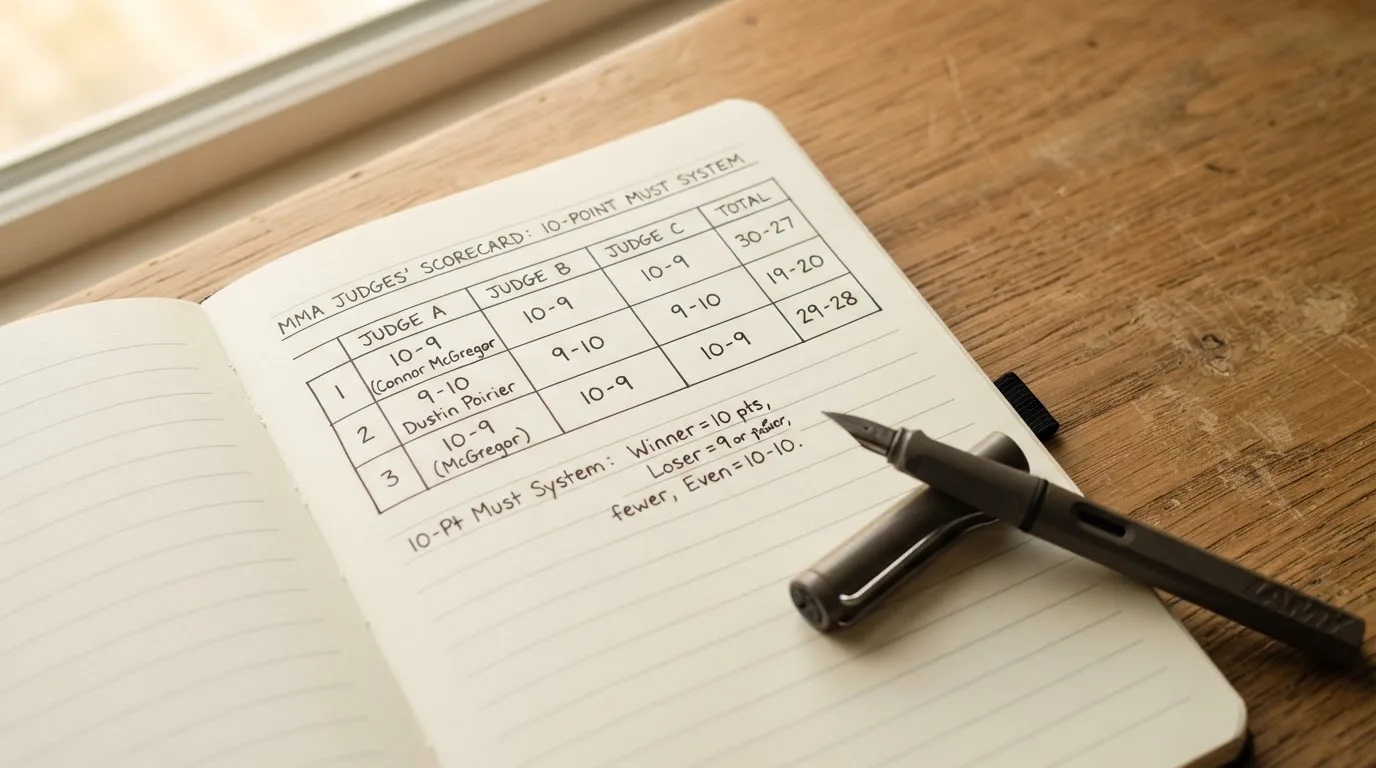
A bout is three rounds for non-title fights and five rounds for title fights. Each round lasts five minutes with a one-minute rest, and the judges score under the ten-point must system: the round winner takes ten points, the loser nine or fewer, and a round scored even is ten-all. A decision is unanimous, majority or split depending on how the three judges agree, and a draw follows the same three flavours. A bout ends in disqualification if an intentional foul leaves a fighter unable to continue, and in a no contest if an unintentional foul does the same. Those rules matter to the punter because they decide when a method-of-victory market settles and how an in-play position behaves when a fight is stopped early.
How MMA betting odds work
A fight has three outcomes at the level of the result: fighter A wins, fighter B wins, or the fight ends in a draw. Most GB sportsbooks frame the main market as two selections — back fighter A or fighter B — and treat the draw as a separate line. On a perfectly priced fight the implied probabilities of those two outcomes would sum to 100% and the bookmaker would keep nothing; in practice they sum to more than 100%, and the surplus is the margin.
Take an even fight priced 1.91 / 1.91 in decimal, the equivalent of 10/11 in fractional. The reciprocal of each price — 1 ÷ 1.91 — gives the implied probability of each outcome, 0.524 each. The two implied probabilities sum to 1.048. The bookmaker’s margin is the surplus over 1: a margin of 4.8%, with the remaining 95.2% paid out as winnings to whichever selection wins. The narrower the margin, the more of every pound staked the bookmaker returns to the punter as winnings over the long run. The wider the margin, the more the bookmaker keeps.
The same calculation works for any number of selections. On a method-of-victory market with six outcomes — knockout, technical knockout, submission, unanimous decision, split or majority decision, and draw — the reciprocals of all six prices are summed and the margin is the surplus over one. The headline price on the main card hides a margin that is typically smaller than the margin on a long-tail market such as “fight ends in round three by submission”, because the bookmaker has more liability to manage and more sophisticated customers on the headline line.
What a winning bet pays back
A bet of £10 at decimal odds 2.50 returns £25: the £10 stake plus £15 in profit. The general formula is straightforward: return = stake × odds, and profit = stake × (odds − 1). On a combined bet such as a four-fold accumulator, the odds of each leg are multiplied together into a single price, and the £10 stake returns £10 multiplied by that combined price. A four-leg acca priced at 6.00 in total returns £60 — £10 in stake, £50 in profit. The catch is that every leg has to win; one loss and the whole bet loses.
Each leg of an accumulator carries its own margin, and the margins compound. A four-leg accumulator at a typical 5% margin per leg does not carry a 5% margin overall; it carries closer to 19%. The longer the accumulator, the more the bookmaker’s edge builds up inside the price. A punter who likes the occasional five-fold should know that the long-run cost of doing so is roughly four times the cost of backing each leg singly.
The margin on an even-money fight
An illustrative even-money fight priced at 1.90 / 1.90 in decimal, the equivalent of 9/10 in fractional, sums to a payout share of 1 ÷ (1/1.90 + 1/1.90) = 0.526, or 52.6% on each side. Combined, the two sides give a total payout share of 1.053 — the bookmaker keeps 5.3% of every pound staked on the market and pays out 94.7% in winnings over the long run. That 5.3% is the margin; the same number expressed from the other side, as a payout share of 94.7%, is what the punter receives on average across all bets settled on this market.
The 5.3% on this illustrative even-money line sits inside the band a British punter should expect on a major UFC main event: headline prices on the biggest fights cluster between 3% and 6% depending on the bookmaker and the timing of the price. The margin on a method-of-victory market is wider, the margin on a round-grouping line wider still, and the margin on the smallest fight-of-the-night markets often crosses 10%. The size of the margin is rarely visible from the price on a single outcome; it shows up only in the sum of implied probabilities across the whole market.
Best Odds Guaranteed and why it matters for MMA
Several British bookmakers — William Hill and Fafabet among them — pay Best Odds Guaranteed on UK and Irish horse racing rather than MMA, and the distinction matters for a punter who also bets on the flat. William Hill pays best odds from 8 AM on the day of the race on single and multiple bets, but not on ante-post, tote or pari-mutuel bets. Fafabet pays best odds from 9 AM on race days on win and each-way bets: where the starting price is larger than the price the punter took, the larger odds are paid. Neither rule applies to a UFC card. For MMA, the punter takes the price as printed at the time of bet, and no late upgrade is paid.
What the price does not show
A headline price of 1.91 on a fighter does not say how much the bookmaker will let the punter stake, what the maximum payout is, or how the line will move between the price being printed and the fight starting. Those rules sit in the bookmaker’s terms, not in the price, and the punter who plans to back a heavy favourite to a meaningful stake checks them before placing the bet rather than after. Several operators cap the maximum stake on price-boosted markets, on enhanced-odds offers, and on free-bet selections; the headline price on a boosted market is the headline price on that selection only, and the cap is a separate number.
The legal frame in Great Britain
The Gambling Commission regulates the British commercial betting market under the Gambling Act 2005, which covers England, Scotland and Wales. Northern Ireland sits outside the Act and runs under older legislation, so a Great Britain licence is not, on its own, a Northern Ireland licence. Since the Gambling (Licensing and Advertising) Act 2014, an operator whose remote facilities are used in Great Britain needs a Commission licence wherever it is based — a Curaçao, Maltese or Gibraltar licence is not a substitute. There is no state monopoly, no cap on the number of licences, and no statutory list of permitted sports or markets: a bookmaker serves customers in Great Britain under one of several licence categories, of which remote general betting standard (real events) is the relevant one for MMA.
Every operator listed later in this guide holds a Commission remote general betting standard (real events) licence, and every detail comes from the Commission’s public register. The register can be searched by business name, trading name, domain or account number; the punter who wants to check that a brand is licensed types the brand into the Commission’s online register rather than trusting the brand’s own footer. A licensed brand may use either a .com or a .co.uk domain — both are equally legitimate — and several operators in this comparison run under a single licence holder. Ladbrokes and Coral, for example, share a LeoVegas parent and BetUK sits with them; Paddy Power and Betfair share Flutter. None of that is a quality judgement; it is just the shape of the industry.
The minimum age is 18, and identity is verified before the first deposit or bet, including where the bet is funded by a free bet or a bonus. That means no anonymous play at a licensed British site: name, address and date of birth are checked before a stake can be placed, and source-of-funds questions at higher spend are normal under anti-money-laundering rules. Credit cards are banned for gambling in Great Britain, including credit-card-funded e-wallet payments, but debit cards and bank-based methods sit outside that ban. Cryptocurrency is not banned at licensed operators and is not licensed either: each operator decides whether to take it, and the punter who wants to deposit in bitcoin or ether should expect fewer options than the punter with a debit card.
Financial spread betting is regulated by the Financial Conduct Authority, not the Commission. Spreadex and Sporting Index both sit on both sides of that line: spread bets on financial indices are FCA, sports spread bets are Commission, and the punter who opens a spread-bet account at one of those brands is taking on a product whose losses can exceed the deposit. That is a different product from a fixed-odds bet and the terms say so; it is not a quirk of those brands.
What this means for the punter
A Great Britain licence buys the punter five things that an unlicensed site cannot supply. The first is GAMSTOP, the multi-operator self-exclusion scheme every licensed remote operator has been a member of since 31 March 2020. The second is a Commission complaints route and an approved dispute-resolution service. The third is the financial vulnerability check from 28 February 2025, which flags public-record indicators such as bankruptcy or county court judgments when deposits minus withdrawals cross £150 in a rolling thirty days. The fourth is the 10x wagering cap on bonuses that took effect on 19 January 2026, under which a £10 bonus at 50x wagering would have required £500 of bets and under the cap requires no more than £100. The fifth is the player-pays-no-tax rule on betting winnings, which is the operator who pays General Betting Duty at 15% (rising to a 25% remote rate from 1 April 2027).
A punter on an unlicensed offshore site forfeits all five. The site may run a larger welcome offer, accept cryptocurrency quietly and verify nobody on the way through. What it does not do is cover the punter under GAMSTOP, complain to the Commission on the punter’s behalf, run a vulnerability check at all, honour the bonus cap, or guarantee the operator will pay out a disputed winning. The Commission’s enforcement is disruption rather than blocking: cease-and-desist notices, search-engine referrals, work with registrars, hosts and payment providers. The punter who chooses the offshore route takes the punt, and the site has no British backstop if the operator decides to withhold funds.
Responsible gambling and the licensed safety net
A British licence makes GAMSTOP a mandatory feature of every remote operator. The scheme takes self-exclusion requests for six months, one year, five years, or five years with auto-renewal. After the minimum period ends the exclusion stays in place for a further seven years unless the customer asks GAMSTOP to remove it. GAMSTOP covers online sites and apps; betting shops run a separate scheme. A punter who registers with GAMSTOP is blocked at every licensed online operator in Great Britain at once.
Beyond GAMSTOP, every licensed operator offers deposit limits, timeouts and self-exclusion at the account level. From 31 October 2025 a phased set of Remote Technical Standards has applied to deposit limits, and a second phase was postponed to 30 September 2026; the practical effect for the punter is that an operator must offer a gross deposit limit on a fixed time frame and the first changes are live. The punter who wants a hard ceiling sets it at the account level and the operator enforces it; there is no state-set ceiling in betting and never has been.
The financial vulnerability check introduced on 28 February 2025 is a public-record check, not a credit check and not an income check. When a customer’s net deposits exceed £150 in a rolling thirty days, the operator runs a check on public-record indicators such as bankruptcies or county court judgments. The wider “financial risk assessments” — the affordability checks of the press headlines — have been announced in a staged plan with no start date as of mid-2026 and are not in force. A punter reading about them in the press should not assume they are active at the betting site.
The help lines are national and free. GamCare runs the National Gambling Helpline; GambleAware funds treatment and education; NHS gambling clinics offer specialist face-to-face support; Gamblers Anonymous runs peer-support meetings. Fitzwilliam Sports, for one, links out to all four from its home page. A punter who wants the British safety net does not need to use a British bookmaker to reach GamCare or the NHS, but a licensed British operator makes the same help lines one click closer.
Cryptocurrency and MMA betting
Four search terms sit behind this cluster — bitcoin MMA betting, crypto MMA betting, MMA betting with bitcoin, MMA betting with crypto — and they all ask the same practical question. Can a British punter deposit in bitcoin or ether, place a bet on a UFC card, and withdraw the winnings without going through a bank?
The honest answer is that the licensed British market does not, on the whole, support it. A licensed GB operator has to verify the customer’s name, address and date of birth before the first deposit or bet, and a wallet address is not a check of identity on its own. Several licensed operators in this comparison run a fiat-only cashier with debit cards, bank transfer and a handful of e-wallets; none of them advertises a bitcoin deposit on the British home page. The punter who wants to bet in crypto on a UFC event moves to an unlicensed offshore operator, accepts the loss of GAMSTOP coverage, the loss of the Commission complaints route, and the loss of the bonus cap, and hopes the operator pays out a disputed winning.
The technical argument for crypto is speed of settlement and lower fees. The operational argument is that a Bitcoin deposit on an unlicensed site reaches the operator’s wallet without a bank intermediating, which means no chargeback and no payment-processor block. The British argument against it is the one made above: the licensed site does the verification, runs the vulnerability check, and gives the punter a route back if the operator fails to pay. The punter who values one set of features over the other is the punter who has already decided.
There is a small adjacent corner where crypto touches a licensed operator. Some licensed operators accept e-wallet funding from a card, and some of those e-wallets can themselves be funded from a crypto balance. The chain is licensed at the bookmaker and unlicensed at the wallet, and the operator’s terms govern the bookmaker side. A punter who plans to fund an account that way should expect the bookmaker to ask where the deposit came from, and the answer to that question is a normal part of source-of-funds checks at licensed sites.
Bonuses and free bets on MMA fights
Five search phrases drive this cluster — MMA betting offers, MMA betting bonuses, MMA betting promotions, MMA bet offers, bet bonus MMA — and they all describe the same product. A licensed British bookmaker runs a sports welcome offer of one form or another, and a punter who wants one of them reads the small print before claiming.
The shapes differ. BetUK pays four £10 free bets after a first £10 sports bet within seven days of registering: two on football accumulators of four or more selections and two on multiples of two or more, valid for seven days with opt-in required. Octobet pays fifty per cent back as a free bet up to £50 plus a £10 casino bonus for new customers. Dabble pays a £10 free bet on a first £10 deposit with a seven-day free bet expiry, a stake not returned, and a minimum odds requirement. Each brand has its own combination of stake-not-returned, expiry, minimum price, and market restriction, and each bonus is the same shape as the small print describes it: a free bet is a free bet, a price boost is a price boost, an enhanced-odds offer is an enhanced-odds offer, and a cashback is a cashback.
The 10x wagering cap that took effect on 19 January 2026 changes the shape of any bonus with a wagering requirement. Under the cap, a £10 bonus cannot ask for more than £100 of qualifying bets; before the cap, the same bonus could ask for £500. The cap also bans mixed-product promotions — an offer that asks the punter to bet on football to claim free spins on a slot, for example. The practical effect on the punter is that any bonus at a licensed operator is bounded: a £10 bonus tops out at £100 of turnover, the rest of the qualifying period is the punter’s to manage, and the offer cannot require gambling on a product the punter did not come for.
Free bets work on a different arithmetic to cash bonuses. A £10 free bet at decimal odds 2.50 returns £25 in winnings — the £10 stake is not returned with a win. Over a market with a 95% payout share, the free bet is worth £10 × (2.50 − 1) ÷ 2.50 × 0.95 = £5.70 on average. The headline value of the free bet is £25 in the winning scenario; the value across many bets at that price is £5.70. That gap between headline and average is the part the small print does not print.
The marketing word is “free”. The arithmetic is more sober. A punter who claims a welcome offer reads the qualifying period, the minimum odds, the market restriction and the stake-not-returned line before placing the first bet, and decides on those numbers whether the offer is worth the trouble.
Mobile and apps for MMA betting
Five search terms — MMA betting app, MMA betting apps, MMA bet app, best MMA betting app, best app for MMA betting — describe a single market, and the market is dominated by the App Store rankings. bet365’s UK app is described as the most downloaded sports betting app in the country, and the dominant position shows in the depth of the in-play product and the live-streaming catalogue.
Lottoland’s UK app combines casino, lottery betting, sports betting and scratchcards and says it is licensed by the Gambling Commission for customers in Great Britain. Spreadex combines fixed-odds and spread betting in one app with one-click, auto and partial cash out, a Bet Builder across fixed odds or spreads, and live streaming of UK and Irish horse racing, greyhounds, tennis, NFL and selected football. Midnite shows in-play events, an acca builder, popular accas and price boosts with maximum-stake limits. Sporting Index offers in-play betting, a Bet Builder for football, auto cash-out and Multi-Markets.
A punter who bets mainly on the main event and on the method-of-victory market, and who wants live in-play on the undercard, finds bet365 the deepest on a UFC night. A punter who wants to combine a fixed-odds bet with a sports spread bet on the same card finds Spreadex the only option in this comparison. A punter who wants a casino-and-sportsbook on one app finds Lottoland. A punter who prefers a stripped-back mobile-first interface finds Kwiff or Midnite. Each app suits a different reading of the word “best”.
The differences are not in the prices — those cluster within a couple of decimal points of each other on the headline line. The differences are in the live-streaming catalogue, the bet-builder depth, the cash-out policy, the deposit method set, and the welcome offer that the punter will or will not claim.
Live betting and cash out on MMA
Five search phrases — live MMA betting, MMA live betting, MMA betting in play, live in play UFC MMA sports betting, live betting on MMA — describe a market that has matured sharply in the last few years. A British punter who watches a UFC card on a Saturday night can back and lay in-play markets from the first bell, the cash-out price on a pre-event bet updates as the fight unfolds, and several bookmakers stream the undercard inside the app.
bet365 runs in-play betting with live streaming across events worldwide, plus a Bet Track, Match Live and a Live Golf Tracker for following bets in play. Midnite shows in-play events as a navigation surface. Spreadex offers one-click, auto and partial cash out alongside live streaming. Sporting Index offers auto cash-out. The cash-out product is roughly the same on every app: a button that settles a position early at a price the bookmaker sets, with a partial cash-out that settles a fraction of the stake. The price the bookmaker sets is the price, and the punter who wants the position to ride out the fight ignores the button.
The undercard is where the live product matters most. A UFC main card streams widely; the undercard streams only on a bookmaker’s app, and the depth of the streaming catalogue decides whether a punter can watch and bet on the prelims. Several operators in this comparison stream only the main card or only selected fights. A punter who plans to bet on the undercard reads the app’s streaming page before the card starts.
Predictions, strategy and the language of MMA betting
Three search phrases — MMA betting tips, MMA betting predictions, MMA best bets — describe a market that is mostly tipsters, mostly wrong, and mostly not licensed. The punter who wants a tip from a regulated source reads the bookmaker’s preview, where it exists, and weighs it against the price; the punter who wants a tip from a tipster pays for it and takes the punt that the tipster’s strike rate justifies the subscription. There is no evidence base for either reading.
The strategy side is more useful. A punter who bets MMA regularly treats the sport as a small-margin niche: the bookmakers’ pricing models are less mature than on football or tennis, the betting volume is lower, and the price is more often wrong by enough to be worth taking. The punter who finds those prices puts a stake on them at a stake size that does not blow the bankroll on a single fight, keeps records, and reviews them after the card. That is the discipline. There is no system that wins at MMA betting, and any subscription that promises one is selling something the seller cannot deliver.
The two practical disciplines are bankroll management and price shopping. Bankroll management means betting a fixed percentage of the bankroll on each fight, never chasing losses, and never raising the stake because the last fight was a winner. Price shopping means opening accounts at more than one bookmaker and taking the best price on each selection rather than the one bookmaker’s price. The latter is more powerful than it sounds: a couple of decimal points across a season of bets is a meaningful difference to the bottom line, and it costs the punter nothing but a few extra minutes per fight.
Markets and bet types on MMA
The headline market on a UFC fight is the moneyline: back fighter A or fighter B, with the draw a separate line at longer odds. Below the moneyline sit the markets that make MMA distinctive. The method of victory market prices knockout, technical knockout, submission and decision as separate outcomes, sometimes with the round grouping bolted on. The over/under on total rounds goes in half-round increments. The fight-to-go-the-distance marker segments, the inside-the-distance marker segments, and several fighter-props on takedowns, significant strikes and submission attempts round out the menu.
LiveScore Bet’s Bet Builder, for example, allows up to ten selections and covers match result, both teams to score, corners, total goals, player scoring and card markets — a football-first feature rather than an MMA one, but the same builder concept has spread to the major combat-sports books. bet365’s Bet Builder+ combines markets from one event into a single bet, available pre-match and in-play, with Super Boosts, Winnings Boosts on Bet Builders and selected singles, and daily Bet Boosts on top. Spreadex offers a Bet Builder across fixed odds and spreads, which is unusual on a combat-sports card. The builder is a powerful tool in the right hands and a quick way to drain a bankroll in the wrong ones: each selection carries its own margin, and the margins compound inside a multi-leg builder exactly as they compound inside an accumulator.
A combination bet prices each leg at the bookmaker’s price and multiplies them together. A four-leg accumulator on method-of-victory markets with each leg at 3.00 prices the combination at 81.00; the £10 stake returns £810 on a winner and zero on a loser. The arithmetic is simple. The cost is the four-way compounded margin that the punter pays for the privilege of needing all four legs to land.
How the top 10 stack up
| Bookmaker | Gambling Commission remote licence | Licence holder | What the operator’s own terms say |
|---|---|---|---|
| bet365 | 055148-R-331498-002 (account 55148) | Hillside (UK Sports) ENC | Bet Builder+, Super Boosts, Winnings Boosts, daily Bet Boosts, in-play betting, live streaming, Bet Track, Match Live, Live Golf Tracker; UEFA Champions League partner; most-downloaded UK sports betting app |
| William Hill | listed under the William Hill organisation on the register | William Hill organisation | Best Odds Guaranteed on UK and Irish horse racing from 8 AM on race day, single and multiple bets; not ante-post, tote or pari-mutuel |
| Octobet | 062545-R-337248-006 (account 62545) | Octopus Game Limited | Sports welcome offer of 50% back as a free bet up to £50, plus a £10 casino bonus for new customers |
| Tote | 054779-R-331321-008 (account 54779) | TDCO Limited | Pool-betting operator with a remote general betting standard (real events) licence; sportsbook carries MMA |
| BetUK | 039198-R-319450-029 (account 39198) | LeoVegas Gaming PLC | Sports welcome offer: deposit £10 and place a sports bet within 7 days to receive four £10 free bets (two football accas of 4+ selections, two multiples of 2+), 7-day expiry, opt-in |
| LiveScore Bet | 056859-R-332720-005 (account 56859) | LiveScore Betting and Gaming (Gibraltar) Limited | Bet Builder with up to 10 selections covering match result, both teams to score, corners, total goals, player scoring, cards |
| Sporting Index | 027343-R-308898-011 (account 27343) | Sporting Index Limited | Fixed-odds and spread betting on the same account; in-play, Bet Builder for football, auto cash-out, Multi-Markets |
| Spreadex | 008835-R-104580-022 (account 8835) | Spreadex Limited | Fixed-odds and spread betting in one app; one-click, auto and partial cash out; Bet Builder across fixed odds or spreads; live streaming of UK and Irish horse racing, greyhounds, tennis, NFL, selected football; losses on spread bets can exceed the deposit |
| Dabble | 065677-R-340363-005 (account 65677) | Dabble Sports UK Ltd | Welcome offer of “Bet £10, Get £10 in Free Bets” on a first deposit for new customers, minimum odds apply, 7-day expiry, stake not returned |
| Fafabet | 057385-R-333191-006 (account 57385) | Taichi Tech Limited | Best Odds Guaranteed on UK and Irish horse racing win and each-way bets from 9 AM on race days; bigger SP paid if it exceeds the original price |
| Kwiff | 044448-R-323408-017 (account 44448) | Eaton Gate Gaming Limited | UK Gambling Commission licensed; described as a Spryme Ltd trademark; 17+ App Store age rating |
The set is wider than the headline names. bet365 and William Hill carry the depth — both stream the undercard, both price the full menu of method-of-victory and round-grouping markets, and both run a deep in-play product on a UFC night. Spreadex and Sporting Index carry the spread-betting side, which is a different product from a fixed-odds bet and one the punter reads the terms before opening. Octobet, Tote, BetUK, LiveScore Bet, Dabble, Fafabet and Kwiff sit in the middle of the market, each with a sportsbook that prices the main card and a smaller in-play product on the undercard.
The licence column tells the punter how to verify what each brand claims. The licence holder column names the company behind the brand — several of these brands share a parent, and a punter who values the parent’s reputation across its other brands looks at it. The right-hand column summarises each operator’s own terms in the punter’s own words; the punter who wants the full small print reads it on the operator’s terms page before betting.
bet365
bet365 sits at the top of the comparison on depth. The app is the most downloaded sports betting app in the UK, the operator is the official global betting partner of the UEFA Champions League, and the in-play product carries the full UFC card from the prelims to the main event. The Bet Builder+ feature combines markets from one event into a single bet, available pre-match and in-play, and the Super Boosts and Winnings Boosts layer on top. Live streaming is extensive, with Bet Track, Match Live and a Live Golf Tracker for following bets in play. The verdict: the right home for a punter who plans to bet across the card and wants the undercard streamed. The headline price on the main card is rarely the cheapest, and those who only bet the main card may find sharper prices elsewhere.
William Hill
William Hill is the high-street name most British punters over a certain age opened an account with first, and the online sportsbook still carries that brand recognition. The sportsbook prices the full UFC menu and runs the Best Odds Guaranteed concession on UK and Irish horse racing from 8 AM on race day. That concession does not apply to MMA, and a punter who crosses over from the flat to the cage should not expect a late upgrade on a UFC price. It serves a punter who already has a William Hill account and wants a consolidated app for racing and combat sports. The undercard product is shallower than bet365’s.
Octobet
Octobet’s licence is held by Octopus Game Limited, and the sports welcome offer is the headline product: fifty per cent back as a free bet up to £50, plus a £10 casino bonus for new customers. The sportsbook is a competent mid-market offering with the main-card markets priced and a smaller in-play product. It suits a punter looking for a fresh app rather than a heritage brand, especially when claiming a welcome offer.
Tote
The sportsbook is part of a wider product, with the tote pool product sitting alongside the fixed-odds sportsbook. It is a logical destination for a punter who values pool-betting on horse racing and wants a sportsbook on the same account. The combat-sports in-play product is shallower than the dedicated sportsbooks.
BetUK
The sportsbook prices the main-card markets on a UFC event with a smaller in-play product. It suits a punter looking for a structured welcome offer with a clear qualifying condition. The football-skewed free-bet split is a hint that MMA is not the brand’s main sport.
LiveScore Bet
The builder is football-first, and the MMA product is a smaller part of the offering. It works well for a punter who crosses between football and MMA on the same app and values the builder interface. The MMA-specific depth is shallower than bet365’s.
Sporting Index
Sporting Index offers fixed-odds and spread betting on the same account, with in-play betting, a Bet Builder for football, auto cash-out and Multi-Markets. The spread-betting product is the headline differentiator: a punter who wants to take a sports spread position on a UFC fight rather than a fixed-odds bet opens a Sporting Index account and reads the spread terms first. Losses on a spread bet can exceed the deposit. Sporting Index is the specialist choice for combat sports spread betting, though less suited to a punter who only wants fixed odds.
Spreadex
Spreadex combines fixed-odds and spread betting in one app, with one-click, auto and partial cash out, a Bet Builder across fixed odds or spreads, and live streaming of UK and Irish horse racing, greyhounds, tennis, NFL and selected football. The brand is FCA-regulated for financial spread bets and Gambling Commission-regulated for sports spread bets and fixed odds, and losses on a sports spread bet can exceed the deposit. It is a dual-product specialist, offering a streaming catalogue and partial cash-out that rewards the punter who reads the spread terms carefully.
Dabble
Dabble’s licence is held by Dabble Sports UK Ltd, and the welcome offer pays a £10 free bet on a first £10 deposit, with minimum odds, a seven-day expiry and the stake not returned. The app is mobile-first and the sportsbook carries MMA alongside a deeper football offering. It provides a simple, stripped-back experience that focuses on ease of use.
Fafabet
Fafabet’s licence is held by Taichi Tech Limited, and the Best Odds Guaranteed concession runs from 9 AM on race days on UK and Irish horse racing win and each-way bets. That concession does not apply to MMA, and a punter crossing over from racing to combat sports should not expect a late upgrade on a UFC price. Fafabet is a strong racing brand with a standard main-card offering for MMA.
Kwiff
Kwiff’s licence is held by Eaton Gate Gaming Limited, and the brand is described as a Spryme Ltd trademark. The app has a 17+ App Store age rating, sits in the mobile-first category, and carries a competent mid-market MMA offering. The verdict: the right home for a punter who wants a fresh app rather than a heritage brand, who is happy with main-card betting, and who values a simple in-play product over a deep one.
The arithmetic of an MMA price
The margin is the number that decides what a price actually costs the punter over a season of bets. Take an even-money fight priced 1.90 / 1.90 in decimal: the implied probability on each side is 1 ÷ 1.90 = 0.526, the payout share is 1 ÷ (0.526 + 0.526) = 0.947, and the margin is 1 − 0.947 = 0.053, or 5.3% of every pound staked on the market. The same arithmetic at 1.85 / 1.85 gives a margin of roughly 8.1%; at 1.95 / 1.95 the margin falls to roughly 2.6%.
A punter who watches the prices move between the card being announced and the fight starting sees the bookmaker tightening the line on the favourite as the liability builds and widening the line on the underdog to balance the book. A 2% movement in the margin on a heavily bet fight is normal; a 5% movement is a signal that something in the betting patterns has changed. The punter who catches the tightening by backing the favourite after the line moves pays a smaller margin and keeps more of every winning stake. The punter who backs the underdog at the original price pays a wider margin and gives up more on every winning stake.
That arithmetic, run across a season of bets at the same bookmaker, is the difference between a punter who closes the year ahead and a punter who closes it behind at the same strike rate. The headline price hides the margin; the sum of implied probabilities shows it.
Picking the right bookmaker
The trade this page set out to map is a trade between depth and price. A punter who wants the deepest possible MMA product — full undercard streaming, every method-of-victory and round-grouping market priced, a Bet Builder that handles combat-sports markets, and an in-play product that runs through the card — finds bet365 the right home. A punter who values Best Odds Guaranteed on horse racing on the same app finds William Hill or Fafabet the right home. A punter who wants sports spread bets alongside fixed odds on the same card finds Spreadex or Sporting Index the right home, with the warning that losses on a spread bet can exceed the deposit. A punter who wants a fresh app with a structured welcome offer finds Octobet, BetUK or Dabble the right home, with the warning that each welcome offer has a small print that the punter reads before claiming.
A punter who only bets the main card and takes the winner market finds almost any licensed bookmaker does the job, and the comparison comes down to welcome offer, app design and the price on the night. A punter who bets the undercard, the method-of-victory market and the round-grouping lines finds the field narrows sharply to bet365 and a handful of mid-market brands, and the comparison comes down to in-play depth and the streaming catalogue.
The licensed route is the default. The Commission licence, the GAMSTOP membership, the 10x bonus cap, the £150 vulnerability check and the Commission complaints route are the British safety net, and a punter who values them takes them. The unlicensed route is the alternative, with the loss of all five, and a punter who values the larger welcome offer, the quiet verification and the crypto deposit accepts that loss and takes the punt on the operator paying out a disputed winning.
Frequently asked questions about MMA betting odds
How does MMA betting work?
A British punter opens an account at a Gambling Commission-licensed bookmaker, verifies name, address and date of birth before the first deposit, and places a fixed-odds bet on a UFC or Bellator card from a menu that includes the moneyline, method of victory, total rounds and several fighter-props. Each bet returns stake × decimal odds if it wins, with the stake returned on a cash bet and not returned on a free bet. The bettor pays no tax on winnings in Great Britain.
Where to bet on MMA fights with high odds?
A higher headline price sits on the underdog in every fight, and the highest prices in the MMA market sit on the long-tail method-of-victory and round-grouping markets rather than on the moneyline. The licensed brands that price the deep menu — bet365, William Hill and a handful of mid-market operators — carry those long-tail markets; a brand that prices only the main card does not. The punter who wants the high odds opens an account at one of the deep-menu brands and reads the price on the specific market before staking.
Is it top value MMA bets for this weekend?
There is no published list of “top value” MMA bets that the punter can rely on, and any subscription service that promises a guaranteed list is selling certainty nobody can supply. The honest path is price shopping across two or three licensed bookmakers, taking the best price on each selection, keeping records, and reviewing them after the card. The discipline matters more than the tip.
How can it be checked that a bookmaker holds a Gambling Commission licence?
The Commission’s public register can be searched by business name, trading name, domain or account number. The punter types the brand name into the register and reads off the licence status, the licence categories, the licence holder and the operating domains. A licensed brand will appear on the register; an unlicensed brand will not. The punter who cannot find the brand on the register closes the account and finds a different one.
How is the return on a bet worked out from the stake and the odds?
Return = stake × decimal odds, and profit = stake × (decimal odds − 1). On a £10 bet at decimal odds 2.50 the return is £25, with £15 of profit. On a combination bet the odds of each leg are multiplied together into a single price, and the £10 stake returns £10 multiplied by that combined price. A free bet does not return the stake on a win: a £10 free bet at 2.50 returns £15 in profit and zero stake.
What is the bookmaker’s margin and how can it be seen in the odds?
The margin is the share of every pound staked that the bookmaker keeps on average across all bets settled on a market. It is calculated by summing the reciprocal of each decimal price across all outcomes of the market and subtracting the sum from one. An even-money fight at 1.90 / 1.90 has an overround of roughly 5.3% and a margin of 5.0%; a wider market such as a six-way method-of-victory typically runs wider. The margin is invisible from a single price and shows up only when the implied probabilities across the whole market are summed.
Combat & motorsport – Fast Payout
Content created by the «Fast Payout» team
