
Rugby union betting in Great Britain: the offers, the markets, the costs
 Available in US
Licensed online rugby union betting in Great Britain runs through the same Gambling Commission register as every other sport, and the operators that hold one — ten reviewed here — agree on the matches they price and disagree sharply on the markets they lay around them. A reader who lands on a site looking for the Six Nations or the next Rugby World Cup is buying two things at once: a price on the match and a set of rules underneath the offer that decides what a £10 stake is actually worth at settlement. This page is a working map of that: who is licensed, what they offer, what they cost the punter, and where the marketing words stop matching the maths.

The figures below are current as of 27 October 2026 and were checked against the Gambling Commission’s public register on the same date. Where a price or a margin appears, the snapshot date is given beside it; numbers move, and a reader betting on a price needs to know the day it was true. Odds research quotes without a snapshot date are described qualitatively, never printed as a price.
Safer gambling in rugby union betting
Anyone who has watched a Six Nations knows that the scoreboard can flip in four minutes and the next match is four days later. That cadence is exactly why a punter needs pre-set limits before a season starts, not after a bad Saturday. The safer-gambling tools are the same ones that sit around every sport under a Great Britain licence, but rugby union carries its own pressure points: long seasons, weekly fixtures, autumn internationals stacked on top of league play, and a Rugby World Cup every four years that pulls casual money into the market without any of the bankroll discipline that seasoned punters apply.

The first line of defence is GAMSTOP, the multi-operator self-exclusion scheme that has been a mandatory licence condition for every online operator since 31 March 2020. Exclusions run for six months, one year, five years, or five years with auto-renewal, and once taken the minimum period sits in place for a further seven years unless the punter asks GAMSTOP to remove it. Rugby union fans who feel the Six Nations pulling them into chasing losses can register once and be shut out of every licensed site and app without further action. The scheme covers online play only; betting shops run their own self-exclusion arrangements.
The second line is operator-side. Since 7 May 2019, every GB-licensed site has to verify name, address and date of birth before the first deposit, so anonymous play is gone. Since 30 August 2024, the licensed operator runs a financial vulnerability check when a customer’s deposits minus withdrawals cross £150 over a rolling 30 days; it is a public-record check, not a credit check, and not an income check. A heavier layer — what the press calls an affordability check — has been announced by the Commission and is staged, with no start date; it should not be treated as in force. Where it does apply, the operator can ask for payslips or bank statements and set a deposit ceiling that the punter cannot raise on their own without a fresh check.
A separate rule, the deposit limit, sits on the operator’s side under the Remote Technical Standards and was first applied from 31 October 2025; a second phase has been postponed to 30 September 2026, and whether it is live across the whole market by 2026 is not established. There is still no state-set ceiling on stakes or losses: the punter chooses their own limit and can ask the operator to lower it instantly, with a 24-hour cooling-off period before the operator can raise it again. Rugby union does not change any of this; the long season and the autumn internationals just give the customer more chances to forget about the limit they set in August.
Outside the operators, free help is available through GamCare and its National Gambling Helpline, through GambleAware, through NHS gambling clinics, and through Gamblers Anonymous. Each of the ten licensed sites reviewed in the comparison block below links to at least one of these services from a footer that is required by the licence. A punter who is chasing, hiding stakes from family, or betting on fixtures they cannot name without looking should treat any of those routes as a normal call, not a last resort.
Help on the rugby union markets themselves comes from the operators in different shapes — ante-post prices that lock months before a tournament, price boosts on a single match, accumulator insurance on a Six Nations acca, Best Odds Guaranteed on a horse-racing parallel that some operators extend to other events. None of these is a substitute for a deposit limit and an exclusion option. The way to read them is as features on top of a market that already costs the punter the margin; the marketing can never make the margin smaller.
Bonuses, free bets and the words around them in rugby union betting
The licensed rugby union market carries every kind of offer a British punter is used to from football: a sign-up free bet, weekly free bet clubs, profit boosts, accumulator insurance, and Best Odds Guaranteed on selected sports. The 10x bonus cap introduced under the Commission’s promotion rules from 19 January 2026 changed the maths underneath each one; offers that once wagered the bonus fifty times are gone, and any offer still asking for more than ten times the bonus amount is below the line.
What a “free bet” actually pays is the part most punters miss. A £10 free bet on a Six Nations match at 3.00 returns £30 — £20 of profit, because the £10 stake does not come back. That same £10 stake as cash would have returned £30 — £20 of profit and the £10 stake back. The free bet is worth £20, not £30, and on heavy favourites the gap is wider: a £10 free bet at 1.50 wins £5 of profit, against £15 of total return on a cash stake. Operators explain this in their terms; the marketing usually does not. On a sport where short-priced favourites are the norm — most Six Nations home wins trade below 1.30 — the gap between a free bet’s headline and what settles in the account is worth calculating before claiming.
The 10x wagering cap applies to cash bonuses and to deposit-gated packages that carry a turnover requirement; its reach over free bets with no rollover is not established. Where a free bet is genuinely stake-not-returned with no further play required, it tends to fall outside the cap. Where it is bundled with a matched deposit that does require turnover, it does not. Reading the offer’s small print is the only place this lands, because the two structures look identical on a sign-up page.
Free bet clubs — the weekly £5 or £10 back-for-£25-wagered format — sit in their own bracket. The cap rules say nothing about a recurring giveaway that has no bonus component; what the operator can do is restrict the markets on which a free bet can be spent, and most do. Rugby union is sometimes in the eligible list, sometimes not. A punter who specifically wants to spend free bets on the Premiership or the autumn internationals needs to check the operator’s weekly terms, not the welcome page.
Profit boosts and price boosts work on a different lever. A profit boost credits the punter with extra winnings — 10%, 20%, sometimes 50% — on a single bet, usually capped, and usually on named markets. A price boost changes the displayed odds and pays at the boosted number if it wins. Both carry the same rule underneath: the boost is applied at settlement, not refunded if the bet loses. A £10 stake at the boosted 5.50 wins £45 instead of the standard £36, but it loses the whole £10 if the selection fails. Rugby union boosts on a Six Nations weekend tend to be margin-rich singles or short accumulators with a cap of £5 or £10; the cost is the lower payout on a win, not any upfront fee.
Accumulator insurance refunds the stake — usually as a free bet, not as cash — if one leg of an acca lets the punter down. The Rugby World Cup and the Six Nations lend themselves to accas, and an insurance leg changes the maths on a five-fold: one losing leg does not zero the stake. The cost is the margin baked into the longer price the operator publishes on a multi-event acca compared with each single leg, plus the days-to-expiry on the free bet refund. A punter who accas every Saturday in the Premiership pays the margin fee for the discipline; a punter who accas the autumn internationals only gets four weekends a year to use it.
Best Odds Guaranteed is most familiar on horse racing, where the rule is that if the starting price beats the price taken earlier, the punter is paid at the bigger number. Some operators extend the rule to greyhounds and, occasionally, to outright tournament winner markets in rugby union — the Rugby World Cup outright, for instance, where the early ante-post price can be beaten by a market move before kick-off. A punter who wants this on outrights needs to read the operator’s BOG schedule, because the inclusion list is narrow and tends to change.
The order of importance in 2026 is: the 10x cap, the stake-not-returned rule on free bets, the eligible-markets list on a free bet club, and the cap on free-bet winnings that some offers carry. A punter who takes these four points on board before claiming avoids the commonest traps: offers that look free and cost their expected value, and offers that look capped and are not.
Live rugby union betting and cash out
Live betting on rugby union is where the sport’s tempo pays off. A try is five points and a conversion adds two, so a side 6–0 down to a stronger opponent can climb back to within a converted try in two scores. The odds on the in-play market reflect that volatility, and a punter who watches the game can find a price that the pre-match book overlooked — a side trading at 6.00 after going a try down in the first ten minutes, for instance, when the rest of the match still has seventy minutes of footballing time to come.
In-play markets under a Great Britain licence are run by the operator under their own licence conditions, not under a separate statutory framework. The Commission’s rules say controls are part of the licencee’s social responsibility duties — suspension of markets on a key event, refusal of bets from automated tools that could compromise the market, and a duty to identify problem behaviour on the customer’s side. There is no statutory list of permitted in-play markets, and no statutory statement that any are prohibited.
Cash out sits on top of the live market. The operator offers a settlement figure mid-game — usually a fraction of what the bet would be worth at full-time — and the punter can take it or leave the bet to run. On a heavy favourite that has just scored, the cash-out value will be close to the maximum; on a tight match with momentum swings, the cash-out value moves with every score. The cost is the operator’s margin plus the haircut they apply to the live fair value, and the shape of that haircut is the only thing that separates a useful cash-out tool from a poor one. Two operators running the same match at the same moment can show different cash-out values, and the difference is the operator’s cut, not the match.
The pace of rugby union means live markets stay open through most of the match. Where they suspend — for sin-bins, for head-injury assessments, for a video review — the punter cannot place a bet or cash out for a window of up to a minute. A punter cashing out on a try that is then overturned by the TMO can find the bet still live and the cash-out value gone. Most operators publish the rules for what happens on a TMO reversal in their live-betting terms; rugby union has more of these than football because the sport uses them more often.
Bet builders — the same-game-multi product most operators now run on football — are starting to land on rugby union, but with a smaller menu of markets. Try-scorer markets, total points, handicap, and team-to-score-first are common; the deeper combinations — a player to score, his team to win, and over X total points, all in one bet — are still patchier on rugby union than on the Premier League. Where they are offered, the margin baked into the combined price is larger than the margin on each leg singly, because the operator is taking on correlation risk.
Live streaming is part of the same package at most licensed operators, and the right to stream a Premiership or a Top 14 match sits with the rights-holder, not the operator. A punter cannot assume a free stream just because they hold an account; some operators stream selected events with a funded account or a recent bet, others do not stream rugby at all. The market for streamed club rugby in Britain is narrow, and internationals are carried by the terrestrial channels whose rights the operators do not hold.
Predictions, form and strategy in rugby union betting
Predictions in rugby union are not the same as predictions in football. The sport has a smaller league structure, longer seasons, fewer fixtures per team, and a points-scoring system that compresses margins. A punter looking for edge has fewer data points per side per week, which means each piece of information carries more weight, and the price moves more slowly than it does on a Premier League match.
Form reads differently. In league play, a side on a four-match losing streak may be saving itself for a cup the following weekend, and a side on a four-match winning streak may have done it against weaker opposition. International windows pull players out of club sides and break the link between club form and international form. The bookmaker’s margin on a Six Nations match tends to be lower than on a friendly — there is more volume, more televised coverage, more markets to balance — and a punter can find a tighter price on a more meaningful match.
The disciplines that matter in a serious strategy are bankroll, odds-shopping and timing. A punter who bets 2% of their bank on a selection, gets the best price across several operators, and takes ante-post value in a tournament outright rather than chasing in-play every week is the textbook profile. Rugby union rewards patience more than football does: fewer matches, longer tournaments, less live data, so a model that uses an Excel spreadsheet with the previous ten fixtures can compete with one that uses a paid feed, because the data is findable on the public leagues’ own pages.
The marketing word to deflate here is “expert tips”. There is no attributable named quote for this sport, and no expert body whose tip has a verifiable track record published. Tips sold on subscription are not tipped in this article; they are not endorsed and not tested. A punter who wants a second opinion uses a tipster whose results are independently audited, who publishes a one-year or longer track record in writing, and who charges a flat fee rather than a percentage of winnings. The odds-shopping, the bankroll discipline and the timing are still theirs.
The strategy that does not work is staking bigger to chase losses, especially across a Six Nations or a World Cup year. A four-week tournament with weekly fixtures gives the punter four chances to recover a bad Saturday, and the temptation to double up on the Tuesday is the commonest path to giving the bankroll back. The licensed operators sit on the operator side with deposit limits and time-outs that the punter can switch on mid-tournament; a punter who feels the chase starting can ask the operator for a cool-off or a self-exclusion without losing the account balance, and most will switch a 24-hour time-out on a simple request.
Strategy inside the markets is narrower. Handicaps on rugby union are set around the side’s expected margin of victory — most Premiership favourites win by single-digit margins and the handicap line tends to be 3.5, 6.5 or 9.5 points. Total points markets are tighter than on football: most Premiership matches finish in a band between 30 and 60 total points, and the over/under line sits in the 40s or low 50s. A punter reading the team-news before kick-off — late changes in the front row, a wet pitch, a side returning from a long tour — can find a meaningful edge on the totals market that the pre-match price has missed.
Bet types and odds in rugby union betting
The odds on a rugby union match come in two forms in Great Britain: fractional (5/1, 11/4, evens) and decimal (6.00, 3.75, 2.00). The conversion is a ÷ b + 1 — so 5/1 becomes 6.00, and 11/4 becomes 3.75. The fractional form is the older British convention, the decimal form is what every online betting slip displays by default. A price shorter than evens is odds-on; a price longer than evens is odds-against.
The payout on a winning bet is stake × odds. A £10 stake at 6.00 returns £60; the punter’s profit is £50, because the £10 stake is part of the return. On a 1.50 favourite, the same £10 stake returns £15 — £10 stake plus £5 profit. A combination bet multiplies the odds: a double at 2.00 and 3.00 carries odds of 6.00, and a £10 stake returns £60 if both legs win. The accumulator is where rugby union becomes dangerous: a five-fold that multiplies out to a price of 50.00 returns £500 from a £10 stake, but every leg has to win, and the more legs the punter adds, the higher the margin baked into the combined price.
The margin in a two-way market at decimal odds 1.90 / 1.90 — an example, not a quoted price — works as follows. The payout share is 1 ÷ (1/1.90 + 1/1.90), which simplifies to 1 ÷ (0.5263 + 0.5263) and comes out at around 0.95, or 95%. The margin is 1 − 0.95, or 5%. A different price on the same market shifts the number: a 1.80 / 2.00 line gives a payout share closer to 93% and a margin near 7%. The shorter the price on a market, the closer the margin runs to its lowest level on that event.
Three-way markets — home win / draw / away win — carry a wider margin because the draw is a third outcome. A Six Nations match priced 1.45 / 25.00 / 4.50 has a payout share of about 88% and a margin near 12%. The bookmaker’s margin on rugby union at the international level sits between 5% on a tight two-way market and 12% on a three-way at the top of a tournament, and the headline price the punter sees is the number after that margin has been taken out.
Handicap markets on rugby union run similarly. A 6.5-point handicap on a Premiership favourite prices around 1.90 / 1.90 when the favourite is seen as a 7-to-10-point winner on average, and the margin on a handicap line tends to be tighter than on the outright result. The reason is volume: more money is laid on the handicap at this level, so the bookmaker’s edge is thinner.
Each-way betting applies to outright tournament winner markets rather than to single matches, and the place terms vary by operator. A £10 each-way bet on the Rugby World Cup is two bets of £10 — £20 total — and pays if the side wins (the win part) and again at a fraction if the side reaches a defined place (the place part). A punter reading a World Cup each-way bet needs the operator’s place terms; most pay 1/4 odds for a place in the top three or four, depending on the field size.
Spread betting on rugby union is its own product, regulated in Britain by the Financial Conduct Authority where the spread is on a financial index and by the Gambling Commission where the spread is on a sporting outcome. Losses on a spread bet can exceed the original deposit, which is the regulatory line that the operator displays on every spread-betting contract; a punter trading a points spread on a Six Nations match is selling themselves potential liability that a fixed-odds book does not carry. Spread betting is offered in Britain under a separate licence category from fixed-odds, and the rules on bonuses, deposit limits and GAMSTOP are the same.
Rugby union tournaments and competitions to bet on
The rugby union calendar in Great Britain runs year-round, but the heavy months are February to March (Six Nations), June (summer tours), October to November (autumn internationals and the start of the club season in Europe), and the year of a Rugby World Cup. World Rugby has governed the sport since 1886; the Rugby World Cup was first held in 1987 in Australia and New Zealand, and New Zealand won the inaugural title. South Africa are the defending champions after beating New Zealand in the 2023 final. The 2027 Rugby World Cup is hosted by Australia from 1 October to 13 November 2027, with 24 teams in six pools of four and 52 matches, which gives the ante-post market a long runway.
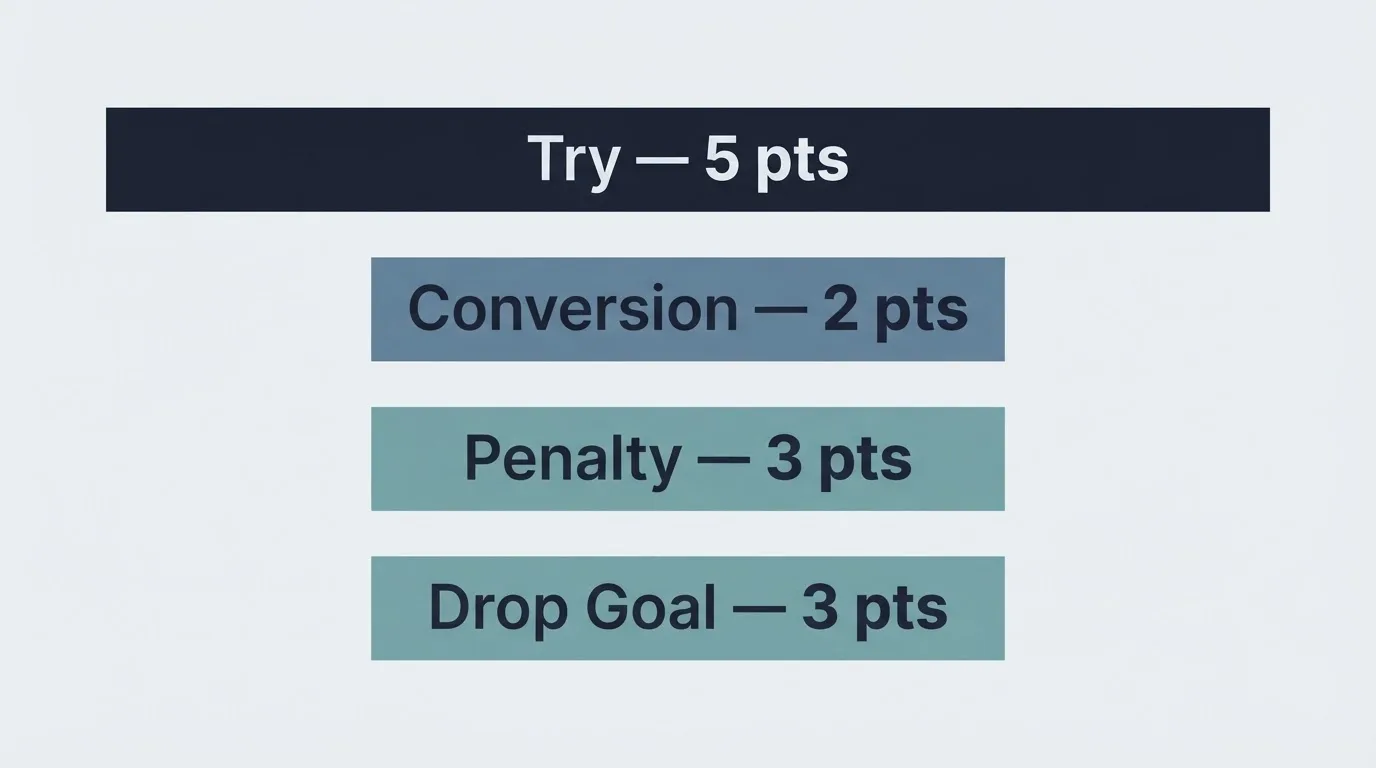
The club scene runs on a different clock. The English Premiership, the United Rugby Championship in Scotland, Wales, Ireland, Italy and South Africa, and the French Top 14 set the club calendar; the European Rugby Champions Cup and the Challenge Cup sit across them. A rugby union team fields fifteen players, the match is two 40-minute halves, and stoppage time does not count so games run longer than 80 minutes on the clock. Scoring is 5 points for a try, 2 for a conversion, 3 for a penalty and 3 for a drop goal.
The depth of markets on each competition varies. The Six Nations and the Rugby World Cup carry the deepest menus — match result, handicap, total points, first try-scorer, half-time / full-time, winning margin, and outright tournament winner. The Premiership carries a similar menu on selected televised matches and a narrower menu on the rest of the fixture list. The Championship, the second tier of English rugby, and the lower leagues carry only the basics, and most operators mark fewer markets on them. Internationals outside the Six Nations — July tours, the Pacific Nations Cup, the autumn internationals — sit somewhere in between, with the autumn fixtures carrying more depth than the summer tours because the volume of betting money is higher.
The ante-post market — the outright tournament winner priced months before kick-off — is where rugby union rewards early money. A World Cup winner taken before the pools are decided returns a much bigger price than a side backed after the quarter-finals have separated the field. The catch is non-runner risk: a side that pulls out of the tournament, or a player who is injured before the tournament starts, can void the bet at the operator’s discretion under its ante-post rules. Rule 4 deductions apply on specific named players; a star player ruled out of a tournament can knock a few points off the ante-post price in the days after the news. A punter taking an ante-post price on a Rugby World Cup outright should read the operator’s non-runner rule and its Rule 4 schedule before placing the bet.
In-play on the smaller competitions is patchy. Some operators suspend markets on a Championship match more often than on a Premiership one, and the live odds on the second tier can be wider apart than on a televised match. A punter who in-plays regularly is better off picking one or two operators with good coverage of the competitions they follow than spreading stakes across all ten.
The cluster of competitions that carries the most betting volume is the Six Nations, the autumn internationals, the Rugby World Cup, the Premiership and the European tournaments. A new punter sticking to those five can find a market at every licensed operator; a more experienced punter who follows the lower leagues or the women’s game can find narrower menus and on at least one site a near-bespoke service.
The top 10 rugby union betting sites in Great Britain
The ten brands below all hold a Gambling Commission remote licence for Great Britain as recorded against the Commission’s public register on the access date given below. None is licensed outside Britain where it is licensed inside, the register’s access date matters, and a punter who wants a live check on a brand can search the register by name, domain or account number. The table gives the licence number, the licence holder as the Commission lists it, and a one-line statement of what the operator’s own terms say about rugby union — the same matters at every brand, so the column reads across cleanly.
Rugby union: the operators at a glance
| Brand | Licence | Licence holder | Rugby union on the operator’s terms |
|---|---|---|---|
| Fitzdares | 000400-R-103839-030 (Commission account 400) | Fitzdares Limited | Cash out, accas, Lucky 15s and ante-post on rugby among other sports |
| Bet Ahoy | 100094-R-341742-003 (Commission account 100094) | Bet Ahoy Ltd | Welcome structure includes a £5 acca slot on a first sports bet |
| Betway | 039372-R-319367-029 (Commission account 39372) | Betway Limited | Free Bet Club pays up to £10 weekly after opt-in |
| Fafabet | 057385-R-333191-006 (Commission account 57385) | Taichi Tech Limited | Best Odds Guaranteed on UK and Irish racing; selected outright extensions |
| Betfair | 039439-R-319330-013 (Commission account 39439) | PPB Counterparty Services Limited | In-play, Bet Builder, free live streaming on selected events |
| NetBet | 039170-R-319343-032 (Commission account 39170) | Netbet Enterprises Limited | Daily Boosts, Profit Boosts, Bet Builder with instant dynamic odds |
| Kwiff | 044448-R-323408-017 (Commission account 44448) | Eaton Gate Gaming Limited | Surprice boosts are the signature feature; in-play on selected events |
| Star Sports | 009177-R-104555-019 (Commission account 9177) | Star Racing Limited | Telephone trading on 08000 521 321 alongside the app and site |
| Dabble | 065677-R-340363-005 (Commission account 65677) | Dabble Sports UK Ltd | Welcome structure back in free bets on a first deposit |
| Midnite | 101839-R-342850-001 (Commission account 101839) | Midnite Limited | In-play, acca builder, price boosts with maximum-stake limits |
Fitzdares — Premium pitch and a rugby union menu
Fitzdares holds licence 000400-R-103839-030 against the account number 400, and the licence holder on the register is Fitzdares Limited. The app offers cash out, accumulators, Lucky 15s, specials and ante-post markets on horse racing, football, tennis, rugby, cricket, golf and American football, and pairs them with in-play live odds. The fit is a punter who treats rugby union as one sport in a wider book — the rugby menu sits on the same screen as the racing menu, and the ante-post lines on the Six Nations and the Premiership are easy to find. The handicap does not favour the live-only rugby fan, because cash-out and in-play are present but not the centrepiece. The verdict: a strong choice for the multi-sport punter who runs an acca over the weekend and wants a single app across racing, football and rugby.
Bet Ahoy — A first-deposit free bet club for a new punter
Bet Ahoy holds licence 100094-R-341742-003 against the account number 100094, with Bet Ahoy Ltd as the licence holder. The welcome structure is “Bet £10 & Get £10 in Free Bets”, split as a £5 sports bet and a £5 acca. The approach suits a punter trying a new book on rugby union for a single weekend — the £5 acca slot takes a small Six Nations or Premiership multi, and the £5 single covers a match-result market. The constraint is the welcome expiry; the offer is for new customers on a first deposit, and the free bets are time-limited. The verdict: a useful trial offer rather than a long-term home for a rugby punter, and the acca slot moves well on a Six Nations Saturday.
Betway — A weekly free bet club that runs through a season
Betway holds licence 039372-R-319367-029 against the account number 39372, with Betway Limited as the licence holder. The weekly Free Bet Club pays up to £10 in free bets after opt-in, split as 2 × £5, after spending £25 or more on sports in a week. The fit is a punter who bets across a Premiership weekend and earns the next week’s free bets inside the same club. The marginal benefit is the recursiveness: a punter who keeps the £25 weekly spend can fund a small rugby stake every Saturday for the whole season. The cap is that free bets at most operators exclude certain markets; the eligible list is on the operator’s terms. The verdict: well suited to a disciplined weekly punter with a steady £25 stake, less so to a tournament-only punter who bets heavily twice a year and idle in between.
Fafabet — Best Odds Guaranteed and a racing-first book
Fafabet holds licence 057385-R-333191-006 against the account number 57385, with Taichi Tech Limited as the licence holder. The headline feature is Best Odds Guaranteed on UK and Irish horse racing win and each-way bets from 9am on race days, with the bigger of original and starting price paid. The BOG rule does not extend across the board to rugby union outrights, but selected tournament markets carry a similar promise. The fit is a punter whose rugby union stake is the outright winner market on the Six Nations or the World Cup, where ante-post pricing is the volume trade. The verdict: strong on outright tournament value; less central on a week-to-week rugby menu than the football-first brands.
Betfair — In-play, Bet Builder and a streaming edge
Betfair holds licence 039439-R-319330-013 against the account number 39439, with PPB Counterparty Services Limited as the licence holder — the same parent that runs Paddy Power, so a punter betting on both brands is at one licensee. The site offers in-play betting, Bet Builder, free live streaming of events such as UK and Irish horse racing and football, and a 90 Minute Payout market. Rugby union is part of the in-play menu, and a punter who values the live stream on a wider range of sports than most operators is well served. The 90 Minute Payout market pays out if the selected team goes two goals ahead in football; it is not a rugby union market but the structure shows how the operator handles mid-game changes. The verdict: a heavyweight choice for a punter who wants a deep in-play rugby union menu and a free stream of selected matches.
NetBet — Daily boosts and a Bet Builder with dynamic odds
NetBet holds licence 039170-R-319343-032 against the account number 39170, with Netbet Enterprises Limited as the licence holder. The site offers Daily Boosts, Profit Boosts, free bet offers, a Bet Builder with instant dynamic odds, and sports stats for major leagues. The Bet Builder on rugby union is the distinguishing feature for a punter who likes to combine markets inside a single match — try-scorer, total points, handicap, and team-to-score-first into one price. Daily Boosts run on rugby union weekends, and a punter who treats the Saturday menu as the central habit will find enough to keep the betting slip active. The verdict: a useful home for a bet-builder punter on rugby union; the daily boost schedule is the centrepiece rather than the welcome structure.
Kwiff — Surprice boosts and a thinner core book
Kwiff holds licence 044448-R-323408-017 against the account number 44448, with Eaton Gate Gaming Limited as the licence holder; the app carries a 17+ age rating in the App Store. The signature feature is the Surprice boost — random odds upgrades applied to selected bets on cricket, football and other sports. Rugby union is covered, but the Surprice mechanic lands on a menu that is narrower than the heavyweight brands. The fit is a punter who values the surprise upgrade more than the depth of the rugby menu. The verdict: a quirky second book for a punter who already has a main account, rather than a primary site for a rugby union regular.
Star Sports — A telephone desk and a long-tail book
Star Sports holds licence 009177-R-104555-019 against the account number 9177, with Star Racing Limited as the licence holder. The site gives a telephone number — 08000 521 321 — on the App Store listing for opening an account, placing bets, or asking questions; email is also listed. The telephone desk is the differentiator on a rugby union autumn weekend when a large ante-post bet on the World Cup outright is best placed by voice. The fit is a higher-stake punter who values speaking to a trader. The verdict: a strong choice for the ante-post punter; less central for a smaller-stake, online-only customer.
Dabble — A back-in-free-bets welcome on a first deposit
Dabble holds licence 065677-R-340363-005 against the account number 65677, with Dabble Sports UK Ltd as the licence holder. The welcome structure is “Bet £10, Get £10 in Free Bets” on a first deposit for new customers, with a minimum-odds rule, a 7-day free bet expiry and the stake not returned. The structure is close to Bet Ahoy’s and serves a first-time rugby union punter on a single weekend. The constraint is the 7-day expiry on the free bets, which tightens the window between claiming and using. The verdict: a one-off welcome, useful as a trial rather than a long-term account.
Midnite — In-play, acca builder and price boosts with stake limits
Midnite holds licence 101839-R-342850-001 against the account number 101839, with Midnite Limited as the licence holder. The site shows in-play events, an acca builder, popular accas and price boosts with maximum-stake limits. The welcome offer is a £25 free bet bundle for new customers who bet £5 or more at EVS (2.0) or greater within 14 days of sign-up, plus 50 free spins valid for 7 days. The rugby union fit is on the live side — in-play and price boosts are the centrepiece. The constraint is the maximum-stake limit on the boost prices, which can be small. The verdict: a competitive second book for a rugby union punter who likes accas and in-play.
Online rugby union betting in Great Britain: the core facts
Rugby union betting in Britain sits inside the same framework as every other sport under the Gambling Commission’s remote-betting licence, but the sport carries its own shape. A rugby union team fields fifteen players across two 40-minute halves, scoring is 5 points for a try, 2 for a conversion, 3 for a penalty and 3 for a drop goal, and stoppage time is not counted so games usually run longer than 80 minutes. World Rugby has governed the sport since 1886; the first Rugby World Cup was held in 1987 and won by New Zealand. The 2027 Rugby World Cup runs in Australia from 1 October to 13 November 2027 across 24 teams in six pools of four, and the 2023 final was won by South Africa over New Zealand, which makes the Springboks the defending champions.
The Rugby Premiership in England, the United Rugby Championship across five home nations and South Africa, the French Top 14, and the cross-border European competitions make up the club calendar. International fixtures run the Six Nations in February and March, summer tours in June and July, and the autumn internationals in October and November; the World Cup sits every four years, with the next at the end of 2027. The licensed market prices these competitions heavily, and the depth of markets on each varies — Six Nations, Premiership and the World Cup carry the deepest menus, while second-tier fixtures and the women’s game carry the basics.
A punter betting on rugby union in Great Britain should know four things before placing a stake. First, every licensed operator verifies identity before the first deposit, so anonymous play is gone; second, the 10x bonus cap introduced on 19 January 2026 means no wagering requirement can ask for more than ten times the bonus amount; third, free bets are stake-not-returned, so the headline number on a winning free bet overstates the cash equivalent; fourth, the bookmaker’s margin on a rugby union two-way market at example odds of 1.90 / 1.90 is around 5%, against closer to 12% on a three-way market at the top of a tournament.
The market works for the punter who treats it as a margin rather than a sport. A small edge — 1% to 3% — compounded over a season and across multiple operators is the path that seasoned rugby union punters take; the path that does not work is staking bigger on a single tournament to recover a bad Saturday. The licensed operators carry deposit limits, time-outs, GAMSTOP, and a Commission complaints route, and the punter who uses these tools before a season starts pays nothing extra for doing so.
How rugby union betting is licensed in Great Britain
The regulator is the Gambling Commission, a non-departmental public body sponsored by the Department for Culture, Media and Sport, and the law is the Gambling Act 2005 (with the Gambling (Licensing and Advertising) Act 2014 amending it for remote operators). The Act covers Great Britain — England, Scotland and Wales — and Northern Ireland sits outside it under an older regime, so a Great Britain licence regulates services to customers in Great Britain, not in Northern Ireland. The Commission’s public register is the whole test of whether a brand holds a licence, and every operator detail on this page comes from the register read on the access date given in the introduction.
A bookmaker whose remote facilities are used in Great Britain needs a Commission licence wherever it is based — sections 33 and 36 of the 2005 Act as amended make offering unlicensed remote gambling to British customers an offence. A Curaçao, Maltese or Gibraltar licence is not a substitute, and the customer who bets on an unlicensed site loses the protections the licence carries: no GAMSTOP coverage, no Commission complaints route, no approved dispute-resolution body, no British consumer redress if funds are withheld, and not subject to the 10x bonus cap or the £150 vulnerability check. Enforcement runs through cease-and-desist notices, search-engine referrals, work with registrars, hosts and payment providers — not through ISP blocking. The honest framing is: licensed means checks, limits, GAMSTOP, the bonus cap and the dispute route, with verification before the first bet; unlicensed means none of those, with no guarantee the funds come back.
The minimum age is 18, and name, address and date of birth are verified before the customer can deposit or gamble, including with a free bet or bonus. Since 7 May 2019 this has been a licence condition; the verification happens against public records and may include a soft credit check that does not appear on the customer’s file. Identity verification prevents anonymous play at every licensed site.
Spread betting sits in its own regulatory frame: the Financial Conduct Authority regulates spread betting on a financial index, and the Gambling Commission regulates spread betting on a sporting outcome; the two regimes are not the same, and losses on a sporting spread bet can exceed the original deposit, which is the regulatory line that the operator displays prominently on every contract. Spread betting is offered in Britain under a separate licence category from fixed-odds, but the safer-gambling rules — GAMSTOP, the financial vulnerability check, the deposit limit — apply across both.
The current bonus cap rules (in force from 19 January 2026) put a 10x ceiling on wagering requirements on cash bonuses; a £10 bonus that once needed £500 of bets at 50x rollover is now capped at £100. Mixed-product promotions — an offer that requires gambling on two or more product types such as betting and casino — are banned. The reach of the cap over free bets with no wagering condition, and any cap on the money value of a bonus, is not settled in the published Commission guidance and should be read from each operator’s current terms.
The player pays no tax on betting winnings in Great Britain. General Betting Duty is the operator’s tax on gross profits, currently 15%; from 1 April 2027 a new remote betting rate of 25% applies within it, with remote bets on UK horse racing, self-service terminal bets, pool betting and in-person betting staying at 15% (HM Government policy paper of 26 November 2025). Whether operators pass duty on through odds is not established, and the player is not charged duty.
Advertising is not licensed by the Commission. The CAP Code (non-broadcast) and the BCAP Code (broadcast), enforced by the ASA, run alongside the LCCP marketing conditions. CAP Code section 16 says marketing must be socially responsible, must not be of strong appeal to under-18s, and no one who is or seems to be under 25 may be featured gambling or play a significant role in a gambling advertisement. “Whistle-to-whistle” — no betting advertisements on TV from five minutes before a live sporting event to five minutes after it, before the 9pm watershed, with horse and greyhound racing excluded — has been in force as an industry code since 1 August 2019. The Premier League clubs’ withdrawal of gambling sponsorship from the front of matchday shirts from 2026/27 is voluntary, not law.
The account-level protections — deposit limits, time-outs, GAMSTOP self-exclusion, and the financial vulnerability check above £150 in net deposits over 30 days — sit across every licensed remote operator. A punter who reads the operator’s safer-gambling page before opening an account can set a deposit limit, switch on a time-out, and pre-register with GAMSTOP. Each one of those moves is reversible on the customer’s side without operator approval.
Frequently asked questions
How does rugby union betting work in Great Britain?
Rugby union betting in Great Britain is run by operators who hold a Gambling Commission remote licence, and the rules apply nationwide under the Gambling Act 2005. A licensed operator verifies your identity before the first deposit, lets you set your own deposit limit, and pays winning bets at the decimal odds shown on the slip. Returns are stake × odds, and a winning £10 stake at 3.00 returns £30 in total. The bookmaker’s margin is taken out of every market, and a two-way rugby union market at example odds 1.90 / 1.90 has a margin of around 5%.
How do I bet on rugby union?
Open an account with a licensed operator, complete the identity check, deposit using a debit card or bank transfer, and pick a market — match result, handicap, total points, first try-scorer, outright tournament winner. Stake the chosen amount, confirm the bet on the slip, and the bet is registered. Winnings on winning bets are paid back into the account balance at settlement; free bet winnings are paid back at the same point but exclude the free bet stake itself.
How do I check that a bookmaker holds a Gambling Commission licence?
Go to the Gambling Commission’s public register on its website and search by business name, trading name, domain or Commission account number. The register entry shows the licence number, the licence holder and the categories under which the licence was issued. A brand that does not appear on the register is not licensed for Great Britain, and betting with an unlicensed brand is at the customer’s own risk.
How is the return on a bet worked out from the stake and the odds?
In decimal odds, the return is stake × odds: a £10 stake at 2.50 returns £25 in total, of which £15 is profit and the £10 stake is also returned. The stake is part of the return on a winning cash bet; on a free bet, the stake is not returned, so the £10 free bet at 2.50 returns £25 in profit and a return figure of £25, not £35. A combination bet multiplies the legs, so a double at 2.00 and 3.00 has combined odds of 6.00 and pays £60 from a £10 stake if both legs win.
What is the bookmaker’s margin, and how can it be seen in the odds?
The margin is the cut the bookmaker keeps from every unit bet on a market, baked into the odds. For a two-way market at example odds of 1.90 / 1.90, the payout share is about 95% and the margin about 5%; for a three-way market at example odds 1.45 / 25.00 / 4.50, the payout share is about 88% and the margin about 12%. Lower margin means better value for the punter; the margin is the same number regardless of which way the market closes.
How do fractional odds such as 5/1 convert to decimal odds such as 6.00?
To convert fractional odds a/b to decimal, divide a by b and add 1. So 5/1 becomes 5 ÷ 1 + 1 = 6.00, and 11/4 becomes 11 ÷ 4 + 1 = 3.75. Evens (1/1) becomes 2.00, and odds shorter than evens — odds-on prices — produce decimals below 2.00. The British betting slip displays the fractional form by default and the online slip the decimal form, and the two are interchangeable descriptions of the same market.
Rugby, cricket & Gaelic – Fast Payout
Content created by the «Fast Payout» team
