
American Football Betting Odds — A Guide for GB Punters
 Available in US
A punter looking at American football betting odds in Great Britain meets the sport through a bookmaker’s screen, and the screen decides what those odds appear to be. Behind every line sits a margin — the slice of every pound staked the bookmaker keeps — and the margin is what makes the price move between firms on the same match. This page is about that picture: how the odds are built, what the licensed bookmakers offer on American football, and what the numbers cost the punter who bets them.

Snapshot: figures current as of 27 October 2026, verified against the Gambling Commission’s public register and each operator’s own published terms.
The shape of American football, before the betting begins
American football is played by two teams of eleven on a rectangular field, four fifteen-minute quarters running to sixty minutes of regulation. Each side fields offence, defence and special teams in turn, and the ball advances by run or pass until a tackle, an incomplete pass, or a turnover stops the drive. Scoring is what every spread and total turns on: a touchdown is six points, the extra-point kick that follows is one and a two-point conversion run or pass is two, a field goal is three, and a safety — awarded to the defence when it tackles an opponent in its own end zone — is two. The kicker, the quarterback and the line matter more than they do in any other sport the British market offers.
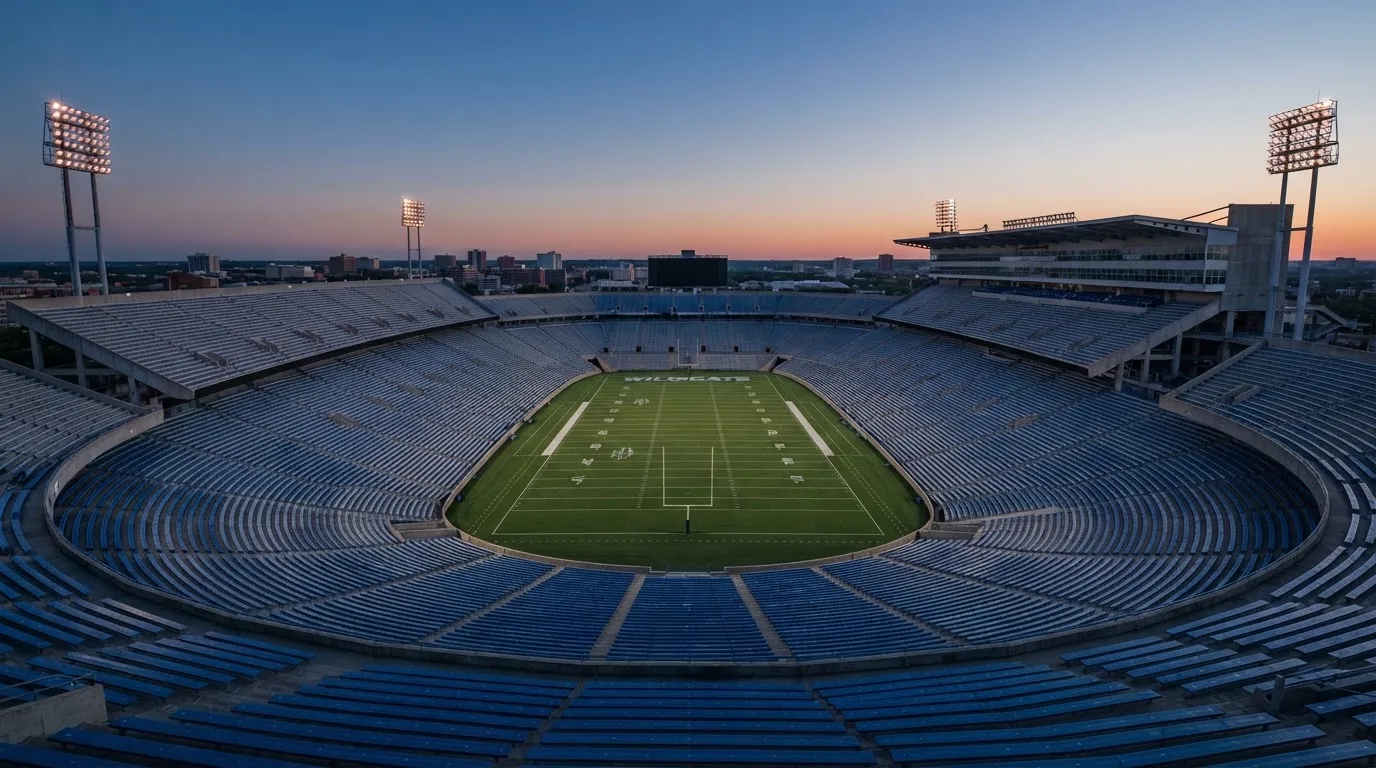
The professional game in the United States is the National Football League, 32 clubs — sixteen in each conference — playing seventeen games across an eighteen-week regular season; seven teams per conference reach the single-elimination playoffs. The post-season ends with the Super Bowl, the championship final. Super Bowl LX was played on 8 February 2026 at Levi’s Stadium in Santa Clara, California, and the Seattle Seahawks beat the New England Patriots 29-13, with Kenneth Walker III named Most Valuable Player. Below the NFL sits the college game, run by the National Collegiate Athletic Association, and north of the border the Canadian Football League plays on a larger field with three downs rather than four and twelve players per side rather than eleven.
American football divides into discrete possessions, and each possession can end in a score, a punt, a turnover, or a failed attempt. That rhythm is what the betting market builds prices around: a drive ends, the bookmaker reprices, and in-play markets follow the sequence rather than a clock.
How odds are priced and what they hide
A betting market is a bookmaker’s view of every outcome a punter can back, priced so that the implied probabilities add up to more than 100 per cent. The gap between 100 and the sum is the margin, and the margin is the bookmaker’s expected profit on the market before any individual outcome is settled. Take the simplest two-way line — a match priced 1.90 against 1.90 in decimal odds. The implied probability of each side is one divided by 1.90, roughly 52.6 per cent, and the two add to 105.3 per cent. The five-point-three percentage points above 100 are the margin: roughly 5.3 per cent of every pound staked across the market goes to the bookmaker in expectation, and the punter receives 94.7 pence of return for every pound bet on a balanced book. This is the prescribed calculation: a margin of around 5 per cent on a symmetrical 1.90/1.90 two-way line, stated as a band because real bookmakers rarely price an NFL game at exactly 1.90 on both sides.

The margin does not change the headline price much. A market at 1.91 against 1.91 carries a margin of roughly 4.7 per cent, and a market at 1.85 against 1.85 carries a margin closer to 8.1 per cent. The point is that a difference of five or six hundredths in decimal odds is the difference between a thin-margin sharp book and a recreational price, and that difference compounds across a season of bets. A punter who backs the same side at 1.85 instead of 1.95 loses roughly 5 per cent of expected return on every wager for no reason visible at the slip.
American football is structurally friendly to a tight margin. Possessions are long, scoring is bunched rather than continuous, and the favourite wins more reliably than in football or basketball. Bookmakers can therefore price pre-match lines with a smaller overround than they would on a high-variance sport. In-play margins are wider because the book has to reprice continuously, but pre-match NFL spreads, moneylines and totals at a licensed firm will typically run with margins that compete with anything on the site.
Markets available on the NFL and college football
A GB-licensed bookmaker offers American football through three families of market. The first is the moneyline, a bet on which side wins — including overtime unless the operator’s rules say otherwise. The second is the point spread, a handicap applied to the favourite so that the favourite must win by more than the line, and the underdog must either win or lose by less than it; if the adjusted margin lands exactly on the spread, the bet is a push and the stake is returned. The third is the total, also called the over/under, a line on the combined points scored by both teams with the same push rule at the exact number.
Beyond those three families sits the prop market. Player props price individual performances — a quarterback’s passing yards, a running back’s rushing attempts, a receiver’s receptions — and game props price events like the first team to score, the result of the opening drive, or whether the match goes to overtime. Same-game multiples, sold as Bet Builder at bet365 and as Acca Builder at Midnite, combine several selections from one match into a single bet; the price is the product of the legs, and a single losing leg voids the whole bet. Bet Builder+ at bet365 extends the format in-play markets.
The futures market covers season-long bets: the Super Bowl winner, each conference’s champion, division winners, regular-season win totals, individual awards. A futures book runs a wider margin than a single match because the bookmaker is exposed across many weeks, and lines move on news — an injury, a trade — rather than on the scoreboard. The futures section is also where outright bets on college football’s national championship live, alongside Heisman Trophy markets and win totals for the major conferences.
Live betting and cash out on American football
In-play betting on American football is well suited to the sport because the action stops every few plays. Drive-by-drive pricing is the norm at firms that take in-play seriously: after each series the book reprices the moneyline, the spread and the next-drive total, and the punter bets between plays rather than between matches. Bet Builder+ at bet365 extends the same format in-play markets, combining selections from one live match into a single bet whose price recalculates as each leg moves. Midnite lists live events across the screen and surfaces an in-play tab on its app.
Cash out is the mechanism that lets a punter settle a bet before the match is over, book closing the position at a price the operator sets. The price is the operator’s view of what the bet is worth at that moment, and it sits inside the live margin. A bet that would pay £100 at full-time might cash out at £70 with twenty minutes left; whether £70 is a fair settlement depends on what the operator’s model says the bet is worth at that point. Cash out is not a separate market and not a separate price — it is the same in-play book expressed as a button.
Live streaming, where the operator shows the match inside the app or site, is a separate decision. Betfair Sportsbook offers free live streaming of events including UK and Irish horse racing and selected football matches, and the same in-house feed carries some American football during the NFL season. bet365 also offers live streaming of events worldwide alongside its in-play betting and a Live Golf Tracker; whether a specific American football game streams depends on broadcast rights in the country the punter is watching from. Swifty Sports lists live streaming alongside in-play betting and a coming-soon Bet Builder. For NFL fixtures, streaming inside a GB-licensed app is patchy because the league’s domestic broadcast rights sit with US networks.
Bonuses and free bets on American football
Bookmaker offers in Great Britain come in three shapes. The first is a deposit bonus, an extra sum tied to a first deposit and unlockable only by meeting a wagering requirement. The second is a free bet — a stake the operator credits, usually with the winnings paid and the stake returned only if the punter asked at the time the offer was framed; the stake of a free bet is usually not paid back with a win. The third is the price boost, an enhanced price on a specific market offered to existing customers. Each shape carries a different cost, and the cost is what determines whether the offer is worth taking.
Unibet’s sports welcome is “Get £40 in Free Bets when you bet £20”: a deposit and a sports bet of £20 or more at minimum odds of 2.0 (1/1), with free bets expiring within seven days of issue, for new GB customers using a debit card or instant bank transfer. The headline frames £40 as the gift, but the £20 stake has to land before any free bet is issued, the qualifying bet is at minimum odds, and the free bet expires a week after issue. A punter who backs a 2.0 shot with £20 sees £40 in free bets credited if the bet wins, and nothing if it loses; the qualifying bet itself is settled at the operator’s margin. BetTom’s sports welcome offers 50 per cent back as a free bet of up to £50 alongside a separate 50 per cent back up to £50 as free slot funds for the casino, the casino half running on its own wagering requirement rather than the sports side. Vbet’s sports welcome is a £10 free bet if a new, verified customer stakes £10 or more on a first-ever bet that loses, so the offer only credits when the qualifying bet loses — it is the only one of the three that returns something on a losing selection.
Promotion rules that took effect on 19 January 2026 cap wagering requirements on bonuses at 10x — a £10 bonus at 50x would need £500 of qualifying bets — and ban mixed-product promotions such as a sports bet that unlocks casino free spins. The cap applies to wagering, not to the headline money value of an offer. “Risk-free” is the marketing word the industry uses for a refund in free bets, and “free bet” is the marketing word for a stake that is not paid back with a win. Both words describe what the offer is, and both are best read alongside the small print.
Predictions, tipsters and what the page can and cannot do
Predictions and tipsters on American football are an industry rather than a fact, and the page can say only what they cost. A tipster is somebody who sells forecasts on individual matches — sometimes free on social media, sometimes behind a subscription — and the punter who follows a tipster pays either money, attention, or both. No tipster can know an outcome before it is played, and the long-run record of a tipster is what the punter is buying. A track record over hundreds of bets at a verifiable bookmaker is more useful than a hot streak over a weekend. American football has fewer professional tipsters than association football, and the college game has fewer still — most tipping concentrates on the NFL.
Bankroll management is the only technique the punter owns rather than buys. The simplest rule is to stake a fixed percentage of the bank on each bet — one per cent or two per cent — so that a losing streak does not wipe the bank and a winning streak compounds. The line that the bookmaker publishes is a price, not a forecast, and the punter’s edge, if any, is in spotting prices that look mispriced rather than outcomes that look likely. A forecast that a side will win is a forecast; a price that pays 2.50 on a side the model says should be 2.20 is a bet. The distinction is what separates betting from tipping.
What the page does not do is name who will win a given match. Nobody can know an outcome, and a reader who acts on a forecast they read here loses real money on the page’s word. The arithmetic presented here is for the punter’s understanding of the market, not a tip on which side to back.
Spread betting and the FCA-regulated side of the market
A separate market runs alongside fixed-odds betting, regulated not by the Gambling Commission but by the Financial Conduct Authority: financial spread betting, in which the punter’s profit or loss is the difference between the price at which they open a position and the price at which they close it, multiplied by their stake per point. Losses on a spread bet can exceed the original stake, and the operator’s own terms say so. Spreadex runs both fixed-odds sports betting, licensed by the Gambling Commission, and spread betting on sports and financial markets, licensed by the FCA, and the two businesses are governed by different regimes with different redress routes.
Financial spread betting on the NFL is a margin and a direction. A punter who buys Super Bowl points at, say, 47.5 profits if the total points scored land above that number by the time they close the position, and loses if the total lands below. The leverage — the stake per point — is what makes the gain and the loss both larger than the fixed-odds equivalent. A £1-per-point stake on a five-point move returns £5 either way, and a ten-point move returns £10. The fixed-odds equivalent on a total-points bet pays the same amount for the same selection but caps the loss at the stake.
The page covers fixed-odds betting on American football; financial spread betting is mentioned here because the FCA-regulated side of Spreadex is part of the landscape, and the punter looking for American football prices will meet both products on the same screen. The two are not interchangeable: one is a bet with a stake and a return; the other is a leveraged position with a stake and a margin call.
What the bookmakers’ own terms say about American football
Licensed bookmakers write their own rules for American football in a dedicated section of the sports rules — Sky Bet’s “American Football Rules (NFL/CFL/NCAA)” runs through game completion, overtime, player props and the push rule on spreads and totals, and is the kind of document the punter reads before staking on an unfamiliar market. The push rule is the most important term: a handicap or total that lands exactly on the quoted line is a push and bets are made void unless a tie was offered as a selection. A punter who backs the favourite giving 3.5 points and the favourite wins by exactly four is a winner; who backs the favourite giving 4 points and the favourite wins by exactly four is back where they started.
Player prop rules are operator-specific. Most count statistics only in regulation, with overtime excluded unless the operator’s terms say it is included; some count combined passing and rushing yards for a quarterback, others separate them. Dead-heat rules apply when two players tie on a market — first touchdown scorer is the obvious example — and the operator’s reduction factor on the stake is set out in the rules. Settlement usually waits for official league data; a stat corrected after settlement does not normally lead to a re-settlement.
In-play rules during American football cover timing and suspension. Markets suspend at kick-off and unsuspend after the first play, then suspend at the end of each drive and unsuspend when the next drive starts; the punter who tries to place a bet during a suspension has the bet rejected. A bet placed between plays that the operator has already repriced may settle at the larger price if the selection wins, and at the smaller price if it loses, depending on the operator’s price-feed timing. Cash out during a suspension is normally unavailable, because there is no current price to offer.
How to read the comparison of licensed bookmakers
Ten brands sit on the Gambling Commission’s public register holding a remote general betting standard (real events) licence, and the ten are reviewed below. The table that follows carries the licence number, the licence holder and what the operator’s own published terms say on the key’s subject — Best Odds Guaranteed on horse racing, Bet Builder on football, the welcome offer’s shape — and the prose after the table picks out where each brand earns and loses to the others. Every brand in the comparison holds a GB licence, every licence is verifiable on the Commission’s public register, and the comparison is not a ranking: a brand that pays Best Odds Guaranteed on racing is irrelevant to a punter betting only on the NFL.
The licences held by the comparison are remote general betting standard (real events) only — none of the ten run a pool betting licence, a betting intermediary licence, or a virtual events licence under the comparison. The full range of licences on the Commission’s register is wider; the comparison fixes on the betting licence that covers American football at a GB-licensed site.
The table that follows is the comparison; the reviews that follow the table are the verdicts.
| Brand | Gambling Commission licence number and holder | What the operator’s own terms state |
|---|---|---|
| Star Sports | Registration Gambling Commission remote licence 009177-R-104555-019 (Commission account 9177); licence holder Star Racing Limited | A trader line for account opening, bets and queries on 08000 521 321, plus support at [email protected] |
| Bar One Racing | Registration Gambling Commission remote licence 056516-R-332750-007 (Commission account 56516); licence holder Bar-One Racing Limited | Irish independent bookmaker with shops across Ireland, horse racing sponsorships at Dundalk, Fairyhouse, Navan, The Curragh, Curraheen Park and Cork, now branded BAR 1 Betting |
| Fafabet | Registration Gambling Commission remote licence 057385-R-333191-006 (Commission account 57385); licence holder Taichi Tech Limited | Best Odds Guaranteed on UK and Irish horse racing win and each-way bets from 9am on race days |
| BetTom | Registration Gambling Commission remote licence 064959-R-339314-003 (Commission account 64959); licence holder Bet Tom Limited | Sports welcome: 50% back as a free bet of up to £50, plus 50% back up to £50 as free slot funds |
| Fitzwilliam Sports | Registration Gambling Commission remote licence 048760-R-335434-009 (Commission account 48760); licence holder SBKI Limited | Dublin bookmaker with capped membership; “High Stakes Welcome” subject to compliance criteria; instant deposits, fast withdrawals, timeouts and deposit limits; links to GambleAware, GamStop and Gamblers Anonymous |
| Betfair | Registration Gambling Commission remote licence 039439-R-319330-013 (Commission account 39439); licence holder PPB Counterparty Services Limited | In-play betting, Bet Builder, free live streaming of UK and Irish horse racing and selected football, and a 90 Minute Payout market |
| Unibet | Registration Gambling Commission remote licence 045322-R-324275-019 (Commission account 45322); licence holder Platinum Gaming Limited | Operating since 1999; sports welcome of £40 in Free Bets on a £20 qualifying bet at minimum odds of 2.0 (1/1), free bets expiring within 7 days |
| Swifty Sports | Registration Gambling Commission remote licence 058957-R-334734-006 (Commission account 58957); licence holder Swifty Global (UK) Ltd | Best Odds Guaranteed, Cash Out on horse racing and football, daily price boosts, live streaming and in-play betting; Bet Builder listed as coming soon |
| bet365 | Registration Gambling Commission remote licence 055148-R-331498-002 (Commission account 55148); licence holder Hillside (UK Sports) ENC | Official global betting partner of the UEFA Champions League; in-play betting, live streaming worldwide, Bet Builder+ pre-match and in-play, Super Boosts, Winnings Boosts on Bet Builders and selected singles, daily Bet Boosts, Bet Track, Match Live and a Live Golf Tracker |
| VBet | Registration Gambling Commission remote licence 044662-R-324273-022 (Commission account 44662); licence holder SCGO Limited | Sports welcome: a £10 free bet when a new, verified customer stakes £10 or more on a first-ever bet that loses |
The register is the source, the operators’ own terms are the source for what each firm publishes, and no third figure is in either cell.
What each licensed bookmaker is worth to a punter who bets the NFL
The ten reviews below are the verdicts. Each one closes on a different point, because each firm’s profile actually says something different to a punter choosing between them. A page that closes ten operator blocks on the same construction has described ten firms and judged none of them.
Star Sports — a phone call before a bet
Star Sports runs a smaller operation than the international firms in the comparison, with a customer-service line that opens an account, places a bet and answers queries at 08000 521 321. A trader can be reached during office hours, and the firm also lists [email protected] for written support. The Gambling Commission licence sits with Star Racing Limited, and the firm is one of a handful of GB-licensed bookmakers that quote over the phone. For a punter who wants a human counterpart before staking on a Sunday morning game, this is the differentiator. For a punter who lives inside an app, it is not — bet365’s in-play product is what that punter wants, and Star Sports does not try to be that. The verdict: worth it for the GB punter who wants telephone access to a trader and who is happy to place bets through that channel rather than through a sportsbook app.
Bar One Racing — an Irish independent without a GB shop estate
Bar One Racing rebranded to BAR 1 Betting and is an Irish independent bookmaker whose shops sit across Ireland, with horse racing sponsorships at Dundalk, Fairyhouse, Navan, The Curragh, Curraheen Park and Cork. The Gambling Commission licence sits with Bar-One Racing Limited, and the comparison has the firm on the GB register because it serves customers in Great Britain remotely. The firm is not one a GB punter bets with for an NFL spread, because its heart sits in Irish horse racing. For a punter looking for an American football spread at a competitive price, BAR 1 Betting is unlikely to be the first port of call. The verdict: a licensed GB bookmaker, but its profile is shaped by Irish racing, and the NFL punter will find a deeper market elsewhere.
Fafabet — racing-first and American football a sideline
Fafabet pays Best Odds Guaranteed on UK and Irish horse racing win and each-way bets from 9am on race days: if the starting price is bigger than the original price, the bigger odds are paid. The gambling licence sits with Taichi Tech Limited. Best Odds Guaranteed is the headline product, and it is irrelevant to an NFL-only punter. The firm does carry American football and the larger North American leagues, but the racing terms are the part of the small print the punter reads. The verdict: a GB-licensed bookmaker whose best-known term sits on horse racing, and an NFL punter should check the firm’s American football market list before staking.
BetTom — a sports welcome paired with a casino half
BetTom’s sports welcome offers 50 per cent back as a free bet of up to £50 alongside a separate 50 per cent back up to £50 as free slot funds for casino play, each half carrying its own terms. The gambling licence sits with Bet Tom Limited. The combined welcome is two offers stacked rather than one offer spread across products — a relevant distinction after 19 January 2026, when mixed-product promotions were banned, because BetTom’s structure keeps sports and casino in separate boxes. The free bet stake is not paid back with a win, as with most sports free bets. The verdict: the welcome is competitive in shape if not headline value, and the split between sports and casino means a punter who only wants the sports half can ignore the casino half entirely.
Fitzwilliam Sports — capped membership and a high-stakes welcome
Fitzwilliam Sports describes itself as a Dublin bookmaker with capped membership and a “High Stakes Welcome” subject to compliance criteria, alongside instant deposits, fast withdrawals, timeouts and deposit limits, and links to GambleAware, GamStop and Gamblers Anonymous. The gambling licence sits with SBKI Limited. Capped membership means the firm takes a smaller customer base than a mass-market bookmaker, and the high-stakes welcome is a different product from the £20-qualifying-bet welcome at Unibet or the refund-on-loss welcome at Vbet. For a punter staking £500 a bet rather than £5, the offering is worth investigating; for a punter staking £5, the welcome is not aimed at them. The verdict: a bookmaker for the higher-stake GB punter rather than the casual one, and the American football markets at the firm deserve a look before staking.
Betfair — the exchange and the sportsbook under one licence
Betfair Sportsbook, not the exchange, is the part of the comparison here, and it offers in-play betting, Bet Builder, free live streaming of UK and Irish horse racing and selected football, and a 90 Minute Payout market. The gambling licence sits with PPB Counterparty Services Limited. The 90 Minute Payout market settles on the result after 90 minutes regardless of extra time, and the in-play product pairs with the firm’s free streaming on racing. The exchange itself is a separate product on a separate licence and sits outside this comparison. The verdict: a deep sportsbook with a unique payout structure, and a strong choice for a GB punter who likes to settle on the 90-minute whistle.
Unibet — the international brand on a GB licence
Unibet states it has operated since 1999, and its UK site is run by Platinum Gaming Limited under Gambling Commission account 45322. The sports welcome offers £40 in Free Bets on a £20 qualifying sports bet at minimum odds of 2.0 (1/1), with free bets expiring within seven days of issue and restricted to new GB customers using a debit card or instant bank transfer. The qualifying bet’s minimum price means a heavy favourite does not count, and the seven-day expiry on the free bets means a slow-staking punter loses the credit. The verdict: a GB-licensed international brand with a competitive welcome if the punter can place a 2.0 qualifying bet inside the qualifying window, and a familiar product for a punter moving from the firm’s other markets.
Swifty Sports — racing-led, with American football on the way
Swifty Sports offers Best Odds Guaranteed, Cash Out on horse racing and football markets, daily price boosts, live streaming and in-play betting, with Bet Builder listed as coming soon. The gambling licence sits with Swifty Global (UK) Ltd. The coming-soon tag on Bet Builder is the relevant fact for an NFL punter, because most of the comparison runs Bet Builder live and the absence of one reduces the in-match combinability. The verdict: a licensed GB bookmaker with a racing-led profile and a sportsbook still adding features — worth a look, but the comparison’s in-play depth sits elsewhere.
bet365 — the depth on a GB-licensed product
bet365 is the official global betting partner of the UEFA Champions League, and its app is described as the most downloaded sports betting app in the UK. The gambling licence sits with Hillside (UK Sports) ENC. The product depth is what defines the firm: in-play betting and live streaming of events worldwide, Bet Builder+ combining markets from one event into a single bet pre-match and in-play, Super Boosts, Winnings Boosts on Bet Builders and selected singles, daily Bet Boosts, Bet Track, Match Live and a Live Golf Tracker. No other firm in the comparison runs the same stack, and the depth is what an NFL punter with a serious bankroll pays the firm for. The verdict: the choice for the GB punter who wants in-play depth, Bet Builder+, live streaming, and the largest feature stack on a GB-licensed product.
VBet — the only welcome that pays back on a loss
VBet’s sports welcome is a £10 free bet if a new, verified customer stakes £10 or more on a first-ever bet that loses. The gambling licence sits with SCGO Limited. The structure means the qualifying bet’s stake is at risk in the normal way, and the offer only credits when the bet loses; a winning first bet pays out at the operator’s normal price and the free bet does not credit. For a punter who would have staked the £10 anyway, the offer is a free option on the side; for a punter staking the £10 only to chase the offer, the offer is not worth chasing. The verdict: the welcome is shaped differently from the comparison’s other welcome offers, and a punter who backs a short-priced first bet may prefer BetTom’s 50 per cent back structure.
The calculation the page earns
A 1.90/1.90 two-way line, taken as an example rather than a quoted price, carries an implied probability per side of 1 ÷ 1.90, roughly 52.6 per cent. The two sides sum to 105.3 per cent, and the 5.3 percentage points above 100 are the margin. Stated as a band rather than a single figure: a symmetrical 1.90/1.90 line carries a margin of roughly 5 per cent, with the band’s lower edge at around 4.7 per cent for a 1.91/1.91 line and its upper edge at around 8.1 per cent for a 1.85/1.85 line. The band is the picture, not the 5 per cent figure on its own.
The same calculation applies to spreads and totals. A spread at -3.5 on the favourite at 1.91 and +3.5 on the dog at 1.91 carries the same 4.7 per cent margin as a 1.91/1.91 moneyline, because the pricing logic is identical. A total at over 47.5 at 1.91 and under 47.5 at 1.91 carries the same margin. The bookmaker does not price one market tighter than another within a match — the margin is the operator’s choice and applies across the board.
The headline price at the slip is 1.91, and the implied margin is 4.7 per cent. The difference between this firm and a 1.85 firm is roughly 3.4 percentage points of margin, which compounds across a season of bets.
What to read on the operator’s site before placing the first bet
A licensed GB bookmaker’s own terms carry the rules that govern settlement, and the punter who reads them first avoids the common surprises. Six points are worth checking before staking on an American football game:
The push rule on the spread and total. A spread that lands exactly on the line is a push and the stake is refunded; a total that lands exactly on the line is the same. The punter should know whether a tie is offered as a selection, because a push on a three-way line behaves differently.
Overtime rules. Some markets count overtime toward settlement, others stop at the end of regulation. Player props usually settle on regulation only unless the operator’s rules say otherwise, and the punter should check the prop’s individual terms.
Player prop scope. Passing yards, rushing yards and receptions are the common props, and the operator’s rules say whether a player’s contribution is counted only while the player is on the field, whether combined or split, and whether post-season or all-star games count.
Settlement timing. Bets settle on official league data once the match is final, and corrections after settlement do not normally trigger a re-settlement. The punter who sees a stat correction on Monday morning has not been short-changed.
Cash out during a suspension. In-play markets suspend at the end of each drive and unsuspend when the next drive starts; cash out is unavailable during a suspension, because the operator has no current price to offer.
Withdrawal time. The licence holders listed in the comparison set their own withdrawal times, and a punter moving a stake from one firm to another should check the firm’s published payout time rather than assume a same-day transfer.
These are the terms the punter reads once per firm, and reading them once is faster than re-learning them at settlement.
The legal and regulatory frame around a GB-licensed bet
The Gambling Commission licenses the whole commercial market in Great Britain under the Gambling Act 2005. The Act covers England, Scotland and Wales; Northern Ireland is outside the Act and has its own older law, so a GB licence is not the same as a UK-wide licence. Since the Gambling (Licensing and Advertising) Act 2014, an operator whose remote facilities are used in Great Britain needs a Commission licence wherever it is based; a Curaçao, Maltese or Gibraltar licence is not a substitute. The Commission’s public register can be searched by business name, trading name, domain or account number and is the whole test of whether a brand holds a licence. Every operator in the comparison holds a remote general betting standard (real events) licence on the register.
Financial spread betting is regulated by the Financial Conduct Authority, not the Commission, and the FCA’s regime is separate from the Gambling Commission’s. A spread betting account with a firm like Spreadex runs on FCA terms and carries the FCA’s redress routes, while the firm’s fixed-odds sports betting runs on Gambling Commission terms. The punter who uses both products sits inside two regulatory regimes rather than one.
Identity verification is mandatory before a customer can deposit or gamble at a GB-licensed site, and name, address and date of birth are checked before the first stake — including on a free bet or bonus. No anonymous play is possible at a licensed site, and source-of-funds questions at higher spend are normal under the money-laundering rules. The minimum age is 18.
A financial vulnerability check applies to licensed remote betting when a customer’s deposits minus withdrawals exceed £150 in a rolling 30 days — a public-record check for bankruptcies or county court judgments, not an income check. Deposit limits are a customer-set choice rather than a state-set ceiling, and operators must offer a gross deposit limit on a fixed time frame. Credit cards are banned for gambling in Great Britain, including credit-card-funded payments through an e-waller. Debit cards and bank-based payments are not covered by that ban.
The player pays no tax on betting winnings in Great Britain; General Betting Duty is the operator’s tax, currently 15 per cent on gross profits. From 1 April 2027 a new remote betting rate of 25 per cent applies within it; whether operators pass the duty on through odds is not established.
Self-exclusion, monitoring and help
GAMSTOP is the national multi-operator online self-exclusion scheme and a mandatory licence condition for online operators; periods are six months, one year, five years, or five years with auto-renewal, and after the minimum period the exclusion stays in place for a further seven years unless the customer asks GAMSTOP to remove it. It covers online sites and apps; betting shops use a separate service. Every operator in the comparison is a GAMSTOP member, and a customer who has registered with GAMSTOP cannot open an account at any of them.
Timeouts and deposit limits are operator-level tools available alongside GAMSTOP, and a punter who wants a shorter break than six months uses a timeout. Fitzwilliam Sports links to GambleAware, GamStop and Gamblers Anonymous from its home page; other operators in the comparison carry equivalent links. The National Gambling Helpline runs through GamCare, and the NHS runs gambling clinics in several cities for face-to-face support.
The honest framing: a licensed GB bookmaker carries GAMSTOP coverage, a Commission complaints route, an approved dispute-resolution body, the 10x bonus cap, the £150 vulnerability check, identity verification before the first bet, and a duty on the operator’s gross profits. An unlicensed brand carries none of those protections, no British consumer redress if funds are withheld, and possible loss of funds. Neither is “the safe choice” by default; the comparison covers the licensed side only.
American football beyond the NFL
The comparison covers the GB-licensed side of the market on American football, but the sport on a GB sportsbook extends past the NFL. The Canadian Football League runs a twelve-player, three-down game on a larger field, and a GB bookmaker that takes NFL also takes CFL. The National Collegiate Athletic Association’s college football season runs from late August to early January, and the major bowl games plus the College Football Playoff run in December and January; lines on college football are wider than on the NFL because the talent gap between teams is bigger and the player pool is less known to a GB-licensed trading team.
The XFL and the United States Football League run in the spring, partly as alternative leagues and partly as developmental leagues, and their GB coverage is patchy. Arena football, indoor football and flag football appear at some firms during major championships, and the IFAF World Championship plus the Olympic flag-football inclusion from Los Angeles 2028 will draw lines at firms that carry them. The punter looking for the NFL should not assume a GB sportsbook carries the alternative leagues at competitive prices; the comparison reviews how each firm prices what it offers, and the punter should check the firm’s American football list before staking on a non-NFL event.
The currency of the comparison
A bookmaker’s margin is the comparison’s currency. A punter who bets the NFL pre-match at 1.91/1.91 pays roughly 4.7 per cent to the bookmaker over a season; a punter who bets at 1.85/1.85 pays roughly 8.1 per cent; a punter who bets only in-play pays more. The 3.4 percentage points between the tight and the loose bookmaker is what the punter is buying with a stake at a different firm, and the stake compounds across a season.
The welcome offers are a separate currency. A £40 free bet on a £20 qualifying bet at minimum odds 2.0 is worth roughly £40 × (2.0 − 1) ÷ 2.0 × 0.947 on the expected-payout-share assumption, roughly £19 on the kind a margin around 5 per cent implies — a number that depends on the odds the punter takes the free bet at and the margin of the market the punter chooses. A £10 free bet on a £10 losing qualifying bet is worth roughly £10 × (the free-bet price − 1) ÷ the free-bet price × 0.947 on the same assumption, and is paid only when the qualifying bet loses. The shape of each welcome is what differs; the headline number is the marketing word.
The licensed operators, the prescribed margin band and the formula of an odds-to-return conversion help a punter see what each firm charges for the right to bet. Reading the comparison and the calculation together shows what the difference between firms is worth over a season.
What the page does not do
The page does not name who will win a given match, because nobody can know an outcome. The page does not print a working bonus code, because the offers are described as each operator’s own terms state them. The page does not recommend a brand, because a brand is a tool the punter uses for a purpose and the right tool depends on the purpose. The page does not list a count of how many licensed firms exist, because the Commission’s register lists more firms than the comparison features and the comparison is the comparison rather than the whole market. The page does not print a Commission DNS-blocking statement, because the policy is announced but the powers are not yet operational. The page describes and judges the bookmakers; it does not urge a bet.
Frequently asked questions
How does a bet on American football actually work?
A bet on American football is a contract with a bookmaker: the punter stakes a sum on a selection, and the bookmaker pays the stake times the decimal odds if the selection wins, or keeps the stake if it loses. The selection can be a moneyline on which side wins, a spread on a handicap, a total on combined scoring, or a player prop on individual performance; same-game multiples combine several selections from one match into a single bet. Markets settle on the operator’s published rules, including the push rule that voids a spread or total landing exactly on the line. The bet is placed through the bookmaker’s app or website, settles when the match is final, and pays out to the punter’s account balance.
What is American football betting?
American football betting is staking on the outcomes of American football matches through a licensed bookmaker. The sport covers the National Football League, the Canadian Football League, the National Collegiate Athletic Association, and various alternative and developmental leagues. Licensed GB bookmakers offer moneyline, spread, total, player prop, game prop and futures markets on the sport, with in-play betting on selected matches and Bet Builder products that combine markets from one match into a single wager. Settlement follows the operator’s published rules, and the margin on a market is the gap between 100 per cent and the sum of the implied probabilities of every outcome.
Where can a GB punter find competitive American football odds?
A GB punter finds competitive American football odds at a licensed bookmaker, and the comparison reviews ten firms on the Gambling Commission’s public register. Pre-match NFL spreads and totals at a tight-margin firm run with margins of roughly 4 to 5 per cent; a loose-margin firm runs with margins of 8 per cent or higher. The margin is what the punter pays, and the firm’s depth on Bet Builder, in-play markets, and live streaming determines what the punter can do inside the match. BetTom, Betfair, Unibet, bet365, VBet and the other firms in the comparison carry American football markets to different depths, and the punter should check each firm’s American football section before staking.
How can a GB punter check that a bookmaker holds a Gambling Commission licence?
The Gambling Commission’s public register can be searched by business name, trading name, domain or account number, and is the whole test of whether a brand holds a licence. A punter who knows the brand’s domain enters it in the search and checks the licence type, the licence holder and the status. Every operator in the comparison is on the register holding a remote general betting standard (real events) licence, and the licence numbers and licence holders are listed in the comparison table. A brand whose domain does not appear on the register, or whose licence status is not active, is not licensed for Great Britain.
How is the return on a bet worked out from the stake and the odds?
For a single bet, the return is the stake multiplied by the decimal odds, and the net profit is the stake multiplied by (odds minus 1). A £10 stake at decimal odds 2.50 returns £25, of which £15 is net profit and £10 is the original stake. For a combination bet, the odds of the legs multiply into one price: a bet with two legs at 2.00 and 3.00 has combined odds of 6.00, and a £10 stake returns £60. The same calculation applies to a free bet whose stake is not paid back with a win: net profit is stake multiplied by (odds minus 1), and the stake is not returned. The return on a winning bet is independent of the probability of the selection winning; it depends only on the stake and the odds.
US & other team sports – Fast Payout
Content created by the «Fast Payout» team
