
Greyhound racing betting tips: reading form, finding value, and what the odds actually say
 Available in US
A “tip” on greyhound racing is one writer’s read of a race, dressed up as a prediction. Strip the packaging away and three things are doing the work: form, the betting market’s own price, and the difference between the two. None of it is a forecast of who crosses the line first. The greyhound board in this country has eighteen licensed stadia holding regular meetings under one regulator, and the same commercial logic — overround, place terms, Rule 4 — sits on top of every price a punter sees. This guide walks through how a tip is built, why “this runner is a certainty” almost never holds up once the bookmaker’s margin is taken into account, and how a small punter decides which of these bets to place at all.
Updated 27 October 2026 against the Gambling Commission’s public register for licensing checks.
How a greyhound tip is actually built
A tip is not a single number. It is a series of judgements stacked on top of each other, and each one has a chance to be wrong. Reading form is the most legible step; building a price for the race is the harder one; comparing the two to find a bet is the part most tipsters skip because it is the part most punters can’t see.

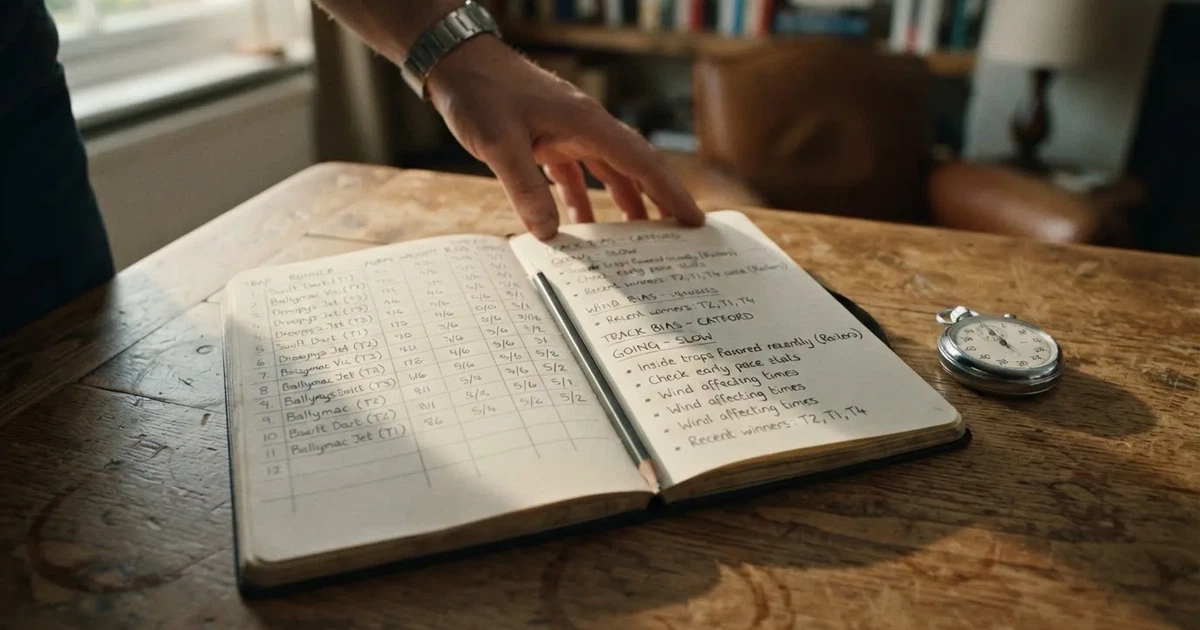
Form is the published history of a greyhound at the same track and distance class, graded for the meeting. Trap draw matters. Grade movement matters: a dog dropping from A1 to A2 often improves on paper without improving on the clock. Recent race times, sectional times when the operator publishes them, and the form of kennel-mates running that night are all inputs. None of them is a forecast. A dog that has won four from four at the track can still meet one that has won six from six at the same trip, and the betting market already knows about both of them. The work is filtering form that the market has already priced, so the bettor doesn’t pay 4/1 on a runner the bookmaker agrees should be 3/1.
Where a tip reads flat — “this dog looks great value at 4/1” without the calculation that puts the true price at, say, 3/1 — the word “value” is doing the work the form is not. That is the part to be suspicious of. A tip is a story; a value bet is a number compared to another number. The rest of this section is the bridge from one to the other.
The landscape of greyhound betting in Britain
Greyhound racing in Great Britain is regulated by the Greyhound Board of Great Britain (GBGB), which licenses eighteen stadia running under one rule book. A mechanically operated artificial lure runs along a rail ahead of the dogs, and races run as either bookmaker meetings or parimutuel pools. The dog’s name on a betting app is the same dog the GBGB has licensed a stadium to put on a track at a graded distance on a given night. New Zealand is going in the opposite direction: the Racing Industry (Closure of Greyhound Racing Industry) Amendment Act 2026, passed on 2 April 2026, ends the sport there with a phase-out set for 1 August 2026; Winston Peters announced the move on 10 December 2024. Before the ban, Greyhound Racing New Zealand ran seven affiliated clubs from Auckland to Southland. For a British punter nothing on this page changes: the supply of graded meetings continues at home.

Where the punter sits matters more than which side of the Tasman the race runs on. A bookmaker taking bets from a customer in Great Britain needs a Gambling Commission licence at the point of consumption, wherever the operator is based, under sections 33 and 36 of the Gambling Act 2005 as amended by the Gambling (Licensing and Advertising) Act 2014. A Curaçao, Maltese or Gibraltar authorisation does not substitute. The Commission’s public register — searchable by business name, trading name, domain, or account number — is the only test of who holds one. Do not assume a brand without that licence is “the same thing”. The protections are not the same thing; they are different in kind, and the difference is covered below in the section on offshore operators.
Reading the odds: what a price is and what it hides
The price the bookmaker shows is not the probability of the runner winning. It is the probability, with a margin added that pays for the bookmaker’s overhead and profit. That added margin is overround, and it is present on every market whether the punter sees it or not.
Consider a two-runner race with one dog priced at 1.90 (9/10 in fractional form) and the other at the same 1.90. That is an even-money picture the bettor might read as a 50/50 contest. It isn’t. The payout share is 1 divided by the sum of the implied probabilities: 1/1.90 + 1/1.90, or about 0.5263 + 0.5263, which equals 1.0526. The payout share is 1 ÷ 1.0526, which rounds to 95%. The margin is 100% − 95%, or 5%. A 50/50 race being offered at 1.90/1.90 is not bad — 5% is on the lower end for a two-way market — but the price itself is paying back 95p for every £1 the punter risks across both runners, before the racing takes place. The 5% is the bookmaker’s cut, and it is sitting inside the price the punter thought was a fair contest.
Move to a six-runner race priced 4.00, 5.00, 6.00, 7.00, 8.00, 12.00 (decimal). The implied probabilities sum to 0.25 + 0.20 + 0.1667 + 0.1429 + 0.125 + 0.0833, which is about 0.968. The payout share is 1 ÷ 0.968, or roughly 103.3%. Wait — that is over 100%, and a margin is normally calculated as 1 − payout share. The usual reading only works if the implied probabilities sum to more than 1. If this market sums to less than 1 it is “underround”, meaning the bookmaker is structurally paying out more than it takes in across the field — which is rare. A normal greyhound market at this kind of price band sums to between 1.05 and 1.15, which puts margins somewhere between 5% and 15%. Best-odds-guaranteed and place markets move the number around, but a 5% book is a tight one and a 15% book is a thin one for the punter.
The margin is not on the side of the bettor, and it is not the same across bookmakers or markets. Each market carries its own margin, and each operator’s book varies from day to day. A punter comparing two operators on the same race often finds the favourite a tick higher at one of them and the longshots a tick higher at the other — neither of which means “the better book” without looking at the total margin, the place terms, the rules, and the price the bookmaker will pay if the favourite drifts at the off (the starting price, or SP).
Value bets: the one concept every punter should be able to defend
A value bet is a wager whose price, after the bookmaker’s margin is stripped out, is higher than the bettor’s estimate of the runner’s true chance. The “estimate” is the hard part. Form, sectional times, kennel form, and trap draw are inputs to it, but the estimate remains a number the bettor is willing to put a stake behind.
Three points clear the air. First, a value bet can lose. The estimation is honest, the price is genuinely above it, and the runner still finishes third. Second, a value bet is not the same thing as a “good each-way bet” or a “fun outsider” — both of those skip the price comparison entirely. Third, a value bet is not identifiable from the form sheet alone; it requires a number for the bettor’s probability. If the punter can’t write the number down, the bet isn’t a value bet. It’s a punt.
This is also why no tip — published, paid-for, free, or sourced from a mate — is ever a certainty. Every value bet can lose on any given night. A long run of losing value bets does not mean the method is broken; a long run of winning non-value bets does not mean the method is good. The proof is the margin of the market and the price the bettor took, both over many wagers. That proof is the slowest thing in betting, and it is the only one that matters.
Statutory frame: what being licensed in Great Britain actually means
The Gambling Commission (UKGC) licenses the whole online commercial market under the Gambling Act 2005, which covers England, Scotland and Wales. Northern Ireland sits under older law and is outside the Act. A licence to take remote bets from customers in Great Britain is required wherever the operator is incorporated, since the 2014 Act closed the route to basing a UK-facing site under any other jurisdiction’s oversight. There is no state monopoly and no cap on the number of licences; the field is open, but each operator must individually hold one.
Licence categories relevant to greyhound betting online are remote general betting standard for real events (the racing-category licence), remote general betting limited for smaller operators, remote pool betting for pool products, and remote betting intermediary for exchanges. Betting and casino are separate permits with separate rules; a casino licence is never a betting licence. The Commission’s public register lists who holds what, and the entry is the only test of whether the brand the punter sees in an app is the same legal entity the licence names. Several consumer brands can run under one licensee (Ladbrokes and Coral; Paddy Power and Betfair) — that licence is one licence, and the punter should know who’s behind it.
Minimum age is 18 across the whole market. Identity verification — name, address, date of birth — is required before the first deposit and the first bet, including with a free bet or bonus, and the verification has been a hard requirement for licensed operators since 7 May 2019. There is no anonymous play at a licensed site. Credit cards have been banned for gambling in Great Britain since 14 April 2020, including credit-card-funded payments via an e-wallet; debit cards and bank-based payments are not covered by the ban.
GAMSTOP is the national multi-operator online self-exclusion scheme and a mandatory condition of any remote licence since 31 March 2020. Exclusion periods run six months, one year, five years, or five years with auto-renewal; after the minimum period, exclusion remains in force for a further seven years unless the customer asks GAMSTOP to remove it. GAMSTOP covers online sites and apps. Betting shops use a separate service.
A financial vulnerability check applies at any licensed remote betting operator when a customer’s deposits minus withdrawals exceed £150 in a rolling 30 days. It is a public-record check (bankruptcy, county-court judgments, similar registers), not an income check and not a credit-reference check. The check came into force on 30 August 2024 and the spending trigger took effect on 28 February 2025. Financial risk assessments — the “affordability checks” of the press — have been announced in a staged plan, with no start date established. There is no state-set deposit ceiling or loss ceiling: the limits are customer-chosen, with operators required to offer a gross deposit limit on a fixed time frame; the first phase of changes has applied since 31 October 2025, a second phase is reported postponed to 30 September 2026, and whether that second phase is live is not established.
The player pays no tax on betting winnings in Great Britain; that is general information, not tax advice, and a professional gambler is a different matter for HMRC. General Betting Duty is the operator’s tax on gross profits, currently 15%; from 1 April 2027 a new remote betting rate of 25% applies within General Betting Duty, while bets on UK horse racing, pool betting and in-person betting stay at 15%. Whether operators will pass duty on through the odds is not established, and the punter should not be told that any duty is charged on winnings.
The cost of an offer: bonus cap, free bets, and what “risk-free” actually costs
Promotion rules in force since 19 January 2026 cap wagering requirements on bonuses at 10x — meaning a £10 bonus at 50x wagering becomes impossible under the cap, with no more than £100 of playthrough required before withdrawal becomes possible — and mixed-product promotions (an offer that requires gambling on two or more product types, like betting plus casino) are banned. Whether the cap applies to a free bet whose stake is not returned with the winnings is not settled in the rules; whether the cap applies to a money-value ceiling on a bonus is also not settled. The punter should read the small print on any free bet, on whether the winnings are capped in money, and on the expiry window.
A “free bet” is a voucher the operator credits to the account after a qualifying wager settles; it is rarely paid back as a stake, even on a win, and it usually expires within seven days. Its expected value is the free-bet amount times (odds − 1) divided by odds, all multiplied by the payout share of the market it is placed on. A £10 free bet on a 4/1 shot (decimal 5.00), placed into a market with a 95% payout share, returns £10 × (5.00 − 1) ÷ 5.00 × 0.95, which is £7.60 of expected value before any expiry or restriction. Read it as 76% of the face value, on average, across many such bets — never as £50 won, never as a guaranteed return. Free bets that pay back the stake with a cap on winnings — for example, “free bet up to £50, winnings capped at £1,000” — carry both an expiry and the cap. The stake is what the punter pays upfront; the cap is what the bookmaker offers; the gap between them is the offer’s actual price tag.
A “risk-free” first bet is a refund as a free bet, not a refund in money. A losing first wager of, say, £20 settles to zero; the operator refunds £20 in free-bet credit, with the credit subject to its own terms — minimum odds, expiry, eligible markets, winnings cap. The punter has not had a free ride. The bookmaker has paid to keep the punter’s bankroll in the product.
A “boosted odds” offer is a one-off price higher than the standard line; the punter’s stake is paid back only as winnings, with the boost usually capped in money. An “accumulator insurance” pays the stake back as a free bet if one leg lets the bet down; otherwise the bet settles as a loss. A “cashback” on a settled day is a percentage of net losses credited back, usually as a free bet rather than cash, and the percentage is rarely above 10% on a greyhound meeting.
Best Odds Guaranteed (BOG) is the operator’s promise that the price paid is the higher of the price taken and the starting price at the off, on win and each-way bets. The cap is real and varies by operator — Fafabet applies BOG to UK and Irish horse racing from 9am on race days; BetGoodwin applies BOG to UK and Irish horse and greyhound racing up to £1,000. A punter who places a greyhound bet early in the morning and sees the price drift by the off collects the bigger number; a punter who places the bet at the off after a steam move collects the smaller one.
The point behind all of this is one: an offer is a price. The price is what the punter gives up (wagering, expiry, cap, eligible market, minimum odds) for what the punter receives (free-bet credit, refund, boosted odds, BOG). The arithmetic is in the small print, and so is the cost.
Mobile and app: getting a greyhound meeting onto a phone
The bulk of greyhound betting in this country is done on phones. A bet app on Android or iOS gives a punter the racing card, form when the operator publishes it, a betting slip, in-play markets where the operator offers them, BOG, and the cash-out button. The four things that decide how good the experience is: race-card legibility on the screen the punter is using; speed of in-play price updates; reliability of cash out; clarity of each-way place terms for greyhounds (which differ from horse racing place terms and vary by operator — typically three places for six or seven runners, two places for five or fewer).
A web browser book works fine for most punters. An app helps when in-play is in use, when the punter wants form alongside the betting slip, and when the operator’s BOG window opens at a specific time. Quality differences sit in the small features: racing-post form data, sectional times when published, live streaming where licensed, push notifications for the races the punter follows, and the speed at which the cash-out price updates after a leader change mid-race. None of those features is a forecast of the race; they are all racing-card plumbing.
Live betting, cash out, and the rhythm of a race
In-play greyhound markets are offered at licensed British operators, with controls set by the operator’s licence conditions and customer-protection duties — not a free-for-all, not “unrestricted” as a legal matter. A greyhound race is short — under a minute for most graded sprints — so the live market’s life is short too. A 30-second break in streaming can mean missing the only price move of any value.
Cash out pays the punter a stake-adjusted quote on an open position before settlement. It is most useful when the race is moving against the bet, the punter doesn’t fancy a redouble of nerves for half a minute, and the cash-out price isn’t a poor one for the level of pain the punter is saving. The cleanest use is the boring one: when the bet has moved into a clear profit and the punter wants to bank it without watching the last bend. A cash-out price that drops faster than the live position is a structural margin, not a market error; the bookmaker is keeping its share on every exit, including this one.
Streaming of greyhound meetings is offered by some operators under licence, typically with the GBGB-licensed tracks. A punter without a streaming subscription at the bookmaker can still bet in-play from the live data feed on the betting slip. Both routes have their uses. Neither is a tip.
Where greyhound tips live — and where they don’t
A free tip column trades on the writer’s name. A paid subscription trades on past form and the promise of an edge. A betting model trades on a backtested probability and a stake-sizing rule. None of them is a forecast on tonight’s race. The most useful guide a punter can take from any of those sources is the same one: which runners the source thinks are overpriced relative to the market, and the price the source put on that judgement.
What no source provides is a wink from a dog. Tipsters with a clean record over 200 races may still be running on a thin sample; tipsters with a stub of a record make most of their published winners on the favourites the market already had at short prices. Whether a tip is a real value bet depends on the price the punter takes, the sample size of the tipster’s record, and the margin of the market the tip is sized against. Three pieces of information. None of them is on the betting slip.
The cheapest defence is bankroll discipline. Staking more than 2% of a bank on a single race stops the bank from surviving a six-race losing streak, which is the minimum a price-driven method has to absorb. A punter increasing stakes after losses to “win it back” is the only one of these behaviours that consistently destroys a bank. Staking the same unit across every bet, or using a level of stakes proportional to perceived edge, is what survives contact with variance.
What kind of bets a greyhound meeting offers
A standard greyhound card offers win and each-way markets on every race, plus forecasts and tricasts (straight, reversed, combination), forecast betting without a banker, betting without the favourite, and trap challenges. Each-way terms on greyhounds usually pay a quarter of the win odds for one place in races of three or four runners, a fifth for two places in five-to-seven-runner races, and a fifth for three places in eight-runner fields. Place terms vary by operator and by race class; the punter should check the small print before staking an each-way.
Ante-post markets are offered on the major greyhound classics weeks before the night. The punter gets a price, but the stake is lost if the dog doesn’t line up — a non-runner rule applies. A punter taking an ante-post bet on the English Greyhound Derby trades early-price value for early-price risk. A later price on the day may be higher or lower; the punter has chosen to bear the non-runner exposure in exchange for the bet.
Spread betting on greyhound races is offered by some financial-spread-betting firms operating under FCA regulation for spread products (the FCA, not the Commission, governs financial spread betting) and is separate from fixed-odds greyhound markets at bookmakers. Spreadex, for example, runs under FCA rules for spread betting and under Commission rules for fixed-odds. The two product types carry very different mechanics: spread-betting losses can exceed the deposit — in financial spread, that is the point — while a fixed-odds greyhound bet has the stake as the maximum loss. The two products are not interchangeable, and a punter who has run a fixed-odds bank for years can still be exposed to a very different kind of loss in a financial-spread product on the same race.
Rule 4 applies when a runner is withdrawn after the betting has started: a deduction is taken from the winnings of the remaining runners and applied to the original price, scaling the return down. The table of deductions is set by the rulebook and is consistent across GB-licensed operators. A punter using multiple operators at once should check whether Rule 4 has been applied correctly on each account.
The major races and how to read them
The English Greyhound Derby, the Scottish Greyhound Derby, and the Irish Greyhound Derby are the classics of the calendar. Ante-post markets open weeks out, the cards tighten as the night approaches, and the betting volume concentrates into the finals. A punter looking for value at a Derby meeting is reading the same card everyone else is, and is rarely finding an edge that hasn’t already been priced.
Field size matters for place terms, and a Derby field of six is a different market from a graded A1 six-bend race at a smaller track. The punter should match the place terms to the field size before staking an each-way: a quarter-of-the-odds place in a six-runner race is a quarter of the win price for one place, which is a thinner bet than a fifth-of-the-odds place for two places in an eight-runner race.
Promotions cluster around the bigger fixtures, with bookmakers offering price boosts on Derby-night cards, BOG cover on the major meetings, and free-bet giveaways keyed to ante-post bets. The punter should weigh the boost against the eligibility: a price boost on a runner the punter wasn’t going to back is not a value bet, however large the price. A boost on a runner already shortlisted, on a market with reasonable place terms, is worth a second look.
Top ten UK-licensed bookmakers for greyhound racing
The ten operators below all hold a Gambling Commission remote licence. Each entry is on the Commission’s public register as a holder of remote general betting standard for real events, the category whose scope covers greyhound racing. Several brands will run under one licensee. The punter should check the licensee name on the register — the licence is for the legal entity, not the trading name on the app.
Each block states the licence details from the Commission’s public register, names the operator’s own most relevant stated terms on greyhound racing from its homepage or app store listing, and ends with this guide’s judgement on what the combination costs the punter. Where a value is not disclosed by the operator, the block says what the operator does cover rather than padding the entry.
BetGoodwin
Licence: Gambling Commission remote licence 002927-R-327985-008 (Commission account 2927), category remote general betting standard (real events), licensee Goodwin Racing Limited. Best Odds Guaranteed is paid on all UK and Irish horse and greyhound racing, up to £1,000, which is the line that makes BetGoodwin a credible greyhound book: BOG on greyhounds is the single feature that converts early-morning price-taking from a punt into a value bet, because any steam at the off is paid back to the bettor up to the cap. With a £1,000 cap, the bettor’s exposure is comfortable, the upper limit is generous, and the early-evening price on the morning card is the price paid. Suits the punter who bets early and on UK and Irish meetings.
Bar One Racing
Licence: Gambling Commission remote licence 056516-R-332750-007 (Commission account 56516), category remote general betting standard (real events), licensee Bar-One Racing Limited. Bar One Racing has rebranded as BAR 1 Betting and operates as an Irish independent bookmaker with shops across Ireland and racing sponsorships at Dundalk, Fairyhouse, Navan, The Curragh, Curraheen Park and Cork. The sponsorship footprint is a credible on-course reputation; the greyhound offer is concentrated at Irish meetings rather than UK ones. Suits the punter whose card is half-horse, half-greyhound and who wants an Irish-shop perspective on the form.
Star Sports
Licence: Gambling Commission remote licence 009177-R-104555-019 (Commission account 9177), category remote general betting standard (real events), licensee Star Racing Limited. Star Sports describes itself as the UK’s leading independent bookmaker, with virtual sports, casino, and live casino alongside the sportsbook. The independent line is the read: a non-corporate book with a UK-facing betting offer. Star Sports’ greyhound listings, from the available material, are confirmed by listings without further detail. A logical pick for the punter who wants a non-corporate, independent bookmaker.
888sport
Licence: Gambling Commission remote licence 039028-R-319297-014 (Commission account 39028), category remote general betting standard (real events), licensee 888 UK Limited. 888sport lists pre-match and in-play betting, Cash Out, Bet Builder, racing streams, BetFinder form tools, a live bet feed, and daily boosted odds. The features are racing streams and BetFinder form tools that are specifically useful for greyhound punters: a live feed with form side-by-side at a UK meeting is a real race-card experience. This mix of data and stream is a strong alternative for the punter looking for form tools.
Fitzwilliam Sports
Licence: Gambling Commission remote licence 048760-R-335434-009 (Commission account 48760), category remote general betting standard (real events), licensee SBKI Limited. Fitzwilliam Sports offers phone and live chat with the office open 09:00 to 21:00, Monday to Sunday, and messenger replies generally within 90 seconds. The hours-long human customer-service window is the standout: a punter with a bet dispute at 8pm on a Saturday has a real human on the phone. The reliable human-contact window is the standout for a punter who avoids automated chat support.
BetTom
Licence: Gambling Commission remote licence 064959-R-339314-003 (Commission account 64959), category remote general betting standard (real events), licensee Bet Tom Limited. The sports welcome offer is 50% back as a free bet of up to £50, with a matching 50% back up to £50 as free slot funds for casino. The matched offer takes the bookmaker from a one-leg welcome into a two-product welcome — a £50 sports free bet and a £50 casino bonus — and the matched structure is consistent with the mixed-product promotional ban flagged in the statutory frame above; what is and isn’t a “mixed-product promotion” under the rules is the small print the punter should read before claiming. Suits the punter who bets both sports and casino from the same wallet.
Unibet
Licence: Gambling Commission remote licence 045322-R-324275-019 (Commission account 45322), category remote general betting standard (real events), licensee Platinum Gaming Limited, Gibraltar. Unibet has operated since 1999 and runs the UK site under that licence. The current sports welcome offer is “Get £40 in Free Bets when you bet £20”: a deposit and a sports bet of £20 or more at minimum odds of 2.0 (1/1), with free bets expiring within 7 days of issue, for new GB customers using a debit card or instant bank transfer. The seven-day expiry is the line that bites — a punter who doesn’t lay a qualifying bet within a week of claim loses the credit. Safer-gambling tools include deposit limits, a Player Profile test, product restrictions, self-exclusion, and links to BeGambleAware, GamCare, GAMSTOP, Gambling Therapy and the BGC. The long-running UK presence and safer-gambling suite make it a solid choice for the risk-conscious punter.
London Bet
Licence: Gambling Commission remote licence 066162-R-340278-004 (Commission account 66162), category remote general betting standard (real events), licensee Thistle Bet Limited. London Bet is published by Thistle Bet Limited, holds a UK licence, and runs an app combining sports betting (football, tennis, horse racing, greyhounds, darts, golf, cricket, NFL, NBA, MLB, snooker) with Pragmatic Play casino slots and live in-play. The sports list explicitly includes greyhounds, which on a smaller site is the read: the operator has built greyhound betting into the product rather than offering it as an aside. This smaller UK brand is a fit for the punter who wants a dedicated, clear greyhound betting line.
Betfred
Licence: Gambling Commission remote licence 039544-R-319290-010 (Commission account 39544), category remote general betting standard (real events), licensee Petfre (Gibraltar) Limited. Betfred’s app features Bet Builder, Sub Switch, Racing Post data, Extra Places, live casino and bingo. The Racing Post data alongside the betting slip is the standout: form on a greyhound meeting typically trails horse racing in data product quality, and an operator that publishes horse-form data well is more likely to publish greyhound sectional data on the same calibre. The Racing Post data makes this a serious contender for a punter who values form-data quality alongside betting utility.
Fafabet
Licence: Gambling Commission remote licence 057385-R-333191-006 (Commission account 385), category remote general betting standard (real events), licensee Taichi Tech Limited. Fafabet pays Best Odds Guaranteed on UK and Irish horse racing win and each-way bets from 9am on race days: if the starting price is bigger than the original price, the bigger odds are paid. The 9am activation is the line that defines when Fafabet’s BOG pays — early-morning greyhound prices are not covered in the same statement as horse racing, and the punter should read the small print on greyhound BOG specifically. Suits the punter who bets horse racing and greyhounds on race days from mid-morning onward.
The licence table
| Brand | Gambling Commission licence and licensee | What the operator’s own terms state on greyhound racing |
|---|---|---|
| BetGoodwin | 002927-R-327985-008, Goodwin Racing Limited | BOG on UK and Irish horse and greyhound racing, up to £1,000 |
| Bar One Racing | 056516-R-332750-007, Bar-One Racing Limited | Irish independent bookmaker; racing sponsorships including Curraheen Park |
| Star Sports | 009177-R-104555-019, Star Racing Limited | UK-leading independent bookmaker; greyhound listings confirmed by listings |
| 888sport | 039028-R-319297-014, 888 UK Limited | Racing streams, BetFinder form tools, daily boosted odds, Cash Out |
| Fitzwilliam Sports | 048760-R-335434-009, SBKI Limited | Phone and live chat open 09:00–21:00 Monday–Sunday |
| BetTom | 064959-R-339314-003, Bet Tom Limited | 50% back as a free bet up to £50 on the sports welcome offer |
| Unibet | 045322-R-324275-019, Platinum Gaming Limited | £40 in free bets on a £20 qualifying bet at min odds 2.0; 7-day expiry |
| London Bet | 066162-R-340278-004, Thistle Bet Limited | Greyhounds listed alongside horse racing and other sports in the app |
| Betfred | 039544-R-319290-010, Petfre (Gibraltar) Limited | Racing Post data and Extra Places on the app; greyhound betting present |
| Fafabet | 057385-R-333191-006, Taichi Tech Limited | BOG on UK and Irish horse racing from 9am on race days |
The licence column is read off the Commission’s public register at the date of writing; the terms column is what each operator’s own homepage or app store listing states, summarised. The punter should re-check both — the register for the entity, the homepage for the terms — before staking.
Offshore and the loss of British protection
The point of consumer protection is the protection itself. A bookmaker that holds no Commission licence takes bets from customers in Great Britain under its own house rules; it does not contribute to the British regulatory framework; it does not require identity verification before the first deposit; it does not honour GAMSTOP; it does not offer the Commission’s complaints route; it does not pay into an approved dispute-resolution body; it is not bound by the 10x bonus cap or the £150 vulnerability check. If the operator withholds funds, the punter has no British consumer redress.
GAMSTOP coverage stops at the licence line, and a self-excluded punter betting on an unlicensed site is an unlicensed site that did no check. The 18+ age verification the British regime imposes before the first deposit is the single biggest e missing from an unlicensed product: there is no anonymous-play risk at a licensed site because the operator verifies before the punter has a chance to bet. An unlicensed site that does no checking exposes itself to the under-18s market in a way a licensed site cannot.
Offshore is also offshore in the worst practical sense. A Curaçao or Maltese licence is real under that jurisdiction’s law but is not enforced by the Commission; the Commission’s enforcement is at the point of consumption, and it runs through cease-and-desist notices, search-engine referrals, registrar and host work, payment-provider engagement, and the kind of DNS blocking powers the regulator is being given or has recently received. None of those terms means “your stake is safe”. They mean “you are at the wrong end of the product if anything goes wrong”.
The honest framing is that licensed and unlicensed are different products with different prices. Licensed is small-print cost, identity verification before the first deposit, the 10x bonus cap, GAMSTOP coverage, and dispute resolution against a real entity. Unlicensed is none of those protections and the constant risk of fund loss. Neither is “the safe choice” by default. The choice is the punter’s, on a clear reading of what each side actually delivers.
Help and the line where a punter should ring someone
GAMSTOP self-exclusion is free, online, and operates across all GB-licensed online operators. The periods are six months, one year, five years, or five years with auto-renewal; after the minimum period the exclusion stays in place for a further seven years unless the customer asks GAMSTOP to remove it. GamCare runs the National Gambling Helpline. GambleAware funds treatment, education, and research. NHS gambling clinics run regional multi-disciplinary services. Gamblers Anonymous runs peer-support meetings. Each of these is the right place to ring or email if the question stops being about a price or a market and starts being about a habit.
A betting bank that has run red for a month, a stake that’s been chasing losses, or a session that has run longer than the punter meant it to are all the same problem in different sizes. The line is well before the bankroll hits zero. The lines above are open before, during and after any of that.
Frequently asked questions
How do you bet on greyhound racing?
Open an account with a Gambling Commission-licensed bookmaker (the Commission’s public register lists who holds one), complete identity verification, and load a debit card or bank-based payment. Open a greyhound meeting, pick a race, choose win or each-way on a runner, enter the stake on the betting slip, and confirm. The starting price at the off is the price paid unless Best Odds Guaranteed is in force.
How do you bet on greyhound dogs?
The mechanics are the same as horse racing: win pays on the dog that finishes first, each-way pays on the place terms the operator states for the field, forecast pays on first and second in either order. Place terms for greyhound each-way are typically a quarter of the win odds on one place in three-or-four-runner fields and a fifth of the odds on two places in five-to-seven-runner fields, but they vary by operator and race class — always check the small print for the specific race before staking.
How do you win at greyhound betting?
The only durable edge is paying a price higher than the runner’s probability once the bookmaker’s margin is taken out, repeated across many bets and sized as a small fraction of the betting bank each time. No method produces wins on every race; a tip is one reader’s read of form, dressed up as a forecast, and the proof is the long-run price-versus-estimate, not the night-to-night result.
What is a value bet and why is no tip ever certain?
A value bet is a wager whose decimal price exceeds the bettor’s estimate of the runner’s true chance. No tip is ever certain because every estimate of a runner’s probability is a guess that can be wrong, and every bookmaker’s price carries a margin that biases the market. Even when a value bet is placed correctly, the runner can still finish second; the proof of an edge is across many such bets, not on any individual race.
What is the bookmaker’s margin and how does it appear in the odds?
The margin is the share of every pound staked that the bookmaker keeps on a market, taking the inverse of the implied probabilities. A two-runner race priced 1.90/1.90 has implied probabilities summing to about 1.0526, a payout share of 95.0%, and a margin of 5.0%; a market with 15% margin returns 85p for every £1 the punter risks across the field. The margin sits inside every price and is never recovered by a winning bettor.
How is the return on a single bet calculated from the stake and the odds?
The full return on a winning bet is the stake multiplied by the decimal odds; the net profit is the stake multiplied by (odds − 1). A £10 bet at decimal odds of 5.00 returns £50 and produces £40 of net profit. A combination bet — a double, treble, or accumulator — pays the same way, with the final odds being the product of the legs’ odds; a treble at 2.00, 3.00 and 4.00 has combined odds of 24.00, and a £5 stake returns £120 for £115 of net profit.
Horse racing & greyhounds – Fast Payout
Content created by the «Fast Payout» team
