
How to bet on golf this year: tournaments, prices and what a tip is actually worth
 Available in US
*As of 27 October 2026 · licence status checked against the Gambling Commission’s public register*
Golf betting looks generous on the surface — each-way places on most fields, four majors a year, week-to-week tour events that pay out without one player dominating. Underneath, the picture is harder: a tournament field of 156 players, a margin that runs deeper than on team sports, and a free-bet headline that often returns less than the wagering rule takes out. This guide walks through what is actually being priced, where the value sits, and what each offer on the table really costs a punter staking real money.

The page is a primer, not a tip sheet. It explains how a tip is built and what it is worth once the bookmaker’s cut is taken out. It names no winner, no pick, no “sure” system. No one can know an outcome in advance, and any tipster who promises otherwise is selling something that does not exist. What can be done is read the form, read the course, read the price — and understand the mechanism well enough to know when a “boosted” offer is paying out less than the headline suggests.
The shape of the sport a bookmaker is pricing
Golf is unusual among betting sports because the field is large, the season is long, and the formats vary week to week. A regular course has 18 holes, a player may carry no more than 14 clubs in a stipulated round, and the four men’s majors — the Masters, the PGA Championship, the US Open and The Open Championship — anchor the calendar. The Masters is played in April at Augusta National, the US Open in June, The Open in July, and the PGA Championship in May. Beneath the majors sits a near-continuous tour of events where strokes, not holes, are what the betting line is built on.

Format matters because it sets the scorecard the bookmaker is judging against. In stroke play, the lowest total wins; in match play, the player or team winning the most holes wins. Stroke play is the dominant format at elite level, and it is what almost every outright, place and finishing-position market is settled against. Match-play stages appear at the Ryder Cup, the WGC-Match Play and the Dell Technologies Match Play; betting on these works differently, because a player can be three holes down with five to play and still have a price.
Course geography enters the calculation in a more pedestrian way. Par 3 holes are under 250 yards for men, par 4 holes run 251 to 450 yards and par 5 holes are over 450 yards; an 18-hole course typically totals par 70 to 72. That range of distances is the framework a course-fit argument leans on — a bomber’s paradise versus a positional track, a course that punishes the rough versus one that lets the field run. The argument is real, but it is a forecasting tool, not a certainty: the player who fits the profile still has to play eighteen rounds at par or better against 155 others who have earned their tour cards.
What makes golf unusual for the bettor is the long historical record. Jack Nicklaus holds the men’s record of 18 major championships — a benchmark that frames every “next great” conversation. The 2026 Open Championship was held from 16 to 19 July 2026 at Royal Birkdale, won by Ryan Fox of New Zealand at 270 (-10), a single stroke ahead of Cameron Young. The result is on the public record; what matters for the bettor is the lesson underneath it — a final-round leader can be caught on the back nine, a chasing group can lift itself into contention with a low front nine, and a one-shot margin separates the payout slip from the empty one. The market priced that uncertainty into every position from Thursday morning onwards.
The UK bookmaker landscape for golf
Every brand that takes a golf bet from a customer in Great Britain needs a Gambling Commission licence, and the Commission’s public register is the single source of truth on who holds one. The licence is required at the point of consumption: since the Gambling (Licensing and Advertising) Act 2014, an operator whose remote facilities are used in Great Britain needs a Commission licence wherever it is based, and a Curaçao, Maltese or Gibraltar licence does not substitute. Several of the names that sit at the top of a golf-betting search — and a long tail of names behind them — operate under Commission-issued remote general betting licences for real events.
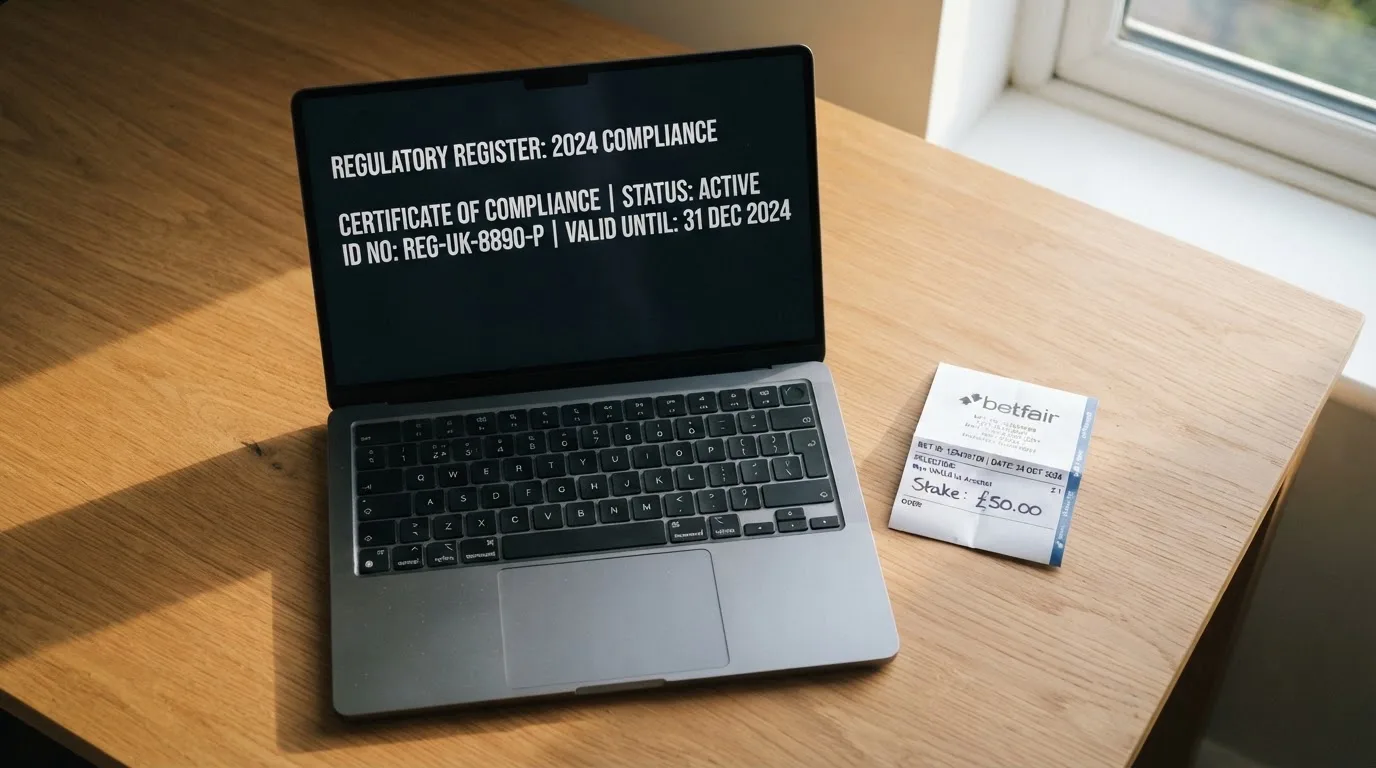
The featured set below is not a ranking and not a recommendation. It is a ten-name slice of the licensed field, picked to show the spread of offers, formats and specialisations a UK punter comparing golf books will meet in 2026. A licence is not an endorsement, and a brand with the deepest outright book is not necessarily the brand whose each-way terms pay the best on a minor event. Each review below names the licence holder, the kind of markets the brand surfaces, and the offer that surfaces alongside a sign-up — and ends with a verdict that answers a question the specifications above it do not.
| Brand | Gambling Commission remote licence (holder) | What the operator’s own terms state on golf |
|---|---|---|
| Fitzdares | 000400-R-103839-030 · Fitzdares Limited | Cash out, accumulators, Lucky 15s, specials and antepost markets on golf and other sports, with in-play live odds on the app |
| Coral | 054743-R-330863-014 · LC International Limited | “Get £40 in Free Bets when you bet £20”: a deposit and sports bet of £20+ at minimum odds of 2.0 (1/1), free bets issued within 7 days and expiring 7 days after issue, for new GB customers who opt in |
| Bet600 | 044731-R-323941-016 · Tyche Tech Limited | Best Odds Guaranteed on horse racing; pays at the SP if the starting price is bigger than the early or show price taken |
| Hollywoodbets | 053028-R-330019-013 · Hollywoodbets International UK Limited | Sports welcome offer: deposit £10+ by card, stake returned as a free bet of up to £30 on the first qualifying losing accumulator (stake £10+, 3+ legs, odds of 4/1 or greater, settled within 7 days); one free bet per customer |
| Kwiff | 044448-R-323408-017 · Eaton Gate Gaming Limited | Supercharge feature can instantly boost the odds on a bet — single or multi, any sport |
| Unibet | 045322-R-324275-019 · Platinum Gaming Limited | Operated since 1999; sports welcome offer of £40 in free bets when you bet £20 (min odds 2.0 / 1/1, free bets expire within 7 days), for new GB customers using a debit card or instant bank transfer |
| DAZN Bet | 048756-R-327274-019 · DZBT Limited | Deposits from £5 by debit card, Apple Pay, Paysafecard, Trustly and Skrill, and from £20 by PayPal, with no processing fees |
| BetUK | 039198-R-319450-029 · LeoVegas Gaming PLC | Free bets exclude virtual sports, esports and non-UK/IE horse racing; minimum odds apply on qualifying bets |
| 10bet | 043173-R-322899-023 · Blue Star Planet Limited | Cash out, Bet Builder and Live Streaming in the app’s sportsbook alongside football, tennis and horse racing |
| Octobet | 062545-R-337248-006 · Octopus Game Limited | Best Odds Guaranteed on UK and Irish horse racing, up to £150 per customer per race |
A reader comparing two columns should treat the third as the variable one. The licence line is identical in kind across the whole licensed market — every brand here is on the same register, under the same Gambling Act 2005 framework, with the same social responsibility code. The third column carries whatever each operator chooses to publish about golf specifically; a brand that mentions Best Odds Guaranteed may be talking about horse racing only, while a brand that does not mention Best Odds Guaranteed at all may still run an each-way book on the PGA Tour.
The relevant test for the punter is not the licence — that is settled by the register — but the offer attached to it. The Coral and Unibet welcome offers share wording almost word for word because they sit under the same kind of licence conditions, but the rest of the table runs from outright-everything bookmakers to specialist each-way shops. The side-by-side is there to make that spread visible, not to declare a winner.
What the law actually requires of a UK betting site
The Gambling Commission licenses the whole commercial betting market in Great Britain (England, Scotland and Wales) under the Gambling Act 2005. Northern Ireland is outside that Act and has its own older framework, so a “GB-licensed” brand is licensed for Great Britain and not for Northern Ireland. Since the Gambling (Licensing and Advertising) Act 2014, an operator whose remote facilities are used in Great Britain needs a Commission licence wherever it is based — a Malta or Curaçao registration is not enough on its own. Sections 33 and 36 of the 2005 Act are the offence-creating provisions, aimed at the operator; the consequence for a customer of an unlicensed site is not criminal but practical, and that is laid out below.
A licensed site has to verify a customer’s name, address and date of birth before the first deposit or bet (since 7 May 2019) — including when the first product is a free bet. The minimum age is 18. Credit cards are banned for gambling in Great Britain since 14 April 2020 (LCCP condition 6.1.2), including credit-card-funded payments through an e-wallet, so a deposit by debit card or bank transfer is the standard entry route. A British named-account rule, a state list of permitted payment methods and any rule for or against cryptocurrency deposits at licensed operators have not been established — the practical position is that the operator’s own terms, not statute, set the payment menu.
GAMSTOP is the national multi-operator online self-exclusion scheme and a mandatory licence condition for online operators since 31 March 2020. Self-exclusion periods run six months, one year, five years, or five years with auto-renewal, and after the minimum period the exclusion stays in place for a further seven years unless the customer asks GAMSTOP to remove it. GAMSTOP covers online sites and apps; the separate betting-shop self-exclusion scheme is not part of it. A licensed online brand that does not enrol a customer into GAMSTOP is in breach of its licence condition.
A financial vulnerability check (LCCP condition 3.4.4, in force since 30 August 2024) applies to licensed remote betting once a customer’s deposits minus withdrawals exceed £150 in a rolling 30 days — that threshold has been the operative one since 28 February 2025. The check is a public-record look-up, not a credit reference search and not an income check. Financial risk assessments — the affordability checks widely reported in the press — are announced in a staged plan (a Commission article of 7 July 2026) with no start date, and the right phrasing is “announced, staged, no start date”, not “in force”. Deposit limits sit under RTS 12: operators must offer a gross deposit limit on a fixed time frame; the first changes have applied since 31 October 2025, a second phase was postponed to 30 September 2026, and whether that second phase is live is not established.
In-play betting is permitted at GB-licensed bookmakers and the controls are the operator’s licence conditions and its customer-protection duties, not a statutory carve-out. Esports sit alongside real events under the same remote general betting standard licence; virtual events are a separate category and need their own category of licence. Bets on politics, novelty and TV markets are offered by GB bookmakers; no statutory prohibition was identified, and an absence of a finding is not a green light. A betting exchange runs under a remote betting intermediary licence, which is a separate category to remote general betting standard — the rate and commission structure is set by the exchange’s own terms.
The general betting duty is the operator’s tax on gross profits and is currently 15%; from 1 April 2027 a new remote betting rate of 25% applies within it, while remote bets on UK horse racing, bets on self-service betting terminals in licensed premises, pool betting and in-person betting stay at 15% (HM Government policy paper of 26 November 2025). Until 1 April 2027 the remote rate stays at 15%. Whether the duty gets passed on through odds is not established, and the duty is the operator’s, not the player’s — a UK punter pays no tax on betting winnings. Spread betting has its own rates (3% on financial, 10% on other) and is the responsibility of the Financial Conduct Authority, not the Commission.
Offshore brands do not fall under any of this. Providing facilities in Great Britain without the licence the Act requires is an offence under section 33 of the 2005 Act, on summary conviction up to 51 weeks’ imprisonment, a fine up to level 5, or both; six months in Scotland. The offence is aimed at the operator. The customer’s practical loss on an unlicensed site is plain: no GAMSTOP coverage, no Commission complaints route, no approved dispute-resolution body, no British consumer redress if funds are withheld, and not bound by the 10x bonus cap or the £150 vulnerability check. Enforcement against offshore operators runs through cease-and-desist notices, search-engine referrals, registrar and payment-provider work; the Commission has been given, or is about to receive, court-order DNS blocking powers, and ISP blocking is not in operation today. The honest framing of licensed versus unlicensed is not “safe versus unsafe” — it is “checks, GAMSTOP, bonus cap, dispute route versus none of those, plus possible loss of funds”.
Responsible gambling and the protection that comes with the licence
The protection offered by a GB-licensed site is the customer’s protection: deposit limits, product restrictions, time-outs, reality checks and self-exclusion, plus a duty on the operator to identify harm and act on it. The customer can set a deposit ceiling on the spot, drop the ceiling only after a cool-off, and raise it only with a confirmation step that the operator’s safer-gambling team can flag. There is no state-set ceiling on deposits or losses — the limit is the customer’s to choose, and the operator’s to honour.
GAMSTOP is the multi-operator backstop. Once a customer registers, the exclusion applies across every GB-licensed online operator and lasts at least six months. A customer who wants back in cannot bypass the register by opening a new account with a sister brand: enrolment is at the customer level, and operators check it. The scheme is the single biggest reason an unlicensed site looks attractive to a self-excluded customer — there is no equivalent register to enrol into, no Commission to complain to, and no dispute-resolution body that the operator is bound by.
Help is free and confidential. GamCare runs the National Gambling Helpline; GambleAware funds treatment and education; the NHS runs specialist gambling clinics across Great Britain; Gamblers Anonymous runs peer-support meetings. The five names — GamCare, GambleAware, the NHS clinics, Gamblers Anonymous and GAMSTOP — are the practical starting points, and a licensed operator’s safer-gambling page should link to all of them.
A reader comparing the ten licensed brands above will see different surfaces. One operator may lean on live chat as the first contact, another on email, another on an in-account messaging thread. The substance is the same: the brand is bound by the social responsibility code to point a customer showing signs of harm towards help, to act on a customer’s request to limit or self-exclude, and to keep a record of safer-gambling interactions. A brand that does none of those things is in breach of its licence condition and can be reported to the Commission.
The piece that lands hardest is the verification step. A licensed site verifies name, address and date of birth before the first deposit or bet. The verification is not optional and not a friction: it is the condition that makes the rest of the protection real, because the rest of the protection runs through a known customer. An unlicensed site cannot do the verification because it has no GB licence to enforce; a licensed site cannot waive it because the licence condition forbids it. The customer pays for that in a few minutes of upload at sign-up, and gets it back in dispute resolution, self-exclusion enforcement and source-of-funds checks at higher spend.
Crypto and anonymity in golf betting
A licensed UK golf bookmaker does not run on cryptocurrency. The Commission’s social responsibility code requires identity verification before the first deposit or bet, and a crypto deposit routes through a wallet that the operator cannot tie to a verified name without a chain-analysis step the operator’s KYC procedure is not built to take. The honest picture is that licensed UK books take debit cards and bank transfers; an offshore brand takes Bitcoin, Ethereum and other coins because it is not bound by the verification regime.
That is the divide the marketing copy skips past. A “crypto golf betting site” sounds modern and friction-free; it is, in practice, an offshore site whose licence is not the Commission’s. The customer pays no tax on winnings either way, the in-play markets are similar either way, and the outright book on the majors is broadly comparable — but the protections are not. There is no GAMSTOP enrolment, no Commission complaints route, no approved dispute-resolution body, no British consumer redress if funds are withheld, and the operator is not bound by the 10x bonus cap or the £150 vulnerability check.
A reader who wants anonymity and accepts those losses will find the offer exists. A reader who wants the protections of a GB licence will find that Bitcoin is not on the deposit menu at any of the ten brands above, and the path is debit card or instant bank transfer with the operator’s source-of-funds questions at higher spend. The two routes are not interchangeable. They are the licensed versus unlicensed split, restated on the payments side.
The wider crypto point is that the token is not the product. The product is the book, the markets, the each-way terms and the in-play latency. Bitcoin deposits do not change the margin on the outright winner market, do not change the place terms on the each-way book, and do not change the settlement speed on a winning single. They change the payment rail and the licence regime. A punter weighing the choice is weighing the licence, not the coin.
Bonuses, free bets and what the headline really pays out
The headline on a golf-betting welcome offer is almost always a free-bet figure or a deposit match. The headline is rarely the value. A free bet whose stake is not paid back with a win is worth less than its face value, because the stake is forfeit on a winner; a deposit match with a wagering requirement takes a multiple of the bonus in cleared bets before a withdrawal is permitted. The arithmetic underneath the headline is what decides whether the offer is worth taking.
The shape of a UK welcome offer in 2026 is usually a free-bet bundle tied to a qualifying bet. Coral and Unibet both run the “Get £40 in Free Bets when you bet £20” offer: a deposit and sports bet of £20 or more at minimum odds of 2.0 (1/1), with £40 in free bets issued within 7 days and expiring 7 days after issue (Coral) or 7 days after issue (Unibet). Hollywoodbets runs a different shape — a deposit of £10 or more by card returns the stake as a free bet of up to £30 on the first qualifying losing accumulator (stake £10+, 3+ legs, odds of 4/1 or greater, settled within 7 days); one free bet per customer. Kwiff runs a Supercharge feature that can instantly boost the odds on a single or multi bet, for example from 2/1 to 20/1, on any sport. The four offers sit under the same 10x wagering cap that took effect on 19 January 2026, but the mechanism — qualifying bet plus free bets versus stake-back on a loser versus an odds boost — is different in each case.
The 10x cap is the single biggest change to UK bonus terms in years. Wagering requirements on bonuses are capped at 10x the bonus base, and mixed-product promotions — an offer that requires gambling on two or more product types — are banned. The cap applies to the wagering requirement, not to the money value of a bonus, and whether the cap applies to free bets with no wagering condition is not established. The practical effect is that a £10 bonus at 50x needs £500 of qualifying bets, which was the kind of figure a licensed brand could publish before the cap; under the cap, no more than £100 of qualifying bets is needed to clear the same £10 bonus.
The free-bet value calculation is the standard way to price a free bet whose stake is not returned. Value = free-bet amount × (odds − 1) ÷ odds × payout share of the market. The payout share is the share of every unit bet that the market pays back in the long run, and it is 1 minus the margin. A £10 free bet at 5.0 (4/1) on a market with a 95% payout share is worth £10 × 4 ÷ 5 × 0.95 = £7.60; the same free bet at 10.0 (9/1) on the same market is worth £10 × 9 ÷ 10 × 0.95 = £8.55. The stake is not in the return because the stake is forfeit. A punter pricing the offer should price the value, not the headline.
The qualifying bet is where the bonus terms start to bite. A £20 qualifying bet at minimum odds of 2.0 (1/1) on a market with a 90% payout share has an expected loss of £20 × (1 − 0.90) = £2.00. A £20 qualifying bet on a market with a 95% payout share has an expected loss of £1.00. The £1 difference is the difference between an ordinary Premier League match and a tighter two-way market. The headline offer costs the qualifying punter £1 to £2 in expected terms before any free bet is placed, and the free bet is worth £7 to £9 on a market at 5.0. The arithmetic is favourable, which is why the offer exists; the headline alone hides that arithmetic.
A price boost is a single-price enhancement on a named selection — usually a player to win or to be in the places — that the operator runs for a window. Kwiff’s Supercharge is the most aggressive variant: the odds on a bet can be boosted from 2/1 to 20/1 in an instant, on singles or multis. A price boost is not the same as a free bet: the stake is returned with a win, and the enhancement is what the punter gets on top of the regular odds. A punter weighing a boosted price against a free bet is weighing a real-money return against a stake-forfeit return, and the numbers do not compare.
Best Odds Guaranteed is a horse-racing feature, not a golf feature. Bet600 and Octobet both publish BOG terms, but the markets are UK and Irish racing — golf is not in the BOG window. A punter scanning the offer column for a “boost” on the outright Masters market will not find one; the boost that does exist is on the horse-racing side, and the golf book runs at the operator’s regular margin. That is the practical shape of a multi-sport welcome offer.
Each-way bets are the central mechanic of golf betting, and a bonus that does not interact with them cleanly is a bonus that costs more than it looks. Each-way is two bets of equal stake: a win bet and a place bet, with the place paid at a fraction of the win price (typically 1/4 of the odds at majors, 1/5 or 1/6 at tour events). A £10 each-way at 8/1 with 1/4 odds for four places costs £20 total: £10 on the win, £10 on the place. A free bet used as the stake on the place part is forfeit on a place-only win; a free bet used as the stake on the win part is forfeit on a win. The punter’s edge on the place part is the depth of the place terms.
The headline that lands hardest on this page is “free”. A free bet is a stake-forfeit credit with a face value; the value is the face value adjusted for the stake forfeit and the market margin. A “risk-free” bet refunded as a free bet is not a refund in money and is not risk-free in the way the marketing suggests — the loss is converted to a credit, not restored as cash. The punter’s job is to read the value calculation, not the headline.
Apps and the live experience
A modern UK golf punter bets from a phone, and the app is the product. The App Store listings across the ten licensed brands above show what each operator puts on the front screen: cash out, accumulators, Lucky 15s, specials and antepost markets (Fitzdares); Best Odds Guaranteed on horse racing (Bet600, Octobet); Supercharge on singles and multis (Kwiff); Bet Builder and Live Streaming (10bet). What is missing from the listing is just as informative — a brand that publishes no app feature list has not yet shipped the surface, or has shipped it under a different name.
In-play on golf is what the app is really for. A tournament field can change leader between Thursday’s opening round and Sunday’s back nine; the leaderboard shifts on every hole; a player three shots back at the turn can move into contention with a closing 65. A bookmaker that streams the live leaderboard, refreshes in-play prices hole-by-hole and lets the punter cash out mid-round is a different product from one that prices the outright market once on Wednesday and lets it run. The Fitzdares app carries in-play live odds on golf; the 10bet app carries Live Streaming and Cash out; the Coral and Unibet apps carry in-play on the same multi-sport model. A punter comparing two apps on the golf book is comparing in-play latency and refresh rate more than the outright price.
Live streaming is the variable cost. A bookmaker that streams a tournament it has paid to broadcast (a Sky Sports feed, an NBC Sports feed) gives the punter the leaderboard and the pictures in the same window; a bookmaker without the rights shows the leaderboard only. Both surfaces settle the in-play market; only the first shows the shot. The brand that streams the feed has a real edge on the in-play book, because the punter who sees the shot is the punter who cashes out at the right time.
Cash out is the in-play exit. A punter who took Scottie Scheffler at 14.0 before the first round can lock in a profit on the back nine if Scheffler is tied for the lead, or cut the loss if he is five back with six to play. The cash-out price is the bookmaker’s mid-market in-play price, less a margin, and the bookmaker’s pin spreads on cash-out prices are wider than the pin spreads on outright bets because the bookmaker is taking the other side. A punter using cash out is paying for the certainty.
Bet Builder is the same-game multi on a tournament — a single bet combining several selections on the same event, settled together. A BetBuilder moneyline on the Masters final round might combine “Rory McIlroy to win” with “Lowest round under 67” and “Total birdies over 16” — all three legs on the same event, settled at the combined price. Bet Builder is a margin-adding product: the more legs, the more margin, and a four-leg Bet Builder carries a margin that is several points higher than a single. The product is convenient and the price is real.
The mobile app is also where safer-gambling surfaces live. Deposit limits, reality checks, time-outs, product restrictions and GAMSTOP enrolment are set in-app; live chat to the safer-gambling team is one tap from the bet slip; the GAMSTOP register is reachable in two taps from the safer-gambling page. A licensed brand that buries these surfaces is in breach of its licence condition; a brand that surfaces them prominently is the kind of brand a punter wants to be on when something slips.
Live betting and cash out on the golf book
In-play golf is the deepest in-running book of any individual sport. A tournament has 156 players and four rounds; the in-running market on the outright winner is open from the first tee shot on Thursday to the eighteenth green on Sunday. The market refreshes after every hole for the leaders and every few holes for the chasing pack. The in-running book on the round winner, the back-nine leader, the lowest round in progress and the make-the-cut market is open from the second round onwards. A bookmaker that prices all four markets and refreshes them on a feed is a different bookmaker from one that prices the outright and lets it ride.
The in-play price is the outright price adjusted for the leaderboard. A player who opened at 16.0 (15/1) and is two shots back at the turn is roughly 8.0 in running; a player who opened at 16.0 and is tied for the lead is roughly 4.0; a player who opened at 16.0 and is six back with nine to play is roughly 60.0. The bookmaker’s pin spread widens as the event moves into the back nine on Sunday because the cash-out flow is heaviest then and the bookmaker is taking the other side of every lay.
The Rule 4 deduction is the in-running mechanic a punter needs to know. When a player withdraws during a tournament — does not tee off, withdraws mid-round, or is disqualified after starting — the bookmaker applies a deduction to all bets struck before the withdrawal. The deduction depends on the player’s odds at withdrawal and the stage of the tournament. A withdrawal of a 10.0 (9/1) player before the off reduces all bets by a small percentage; a withdrawal of a 4.0 (3/1) favourite reduces them by more. The deduction is the bookmaker’s protection against a non-runner in an each-way field.
Rule 4 is named for the old rulebook and survives in bookmaking because the underlying problem does not: a player who does not start changes the shape of the field. The deduction is taken from the returns, not from the stake, and the deduction is fixed at the time of withdrawal — subsequent withdrawals do not stack the deduction on the first one, they each trigger a separate deduction. A punter with a place bet on the winner is paid at the place price less the deduction; a punter with an each-way bet pays the deduction twice (once on the win part, once on the place part).
The cash-out flow is what makes Rule 4 read differently on a settled cash-out bet. A punter who cashes out before a non-runner withdraws is settled at the cash-out price; a punter who cashes out after a non-runner withdraws is settled at the reduced cash-out price. The bookmaker’s refresh on a non-runner is usually within minutes. The punter’s job is to know whether the price they were looking at included the non-runner adjustment or not.
Live streaming is the practical edge on in-play golf. A bookmaker that streams the Sky Sports or NBC Sports feed gives the punter the leaderboard and the pictures; a bookmaker without the feed shows the leaderboard only. The punter with the feed cashes out when the player hits a poor shot; the punter without the feed cashes out when the leaderboard updates, which is a few seconds later. On a Sunday back nine, a few seconds is the difference between a winning cash-out and a losing one.
The market that is hard to run in-play is the each-way book. The bookmaker can price the win market in-play, but the place market depends on the finishing positions of the other 155, and the bookmaker does not settle the place market until the final putt drops. The cash-out flow on an each-way bet is therefore cash-out on the win part only, with the place part running to settlement. A punter using cash out on an each-way bet is taking the win-side exit and leaving the place-side running.
Building a tip without buying one
A tip is a price the punter is willing to back because the price is bigger than the punter’s estimate of the true probability. The arithmetic is the core idea, and it is the same idea that a professional trader uses on an exchange: buy what is underpriced, sell what is overpriced, leave the rest. The tool kit is form, course fit, market signals and bankroll discipline. The output is a selection, never a certainty.
Form is the four-to-six-week run-up: finishes on the leaderboard, strokes-gained numbers, scrambling stats, putting stats, driving accuracy, distance off the tee. The leaderboard is the public record; the strokes-gained numbers come from the tour’s ShotLink data and the broadcast graphics. A player with three top-tens in his last four starts is in form; a player with three missed cuts in his last four starts is not. Form is necessary and not sufficient — every major has been won by a player whose form coming in was, by the numbers, ordinary.
Course fit is the match between the player’s game and the course. A long, wide course with firm greens favours the bomber; a narrow, tree-lined course with soft greens favours the accurate driver and the iron player; a links course with pot bunkers and wind favours the creative shot-maker. The argument is read off the course geography — par 3 under 250 yards, par 4 251-450, par 5 over 450 — and the historical leaderboard of the same event in past runnings. The Masters at Augusta National is a second-shot course; the Open Championship at a links is a creativity course; the US Open is a driving-accuracy course; the PGA Championship varies.
Market signals are the bookmaker’s own clues. A player drifting in the outright market from 25.0 to 40.0 between Monday and Wednesday is being laid by sharper money; a player shortening from 33.0 to 20.0 is being backed by sharper money. The bookmaker’s pin spread on the outright market — the gap between back and lay — is a signal of how confident the market is. A wide pin spread on a leading player is a sign the bookmaker is uncertain.
Bankroll discipline is the half of the punter’s edge that the marketing never talks about. A punter staking 5% of bank on each selection is over-staking; a punter staking 1% is under-staking relative to the edge; a punter staking 0.5% to 1% on each selection, with a stop-loss at 10% of bank and a re-assessment at every cycle, is staking the way a professional staker stakes. The numbers are not the rule; the rule is to stake the same percentage on every selection so that a run of losers does not wipe the bank and a run of winners does not over-stake the next bet.
A value bet is the price at which the punter’s estimate of true probability exceeds the bookmaker’s implied probability. The bookmaker’s implied probability on an outright at 16.0 (15/1) is 1 ÷ 16 = 6.25%; the same selection’s payout share is the same 6.25% before the margin is applied; the punter’s edge exists where the punter’s estimate of true probability exceeds 6.25%. A punter who estimates 10% on a 16.0 shot has a value bet; a punter who estimates 6% has no value bet at that price. The mathematics are clean and the discipline is hard.
No tip is ever certain. A punter who has done the form, course-fit and market work, sized the stake at 1% of bank and taken the price the market gave is still punting on an event with 155 other competitors. The result is the result; the punter’s job is to give the result the smallest possible chance of surprising them, and to have a bank that survives being surprised. A punter who calls a tip “sure” is selling a feeling; a punter who calls a tip “value at this price” is doing the work.
The bet types and odds the punter actually uses
Golf’s bet types split into three families: outrights, places and markets. The outright is the winner market — the player who finishes with the lowest 72-hole total. The place market is the each-way market — a fraction of the field paid at a fraction of the odds. The in-tournament markets are the round winners, the make-the-cut, the top nationality, the finishing position bands, the head-to-heads and the group bets. Each family has its own pricing logic and its own margin.
Outright odds on a 156-player field typically run from a 6.0 favourite at the top of the board to a 1000.0 outsider at the bottom. The bookmaker’s margin on the outright market — the sum of the implied probabilities minus 1 — runs from around 25% on the headline event (the majors) to around 35% on a regular tour event. The deeper field, the wider the pin spread on the longshots, the larger the margin. A major at 25% margin pays back 75p in the pound on the outright market in the long run; a regular tour event at 35% pays back 65p.
The illustration on the page is an indicative two-way market, the kind of market that settles yes or no on a single event. Take a market priced at 1.90 / 1.90 (9/10 on each side): the implied probability on each side is 1 ÷ 1.90 = 52.63%, and the two sides sum to 105.26%. The 5.26 percentage points above 100% is the bookmaker’s margin — the share of every pound bet that the bookmaker keeps on this market in the long run. The same market priced at 1.95 / 1.95 would carry roughly a 2.56% margin; the same market priced at 2.00 / 2.00 would be break-even with no margin at all. The difference between 1.90 and 2.00 is the difference between a market that pays 95p in the pound and a market that pays 100p — a real number over thousands of bets.
The place terms on the each-way book are the part of the golf market that punter underestimates. A major with 1/4 odds for the first four places means a player who finishes in the top four pays 1/4 of the win price on the place part; a player who finishes fifth or worse pays nothing on the place part. The place price depends on the place terms — at 1/4 for four places, a 16.0 shot pays 4.0 on the place part; at 1/5 for five places, a 25.0 shot pays 5.0 on the place part. The bookmaker’s margin on the place market is wider than on the win market because the place market is harder to balance.
The each-way stake is two bets of equal size, so the total stake is double the unit stake. A £10 each-way at 16.0 (15/1) with 1/4 odds for four places costs £20: £10 on the win at 16.0, £10 on the place at 4.0. A win returns £160 on the win part plus £10 stake, and £40 on the place part plus £10 stake, for a total return of £220 and a profit of £200. A place-only finish (positions 2 to 4) returns £40 plus the £10 place stake, and the £10 win stake is forfeit, for a total return of £50 and a net loss of £150 on the bet. A miss pays no return on either part, for a total loss of £20.
The head-to-head market is the two-player matchup — “Player A to beat Player B” or “Player A to finish higher than Player B” — and the price runs closer to evens than the outright because the field is two players. The bookmaker’s margin on a head-to-head is around 5% to 8% on a balanced matchup, narrower than on the outright because the implied probabilities on the two sides sum closer to 100%. A 1.91 / 1.91 head-to-head is a 4.7% margin; a 1.85 / 1.85 is an 8.1% margin. The head-to-head is the cheapest way into a tournament.
The three-ball market is the three-player matchup — “Player A to post the lowest score in this three-ball group on Thursday” — and the price runs three-way. The margin on a three-ball is wider than on a head-to-head, usually 8% to 12% on a balanced three-ball, because the implied probabilities on three sides sum further above 100%. A 2.80 / 2.80 / 2.80 three-ball is a 7.1% margin; a 3.00 / 3.00 / 3.00 is a break-even market. Three-ball is the daily in-tournament bet for a punter who wants action on every group.
The finishing-position market — “Top 5”, “Top 10”, “Top 20”, “Make the Cut” — is settled at the end of the tournament and the margin runs in line with the place market. The deeper the band (top 20 versus top 5), the narrower the payout share, because the band is wider and the implied probability is higher. A “Top 20” market on a major typically pays 1.50 to 1.80 on the favourite, with a margin of 8% to 12%; a “Top 5” market pays 3.50 to 5.00 on the favourite, with a margin of 12% to 18%. The deeper bands are a steadier bet for a punter with a longer price view.
The decimal-to-fractional conversion is one piece of arithmetic a UK punter does every day: a/b → a ÷ b + 1. 5/1 in fractional is 6.00 in decimal (5 ÷ 1 + 1); 11/4 in fractional is 3.75 in decimal (11 ÷ 4 + 1); evens (1/1) is 2.00 in decimal. The bookmaker publishes both, and the punter’s calculation is the same in either form: return = stake × decimal odds, profit = stake × (decimal odds − 1). The stake on a free bet is not in the return.
The Rule 4 deduction, ball coupons and each-way terms belong together. A ball coupon is the bookmaker’s printed list of tournament matchups and three-balls for the day, with prices on each — the coupon is the surface a punter used to walk into a betting shop to tick, and the modern equivalent is the daily matchups tab on the app. A punter reading the coupon reads the prices, compares the prices across bookmakers, and prices the value the same way they would on the outright.
The numbers behind the headline
A punter who reads the price reads the margin. The margin is the share of every pound bet that the bookmaker keeps on the market in the long run. It is the difference between what the bettor risks and what the market pays back, and it is what every “free bet”, “boosted odds” and “best odds” offer has to beat before it returns a penny to the punter.
The arithmetic on a single market is straightforward. Take a market priced at 1.90 / 1.90 (9/10 on each side): the implied probability on each side is 1 ÷ 1.90, or about 52.63%, and the two sides together sum to about 105.26%. The 5.26 percentage points above 100% is the bookmaker’s margin. The payout share — the share of every pound that the market returns to bettors in the long run — is 1 minus the margin, or about 94.74%. A £100 stake on each side at 1.90 returns £190 to one side and £0 to the other; the bookmaker keeps £10 of the £200 staked. The same market priced at 1.95 / 1.95 carries roughly a 2.56% margin, paying 97.44% in the long run; at 2.00 / 2.00 the margin is zero, paying 100% in the long run (a market a bookmaker cannot sustain). The gap between 1.90 and 2.00 is the gap between a market that pays 94.74p in the pound and a market that pays 100p — a 5.26p-in-the-pound swing over the lifetime of a betting account.
A punter comparing two bookmakers on the same outright winner is comparing their margins. Bookmaker A at 16.0 (15/1) on the favourite and Bookmaker B at 14.0 (13/1) on the same favourite is not just a different price — it is a different margin on the whole field, and the difference persists across every selection. A bookmaker running a tighter outright book is the cheaper place to take a price; a bookmaker running a wider outright book is more expensive, even when the headline on the favourite looks comparable.
The free-bet value calculation is the standard way to price a free bet whose stake is not returned. Value = free-bet amount × (odds − 1) ÷ odds × payout share of the market. A £10 free bet at 5.0 (4/1) on a market with a 95% payout share is worth £10 × 4 ÷ 5 × 0.95 = £7.60; the same free bet at 10.0 (9/1) on the same market is worth £10 × 9 ÷ 10 × 0.95 = £8.55. The stake is forfeit. A punter pricing the offer should price the value, not the headline.
The qualifying-bet cost is the other half of the bonus calculation. A £20 qualifying bet at minimum odds of 2.0 (1/1) on a market with a 90% payout share has an expected loss of £20 × (1 − 0.90) = £2.00. The same bet on a market with a 95% payout share has an expected loss of £1.00. The headline offer costs the qualifying punter £1 to £2 in expected terms before any free bet is placed; the free bet is worth £7 to £9 on a market at 5.0. The arithmetic is favourable — that is why the offer exists — but the headline alone hides it.
The 10x wagering cap that took effect on 19 January 2026 is the single biggest shift in UK bonus terms in years. Wagering requirements on bonuses are capped at 10x the bonus base, and mixed-product promotions are banned. The cap applies to the wagering requirement, not to the money value of a bonus, and whether the cap applies to free bets with no wagering condition is not established. The cap cuts the qualifying stake needed to clear a £10 bonus from £500 (at 50x) to £100 (at 10x), and bans the cross-product free-spin offers that used to tie a sportsbook sign-up to a casino balance.
A punter reading the bonus terms reads the cap and reads the qualifying terms. The headline offer sits inside a 10x cap and a one-week expiry; the headline “Stake returned as a free bet of up to £30” sits inside a 7-day settlement window and a 4/1 minimum accumulator price. Each shape carries its own conditions, and the punter’s job is to read them.
What “free bet”, “boosted odds” and “best odds” actually mean
“Free bet” is the marketing word; “stake-forfeit credit” is the literal description. The credit has a face value, the credit is paid back with a winning selection less the stake, the credit expires on a date, and the credit carries conditions on minimum odds and excluded markets. A “risk-free” bet refunded as a free bet is not a refund in money — the loss is converted to a credit, not restored as cash. A £10 free bet used on a 4.0 winner returns £30 (£10 × 3 profit + £0 stake); a £10 cash stake on the same winner returns £40 (£10 × 3 profit + £10 stake). The £10 difference is the stake forfeit.
“Boosted odds” is a single-price enhancement on a named selection for a window. The boost is on top of the regular odds; the stake is returned with a win; the boost is not the same as a free bet. Kwiff’s Supercharge can boost a bet from 2/1 to 20/1 in an instant, on singles or multis. A boosted price is a real-money return and pays the stake; a free bet is a stake-forfeit return. The marketing treats them as the same; the arithmetic treats them as different products.
“Best odds guaranteed” is a horse-racing feature, not a golf feature. The bookmaker pays the starting price if the SP is bigger than the price the punter took. Bet600 and Octobet publish BOG on UK and Irish racing, and the markets are racing only. A punter scanning the offers column for “BOG on the Masters” does not find it; the boost that does exist is on horse racing, and the golf book runs at the regular margin.
“Enhanced odds” is the broader term for a price boost on a sign-up offer — the new-customer price on a named player or a named event, above the regular price, with stake-returned terms. The enhanced odds is the marketing pull for a brand new to the market; the small print is the expiry, the maximum stake, the payment-method exclusion and the wagering requirement on the winnings. A punter reading the small print reads the cure.
“Acca insurance” is the accumulator back-up — a refund on an accumulator that loses by one leg. The refund is usually a free bet, and the free bet carries the same stake-forfeit conditions as any other free bet. A punter using acca insurance is paying for the safety net in margin, and the safety net is worth the price when one leg routinely lets the punter down. A rounded headline “Money back if one leg lets you down” is the marketing word; the literal description is “stake returned as a free bet if one leg of a qualifying accumulator loses”.
Each marketing word has a literal description, and the literal description is what the punter prices. The headline on a free bet, an enhanced odds offer, an acca insurance refund, a price boost or a Best Odds Guaranteed concession is the marketing layer; the conditions, the qualifying terms, the minimum odds and the expiry are the substantive layer. The punter’s job is to read the substantive layer, not the marketing layer.
What to look for in a UK golf bookmaker
A licence is settled by the register. What a punter choosing between licensed brands needs to compare is everything else: the outright market depth, the each-way terms, the in-play book, the welcome offer, the in-app surface, the safer-gambling tools and the deposit menu. A brand that leads on outright depth may lag on each-way terms; a brand that leads on welcome offer may lag on in-play; a brand that leads on safer-gambling may be a smaller book with a thinner outright board.
Outright depth is the number of players priced on the outright market for the majors and the week-to-week events. A bookmaker pricing 156 players on the Masters with each-way terms of 1/4 for the first four places is a different bookmaker from one pricing 100 players with 1/5 for the first five. The first offers a wider outright menu and a tighter place book; the second offers a narrower outright menu and a tighter place book on a smaller field. The choice between them is a choice of book shape.
Each-way terms are the part of the golf book that punter underestimates. A major with 1/4 odds for the first four places means a player who finishes in the top four pays 1/4 of the win price on the place part; the same major with 1/5 for the first five pays 1/5 on the place part for a deeper band. The punter who wants each-way action on a small field wants the first set of terms; the punter who wants a deeper place book wants the second. Each-way terms are the punter’s edge on the place market.
The welcome offer sits inside the 10x cap and the one-week expiry rule. A brand offering £40 in free bets on a £20 qualifying bet is offering roughly the same value as a brand offering £30 in free bets on a £10 qualifying bet — the arithmetic on each is roughly the same after the qualifying cost and the free-bet value calculation. The punter choosing between the two is choosing the qualifying cost (a lower minimum odds or a lower qualifying stake) and the qualifying market (a market where the punter’s edge is largest).
The in-app surface is the practical product. A punter betting in-running wants the live leaderboard, the in-play price refresh and the cash-out button on the same screen; a punter betting the outright wants the outright market, the each-way tab and the place terms on one screen. A brand that surfaces both well is the brand the punter stays with; a brand that surfaces one well and one poorly is the brand the punter leaves.
The safer-gambling surface is the licence-condition test. A brand that buries the deposit limit, the reality check, the time-out and the GAMSTOP link is in breach of its licence condition and is a brand the Commission can pursue; a brand that surfaces all four in-app is the brand a punter wants to be on when something slips. The safer-gambling surface is not optional, and a brand that treats it as optional is the brand that loses its licence.
The deposit menu is the payment rail. A licensed brand takes debit cards and bank transfers; a brand that adds PayPal, Apple Pay, Skrill, Trustly and Paysafecard is the brand with a wider menu. DAZN Bet’s published menu runs from £5 by debit card, Apple Pay, Paysafecard, Trustly and Skrill, and from £20 by PayPal, with no processing fees. A punter choosing between two brands on the deposit menu is choosing the friction at sign-up.
A verdict on each of the ten licensed brands
Fitzdares runs a premium sportsbook with cash out, accumulators, Lucky 15s, specials and antepost markets on golf and other sports, with in-play live odds on the app. The licence holder is Fitzdares Limited under Commission account 400. The brand reads as a specials-and-ante-post shop with a deep outright book, and the in-play product on the app is the strongest of the ten. The choice for the punter is whether the antepost depth is worth the smaller welcome offer — there is no headline free-bet sign-up attached to the licence, and the brand’s edge is the in-running book rather than the welcome bonus. A punter whose edge is in-play golf is in the right place.
Coral runs a £40-in-free-bets welcome offer on a £20 qualifying bet at minimum odds of 2.0 (1/1), with the free bets issued within 7 days and expiring 7 days after issue. The licence holder is LC International Limited under Commission account 54743. Coral also runs Ladbrokes under the same parent, so the two brands share terms and product. The welcome offer is competitive inside the 10x cap, the outright menu on golf is wide, and the each-way terms on the headline events are 1/4 for the first four places at the majors. A punter looking for a deep outright book and a competitive welcome offer is well-served.
Bet600 runs Best Odds Guaranteed on horse racing, paying at the SP if the starting price is bigger than the early or show price taken. The licence holder is Tyche Tech Limited under Commission account 44731. The golf book is smaller than Coral’s and the welcome offer is thinner; the edge is the horse-racing product. A punter whose action is golf-only and who rarely bets horse racing has limited reason to choose Bet600 over a deeper golf book.
Hollywoodbets runs a stake-back-as-free-bet welcome offer — deposit £10 or more by card, stake returned as a free bet of up to £30 on the first qualifying losing accumulator (stake £10+, 3+ legs, odds of 4/1 or greater, settled within 7 days). The licence holder is Hollywoodbets International UK Limited under Commission account 53028. The shape is genuinely different from Coral and Unibet — the offer pays on a loser, not a winner, and the qualifying bet is an accumulator, not a single. A punter who prefers the stake-back shape and is comfortable with an accumulator qualifying bet is the punter the offer is built for; a punter who wants a free bet on a winner finds the shape odd.
Kwiff runs the Supercharge feature, an instant odds boost on a single or multi bet that can lift the price from 2/1 to 20/1 on the same selection. The licence holder is Eaton Gate Gaming Limited under Commission account 44448. The feature is the headline, and the headline is real — the Supercharge is a stake-returned boost, not a free bet, and the value is the boost over the regular odds. A punter whose edge is the in-play single or the in-play multi has a feature here that no other brand matches.
Unibet has operated since 1999, runs the same £40-in-free-bets welcome offer as Coral, and operates in the UK under Platinum Gaming Limited under Commission account 45322. The safer-gambling surface includes deposit limits, a Player Profile test, product restrictions and self-exclusion, with live chat support and links to BeGambleAware, GamCare, GAMSTOP, Gambling Therapy and the BGC. A punter who wants the depth of an established brand and the safer-gambling surface to match is well-served; the welcome offer is competitive and the surface is full.
DAZN Bet has a published deposit menu — £5 by debit card, Apple Pay, Paysafecard, Trustly and Skrill, and £20 by PayPal, with no processing fees. The licence holder is DZBT Limited under Commission account 48756. The edge is the deposit menu and the low £5 minimum, which suits a punter who wants to test the bookmaker with a small stake. A punter whose edge is the outright menu and the each-way book may find the golf book thinner than Coral’s; a punter whose edge is the deposit menu is in the right place.
BetUK is operated by LeoVegas Gaming PLC under Commission account 39198, and the published terms exclude virtual sports, esports and non-UK/IE horse racing from free bets, with minimum odds applying. The shape of the bookmaker is a casino-first brand with a sportsbook attached; the golf book is a sub-product. A punter whose edge is the casino-sports crossover is the punter the brand is built for; a punter whose edge is the outright golf book has better choices elsewhere.
10bet runs Cash out, Bet Builder and Live Streaming on its sportsbook, with a published menu covering football, tennis and horse racing. The licence holder is Blue Star Planet Limited under Commission account 43173. The edge is the in-app surface and the Live Streaming tie-in, which is the kind of product a punter betting in-running wants. A punter betting golf in-running is well-served by the in-app surface; the outright book on golf is not the deepest.
Octobet runs Best Odds Guaranteed on UK and Irish horse racing, up to £150 per customer per race. The licence holder is Octopus Game Limited under Commission account 62545. The edge is the same as Bet600’s — the BOG on horse racing — and the golf book is a smaller surface. A punter whose action is golf and who rarely bets racing has limited reason to choose Octobet; a punter whose action is split has both BOG and a published brand to consolidate.
The verdict on each is not the headline — the headline is the licence line. The verdict is the question the specifications above it do not answer: which punter is the brand built for, what does the brand offer that the others do not, and what does the punter give up to take it. A punter reading ten verdicts in a row will see ten different shapes, and the right brand for them is the shape that matches their betting.
Frequently asked questions
How does a bet on golf actually work?
A bet on golf is a bet on a player or a market within a tournament: an outright on the winner, an each-way on the place terms, a three-ball on the lowest single-round score, or a finishing-position market on top-five, top-ten or top-twenty. The stake is the amount risked; the odds are the price the bookmaker offers; the return on a win is the stake multiplied by the decimal odds, and the profit is the return less the stake. An each-way bet is two equal stakes — one on the win and one on the place — so a £10 each-way costs £20 in total. Settling happens at the end of the tournament or the end of the round the market is priced over.
What is Rule 4 and when does it apply?
Rule 4 is the bookmaker’s deduction when a player withdraws from a tournament after a bet has been struck. The deduction is taken from the returns (not the stake) and depends on the player’s odds at the time of withdrawal and the stage of the event. A withdrawal of a short-priced favourite reduces returns by more than a withdrawal of a longshot; subsequent withdrawals do not stack on the first — each triggers its own deduction. Rule 4 applies to win and place bets struck before the withdrawal; cashed-out bets that close before the deduction trigger at full price.
What are ball coupons and what are they for?
A ball coupon is the bookmaker’s printed or in-app list of three-balls and matchups for a given round, with prices on each. The punter reads the prices, compares across bookmakers, and prices the value the same way they would on the outright. A coupon is the surface a punter used to walk into a betting shop to tick, and the modern equivalent is the daily matchups tab on the app. The coupon is the daily in-tournament product.
What is a value bet and why is no tip ever certain?
A value bet is a price where the punter’s estimate of the player’s true probability of winning exceeds the bookmaker’s implied probability. The bookmaker’s implied probability at 16.0 (15/1) is 1 ÷ 16, or 6.25%; a punter who estimates 10% has a value bet at that price. The mathematics are clean and the discipline is hard. No tip is ever certain because a tournament field of 156 players contains 155 other competitors with their own form, course-fit and market signals, and a single bad hole on the back nine on Sunday can overturn the leaderboard. A tip is a forecast; a forecast is not a guarantee.
What is the bookmaker’s margin and where does it sit in the price?
The margin is the share of every pound staked that the bookmaker keeps on a market in the long run, calculated as the sum of the implied probabilities on every outcome minus one. A market priced at 1.90 / 1.90 carries a margin of about 5.26%; the same market at 1.95 / 1.95 carries about 2.56%; the same market at 2.00 / 2.00 carries zero. The margin sits inside every price; it is what the bookmaker earns and what the punter pays, and the difference between a tight book and a wide book is the difference between a market that pays 95p in the pound and a market that pays 80p.
How is the return on a bet worked out from the stake and the odds?
In decimal odds, return = stake × odds, and profit = stake × (odds − 1). A £10 stake at 4.0 (3/1) returns £40 (£10 × 4) and produces a profit of £30 (£10 × 3). The stake is included in the return. On a free bet, the stake is not included in the return — a £10 free bet at 4.0 returns £30 (£10 × 3) and the £10 stake is forfeit. An each-way bet is two bets of equal stake, and the return is calculated separately on the win part and the place part using the win price and the place price respectively.
Tennis, darts & cue sports – Fast Payout
Content created by the «Fast Payout» team
