
Field hockey betting odds in Great Britain — what the price carries
 Available in US
Field hockey does not arrive on British betting slips the way football does, and that is the first thing worth saying. The sport is sparsely covered by GB-licensed bookmakers compared with horse racing, football or cricket, and a bettor looking to put money on a FIH Pro League fixture, a domestic league abroad, or a Hockey World Cup qualifier may find the market missing, the price lagged, or the in-play offering thinned to one or two lines. The odds that do appear carry a margin — the cut the bookmaker keeps on every unit staked — and a small market tends to wear a larger one. This page works through how field hockey betting works in Great Britain, which operators carry a remote licence to take bets from GB customers, what the bonus offers actually cost once the small print is read, and where the bookmaker’s margin shows up inside the price.

The article uses prices and conditions current as of the snapshot date; the licence register and individual operator terms were checked against the Gambling Commission’s public register and each brand’s own pages.
*Current as of 27 October 2026 · Gambling Commission public register and individual operator terms*
Safer gambling sits underneath every figure on this page
Field hockey is a thin enough market that a bettor who has not set a deposit cap, a time-out, or a self-exclusion can chase a missing price without noticing they are spending more than they meant to. Every GB-licensed remote operator must offer the standard safer-gambling toolkit, and the headline rules live in the Commission’s Licence Conditions and Codes of Practice.

Deposit limits are set by the customer, not by the regulator, and most operators let a bettor put a hard ceiling on the gross amount staked over a fixed period — daily, weekly or monthly — that the site will not let them cross without a positive cooling-off step. Time-outs are short pauses of twenty-four hours to six weeks; self-exclusion is the longer lever, and it has to be at least six months. GAMSTOP, the national multi-operator self-exclusion scheme, is the one that covers every GB-licensed remote operator at once, with periods of six months, one year, five years, or five years with auto-renewal; the scheme is a mandatory licence condition for online operators.
On top of that, since 30 August 2024 a financial vulnerability check applies once deposits net of withdrawals exceed £150 over a rolling thirty days (in force from 28 February 2025). It is a public-record check, not an income check or a credit-reference look-up — bankruptcy or county-court judgments can surface, for instance — and it does not change the odds. GamCare runs the National Gambling Helpline; GambleAware, NHS gambling clinics and Gamblers Anonymous sit beside it.
The wider point: a bookmaker’s licence is the bettor’s set of protections — limits, exclusion, a Commission complaints route, an approved alternative-dispute-resolution body. A brand outside that frame offers none of them, and funds withheld offshore are very rarely recoverable in a British court.
Bonuses and free bets on a quiet sport
The welcome offers licensed GB bookmakers run on sports betting mostly reward a first qualifying bet with a free bet of one size or another — usually between £10 and £40 — and the headline rarely tells the reader what the offer actually costs. On a thin sport like field hockey the small print matters more than usual, because the minimum price, the qualifying market and the expiry all narrow where the offer can be put to use.
Take a “Bet £10, Get £10 in Free Bets” construction. The qualifying bet is £10, and on most books the free bet expires seven days after issue with the stake not returned on a win. A free bet whose stake is not paid back is worth less than its face: on a market whose margin is around 5%, the expected value of a £10 free bet at decimal odds of 3.00 is £10 × (3.00 − 1) ÷ 3.00 × 0.95, which works out to roughly £6.33 — not £10, and not £30 even if the bet lands.
The promotional rules the Commission brought in on 19 January 2026 changed the picture further. Any bonus that carries a wagering requirement is now capped at ten times the bonus amount — a £10 bonus at fifty times would have asked for £500 of qualifying bets; under the cap, no more than £100 can be asked for. Mixed-product promotions — an offer that requires gambling on two or more product types, like a free bet linked to free casino spins — are banned outright.
A “100% matched free bet” is not free money. The stake the bookmaker matches comes with a minimum odds floor (often 1.60 or 2.00), an expiry window, a market restriction, and the rule that the free-bet stake is not paid back on a win. Where the headline promises £40 for a £20 bet, the underlying calculation is what the free bet is worth at the price the bettor can actually place it — and that price lives in the terms.
The honest comparison between offers is not “which pays more”, but “which leaves the most expected value once the wagering, the minimum price and the expiry are read”. On field hockey that often means accepting a smaller free bet with a lower qualifying odds floor over a larger headline with conditions the sport cannot meet.
Live betting and cash out on field hockey
In-play betting on field hockey exists, but it is a thinner book than the same bookmaker offers on football. Most GB-licensed operators carry 1X2-style lines and a totals market during live coverage of a FIH Pro League fixture, a Hockey World Cup qualifier or a domestic league final abroad, and the offering may shrink to one or two markets when a live feed is patchy. Field hockey is not on the list of sports covered by the Commission’s whistle-to-whistle advertising code — that rule applies to television advertising and the broadcast schedule, not to betting markets.
Cash out works the same way it does on any other sport: the bookmaker offers a settlement price at a chosen moment, and the bettor takes it or leaves it. Auto cash-out, where the bettor sets a threshold at which the bet settles without intervention, is offered by some books for football and a small set of other sports, but it is rarely available on field hockey because the in-play market is too thin to support frequent price updates. Where it is offered, it is a useful way to lock profit before the last quarter, when field hockey’s penalty-corner rate climbs and a one-goal lead can flip.
The Bet Builder products the bigger books offer — same-game multiples built from markets of one fixture — are dominated by football and, on some books, by cricket and American sports. Field hockey Bet Builders exist on a handful of sites and only on selected events. A multi-leg acca across two or three field hockey fixtures is the practical route, and it is offered on most GB-licensed books.
The live-betting experience on field hockey, then, is largely a function of whether the bookmaker has invested in the data feed. The bigger the operator, the more likely a Bet Builder, a cash-out button and a price-boost tab are visible during a live match. The smaller the operator, the more likely the in-play page collapses to a single 1X2 line.
Predictions, tips and the fantasy of a “sure” bet
Search interest in “field hockey best bets” and “field hockey betting tips” is real, and it pays to be straight about what a tip can and cannot deliver. A tip is one person’s read on a fixture, and the tipster who publishes a public record is publishing past picks with their outcome — sometimes with a yield figure, sometimes without. The yield figure is a useful filter: a tipster whose tips would have produced a positive yield over hundreds of bets is not the same as a tipster whose last six picks all landed.
No published tip changes the margin inside the price. The bookmaker’s margin — the cut it keeps from every unit staked — is built into the odds, and a tip that beats the bookmaker’s margin by being more accurate than the market has to be more accurate by enough to overcome it. On a thin market the margin is wider, and the accuracy bar is higher.
The strategy that holds across thin sports is bankroll discipline: a unit size set as a percentage of the bank, a fixed number of units per bet, a stop at the agreed loss for the day or the week. A staking plan does not turn a negative-yield tip into a positive one, but it does protect the bettor from the most common way thin-market betting empties a bank — letting one bad afternoon push the next stake up.
The wider point about field hockey is that the public data on the sport is thinner than on football or basketball. Player news, injury updates, line-up announcements and weather conditions on a domestic pitch in the Netherlands or in India are harder to find and slower to arrive than they are on the Premier League. A tipster who quotes a sharp line on a Dutch league match has done research the public record does not show.
Bet types and odds
Field hockey’s betting lines look like football’s, scaled to a smaller book. Most GB-licensed operators that carry the sport at all offer the same core menu. The 1X2 market in field hockey is unusual: in regulation time a draw is a common outcome, and several competitions settle it that way; FIH rules since March 2013 send tied classification matches to a penalty shoot-out, and the 1X2 is settled on regulation time rather than on the shoot-out unless the bookmaker’s house rule states otherwise.
Totals, or over/under, is offered at a goal line — typically over/under 2.5, sometimes over/under 3.5 or 4.5 on a friendly or a domestic league final. Handicap lines are common at +1.5 / −1.5 and +2.5 / −2.5 goals, and the bigger books offer Asian lines at quarter-goal intervals for sharper punters. Outright markets on tournaments — the Hockey World Cup, the FIH Pro League, the Olympic tournament — are listed weeks ahead of the competition and settle on the outright winner.
Combination bets work as they do on any sport: a double pays twice the strike, a treble three times, an accumulator multiplies the legs together. Each-way betting is a horse-racing convention that some books carry across onto outright markets — on a Hockey World Cup outright, for instance — and the place terms vary. Each-way doubles the stake because it is two bets of equal size, one on the win and one on the place.
Odds come in two forms on a British site: fractional (5/1, 11/4, evens) and decimal (6.00, 3.75, 2.00). The conversion is a/b → a ÷ b + 1, so 5/1 in fractions becomes 6.00 in decimals and 11/4 becomes 3.75. The return on a winning bet is stake × decimal odds; the profit is stake × (decimal odds − 1).
The bookmaker’s margin sits inside the price. On a market with two equally likely outcomes priced at 1.91 / 1.91, the implied probabilities are 1 ÷ 1.91 + 1 ÷ 1.91, or 52.4% + 52.4% — summing to 104.8%. The excess over 100% is the overround of 4.8%, and the margin is roughly 4.6%. On a real two-way market at 1.90 / 1.90 the implied probabilities are 52.6% on each side, summing to 105.3%; the overround is 5.3%, and the margin is roughly 5.0%. Depending on the competition and the bookmaker, a field hockey 1X2 can carry anywhere from about 5% to over 10%, with the wider figures showing up on less-frequently priced fixtures.
The margins that ride on field hockey
Field hockey is a thin enough market that the margin a bookmaker quotes on a fixture depends on how often the bookmaker has priced that competition. The FIH Pro League, the Hockey World Cup and the Olympic hockey tournament are the events most licensed British books price competitively, and margins on the 1X2 for those events sit in the 5% to 8% range on the bigger books. Domestic leagues — the Dutch league, the German Bundesliga, the Indian league — are priced less often and the margin widens, sometimes into double digits.
The calculation behind every quoted price is the same. Take an illustrative two-way market at 1.90 / 1.90: the implied probabilities are 1 ÷ 1.90 on each side, summing to 105.3%. The bookmaker keeps the 5.3% above fair probability as gross margin on every unit matched. On a three-way market — a 1X2 — the three outcomes sum to more than 100%, and the excess is the margin. A 1.65 / 4.00 / 4.50 line on a football match sums to 1 ÷ 1.65 + 1 ÷ 4.00 + 1 ÷ 4.50, or about 60.6% + 25% + 22.2%, for a margin of roughly 7.8%.
The illustration matters less as a number than as a shape. Every price a bookmaker quotes carries a margin, and the bettor’s edge has to beat that margin before the bettor is ahead. On a thin market, the margin is wider, and the bettor’s edge has to be larger. A published tip does not change the margin; the bettor’s research quality does.
Sports, tournaments and where field hockey sits in the calendar
Field hockey has been on the Olympic programme, off it, and back on it. Men’s hockey was played at the 1908 and 1920 Games, dropped in 1924 and reinstated in 1928; women’s hockey was added in 1980. India won every game at the 1928 Olympic hockey tournament without conceding a goal, took men’s gold in 1932, 1936, 1948, 1952, 1956, 1964 and 1980, and the run remains the dominant chapter in the sport’s Olympic record.
The Hockey World Cup is the senior men’s and women’s world championship run by the International Hockey Federation. The FIH Pro League is the annual home-and-away league that runs across the calendar year, with promotion and relegation, and the men’s and women’s competitions sit on the betting menu of most GB-licensed books that price the sport at all. Continental championships — the EuroHockey Championship, the Asia Cup, the Pan American Games — fill the gaps. Domestic leagues in the Netherlands, Germany, Belgium, India, Australia and England sit underneath.
The British club game runs the England Hockey league system. It is the easiest field hockey for a British bettor to watch, and a small number of GB-licensed books price the league’s top flight. Most of the action in the British betting market sits on the international calendar, and a bettor pricing the FIH Pro League will see a fixture list most weeks during the season.
A tied match may stand, go to extra time or be decided by a penalty shoot-out depending on the competition. Since March 2013 FIH rules send tied classification matches directly to a shoot-out; the league format may treat a draw as a draw, and the bookmaker’s house rule decides how a 1X2 settles when the match ends level in regulation.
Field hockey on the pitch: the lines that shape the betting
Field hockey’s shape on the pitch drives the markets more than the betting menu suggests. A field hockey side fields ten outfield players and one goalkeeper, eleven on the pitch in total. The match is sixty minutes long, played in four fifteen-minute periods since 2017, with a two-minute break between quarters and a fifteen-minute half-time after the second quarter. The team with more goals after sixty minutes wins.
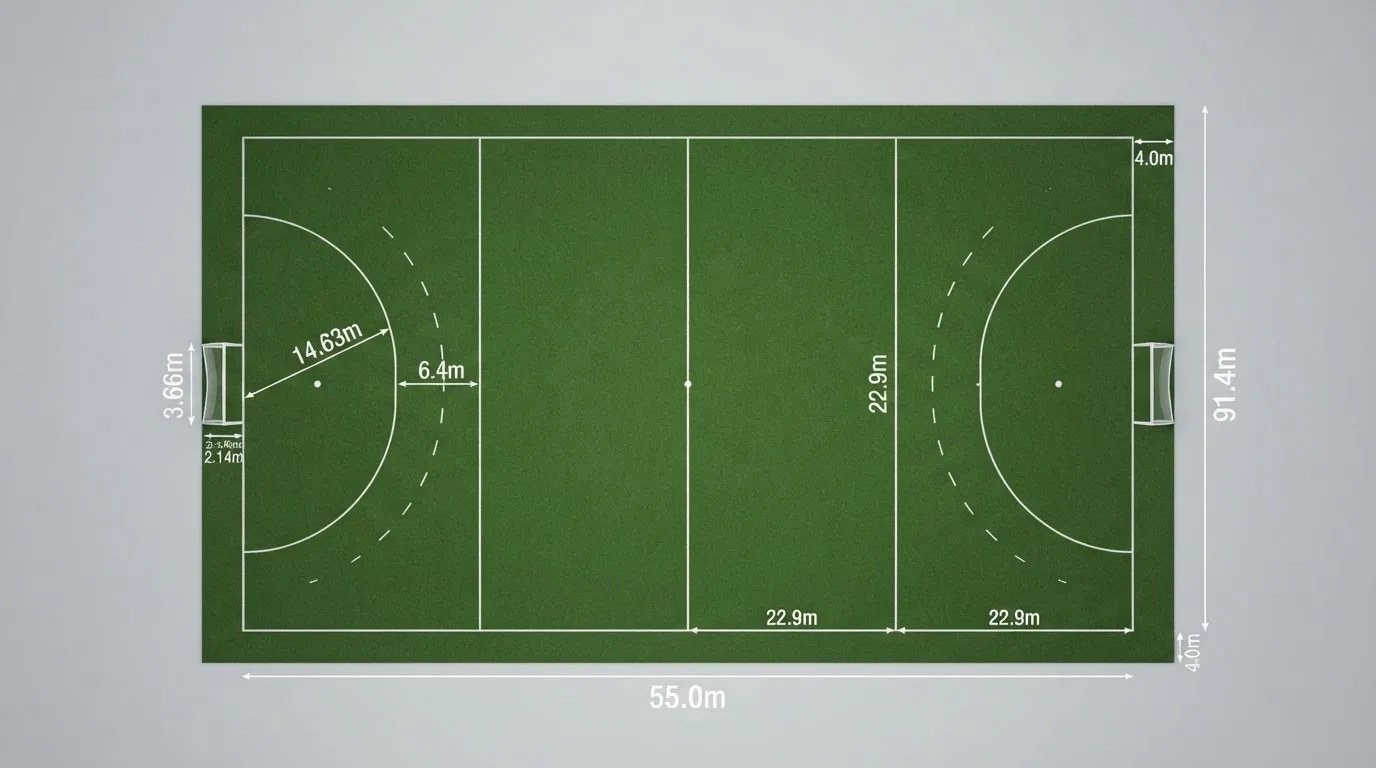
The pitch is 91.4 metres long and 55 metres wide, with goals 2.14 metres high and 3.66 metres wide — the dimensions the FIH rule book sets. The scoring circle is the D-shaped area in front of each goal where the attacking side needs to be for a goal to count, and a penalty corner — the set-piece from which most goals are scored — happens inside the circle.
The shape of the game means that handicap lines cluster low. A one-goal lead is a serious advantage, a two-goal lead is often decisive, and a three-goal lead is a near-certainty. Handicap markets at +1.5 / −1.5 and +2.5 / −2.5 reflect the goal rate; totals lines at 2.5 goals and 3.5 goals are the bands most often quoted.
Penalty corners are a market on some books at higher liquidity, and the rate of penalty corners climbs in the last quarter of a match, when tired legs give away more set-pieces. A live in-play market on the next goal, on the over/under, or on the next penalty corner is the practical way a bettor uses the structure of the game to price a bet.
Licensed bookmakers reviewed
The set below is the reviewed brands; each holds a Gambling Commission remote licence for general betting on real events (or, in Smarkets’ case, as a betting intermediary), and the licence number on the Commission’s public register is what the bettor checks before opening an account. Offers are described the way the operator’s own terms state them; the calculation of what an offer actually costs sits in the earlier section.
| Brand | Gambling Commission licence | Betting Terms |
|---|---|---|
| Fitzwilliam Sports | 048760-R-335434-009 (SBKI Limited) | High-stakes welcome offer |
| Smarkets | 039173-R-319366-011 (Smarkets (Malta) Limited) | Betting exchange commission |
| Sporting Index | 027343-R-308898-011 (Sporting Index Limited) | Fixed odds & spread betting |
| Hollywoodbets | 053028-R-330019-013 (Hollywoodbets International UK Limited) | Stake-back acca offer |
| Betboro | 044181-R-324363-007 (Webmedia Development N.V.) | Matched free bet (£25) |
| Dabble | 065677-R-340363-005 (Dabble Sports UK Ltd) | Social betting & matched free bet |
| Unibet | 045322-R-324275-019 (Platinum Gaming Limited) | Matched free bet (£40) |
| Star Sports | 009177-R-104555-019 (Star Racing Limited) | Trader-led personal service |
| William Hill | 039225-R-319373-015 (WHG (International) Limited) | Deep sportsbook, BOG racing |
| Betmaster | 065699-R-339929-002 (BM Solutions GB Ltd) | eSports-focused sportsbook |
Fitzwilliam Sports — the Dublin bookmaker with a capped membership
Fitzwilliam Sports describes itself as a Dublin bookmaker with capped membership, and its welcome offer is a “High Stakes Welcome” subject to compliance criteria — the kind of offer that targets a higher-stakes bettor rather than the casual market. The site offers instant deposits, fast withdrawals, deposit limits and timeouts, and links to GambleAware, GamStop and Gamblers Anonymous.
The brand’s narrower membership shapes who it suits best: a bettor who wants a smaller bookmaker with a personalised service, a trader to talk to, and a stake profile the site is willing to take. The Commission’s public register shows Fitzwilliam Sports trading under licence 048760-R-335434-009, with licence holder SBKI Limited. The welcome offer’s compliance criteria make it a poor fit for the casual reader, and the capped membership means a new account is not automatic.
The narrow shape of the bookmaker is also the verdict. Fitzwilliam Sports is the right pick for a higher-stakes customer the firm is willing to take on, not for the reader looking for a generic sign-up offer.
Smarkets — the betting exchange
Smarkets is a betting exchange, not a traditional sportsbook, and runs under a remote betting intermediary licence (account 39173, holder Smarkets (Malta) Limited). On an exchange the bettor backs outcomes other customers are laying, or lays outcomes other customers are backing, and the platform takes a commission on net winnings rather than a margin on every price.
The payments set is one of the practical differentiators: open bank transfer deposits are instant from £10 to £10,000, and withdrawals are processed within six hours from £10 up to £100,000; UK debit card deposits are instant from £10 to £15,000. A bettor who values fast withdrawals and a wide payment range finds that on Smarkets, and the exchange structure offers prices the traditional books do not — in particular, the ability to lay a result and lock a position.
The exchange does not run a traditional welcome bonus in the matched-bet sense. The commission rate and the liquidity on each market are the headline terms. For field hockey specifically, exchange liquidity on the sport is thin compared with football or horse racing, and the prices that do appear can be sharper than the bookmaker’s because the exchange carries a lower margin.
The verdict: the right pick for a bettor who wants exchange pricing, fast withdrawals, and the ability to lay a result. A bettor looking for a free bet sign-up offer is in the wrong place.
Sporting Index — fixed odds and spread betting under one roof
Sporting Index lets a customer switch between fixed odds and spread betting, with in-play betting, Bet Builder for football, auto cash-out and Multi-Markets. The dual structure is the firm’s distinguishing feature, and it sits under a remote general betting standard licence (account 27343, holder Sporting Index Limited).
Spread betting carries a separate risk profile: losses can exceed the deposit, and the customer is betting on a range rather than on a binary outcome. Spreadex, which operates in the same market, makes the same disclosure about its spread-betting side. A bettor who understands spread betting finds the dual structure useful; a bettor who does not should stick with the fixed-odds side.
The auto cash-out and Multi-Markets features are familiar from the bigger fixed-odds books, and the Bet Builder is football-led on Sporting Index’s app. Field hockey’s place in the bookmaker’s menu is secondary to football and horse racing, and the prices on field hockey appear when the fixtures warrant them.
The verdict: the right pick for a customer who wants both fixed odds and spread betting under one roof, with the explicit understanding that spread betting is a different product from fixed-odds betting.
Hollywoodbets — the South African bookmaker in the British market
Hollywoodbets’ sports welcome offer is a stake-back as a free bet of up to £30 on the first qualifying losing accumulator, requiring a card deposit of £10 or more and a first accumulator of £10 or more with three or more legs, each at odds of 4/1 or greater, settled within seven days. One free bet per customer.
The South African origin is the brand’s distinguishing feature, and the licence sits with Hollywoodbets International UK Limited (account 53028). The accumulator structure of the welcome is the practical hook: the bettor’s first acca needs three or more legs at 4/1 or greater, and the free bet pays only on a losing first acca — a stake-back rather than a free-bet-on-sign-up.
A three-leg acca at minimum 4/1 per leg carries a minimum combined odds of 64/1 in fractions, or 65.00 in decimals. The minimum combined price alone sets the floor; field hockey fixtures rarely carry odds that wide on a single leg, which means the welcome offer is more easily used across football, horse racing, or a combination of sports. The seven-day settlement window also constrains the offer.
The verdict: a solid choice for a bettor who wants a stake-back rather than a free bet on sign-up, with the understanding that the acca structure and the minimum combined price rule out a single-field-hockey acca on most fixtures.
Betboro — the 100% matched free bet with a minimum price floor
Betboro’s sports welcome offer is a 100% matched free bet of up to £25 on the first qualifying wager, requiring a debit card deposit of at least £10 and a first bet of £5 to £25 with at least three selections each at 3/5 (1.60) or higher. The licence sits with Webmedia Development N.V. (account 44181).
The three-leg minimum and the 3/5 (1.60) per-leg floor make the offer usable on field hockey in a way that Hollywoodbets’ 4/1 floor does not. A three-leg field hockey acca with each leg at 1.60 or above is feasible on a competitive FIH Pro League fixture list, and the £25 ceiling on the matched free bet is the practical size of the offer.
The matched-free-bet structure means the free-bet stake is not paid back on a win, and the £25 cap means a higher-stakes bettor leaves headline value on the table. The terms are readable and the qualifying structure is straightforward, which is the offer’s strength.
The verdict: a strong fit for a casual bettor who wants a matched free bet with a feasible qualifying structure on a thin sport like field hockey. A higher-stakes bettor’s ceiling is the £25 cap.
Dabble — the social betting app
Dabble’s welcome offer is “Bet £10, Get £10 in Free Bets” on a first deposit for new customers, with minimum odds applying, a seven-day free bet expiry and the stake not returned on a win. The licence sits with Dabble Sports UK Ltd (account 65677).
The social-betting structure — letting customers follow other punters and copy their bets — is the app’s distinguishing feature, and the welcome offer is a simple matched free bet on a £10 first deposit. The minimum odds floor is the practical constraint, and the seven-day expiry is short.
Dabble is the right pick for a bettor who likes the social structure: following tipsters, seeing their records, copying their picks. The £10 free bet is a small headline but the cost is low if the £10 first bet lands. Field hockey’s place on Dabble is as part of the wider sportsbook, and the app does not specialise in the sport.
The verdict: a sensible pick for a customer who wants the social-betting angle and a low-stakes welcome. Not a specialist field hockey bookmaker.
Unibet — the long-established brand
Unibet has operated since 1999, and its UK site runs under Platinum Gaming Limited, Gibraltar, on Gambling Commission account 45322. The brand’s sports welcome offer is “Get £40 in Free Bets when you bet £20”: a deposit and a sports bet of £20 or more at minimum odds of 2.0 (1/1), with free bets expiring within seven days of issue, for new GB customers using a debit card or instant bank transfer.
The 2.0 minimum odds floor and the £20 qualifying bet make the offer easy to qualify on a single football or horse-racing bet, harder to qualify on a single field hockey fixture at competitive odds. The £40 headline is generous against Betboro’s £25, and the brand’s wider sportsbook depth — across football, horse racing, tennis, American sports and a long tail — is the practical draw.
The licensed operator is Platinum Gaming Limited, and the licence category is remote general betting standard (real events). Unibet is one of the bigger GB-licensed books with a long operating history, and that history is the trust signal.
The verdict: a strong fit for a bettor who wants a larger welcome free bet, a deep sportsbook, and a long-established operator. The qualifying structure is straightforward, and field hockey sits inside a large menu.
Star Sports — the trader-led bookmaker
Star Sports lets a customer speak to a trader directly on 08000 521 321 to open an account, place bets or ask customer queries, with email backup at [email protected]. The licence sits with Star Racing Limited (account 9177).
The trader-led structure is the brand’s distinguishing feature, and it targets a customer who wants to negotiate stake sizes, get prices on-request, and deal with a human rather than a betting slip. The bookmaker’s market depth is concentrated in horse racing and a smaller set of sports; field hockey’s place is part of the wider menu.
A bettor who values a phone call to a trader over a slick app finds the Star Sports model appealing; a bettor who wants a frictionless mobile-first experience finds it old-fashioned. The head office is British and the operator is independent of the bigger multinational brands.
The verdict: a sensible pick for a customer who wants to deal with a trader directly. Not the right pick for the app-first reader.
William Hill — Best Odds Guaranteed on horse racing
William Hill pays Best Odds Guaranteed on UK and Irish horse racing from 8 AM on the day of the race, on both single and multiple bets; the offer does not apply to ante-post, tote or pari-mutuel bets. The licence sits with WHG (International) Limited (account 39225).
Best Odds Guaranteed is a horse-racing offer and does not apply to field hockey. What William Hill offers a field hockey bettor is a deep sportsbook, a long-established brand, and the customer-protection framework that comes with a major GB-licensed operator. The brand is one of the bigger British high-street names with a substantial online operation, and the trust signal that brings is the practical draw.
The wider sportsbook is broad, and field hockey is part of the menu when the fixtures warrant it. The size of the operation means liquidity on the bigger events is high, and prices on the FIH Pro League and the Hockey World Cup tend to be competitive.
The verdict: a sensible pick for a bettor who wants a major-brand sportsbook with a deep horse-racing offering. BOG is the headline on racing; field hockey sits inside the wider menu.
Betmaster — the multi-sport app
Betmaster is published by BM Solutions GB Ltd (account 65699) and covers football, cricket, horse racing, NFL and eSports — specifically League of Legends and Dota 2. Field hockey is not a headline sport on the app, and a bettor pricing a field hockey fixture on Betmaster will likely find a thin menu.
The app’s distinguishing feature is its eSports coverage, with League of Legends and Dota 2 as named products, and the broader menu of football, cricket, horse racing and NFL. The licence category is remote general betting standard (real events), and BM Solutions GB Ltd is the licence holder.
A bettor who wants eSports, cricket and NFL on one app, with football and horse racing underneath, finds the menu useful. A bettor looking for field hockey finds the sport poorly covered, and the right move is to use a bigger book for field hockey and Betmaster for the sports it leads on.
The verdict: the right pick for a multi-sport bettor who values eSports, cricket and NFL coverage, with the understanding that field hockey sits outside the app’s lead sports.
Overview — what field hockey betting looks like in Great Britain
Field hockey sits in the long tail of British sports betting. The bigger GB-licensed operators — William Hill, Unibet, the major brands — price the FIH Pro League, the Hockey World Cup and the Olympic hockey tournament during those events, and a thinner set of operators carry the sport year-round. A bettor looking for year-round field hockey prices finds a smaller menu than they would on football or horse racing.
The structure of the sport shapes the markets. A sixty-minute match with four fifteen-minute quarters and a high rate of penalty corners is a fast-paced game in which a one-goal lead is meaningful, totals cluster at 2.5 and 3.5 goals, and handicap lines run at +1.5 / −1.5 and +2.5 / −2.5. The 1X2 is settled on regulation time on most books, and FIH’s rule that tied classification matches go to a penalty shoot-out matters for outright markets more than for individual fixtures.
The market’s margins sit inside the prices. On a well-priced two-way market the margin is around 5%, on a less frequently priced fixture it widens. The book’s job is to keep the margin inside the price; the bettor’s job is to beat it. On a thin market, beating the margin is harder, and that is the honest framing of what field hockey betting in Great Britain is.
Legality, regulation and the licence test
Every commercial bookmaker taking bets from customers in Great Britain needs a Gambling Commission remote licence, and the Commission’s public register is the whole test of who holds one. The register can be searched by business name, trading name, domain or account number, and it lists the licence categories each operator holds. There is no state monopoly and no cap on the number of licences.
Since the Gambling (Licensing and Advertising) Act 2014 an operator whose remote facilities are used in Great Britain needs a Commission licence wherever the operator is based. A Curaçao, Maltese or Gibraltar licence is not a substitute for a Commission licence, although several GB-licensed operators are based in Gibraltar or Malta. The five remote licence categories are general betting standard (real events), general betting standard (virtual events), general betting limited, pool betting, and betting intermediary (the exchange category). Each operator’s card above states the licence category from the register.
Identity verification is the rule no anonymous offshore brand can match. Since 7 May 2019, name, address and date of birth are verified before a customer can deposit or gamble at a licensed site — including with a free bet or a bonus. A credit card has been banned for gambling in Great Britain since 14 April 2020 (LCCP condition 6.1.2), including credit-card-funded payments through an e-wallet; debit cards and bank-based payments are not covered by the ban. A bettor with a credit card cannot deposit one at a GB-licensed bookmaker.
The player pays no tax on betting winnings in Great Britain, and that has been the rule for decades. General Betting Duty is the operator’s tax, currently 15% on gross profits; from 1 April 2027 a new remote betting rate of 25% applies within it, while remote bets on UK horse racing, bets on self-service betting terminals in licensed premises, pool betting and in-person betting stay at 15%. Until 1 April 2027 the remote rate stays at 15%; whether operators pass duty on through odds is not established. Spread betting has its own rates — 3% financial, 10% other — and Spreadex is regulated by the Financial Conduct Authority on the financial-spread side, by the Commission on the fixed-odds side.
The promotional rules in force since 19 January 2026 cap wagering requirements on bonuses at ten times the bonus amount and ban mixed-product promotions. The whistle-to-whistle television-advertising code is an industry code, not law: since 1 August 2019 betting advertisements are not shown on TV from five minutes before a live sporting event to five minutes after it, before the 9 pm watershed, with horse and greyhound racing excluded. Field hockey is not on the whistle-to-whistle list.
A brand without a GB licence offers none of these protections — no GAMSTOP, no Commission complaints route, no approved alternative-dispute-resolution body, no British consumer redress if funds are withheld. The honest framing is that licensed = checks, limits, GAMSTOP, the bonus cap and the £150 financial vulnerability check; unlicensed = none of those and the loss of practical recourse.
Frequently asked questions
How can it be checked that a bookmaker holds a Gambling Commission licence?
The Commission’s public register can be searched by business name, trading name, domain or account number. Each reviewed brand above lists the account number alongside its licence category and holder; the register is the whole test of who holds one.
How is the return on a bet worked out from the stake and the odds?
In decimal odds, the return is the stake multiplied by the odds; the profit is the stake multiplied by the odds minus one. A £10 stake at 3.00 returns £30, of which £20 is profit; a £10 stake at 1.50 returns £15, of which £5 is profit. For an accumulator, the legs multiply into one price.
What is the bookmaker’s margin and how can it be seen in the odds?
The margin is the cut the bookmaker keeps on every unit staked. It shows up as the gap between 100% and the sum of implied probabilities across the outcomes of one market. On a two-way market at 1.90 / 1.90 the implied probabilities sum to 105.3%, making the overround 5.3% and the margin about 5.0%. On a three-way 1X2 at 1.65 / 4.00 / 4.50 the implied probabilities sum to about 107.8%, making the overround 7.8% and the margin roughly 7.3%. Field hockey’s margins sit in the 5% to 10%+ band, depending on the competition.
How do fractional odds such as 5/1 convert to decimal odds such as 6.00?
The conversion is a/b → a ÷ b + 1. Five-to-one in fractions is 5 ÷ 1 + 1 = 6.00; eleven-to-four is 11 ÷ 4 + 1 = 3.75; evens is 1 ÷ 1 + 1 = 2.00. The return is the decimal odds multiplied by the stake; the profit is the decimal odds minus one, multiplied by the stake.
Which tools for controlling play does a licensed bookmaker have to offer?
Deposit limits set by the customer, timeouts of twenty-four hours to six weeks, and self-exclusion of six months to five years. GAMSTOP covers every GB-licensed remote operator at once and is a mandatory licence condition. GamCare runs the National Gambling Helpline; GambleAware, NHS gambling clinics and Gamblers Anonymous sit beside it.
Are betting winnings taxed in Great Britain, and who pays General Betting Duty?
Betting winnings are not taxed on the player. General Betting Duty is the operator’s tax on gross profits, currently 15%; from 1 April 2027 a new remote betting rate of 25% applies within it, while remote bets on UK horse racing, bets on self-service betting terminals, pool betting and in-person betting stay at 15%. Spread betting has its own rates (3% financial, 10% other). A professional gambler should ask HMRC or an adviser.
US & other team sports – Fast Payout
Content created by the «Fast Payout» team
