
Darts Betting Tips 2026: How to Find Value Without Chasing Tips
 Available in US
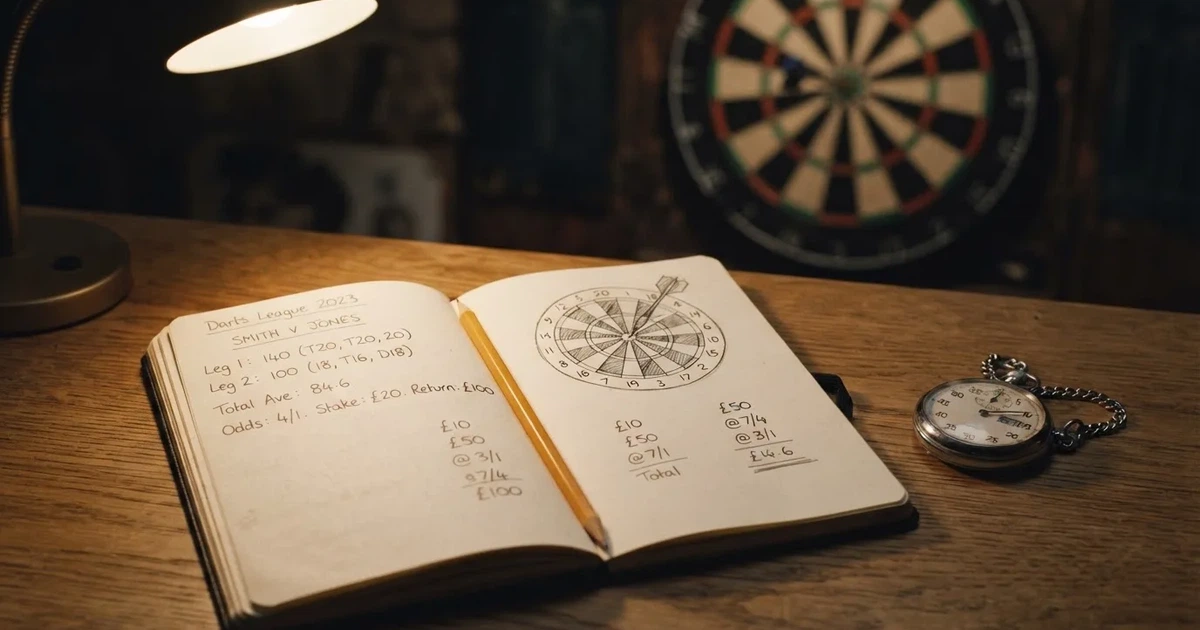
Darts looks like the easiest sport to predict — three darts, a score, a winner. The scoreboard tells you who threw well. It does not tell you whether the price on offer is worth taking, and it never tells you that the next leg will land the same way. A tipster who hands you a name is selling you a feeling they cannot enforce. The work that turns a darts match into a bet is the work that sits underneath the name: the form run, the head-to-head, the finishing percentages, the schedule, the price, and the slice the bookmaker has quietly taken from every market before you even looked. This guide walks through that work. It does not pick winners. It shows how the market is built so you can decide whether to take it.
Data current as of 27 October 2026, based on the operator terms and the Gambling Commission’s public register.
Last reviewed against operator terms on 16 October 2026 and cross-checked against the Gambling Commission’s public register.
Staying in Control Before You Pick a Match
The first paragraph of any darts betting page used to be about which player to back. The first paragraph of this one is about the bettor, because the controls you set before the match shape everything that follows. A punter who has decided how much they can lose in a session and written that figure down cannot be flattered by a tipster into chasing it back. A punter who has not decided that is exactly the person a tipster is built for.
Darts has a quiet danger. The matches are short, the calendar is dense, and a session that started at the Ally Pally can run through the Premier League, the World Matchplay, the Grand Slam and the Players Championship Finals before it has ended. The PDC runs a near-continuous tour, and the broadcasters stream most of it. The action is always on, and a near-continuous action is the surface a problem gambler slides on. The British framework is built around that risk and the framework starts with self-exclusion. GAMSTOP is the national multi-operator scheme: register once and every licensed online bookmaker in Great Britain has to refuse your account for the minimum period you choose. The minimums are six months and one year; the longer periods are five years and five years with auto-renewal. After any minimum the exclusion stays in place for a further seven years unless you ask GAMSTOP to remove it. The scheme covers online channels and apps. Betting shops use a separate service.
Deposit limits sit one step below self-exclusion. Every licensed remote operator must offer a gross deposit limit on a fixed time frame; whether the second phase of the rules is in force at the moment you read this is not something to assume. The first changes applied from 31 October 2025 and a second phase was postponed to 30 September 2026. Check the operator’s safer-gambling page before you set a number, then set one anyway — the regulator’s floor is not a substitute for your own ceiling. There is no state-set deposit or loss ceiling. The ceiling is yours.
A second control, and a newer one, sits in the middle of a normal session. Since 30 August 2024 licensed remote bookmakers have run a financial vulnerability check on customers whose net deposits cross £150 in a rolling 30 days — the test went live in February 2025. The check is a public-record look-up (bankruptcies, county court judgments) and not an income or credit reference check. A financial risk assessment — what the press calls an affordability check — has been announced in a staged plan, with no start date. Treat the announcement as a direction of travel, not a rule you can be prosecuted for ignoring today.
Help is one tap away if any of these controls feel like they are not enough. GamCare runs the National Gambling Helpline. GambleAware funds treatment and produces plain-language guidance. The NHS runs gambling clinics across England. Gamblers Anonymous runs meetings in person and online. Unibet’s safer-gambling page, for instance, links to BeGambleAware, GamCare, GAMSTOP, Gambling Therapy and the Betting and Gaming Council. The bigger operators carry the same list. Read it before you need it.
What a Darts Bonus Is Really Worth
Every bookmaker running a sportsbook in Great Britain offers a welcome package of some shape, and every one of those packages reads better than it plays. The headline is almost always “£X in free bets”, and the unwritten second half of the headline is the turnover the free bet has to clear before it pays out as withdrawable cash, the minimum price the qualifying bet must be placed at, the deadline that runs against you while you decide, and the cap on what a free-bet win can pay. Read the terms once and the bonus shrinks. Read it twice and the difference between one offer and the next is mostly the difference between two sets of conditions.
The qualifying bet
A typical welcome offer works like this. You open an account, deposit, and place a small fixed-odds bet at a minimum price — usually evens (2.00 decimal) or longer — within a short window after sign-up. If that bet wins you collect a normal payout. Either way the bookmaker credits the free bets the terms promised. The qualifying bet is the cost of entry, not a free shot at the day’s racing. Midnite’s sports welcome offer, as published on its app store listing, requires a £5 or larger pre-match bet at EVS (2.0) or greater within 14 days of sign-up; the bonus is £25 in free bets plus 50 free spins, and the bonus is valid for 7 days from credit. Sporting Index’s offer is the more involved example: a £10 fixed-odds bet at minimum odds of 1/2 (1.50 decimal) unlocks three £10 fixed-odds free bets, three £5 Total Goals spread bets, three £5 Winning Favourites spread bets and a £1 Race Index spread bet, with the qualifying bet ineligible if placed in play or cashed out early. The shape is the same on every welcome page. The numbers change; the structure does not.
The free bet itself
A free bet is a credit you can stake but not withdraw. The stake is usually not returned with a winning free bet: a £10 free bet at 3.0 returns £20, not £30. The arithmetic is straightforward once you write it down. Stake £10 at decimal odds 3.0. Profit on the bet is stake × (odds − 1), so £10 × 2 = £20. The original £10 disappears because it was never yours. A £10 free bet at 4.5 pays £35 in profit. The free-bet value rises with the price you take it at, which is why a high-priced free bet placed on a long shot is the most efficient use of the credit. The cap on free-bet winnings matters more than the headline in some offers — a free bet that pays a maximum of £500 on a darts 180-line at 10/1 sounds generous until you realise the ceiling is what stops the offer from being generous.
Wagering requirements are capped in Great Britain. The promotion rules in force since 19 January 2026 put a 10x ceiling on wagering — a £10 bonus with a 50x requirement would have demanded £500 of qualifying bets; under the cap no offer can require more than £100 of qualifying turnover per £10 of bonus. Mixed-product promotions — an offer that compels you to bet on football to earn free spins, or to play casino to clear a sports bonus — are banned outright. Free bets with no wagering condition are not covered by the 10x cap; whether a money cap exists is not established and varies by operator. Read the offer’s terms for the figure that matters to you.
The deadline, the minimum price, the cap
Three conditions decide whether a bonus is worth claiming. The deadline: most free bets expire in seven days from credit, and a darts calendar that does not run every day can leave you with a free bet you cannot place. The minimum price: a free bet that must be placed at evens (2.0) or longer is fine on a Premier League night but useless on a one-off exhibition where the favourite is shorter. The cap: a free bet whose winnings are capped at a multiple of the bonus amount can pay less than the price you took suggests it will.
A small worked illustration makes the point. Take a £10 free bet on Luke Littler to win a tournament at decimal odds 4.0. The free bet pays £30 in profit if he wins (£10 × (4.0 − 1)). The same £10 placed as cash would have paid £40 in total — £30 profit plus the £10 stake back. The free bet is worth £10 less than the cash stake at the same price, because the stake is forfeit. The bookmaker’s offer has paid you £30 to take a position you would otherwise have paid £40 to take. The £10 difference is the cost of the bonus, paid for by the bookmaker’s marketing budget. That is what a “free” bet costs. The bookmaker is happy to pay it because the bonus attracts customers who go on to bet at full margin on other markets.
A bonus is a marketing expense dressed as a gift. Treat it as one and you will never be surprised by the terms. Treat it as a gift and you will be surprised by the terms every time.
Live Darts Betting and the Cash Out Question
Darts is one of the friendliest sports for in-play betting. A match is a series of discrete legs; each leg settles in under a minute; the scoreboard updates in real time; the bookmaker’s markets reopen before the next player steps up. Premier League nights and PDC majors carry dozens of in-play markets on the bigger operators — match winner, next leg, 180s in the next leg, highest checkout, handicap on legs won. Midnite’s home page lists in-play events alongside its acca builder, popular accas and price boosts. Paddy Power’s app adds an expanded Win More market and player and ACCA stats. The infrastructure is in place.
The legal frame is the operator’s licence conditions and customer-protection duties, not a statute. In-play is not “unrestricted” in any technical sense; it is permitted under each bookmaker’s licence and run by the bookmaker’s own trading desk. A licence condition does not write a market; the bookmaker writes the market and the licence conditions police it. That distinction matters when a market is suspended mid-leg, which it usually is from the moment a player picks up a dart until the score is registered. Suspension is the operator’s risk control, not the regulator’s.
Cash out is the second piece of the live-betting picture. A cash out lets you settle a bet before the event has finished — at a price the bookmaker quotes, not at a price you choose. The price is built the same way every other price is built: the bookmaker’s view of the probability of the remaining outcomes plus a margin. A cash out at decimal odds 1.50 on a bet you placed at 2.10 is the bookmaker offering you £15 for a position that would pay £21 if you waited; the £6 difference is partly the margin and partly the value of settling now. Cash out is convenient when a match has turned against you and the alternative is a loss. It is expensive when a match has turned in your favour, because the cash out price never quite reflects what the position would pay at the end.
Two rules of thumb cover most of the live-betting decisions a punter will face. First, the in-play margin is wider than the pre-match margin on the same market. The bookmaker’s risk on a live market is harder to hedge, and the wider margin is the cost of that risk. Second, the more frequently a market is offered, the wider the average margin tends to be — next-leg winner is more expensive to back than match winner, and the more granular the market the more it costs. That is not a reason to avoid live betting. It is a reason to price it in.
The single most useful live-betting discipline in darts is the one that has nothing to do with the score. Stop betting when the schedule says you should stop. The Premier League runs weekly; the World Matchplay runs over ten days; the Players Championship events run three at once. A punter who bets on every televised match loses the difference between the price they took and the price they would have taken with a clear head. A punter who bets on the matches they prepared for does not.
Predictions, Value and Why No Tip Is Certain
The darts calendar is so dense and the broadcast window so wide that a tipster can publish a selection for almost every televised session. The volume is not the work. The work is what the selection rests on, and what rests on nothing is what a tip sheet becomes once you read past the first three names.
Form, not hype
Form in darts is measurable. First nine-dart average. First finishing percentage on the doubles. Checkout completion rate. Number of 180s per leg. Head-to-head record at the venue or in the format. Schedule density in the preceding fortnight. Whether the player is in a tournament run or in a slump that the broadcast has decided to ignore. A model that reads these numbers can rank a field more accurately than a model that reads the previous champion’s name.
The numbers are available because the PDC publishes them on its stats service and because the major broadcasters carry on-screen data during live coverage. A punter who reads form before the market opens pays less for the same edge than a punter who reads form after the market has closed. The difference is small on each match and material over a season. The discipline is to read the form on Tuesday for a Thursday night, not to read it on Thursday at 19:55 with the first leg about to start.
Value, not certainty
A value bet is a price that is higher than the true probability of the outcome justifies. If a player is 50/50 to win a match, the fair decimal price is 2.00 on each side. The bookmaker’s price on each side is 1.90 because the bookmaker keeps a margin. A tipster who tells you the player is 50/50 has told you the price is wrong. A tipster who tells you the player will win has told you nothing the price has not already told you.
No tip is ever certain because no model of darts pricing closes the residual uncertainty. A player who has won nine matches in a row can lose the tenth. A player who has lost nine in a row can win the tenth. The punter who bets on every favourite wins the matches that go to form and loses the ones that do not. The punter who bets only when the price overstates the favourite’s chance — when the favourite’s form says 65% and the price says 55% — wins more matches than they lose, because the price does the work, not the prediction.
Value is the difference between the model’s probability and the price’s implied probability. The price’s implied probability is 1 ÷ decimal odds. A bet at 3.00 implies 33.3%. A model that rates the bet at 40% has found 6.7% of value. A bet at 1.50 implies 66.7%. A model that rates the bet at 70% has found 3.3% of value. The first is a larger edge but a lower probability of winning. The second is a smaller edge but a higher probability. Most bankroll frameworks stake more on the first and less on the second; that is the entire discipline of value betting in one sentence.
Bankroll, not bravado
Bankroll is the amount you have set aside for betting, separated from the money that pays the rent. A unit is a small fraction of the bankroll — 1% is conservative, 2% is standard, 5% is aggressive. Every bet is one unit, or some multiple of one unit when the price is long enough that the edge justifies a larger position. A punter who stakes 1% per bet can lose fifty bets in a row without the bankroll being exhausted. A punter who stakes 5% per bet cannot afford ten. The model does not need to be good for the bankroll framework to work. The model needs to be a small positive edge, and the bankroll needs to be sized so the variance does not break it.
The other bankrule discipline is to keep a record. Bet, date, event, market, stake, price, result, profit. The record reveals the punter’s edge in cold figures, after the variance has averaged out, over hundreds of bets. The record also reveals when the punter’s edge has shrunk — when the same model that was 6% of value six months ago is 2% now — and when a market has closed to the punter. A punter who does not keep a record is a punter who is guessing with the lights off.
Why no tip is certain
Three reasons. Darts is a finishing sport, and a missed double at double 16 changes a match that was 5–4 to 5–3 with no warning. Schedule density affects form in ways the public numbers do not always capture. And the bookmaker’s margin sits inside every price, so a model that is exactly right about the probability is still losing money on average until it is more right than the margin is wide. The first two reasons mean the model is always a probability, never a forecast. The third reason means even a perfect model is not free. A tipster who promises certainty is promising something the maths will not deliver.
Bet Types and How the Odds Are Built
Darts betting is a small set of bet types applied to a small set of markets. The bet types are common to every sport; the markets are what darts offers. Knowing the difference is the work that turns a bettor into a punter.
The bet types
A single is one bet on one outcome. A double is two singles in one stake; either both win or the bet loses. A treble is three. An accumulator (“acca”) is four or more, with each leg multiplying into the next; a £10 acca with four legs at 3.0 pays £10 × 3.0⁴ = £810 if all four win, which is the appeal and the peril of the format. Each-way is two bets of equal stakes, one on the win and one on the place; the stake doubles. A Trixie is three doubles and one treble from three selections, four bets in total. A Patent is three singles, three doubles and one treble from three selections, seven bets. A Yankee is six doubles, four trebles and one fourfold from four selections, eleven bets. A Lucky 15 is a Yankee plus four singles, fifteen bets. A Super Yankee (Canadian) is twenty-six. A Heinz is fifty-seven. A Goliath is two hundred and forty-seven. The total stake is unit stake × number of bets — a £1 Lucky 15 costs £15; a £1 Goliath costs £247. The combined bets are the structure; the singles and the acca insurance are the safety net.
A bet builder is the same structure on a single event: player to win, over 4.5 legs, over 3.5 180s, highest checkout over 100.5, all priced into one ticket. The price is the product of the legs with the bookmaker’s margin layered on top. Paddy Power’s Bet Builder+ and Midnite’s acca builder are the canonical examples on the licensed UK side.
The dartboard, the match and the distance
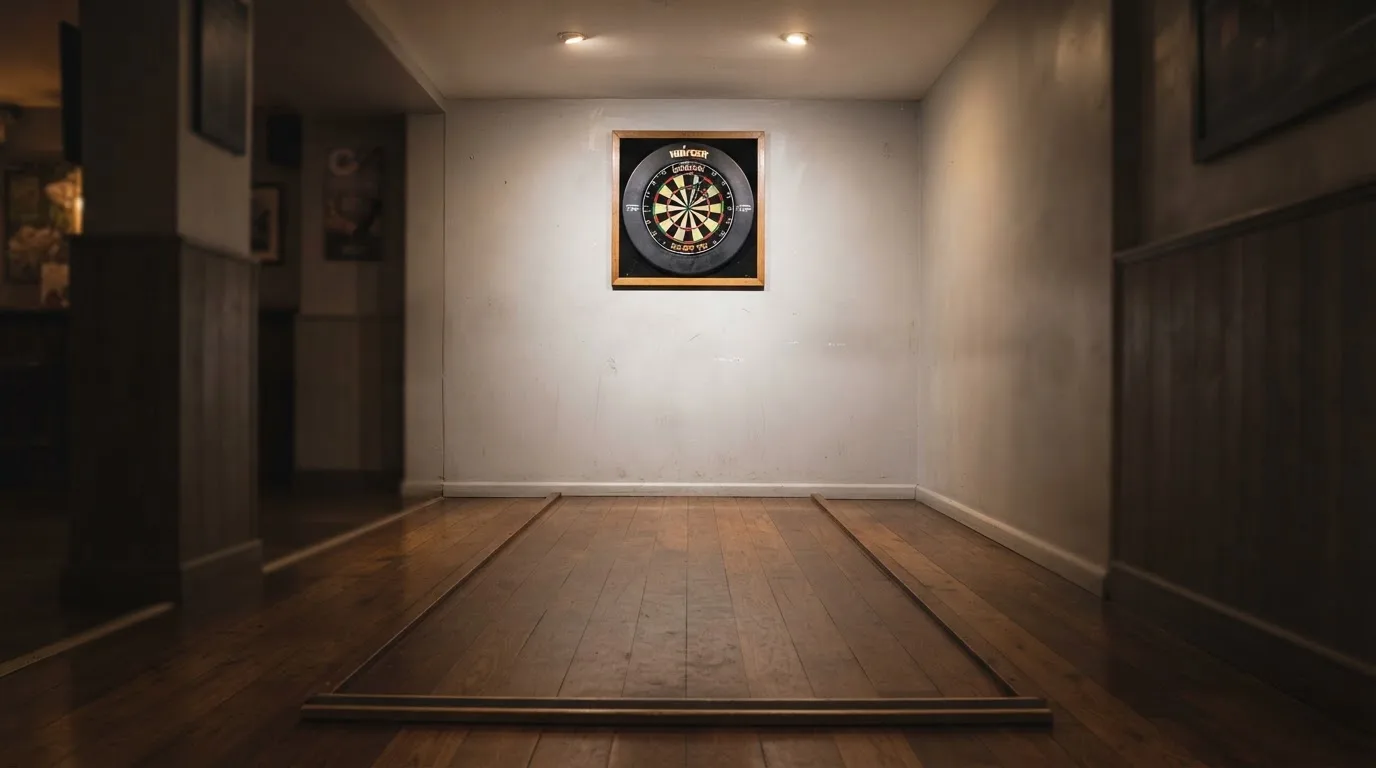
A standard dartboard has 20 numbered segments, each split into single, double and treble areas; the bullseye is worth 50 and the outer bull 25. In 501 darts — the discipline that runs almost all televised match play — players start at 501 and must finish on a double or the bullseye. The highest possible three-dart finish is 170 (treble 20, treble 20, bullseye). The minimum possible leg is nine darts. The standard throw distance is 2.37 metres (7 feet 9 inches), and the bullseye is 1.73 metres above the floor. The numbers are not trivia; they explain why the double is the match’s defining shot and why a player who cannot hit double 16 under pressure loses more matches than the three-dart average suggests.
The match and the tournament
The 2026 PDC World Darts Championship ran from 11 December 2025 to 3 January 2026 at Alexandra Palace, London, with 128 players in the main draw — up from 96 the year before. Luke Littler beat Gian van Veen 7–1 in the final; the prize fund was £5,000,000, with £1,000,000 to the winner. Round lengths in that tournament were first to 3 sets in rounds 1 and 2, first to 4 in rounds 3 and 4, first to 5 in the quarter-finals, first to 6 in the semi-finals and first to 7 in the final. The format changes the value of any outright bet: a longer format favours the deeper finisher, a shorter format flattens the field and lifts the price on the longer-priced runner.
The PDC is one of two governing bodies at the top of the sport; the World Darts Federation is the other. The PDC World Championship is held annually over the Christmas and New Year period and is the calendar’s centre of gravity. Around it sit the Premier League (a weekly invitational through the spring), the World Matchplay (summer), the Grand Slam (autumn), the Players Championship Finals (late autumn), the World Series of Darts Finals, and a near-continuous stream of Players Championship events on the floor tour. Outright winner markets settle early in the calendar and stay open through the season; each-way terms vary by event.
How the margin shapes the odds
A bookmaker’s margin is the slice of every market they keep, on average, over the long run. The simplest way to see it is on a two-way market priced at 1.90 and 1.90. The implied probabilities add to 1 ÷ 1.90 + 1 ÷ 1.90 = 0.5263 + 0.5263 = 1.0526, or 105.26%. The extra 5.26% above 100% is the margin — the bookmaker’s edge built into the price. A market priced at 1.85 and 1.85 carries a margin of 1 ÷ 1.85 + 1 ÷ 1.85 − 1 = 8.11%. A market priced at 2.00 and 2.00 is a margin-free “fair” price, which no licensed bookmaker offers on a two-way line because there is no edge in it.
The result is a band, not a figure. Two-way darts match winner markets at major bookmakers typically carry a margin in the 5–8% region. Three-way markets — player A, player B, draw is not relevant in darts — sit slightly higher because more outcomes on each side have to be priced. Specialty markets (next-leg winner, 180s in the next leg, highest checkout) carry higher margins still, often 8–12%, because the bookmaker’s risk on a live market is harder to hedge. This band shows the pricing reality: the closer to 5% a market sits, the cheaper the price; the closer to 12%, the more the punter is paying for the convenience of a market that updates every leg.
The corollary is that any model of value has to clear the margin before it pays. A model that says the favourite is at 60% on a 6% margin market has to find a price that prices the favourite at decimal odds above 1 ÷ 0.60 = 1.667, which is a price of 1.70 or better. Anything shorter is a bet the model cannot justify. A punter who bets the favourite at 1.55 is not betting value; the punter is betting the name.
The Landscape of Darts Betting Sites in the UK
Ten bookmakers carry a UK Gambling Commission remote licence and serve darts betting markets to customers in Great Britain. Each is described below on the same axes: the licence and its holder, the offer on the operator’s own terms, the payment methods the operator publishes, the safer-gambling tools, and the shape of the darts product. None is recommended over another in this section. Each is presented on what it carries, and the verdict at the end of each is the page’s own judgement, drawn from the materials each operator publishes.
Paddy Power
Gambling Commission account 39439 (remote licence 039439-R-319330-013), held by PPB Counterparty Services Limited, listed on the public register against the trading name Paddy Power. The Paddy Power app carries Bet Builder+, a popular Bet Builders rail, Super Sub (a bet rolls over to a substitute if the selected player is replaced mid-match), expanded Win More markets and player and ACCA stats. Paddy Power is part of the Flutter group, which also runs Betfair; the two brands share a corporate parent but present as separate operators on the Commission register.
The darts product on Paddy Power is among the deepest of the licensed UK bookmakers — outright winner, match winner, set handicap, leg handicap, 180s markets, highest checkout markets and a Bet Builder+ that covers most of the same legs in one ticket. The Super Sub rule is genuinely useful on a sport where a withdrawal between the betting window and the start of play is not unknown; the bet does not lose, it transfers. The expanded Win More markets are a marketing name for enhanced accas, not a structural edge. Paddy Power’s safer-gambling page is full and the brand is a GAMSTOP member.
Verdict: Paddy Power is the strongest pick on the page for a punter whose priority is a deep, well-built darts product with a genuine bet builder and a substitution rule that protects the bettor.
Betmaster
Gambling Commission account 65699 (remote licence 065699-R-339929-002), held by BM Solutions GB Ltd, registered in Malta. Betmaster states it holds a UK Gambling Commission licence for customers in Great Britain and operates under that licence.
The published product on Betmaster is a standard licensed-UK sportsbook: pre-match and in-play markets on darts, a bet builder on football and the major US sports, and a casino attached. The darts product on the home page is present but not headline; Betmaster’s prominence on the licensed-UK scene is broader than darts. Payment methods and safer-gambling tools are standard for the segment.
Verdict: Betmaster is a competent licensed-UK bookmaker for a punter who bets across several sports and wants a single account; the darts product is adequate rather than standout.
BetGoodwin
Gambling Commission account 2927 (remote licence 002927-R-327985-008), held by Goodwin Racing Limited, listed on the public register against the trading name BetGoodwin. BetGoodwin pays Best Odds Guaranteed on all UK and Irish horse and greyhound racing, up to £1,000 per bet, as its own App Store listing states.
The headline on BetGoodwin is horse and greyhound racing. The darts product exists on the licensed-UK bookmaker but is not the brand’s centre of gravity; the price boosts and BOG-style concessions are concentrated on the racing side. A punter whose calendar is racing-led and who wants a darts product on the same account is reasonably served; a punter whose calendar is darts-led will find a thinner product.
Verdict: BetGoodwin suits the punter who values racing concessions, although darts betting remains a secondary feature here.
Sporting Index
Gambling Commission account 27343 (remote licence 027343-R-308898-011), held by Sporting Index Limited. Sporting Index is a spread-betting operator and runs fixed-odds sports on the same account. Spreadex, by contrast, is regulated by the FCA for spread betting and by the Gambling Commission for fixed-odds betting, and states that spread betting losses can exceed deposits — the FCA regulation is for the financial product, the Commission regulation is for the fixed-odds product. The two brands are separate operators.
Sporting Index’s new-customer offer, as published on its App Store listing, is the most involved on the licensed-UK side: a £10 fixed-odds bet at minimum odds of 1/2 (1.50 decimal) unlocks three £10 fixed-odds free bets, three £5 Total Goals spread bets, three £5 Winning Favourites spread bets and a £1 Race Index spread bet, with the qualifying bet ineligible if placed in play or cashed out early. The offer is built for a punter who uses both products.
Verdict: Sporting Index is the primary choice for those needing both fixed-odds and spread betting on one account; the offer is less interesting on either product alone.
LiveScore Bet
Gambling Commission account 56859 (remote licence 056859-R-332720-005), held by LiveScore Betting and Gaming (Gibraltar) Limited. LiveScore Bet’s help pages name the payment methods the brand accepts: debit cards (Visa and Mastercard), Apple Pay, PayPal, Pay by Bank (Open Banking) and Revolut Pay. That is a fuller payments set than the segment’s median.
The LiveScore brand carries a strong live-scores product across football, basketball and several other sports; the sportsbook is attached. The darts product on LiveScore Bet is present and the in-play markets are functional. Safer-gambling tools and the standard GAMSTOP membership are in place.
Verdict: LiveScore Bet is a functional choice for the punter who already uses the scores app, featuring a broader payments set than most of the licensed UK field.
Midnite
Gambling Commission account 101839 (remote licence 101839-R-342850-001), held by Midnite Limited. Midnite’s site cites its Commission licence on the home page, and the App Store listing publishes a sports welcome offer: new customers who bet £5 or more on pre-match odds of EVS (2.0) or greater within 14 days of sign-up receive £25 in free bets and 50 free spins, valid for 7 days.
Midnite’s home page shows in-play events alongside an acca builder, popular accas and price boosts, with maximum-stake limits attached to the boosted prices. The product is modern and the brand is built around the in-play experience. The sports welcome offer is straightforward and the qualifying bet is small.
Verdict: Midnite caters to the modern in-play punter, and its £5 qualifying bet at EVS represents a relatively low-friction welcome offer.
DAZN Bet
Gambling Commission account 48756 (remote licence 048756-R-327274-019), held by DZBT Limited. DAZN Bet publishes a clear deposit-methods page on its help centre: deposits start at £5 by debit card, Apple Pay, Paysafecard, Trustly and Skrill, and at £20 by PayPal, with no processing fees from the operator.
DAZN Bet is attached to the DAZN sports-broadcasting brand, which gives it a media footprint most of the licensed UK field does not have. The darts product is present on the licensed-UK bookmaker and the live-betting infrastructure is built around the same broadcast feeds. Safer-gambling tools and the standard GAMSTOP membership are in place.
Verdict: DAZN Bet is a clear choice for the punter who watches on the DAZN network, with a £5 minimum deposit across most methods.
Lottoland
Gambling Commission account 38991 (remote licence 038991-R-319408-020), held by EU Lotto Limited. Lottoland’s UK app combines casino, lottery betting, sports betting and scratchcards, and the App Store listing states it is licensed by the Gambling Commission for customers in Great Britain.
Lottoland’s centre of gravity is lottery betting and casino; the sportsbook is attached. The darts product exists but the brand’s depth of coverage on the sport is shallower than a sports-first bookmaker.
Verdict: Lottoland is an option for the casino-focused punter, though dedicated darts fans may prefer a more specialized bookmaker.
Fitzwilliam Sports
Gambling Commission account 48760 (remote licence 048760-R-335434-009), held by SBKI Limited. Fitzwilliam Sports publishes its customer-service hours on its home page: phone and live chat with the office open 09:00 to 21:00, Monday to Sunday, with messenger replies generally within 90 seconds. That is a published, narrow-window phone service rather than a 24-hour live chat.
Fitzwilliam Sports is an independent licensed UK bookmaker; the darts product is present. The published phone hours are unusually specific and unusually narrow for the segment.
Verdict: Fitzwilliam Sports provides a solution for the punter who prioritizes personal phone contact, though the 09:00 to 21:00 window may be restrictive for some.
William Hill
Gambling Commission account 39225 (remote licence 039225-R-319373-015), held by WHG (International) Limited. William Hill publishes Best Odds Guaranteed on UK and Irish horse racing from 8 AM on the day of the race, on both single and multiple bets; the rule does not apply to ante-post, tote or pari-mutuel bets. The brand is one of the longest-established names on the UK high street and on the licensed-UK remote register.
The darts product on William Hill is broad — outright winner, match winner, in-play markets and a bet builder on the major sports. The BOG concession on racing is a structural edge for racing-led punters; the darts product is competitive rather than headline.
Verdict: William Hill is the right pick for a punter who values an established name, a deep racing product with BOG and a competent darts product on the same account.
Reading a Licence and Trusting the Register
Every brand named in this guide holds a Gambling Commission remote licence, and every brand named in this guide is verified against the Commission’s public register. The register is the test of whether a licence is real, and the register can be searched by business name, trading name, domain or account number. A licensed operator using .com rather than .co.uk is normal; the domain does not prove the licence either way. The Commission account number is the test that does.
Minimum age is 18. Name, address and date of birth are verified before a customer can deposit or gamble — the rule has been in force since 7 May 2019 and applies even to a free bet or a bonus credit. A bettor who cannot pass verification cannot use the site, including for a no-deposit promotion. The verification is the licensed-UK bookmaker’s cost of doing business, and the cost is borne by the bookmaker, not the bettor.
Financial spread betting on financial markets sits outside the Commission’s frame. Spreadex is regulated by the FCA for spread betting, the Commission for fixed-odds; the two regulators cover different products on the same operator. A punter who opens a spread-betting position on a financial market is in the FCA’s territory; a punter who opens a fixed-odds sports bet is in the Commission’s territory. The two are not interchangeable. A spread bet can lose more than the deposit; a fixed-odds sports bet cannot.
The Commission’s framework is not the only thing that matters. The Commission sets the floor. Each operator sets the ceiling — its own maximum stake, its own market list, its own payment-method list, its own safer-gambling tools. A licensed-UK bookmaker is licensed to a standard; it is not licensed to be the same as the next one. The differences between operators are real and the differences between operators and an unlicensed site are larger still. An unlicensed site is not “the safe choice”; an unlicensed site is not a choice the Commission has tested.
Offshore, Unlicensed and What the Customer Loses
A bookmaker based in Curaçao, Malta or Gibraltar, and not licensed by the Commission, can still accept a customer in Great Britain. The customer is in breach of nothing; the operator is in breach of section 33 of the Gambling Act 2005 (as amended by the Gambling (Licensing and Advertising) Act 2014). No offence aimed at the customer who bets on an unlicensed site was found. The cost to the customer is on the protection side, not on the prosecution side.
An unlicensed site is not in GAMSTOP. An unlicensed site is not bound by the Commission’s affordability and vulnerability checks. An unlicensed site is not bound by the 10x bonus cap or the mixed-product promotion ban. An unlicensed site has no Commission complaints route and no approved alternative dispute resolution body. An unlicensed site can withhold funds without a British consumer remedy. None of this is illegal for the customer. All of it is a real loss of protection.
Enforcement is at the operator, not at the customer. The Commission can issue cease-and-desist notices, refer sites to search engines, work with registrars, hosts and payment providers, and now has — or is about to receive — court-order DNS blocking powers. ISP blocking is not in operation as a standing rule; the framework is disruption, not a firewall. A punter who reaches an unlicensed site from a British IP has done so through a gap the Commission has not yet closed, not through a route the Commission has endorsed.
The honest framing is short. A licensed-UK bookmaker offers verification, deposit limits, GAMSTOP, the 10x bonus cap, the £150 vulnerability check and a Commission complaints route. An unlicensed site offers none of those. The licensed site is also bound to verify you before the first bet, which an unlicensed site does not. Neither is “safe” by default; both are real choices with real consequences. The choice belongs to the punter.
Top 10 Darts Betting Sites Compared
The table below sets each licensed UK bookmaker on the same axes: the licence and its holder, and what the operator’s own terms state on the payment methods, on the safer-gambling and verification regime, and on the darts-specific product. The columns are the matters that decide between operators. The cells are what each operator’s own published materials carry.
| Brand | Gambling Commission account and licence holder | Payment methods published by the operator | Safer-gambling and verification regime | Darts product on the operator’s own materials |
|---|---|---|---|---|
| Paddy Power | Account 39439 (remote licence 039439-R-319330-013); PPB Counterparty Services Limited | Debit cards, Apple Pay, PayPal and the operator’s published e-wallet list | Standard UK consumer protection regime with GAMSTOP, deposit limits and full safer-gambling tools | Bet Builder+, Popular Bet Builders, Super Sub, expanded Win More markets, player and ACCA stats |
| Betmaster | Account 65699 (remote licence 065699-R-339929-002); BM Solutions GB Ltd | Debit cards, e-wallets | Standard UK consumer protection regime with GAMSTOP membership and verification before first deposit | Standard sportsbook with bet builder on the major sports and an attached casino |
| BetGoodwin | Account 2927 (remote licence 002927-R-327985-008); Goodwin Racing Limited | Debit cards, Apple Pay | Standard UK consumer protection regime | Racing-led sportsbook with BOG on UK and Irish horse and greyhound racing, up to £1,000 per bet |
| Sporting Index | Account 27343 (remote licence 027343-R-308898-011); Sporting Index Limited | Debit cards, bank transfer | Standard UK consumer protection regime; fixed-odds and spread betting on the same account | Fixed-odds and spread betting markets on darts and the major sports |
| LiveScore Bet | Account 56859 (remote licence 056859-R-332720-005); LiveScore Betting and Gaming (Gibraltar) Limited | Debit cards (Visa and Mastercard), Apple Pay, PayPal, Pay by Bank (Open Banking), Revolut Pay | Standard UK consumer protection regime | LiveScore-branded sportsbook attached to the LiveScore scores product |
| Midnite | Account 101839 (remote licence 101839-R-342850-001); Midnite Limited | Debit cards, Apple Pay | Standard UK consumer protection regime; verification before first deposit | In-play events, acca builder, popular accas and price boosts with maximum-stake limits |
| DAZN Bet | Account 48756 (remote licence 048756-R-327274-019); DZBT Limited | Debit card (£5), Apple Pay (£5), Paysafecard (£5), Trustly (£5), Skrill (£5), PayPal (£20); no processing fees | Standard UK consumer protection regime | Sportsbook attached to the DAZN broadcast brand, with live markets on the major sports |
| Lottoland | Account 38991 (remote licence 038991-R-319408-020); EU Lotto Limited | Debit cards, e-wallets | Standard UK consumer protection regime | Casino, lottery betting, sports betting and scratchcards on one app |
| Fitzwilliam Sports | Account 48760 (remote licence 048760-R-335434-009); SBKI Limited | Debit cards, bank transfer | Standard UK consumer protection regime; phone and live chat 09:00 to 21:00, Monday to Sunday | Independent licensed-UK bookmaker with sports markets on darts and the major sports |
| William Hill | Account 39225 (remote licence 039225-R-319373-015); WHG (International) Limited | Debit cards, Apple Pay, PayPal | Standard UK consumer protection regime | Broad sportsbook with BOG on UK and Irish horse racing from 8 AM on the day of the race; darts product present |
The spread the table shows is the spread of business models, not the spread of quality. Paddy Power, Midnite and DAZN Bet are the more modern products on the list; William Hill is the longer-established name; Lottoland and Sporting Index sit at the intersection of sports and another product. BetGoodwin is the racing-led bookmaker. Betmaster, LiveScore Bet and Fitzwilliam Sports are the more conventional licensed-UK books. The choice between them is not a ranking. It is a match between the punter’s calendar and the operator’s centre of gravity.
Frequently Asked Questions
How do you bet on darts?
Darts betting works the same way betting on any sport works. Open an account with a licensed UK bookmaker, deposit by a permitted method, choose a match, choose a market, enter a stake and confirm. The bet settles when the match settles — a match winner settles on the final set, a next-leg winner settles on the next leg, an outright winner settles when the tournament ends. The odds on each market are set by the bookmaker and carry a margin, so the implied probabilities of the outcomes add up to more than 100%. A bet wins if the outcome lands; the payout is stake multiplied by the decimal price.
What is darts betting?
Darts betting is the practice of staking money on the outcome of a darts match, a leg, a tournament or a specific event within a leg — a 180, a highest checkout, a handicap on legs won. The sport is governed in the professional game by the PDC and the WDF, with the PDC World Championship held annually over the Christmas and New Year period. Licensed UK bookmakers offer match winner, outright winner, set and leg handicaps, in-play markets and bet builders on the major tournaments. The full market list is the operator’s; the legal framework is the Gambling Act 2005 and the Gambling Commission’s licence conditions.
How does darts handicap betting work?
A handicap in darts is a way of making a one-sided match a bet. If Luke Littler is at 1.20 to win a match and his opponent is at 5.50, the bookmaker offers a handicap line: Littler −2.5 sets (he must win by three clear sets), or the opponent +2.5 sets (the opponent must not lose by three clear sets). The handicap is added to or subtracted from the actual result. A bet on the opponent at +2.5 wins if the opponent loses 4–3 in sets; it loses if the opponent loses 5–0. The handicap is the bookmaker’s way of offering a price on both sides when one side is much stronger than the other.
What is a value bet and why is no tip ever certain?
A value bet is a price that is higher than the true probability of the outcome justifies. If a player has a 50% chance of winning a match, the fair decimal price is 2.00. The bookmaker offers 1.90, which implies 52.6% — the price is too short. A punter with a model that rates the player at 50% has found a value bet at any price above 2.00. The model is a probability, not a forecast; it is rarely exactly right, and the residual uncertainty is part of every bet. A tip can never be certain because darts is a finishing sport, schedule density affects form in ways the public numbers do not always capture, and the bookmaker’s margin sits inside every price.
What is the bookmaker’s margin and how can it be seen in the odds?
The margin is the slice of every market the bookmaker keeps on average over the long run. On a two-way market priced at 1.90 and 1.90, the implied probabilities are 52.6% and 52.6%, totalling 105.3%. The 5.3% above 100% is the margin. A market priced at 1.85 and 1.85 carries a margin of about 8.1%; a market priced at 2.00 and 2.00 carries no margin. The margin is the bookmaker’s edge built into the price; the punter’s edge has to be larger than the margin to be a value bet. A punter who wants to see the margin in the odds adds up 1 ÷ decimal odds on each outcome and compares the total to 100%.
How is the return on a bet worked out from the stake and the odds?
The return on a winning bet is the stake multiplied by the decimal odds. A £10 bet at decimal odds 3.00 returns £30 in total — the £10 stake plus £20 in profit. The profit alone is stake × (odds − 1), which is £10 × 2.00 = £20 in the same example. A free bet does not return the stake with a win: a £10 free bet at 3.00 returns £20 in profit, not £30 in total. The arithmetic is the same on every bet type; an accumulator multiplies the odds of the legs together, so a £10 acca with three legs at 3.00, 2.50 and 4.00 returns £10 × 30.00 = £300 in total.
Tennis, darts & cue sports – Fast Payout
Content created by the «Fast Payout» team
