
Cycling Betting Odds 2026: How Prices Are Set, Which Markets to Use, and Who Offers the Best
 Available in US
Cycling odds move to a different rhythm from most sports. A Grand Tour lasts three weeks; one rider’s form at the prologue tells you almost nothing about his shape in week three, and the betting market knows it. A short sprint stage and a mountain queen stage sit next to each other on the same coupon, and the bookmaker quotes both. The odds posted for the Tour de France general classification at 9 a.m. are not the odds posted after the first summit finish. Cyclists fall, abandon, crash in the gruppetto. Stage prices collapse on a thirty-second climb. This page is about how that market works in Britain — who sets it, what it costs the bettor, and where each operator fits.
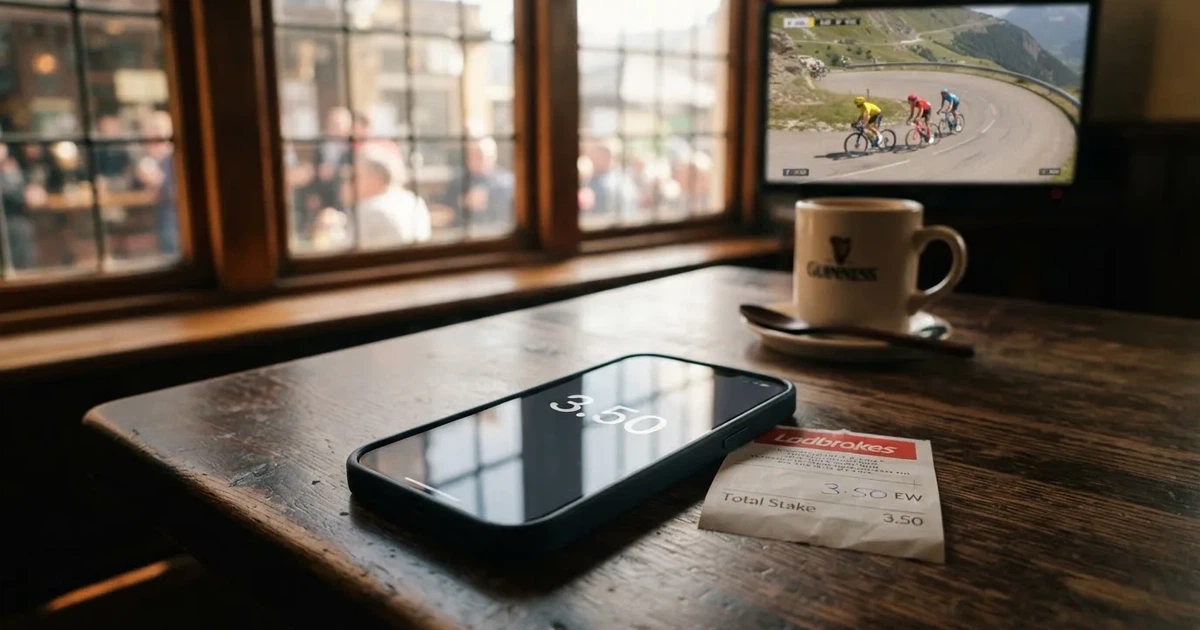
*Currency stamp: figures current as of 27 October 2026, verified against the Gambling Commission’s public register and each operator’s own terms page.*
The shape of the cycling betting market
Cycling is a niche within a niche for British bookmakers. Football, horse racing and tennis fill the front page; cycling lives a couple of tabs deeper, usually inside the “Specials” or “Cycling” lobby. That niche size is not a statement about the sport’s appeal in Britain — the Tour de France still pulls live television audiences and a British winner is one of the few certainties in summer viewing — but about the structure of the betting market. A bookmaker wants every Premier League match quoted, with five markets at minimum. A bookmaker wants every Tour de France stage quoted, but a British audience for a Tuesday afternoon Pyrenean stage is smaller and the menu is thinner.
The single most important thing a new bettor learns about cycling odds is that they are not a single number. The market splits into three distinct levels, and each one moves on its own clock.

The first level is outright, or ante-post, betting. This is the overall winner of the Tour de France, the Giro d’Italia or the Vuelta a España, the green jersey, the polka-dot jersey, the white jersey, the King of the Mountains, the points classification, the young rider classification, and often the team classification. These odds are quoted months ahead, sometimes more than a year for the next Tour. They absorb team news, route announcements, last year’s form and the bookmaker’s view of how the public will lay its money. They move on slow news and on the rider’s health in the run-up.
The second level is stage betting. The Tour runs twenty-one stages in 2026; the Giro and the Vuelta run similar lengths; the WorldTour one-day Classics (Milan–San Remo, the Tour of Flanders, Paris–Roubaix, Liège–Bastogne–Liège, Il Lombardia) sit between. Each stage has its own market: stage winner, top three, top six, head-to-head between two named riders, sometimes a market on whether the breakaway will hold. Stage odds are quoted the morning of the stage and repriced throughout the day. They can swing wildly if a rider crashes in the neutral zone or if a team announces a tactical change an hour before the start.
The third level is in-play, or live, betting. The bigger operators take in-play bets during a stage. The market is thinner than football’s, the suspension window is wider (a bookmaker stops taking bets when a crash happens or when a significant split forms), and the prices move on bigger spreads because the in-play trading team is quoting a niche market rather than a flagship one.
A fourth level is worth naming because it does not fit cleanly into the others: matchups, head-to-heads and specials. “Rider A to finish ahead of Rider B”, “British rider to win a stage”, “any breakaway to survive to the finish” — these are the markets the bookmaker’s traders build on top of the underlying stage and race odds. They are popular because they let a bettor with limited knowledge of professional cycling express a view: this sprinter is in better form than that one, this team controls this race, that mountain stage favours the climbers.
How the price gets built
Every price on every market at every British bookmaker carries a margin. The margin is the cut the bookmaker takes on every pound staked; the rest is paid back, on average, to bettors as winnings. A market with a 5% margin returns 95 pence in winnings for every pound bet, on average. A market with an 8% margin returns 92 pence. Football match odds at major British bookmakers typically run between 4% and 6% margin; cycling outright markets tend to run a touch higher because the field is deeper and the bookmaker’s pricing model is less certain; stage winner markets can be higher still.

The page’s worked example is a two-way market at decimal odds 1.90 / 1.90, the kind of symmetric price a bookmaker would post for a head-to-head between two evenly-matched riders. The arithmetic of the margin is straightforward: the payout share of that market equals one divided by the sum of the reciprocals of the odds. With both sides priced at 1.90, the payout share is one divided by (one over 1.90 plus one over 1.90), which is one over (0.5263 + 0.5263) = one over 1.0526 = 0.9500. The margin is one minus the payout share, which is 0.0500, or 5.0%.
That number — 5% — is the price the bettor pays to take the bet. A 5% margin is ordinary for British bookmakers on a major market and unremarkable when the same bookmaker is offering a niche market at 7%. The margin is the comparison that matters when two odds are placed beside each other: 2.00 versus 2.02 on the same selection looks like a two-point gap, but on a 5% margin it is a 12% bigger return for the bettor, and on a 10% margin it is a 22% bigger return. The headline price sits inside a margin the page cannot see; the page must take both into account.
For outright markets, the field is wider and the bookmaker quotes a price on each of twenty or thirty riders. The arithmetic generalises — sum the reciprocals of every price quoted across the field, take the inverse, subtract from one — but the practical consequence is that the bookmaker’s margin climbs because the longer the field, the harder the bookmaker has to work to balance the book. A cycling outright market with a 12% margin is normal; an outright market with a 6% margin is unusually competitive.
For stage winner markets, the bookmaker usually quotes ten or fifteen riders. Margins of 7% to 10% are ordinary. For head-to-head markets, the field is two riders and the margin is closer to a football match odds margin. The bettor who knows the sport will spend more time on the markets with the tightest margins and the most information available — head-to-heads in particular, where two riders’ recent form is a small dataset and the bookmaker’s pricing model is exposed.
What the bookmaker’s terms actually say
Every British bookmaker lists a set of rules for cycling specifically. They are not the same as the rules for football. The rules cover a small number of recurring situations the bettor needs to understand before placing the bet.
The first is the question of what happens when a rider does not start. If a rider is quoted at 50/1 to win the Tour and pulls out with a broken collarbone in week one, the bookmaker’s standard rule is to make the bet void and return the stake. The same applies to stage bets: if the rider does not start the stage, the bet is void. The exception is the small print on each-way bets and on certain accumulator promotions: a non-runner may reduce the bet rather than void it.
The second is the question of what counts as the result. For outright markets, the result is the official UCI classification at the end of the final stage. Time bonuses, post-stage adjustments and disqualifications after the finish all flow through the official classification; the bookmaker pays the official result, not the result as it crossed the line. For stage markets, the result is the order in which the riders cross the finish line of the stage; the photo finish is the result, even if the UCI later disqualifies a rider for a sprint irregularity. For head-to-head markets, both riders must start the race (or the stage); if one rider does not start, the bet is void.
The third is the question of when a market is suspended. Live markets on cycling are suspended more often than live markets on football, for the simple reason that crashes, splits and decisive moves happen at high speed and the bookmaker’s trading team needs time to reprice. A suspension does not void an existing bet; it stops the bettor from placing a new one. The bettor who wants to place a stage bet during the stage has to expect the suspension window to be longer than the football equivalent.
The fourth is the question of each-way terms. Each-way bets are split into a win bet and a place bet, at equal stakes; the stake doubles. The place terms for cycling are usually one quarter of the win odds for the first three places in stage races and one third for the first two in smaller one-day races, but the terms vary by bookmaker and are spelled out in each bookmaker’s cycling rules page. The bettor who bets each-way on a 25/1 outsider to win a Grand Tour is paying two unit stakes for the privilege of getting a small place return if the rider finishes on the podium; that is rarely worth it.
How Great Britain regulates the market
The Gambling Commission regulates commercial gambling in Great Britain under the Gambling Act 2005. The Act covers England, Scotland and Wales. Northern Ireland is outside the Act and operates under its own older law, so a “Great Britain licence” is a GB licence and not a UK-wide licence.
The starting point for the bettor is the Gambling Commission’s public register. The register lists every operator licensed to take bets from customers in Great Britain, by business name, trading name, domain or account number. The register is the whole test of whether a brand holds a licence; no other source supersedes it. The register also carries the categories of licence each operator holds: remote general betting standard (real events), remote general betting standard (virtual events), remote general betting limited, remote pool betting, and remote betting intermediary (the licence that covers betting exchanges). A brand on the register for general betting standard may take bets on cycling; a brand on the register only for pool betting may take bets on horse racing and greyhound racing pools but not on cycling outright markets.
Since the Gambling (Licensing and Advertising) Act 2014 an operator needs a Gambling Commission licence wherever it is based if its remote facilities are used in Great Britain. A Curaçao, Maltese or Gibraltar licence is not a substitute for a Commission licence when the customer is in Great Britain. The brand runs the page from Malta or Curaçao or Gibraltar; the licence is the Commission’s. The bettor who looks at the bottom of the page for a Maltese logo is looking at the wrong address: the Maltese licence is the address of the operating company, the Commission’s licence is the address of the legal right to take bets from Great Britain.
No statutory list of permitted bets or markets exists. The Act does not name the sports a bookmaker may quote, the markets within those sports, or the events a bookmaker may offer. A bookmaker holding a remote general betting licence may offer whatever cycling markets its trading team is willing to price. In-play betting is permitted; no rule prohibits it. Bets on amateur cycling, esports cycling and novelty markets are not built into the Act as a separate category; the bookmaker takes them under its general betting licence and its own rules.
Identity is verified before the first bet. Since 7 May 2019 licensed bookmakers have had to verify name, address and date of birth before the customer can deposit or gamble, including with a free bet. The bettor who registers at a licensed brand and tries to deposit before the verification is complete finds the deposit blocked. The rule is the Commission’s, not the brand’s choice; the brand is the one enforcing it.
The minimum age is 18 for any gambling product in Great Britain.
The spread betting exception is worth its own sentence. Spread betting on financial markets is regulated by the Financial Conduct Authority, not by the Gambling Commission; spread betting on sports sits inside the Commission’s regime. The page refers throughout to fixed-odds and exchange betting, which sit firmly inside the Commission’s remit.
The financial protection framework
The Commission’s customer-protection duties sit in the Licence Conditions and Codes of Practice (LCCP) and the Remote Technical Standards (RTS). Three pieces of that framework touch the cycling bettor directly.
The first is the financial vulnerability check. From 28 February 2025 licensed remote bookmakers must run a public-record check on a customer whose deposits minus withdrawals exceed £150 in a rolling 30-day period. The check looks at public records — bankruptcy registers, insolvency notices, county court judgments — and is not an income check, not a credit reference check, not an affordability assessment in the press sense. The bettor who reaches the threshold is asked a small set of questions, the result is recorded, and the account stays open.
The second is the deposit limit. RTS 12 has required operators to offer a gross deposit limit on a fixed time frame since 31 October 2025. A second phase was postponed to 30 September 2026. Whether the second phase is live at the moment the reader looks at the page is not established; the bettor should expect the bookmaker to offer a deposit limit and to ask whether the customer wants one set.
The third is the financial risk assessment. The Commission has announced a staged plan for fuller affordability checks, with no start date at the time of writing. The page describes it as “announced, staged, no start date”, which is what the Commission’s own article of 7 July 2026 says. The bettor who reads a newspaper article that the “affordability checks are now in force” is reading ahead of the framework’s actual implementation.
GAMSTOP is the national multi-operator online self-exclusion scheme and a mandatory licence condition for online operators since 31 March 2020. Exclusion periods run six months, one year, five years, or five years with auto-renewal; after the minimum period the exclusion stays in place for a further seven years unless the customer asks GAMSTOP to remove it. GAMSTOP covers online sites and apps; high-street betting shops use a separate, in-shop self-exclusion scheme. Every GB-licensed online operator takes part, so a self-excluded customer is excluded across the whole licensed market, not just from one brand.
Advertising, bonuses and tax
Advertising is not licensed by the Commission. It runs through the CAP Code (non-broadcast) and BCAP Code (broadcast), enforced by the ASA, alongside the Commission’s own marketing rules in the LCCP. The CAP Code requires marketing to be socially responsible, prohibits marketing of strong appeal to under-18s, and restricts who may appear in gambling advertising: no one who is or seems to be under 25 may feature gambling or play a significant role. The rule concerns who may appear in the advertisement, not who may bet.
Bonus rules have tightened. Since 19 January 2026 wagering requirements on bonuses are capped at 10x: a £10 bonus with a 50x wagering requirement needed £500 of qualifying bets; under the cap, no more than £100 is needed. The cap has not been confirmed to apply to free bets with no wagering condition, and no cap on the money value of a bonus has been confirmed. Mixed-product promotions — an offer that requires gambling on two or more product types such as betting, casino, bingo and lottery, for example “bet on football to get free spins” — are banned. The bettor who is offered a “bet on cycling to get casino spins” promotion is being offered something a licensed brand is not allowed to advertise; the offer, if it exists, will be removed.
The player pays no tax on betting winnings in Great Britain. That is general information, not tax advice; a professional gambler should ask HMRC or an adviser. The General Betting Duty is the operator’s tax on gross profits, currently 15% across the board; from 1 April 2027 a new remote betting rate of 25% applies to remote bets generally, while remote bets on UK horse racing, self-service betting terminal bets in licensed premises, pool betting and in-person betting stay at 15%. Whether operators pass duty through into the odds is not established; the page does not say either way.
The offshore option
A brand licensed in Curaçao or Malta or Gibraltar is licensed in Curaçao or Malta or Gibraltar. Providing gambling facilities in Great Britain without a Commission licence is an offence under section 33 of the Gambling Act 2005 — on summary conviction up to 51 weeks’ imprisonment, a fine up to level 5, or both, with six months in Scotland — and the offence is aimed at the operator, not the customer. No offence aimed at a customer who merely bets on an unlicensed site has been established. The honest framing is this: an unlicensed brand offers none of the protections a licensed brand offers — no GAMSTOP coverage, no Commission complaints route, no approved dispute-resolution body, no British consumer redress if funds are withheld, no bonus cap, no vulnerability check — and may withhold funds without recourse. The bettor who chooses the unlicensed route is choosing a different product, not a cheaper version of the same one.
Enforcement is disruption, not blocking. The Commission works with search engines, payment providers, hosting companies and domain registrars; cease-and-desist notices are issued; the Commission has been given, or is about to receive, court-order DNS blocking powers. ISP-level blocking has not been confirmed as in operation.
Safeguards and where to get help
The Commission publishes safer-gambling guidance and lists the approved organisations. The main ones are GamCare (which runs the National Gambling Helpline), GambleAware, the NHS gambling clinics network, and Gamblers Anonymous. GamCare’s website carries a live-chat helpline; the National Gambling Helpline number is 0808 8020 133. NHS gambling clinics offer treatment for gambling-related harm in several regions of England, with referral through a GP. Gamblers Anonymous run face-to-face and online meetings.
GAMSTOP is the route for a customer who wants to stop, across the whole licensed market, for six months or longer. The bettor registers at GAMSTOP, picks a period, and the exclusion applies across every brand on the register. The bettor does not need to know which brands to exclude: every licensed online brand is in.
Most licensed brands also offer timeouts (shorter breaks of 24 hours to several weeks), deposit limits (the customer chooses a daily, weekly or monthly ceiling), reality checks (a pop-up during a long session) and product-specific blocking (turning off casino while keeping sports betting, for example). The product-specific controls vary by brand; the bettor who wants to keep cycling but lose the casino finds the controls at the brand’s safer-gambling page.
Self-exclusion is not a fix for serious gambling harm. The bettor who is spending more than they can afford, chasing losses, lying about their betting, or betting to escape problems they cannot face is being harmed by gambling, and the page recommends GamCare and the NHS clinics as the right places to start. A self-exclusion tool does not address the underlying behaviour; a treatment service does.
The Grand Tours, the WorldTour and what the bettor actually bets on
The UCI, the Union Cycliste Internationale, has governed road cycling since 1900, runs from Switzerland, and holds the annual men’s and women’s road world championships. The UCI WorldTour was created in 2005 as the ProTour, renamed the WorldTour in 2011, and is the top tier of professional road cycling. It includes the Grand Tours and a calendar of one-day Classics and shorter stage races.
The three Grand Tours are the Giro d’Italia (first held 1909), the Tour de France (1903) and the Vuelta a España (1935). UCI rules allow Grand Tours to last 15 to 23 days. The leaders’ jerseys are pink in the Giro, yellow in the Tour and red in the Vuelta; Grand Tour schedules usually include two rest days. Each Grand Tour awards the overall classification to the lowest cumulative time, the points classification to the most consistent finisher across stages, the King of the Mountains to the best climber, and the young rider classification to the best rider under 26.
The 2026 Tour de France ran from 4 to 26 July 2026, starting in Barcelona with a team time trial and finishing on the Champs-Élysées in Paris, over 21 stages and 3,245 km, with 23 teams. Tadej Pogačar of UAE Team Emirates, the Slovenian, won the 2026 Tour, his fifth. The result was a Pogačar fifth Tour title — a number that puts him among the most successful Tour riders in history.
A bettor in 2026 betting on cycling has a particular calendar to plan against. The Giro d’Italia runs in May and June. The Tour de France runs in July. The Vuelta a España runs in August and September. The one-day Classics run from February (the opening races in the Middle East and southern Europe) through October (Il Lombardia in Italy). The World Championships run in late September. The bettor who wants to bet on cycling as a season-long activity plans the ante-post positions in February (for the spring Classics and the Giro), refreshes them at the team presentations in late June (for the Tour) and again at the Vuelta start in late August.
The cycling markets a British bookmaker offers
The cycling outright market at a British bookmaker covers the major races: the three Grand Tours, the five Monuments (Milan–San Remo, Tour of Flanders, Paris–Roubaix, Liège–Bastogne–Liège, Il Lombardia), the World Championships road race and time trial, and often the Olympic road race. Stage-by-stage markets sit underneath the Grand Tour outright: stage winner, top three, top six, head-to-head between two named riders.
The market depth varies by race. A Tour de France outright market has 50 to 80 runners priced. A Milan–San Remo market has 80 to 100. A WorldTour one-day race market has 30 to 60. A lower-tier stage race market may have 20 to 40. The depth tells the bettor how much information the bookmaker’s trading team has applied: a deeper market is the outcome of more pricing work and more accurate odds.
Recommended markets by reading
A bettor who follows professional cycling closely has an information edge on stage markets, where the form of a small group of riders matters more than the form of the field as a whole. The market to lean on is the head-to-head matchup, where two riders are quoted at close odds and the bettor’s read of one rider’s recent form is the difference. The bookmaker’s margin is tight on these markets and the price discipline is high.
A bettor who follows cycling less closely has an information edge on outright markets with a clear favourite, where the favourite’s price is short and the bettor is being asked only whether the favourite wins. The information needed to make that call is the recent form of two or three riders, not the form of fifty.
A bettor who bets during the race should expect suspension windows. The bookmaker stops taking in-play bets when a crash happens, when a breakaway forms, or when a decisive move goes up the road. The bettor who waits out the suspension will usually find the market reopened at a different price.
Stage structure matters to the bettor
A flat stage suits the sprinters. A mountain stage suits the climbers. A time trial suits the time-trial specialists. A bookmaker’s odds reflect the type of stage, and the bettor who knows the stage type has an edge the bookmaker’s model has already absorbed.
The 2026 Tour de France opened with a team time trial in Barcelona, which favoured the team-based riders — Ineos Grenadiers, Visma–Lease a Bike, UAE Team Emirates — and the field. The mountain stages in the Pyrenees and the Alps decided the general classification, and the bettor who had read the route map before the ante-post market opened had an edge in pricing Pogačar’s Tour-winning odds.
A Grand Tour route announcement is therefore a bigger pricing event than the previous year’s form. The route tells the bettor how many time-trial kilometres, how many mountain-top finishes, and how many sprint stages the race will hold, and the ante-post market repriced within hours of the route going public. The bettor who waited for the route before placing the ante-post bet paid a tighter price than the bettor who placed the bet six months earlier on last year’s form.
The ten reviewed bookmakers
The ten brands below are listed on the Gambling Commission’s public register against a licensee holding a remote betting licence for Great Britain. They are the ten the page reviews in the order research routes them. None is “the only” licensed brand — the register lists many more — and none is recommended over the others on the basis of licence alone.
DragonBet — the Welsh-rooted bookmaker
DragonBet’s app is published by DragonBet Ltd and the brand’s content leans into Welsh football and Welsh rugby alongside racing, American football, in-play and bet builder markets. The Cycling outright menu at DragonBet is thinner than the racing menu; the brand’s depth is in regional British sport, and the bettor who wants Welsh-language commentary on a Welsh rugby match and a long-priced outsider in a Grand Tour stage gets both.
The Commission’s register lists DragonBet under account 64908, with categories remote general betting standard (real events). The licence holder is DragonBet Ltd.
DragonBet suits the bettor whose main interest is racing and regional British sport, with cycling as a side interest. The bettor whose cycling betting is the bulk of their action will find a thinner menu here than at a brand whose cycling menu is its flagship.
Fafabet — racing-led with cycling as second column
Fafabet pays Best Odds Guaranteed on UK and Irish horse racing win and each-way bets from 9 a.m. on race days: if the starting price is bigger than the original price taken, Fafabet pays the bigger odds. The BOG offer is racing-led; the cycling offer is built around the Grand Tours and the major one-day races, with stage markets and outright markets. Fafabet’s strength is its horse racing pricing; its cycling market is present but not deep.
The Commission’s register lists Fafabet under account 57385, with categories remote general betting standard (real events). The licence holder is Taichi Tech Limited.
Fafabet suits the bettor who bets racing seriously and wants a competent cycling menu alongside. The bettor whose cycling betting is the bulk of their action will find better depth elsewhere.
Betboro — small-stake welcome with cycling depth
Betboro’s sports welcome offer is a 100% matched free bet of up to £25 on the first qualifying wager. The qualifying conditions are specific: a debit card deposit of at least £10 and a first bet of £5 to £25 with at least three selections, each at 3/5 (1.60) or higher. The bonus base is the first bet’s stake; the cap is £25.
The cycling market at Betboro covers the three Grand Tours, the one-day Classics and the World Championships, with outright markets and stage markets. The depth is competitive with the larger British bookmakers, and the in-play menu during a Grand Tour stage is present.
The Commission’s register lists Betboro under account 44181, with categories remote general betting standard (real events). The licence holder is Webmedia Development N.V.
Betboro suits the bettor who wants a small, well-defined welcome offer and a competent cycling menu. The bettor who bets large will find the £25 cap on the free bet limiting; the bettor who bets small will find the £10 minimum deposit workable.
Matchbook — the exchange option
Matchbook is a betting exchange: customers bet against other users rather than against the bookmaker. The model is fundamentally different from a fixed-odds bookmaker. The exchange takes a commission on net winnings rather than building a margin into the odds; the headline price is therefore typically closer to the true probability than a fixed-odds bookmaker’s price, but the bettor pays commission on the winnings.
Matchbook offers Bet Builder, multiples, in-play betting and live streaming of horse racing and greyhounds. The cycling market at Matchbook is present but thinner than at the fixed-odds majors; the exchange’s depth is in football, horse racing and the major US sports. The bettor who wants to lay a bet (bet against a selection winning) rather than back it must use an exchange or a spread betting brand.
The Commission’s register lists Matchbook under account 39504, with categories remote general betting standard (real events) and remote betting intermediary. The licence holder is Triplebet Limited.
Matchbook suits the bettor who wants to back and lay, who understands commission rather than margin, and who is willing to accept a thinner cycling menu in exchange for tighter prices and the option to trade out of a position during a race. The bettor who wants the simplest possible bet — one bet, one stake, one outcome — finds the fixed-odds brands easier.
Spreadex — fixed-odds and spread in one account
Spreadex is regulated by the FCA for spread betting and by the Gambling Commission for fixed-odds betting, and the brand’s own site states that spread betting losses can exceed deposits. That single sentence is the key fact about Spreadex’s spread products: a losing spread bet on a financial index or a sporting quote can cost more than the deposit, because the loss is calculated on the size of the position, not on the stake.
For fixed-odds betting, Spreadex combines fixed odds and spread betting in one app, with one-click, auto and partial cash out, Bet Builder across fixed odds or spreads, and live streaming of UK and Irish horse racing, greyhounds, tennis, NFL and selected football. The cycling market is built into the fixed-odds menu.
Spreadex (account 8835) is licensed by the Gambling Commission for remote general betting standard (real events) under Spreadex Limited.
Spreadex suits the bettor who understands the difference between fixed odds and spread betting and who wants both in one account. The bettor who is new to spread betting must read the brand’s spread betting risk disclosure, because the risk model is genuinely different.
DAZN Bet — sport-led with broadcast crossover
DAZN Bet’s deposit menu starts at £5 by debit card, Apple Pay, Paysafecard, Trustly and Skrill, and at £20 by PayPal, with no processing fees. The minimum deposit is therefore £5 for most methods and £20 for PayPal users — a small difference that matters to the bettor who wants to deposit a small amount. DAZN Bet is a sportsbook with a broadcast tie-in to the DAZN streaming platform, and the brand’s app leans on the broadcast for content (highlights, previews, post-race analysis).
The cycling market at DAZN Bet covers the Grand Tours and the major one-day races, with outright and stage markets. The depth is competitive and the in-play menu during a Grand Tour stage is present.
DAZN Bet (account 48756) holds a remote general betting standard (real events) licence, held by DZBT Limited.
DAZN Bet suits the bettor who watches a lot of cycling on broadcast and wants a sportsbook that integrates with the broadcast. The bettor who does not subscribe to DAZN’s streaming platform finds the sportsbook usable as a standalone product but loses the broadcast tie-in.
Bet Ahoy — light welcome, clean menu
Bet Ahoy’s welcome offer is a “Bet £10 & Get £10 in Free Bets” structure, made up of a £5 sports bet and a £5 acca. The structure is small and the qualifying conditions are simple: a £10 stake on a qualifying bet returns £10 in free bets, split between a single-sport free bet and an accumulator free bet. The bonus cap is £10; the bettor who bets small gets the full value of the welcome, the bettor who bets larger does not.
The cycling menu at Bet Ahoy is built around the three Grand Tours, the WorldTour one-day Classics and the World Championships. Outright markets and stage markets are present; the depth is not as wide as at the larger British bookmakers.
Bet Ahoy (account 100094) operates under Bet Ahoy Ltd, with a remote general betting standard (real events) licence.
Bet Ahoy suits the bettor who wants a small, transparent welcome and a competent cycling menu without the depth of the larger brands. The bettor who bets large will find the welcome cap limiting.
London Bet — sports and casino in one app
London Bet’s app combines sports betting (football, tennis, horse racing, greyhounds, darts, golf, cricket, NFL, NBA, MLB, snooker) with Pragmatic Play casino slots and live in-play betting. The combined product is one account, one wallet and one verification, with a single bonus framework. The bettor who wants casino and sports in one place has it here.
The cycling menu at London Bet is a smaller piece of the sports offering: outright markets on the Grand Tours, stage markets on selected stages, and a small selection of head-to-head markets. The depth is thinner than at the cycling-led brands.
London Bet (account 66162) is another operator listed on the Commission’s register under Thistle Bet Limited.
London Bet suits the bettor who wants sports and casino in one account, with cycling as part of the broader offering. The bettor whose betting is cycling-only will find a thinner menu here than at a brand whose cycling market is its flagship.
10bet — mainstream menu with bet builder and streaming
10bet’s sportsbook covers football, tennis and horse racing, with cash out, Bet Builder and Live Streaming as the headline features. The cycling menu is present but is one of several; the brand’s flagship sports are football and tennis. The bettor who wants bet builder across cycling stages will find it; the bettor who wants the deepest outright market will find better depth elsewhere.
10bet (account 43173) is operated by Blue Star Planet Limited and is listed in the Commission’s register.
10bet suits the bettor who bets football and tennis primarily, with cycling as a side interest and a need for the mainstream features (bet builder, cash out, live streaming) on every sport.
Hollywoodbets — racing-rooted with a sports welcome
Hollywoodbets’ sports welcome offer is a refund-as-free-bet structure: new players who deposit £10 or more by card get their stake back as a free bet of up to £30 on their first qualifying losing accumulator. The qualifying accumulator needs at least three legs, each at odds of 4/1 or greater, and must settle within seven days. The cap on the refund is £30; one free bet per customer.
The structure is racing-rooted in framing but applies to the sportsbook accumulator menu, which includes cycling outright and stage accumulators. The bettor who builds a small cycling acca and loses gets a free bet of up to £30 back; the bettor who wins does not get the bonus.
The cycling menu at Hollywoodbets is built around the Grand Tours, the WorldTour one-day Classics and the World Championships, with outright markets and stage markets. The depth is competitive.
Hollywoodbets (account 53028) is held by Hollywoodbets International UK Limited and appears on the Commission’s public register.
Hollywoodbets suits the bettor who bets accumulators and wants a refund-as-free-bet safety net on the first losing acca. The bettor who bets singles does not benefit from the welcome structure.
How the brands compare on what they actually offer
The comparison table below sets the ten brands side by side on three matters: the Gambling Commission remote licence number and the licence holder, and a one-line summary of what the operator’s own terms state on cycling markets. Domains are listed in research and on the Commission’s register; the page does not print domains as bare addresses.
| Brand | Gambling Commission remote licence and licence holder | Cycling coverage in the operator’s own terms |
|---|---|---|
| DragonBet | 064908-R-339041-003 (account 64908) — DragonBet Ltd | Outright and stage markets on Grand Tours and one-day Classics; brand depth is in regional British sport |
| Fafabet | 057385-R-333191-006 (account 57385) — Taichi Tech Limited | Outright and stage markets on Grand Tours; brand depth is in horse racing with Best Odds Guaranteed |
| Betboro | 044181-R-324363-007 (account 44181) — Webmedia Development N.V. | Outright and stage markets on Grand Tours and one-day Classics with a competitive in-play menu |
| Matchbook | 039504-R-319407-024 (account 39504) — Triplebet Limited | Cycling market present but thinner than flagship sports; exchange model with commission |
| Spreadex | 008835-R-104580-022 (account 8835) — Spreadex Limited | Cycling on the fixed-odds menu alongside spread betting; one-click, auto and partial cash out |
| DAZN Bet | 048756-R-327274-019 (account 48756) — DZBT Limited | Outright and stage markets on Grand Tours and one-day Classics with a broadcast tie-in |
| Bet Ahoy | 100094-R-341742-003 (account 100094) — Bet Ahoy Ltd | Outright and stage markets on Grand Tours, Classics and World Championships |
| London Bet | 066162-R-340278-004 (account 66162) — Thistle Bet Limited | Outright markets on Grand Tours and stage markets on selected stages |
| 10bet | 043173-R-322899-023 (account 43173) — Blue Star Planet Limited | Cycling alongside football, tennis and horse racing with Bet Builder and Live Streaming |
| Hollywoodbets | 053028-R-330019-013 (account 53028) — Hollywoodbets International UK Limited | Outright and stage markets on Grand Tours, Classics and World Championships |
The table’s three columns are the matters the spec chose; the rows are the ten brands in the order research routes. The cycling coverage column is qualitative on purpose: the bettor’s decision is partly about which markets are present and partly about how deep the bookmaker’s pricing is, and the depth is not a number the table can carry. The bettor checks the depth at the brand’s cycling lobby before betting.
What the table does not say
A table cannot carry the conditions that matter most. A “free bet” sounds like the same product at every brand; the qualifying conditions, the wagering requirement, the cap on winnings, the minimum odds and the expiry all vary, and a table that lists “free bet: yes” tells the bettor nothing useful. The same is true of a bet builder, a cash out and a live stream: the feature is present at several brands, and the depth of the feature varies.
The bettor reads the operator’s own terms page for the specific feature, the specific offer and the specific market they intend to use. The Commission’s register tells the bettor whether the operator is licensed; the operator’s terms tell the bettor what the licence actually covers in practice.
Working the numbers: return, payout share and margin
The arithmetic of a bet is straightforward, and the bettor who understands it has a tool the bookmaker’s marketing cannot easily take away.
Return on a winning bet. For a single bet at decimal odds D and stake S, the return is S × D. The net profit is S × (D − 1). A £10 stake at decimal odds 6.00 returns £60, with net profit of £50. A £10 stake at decimal odds 1.50 returns £15, with net profit of £5. For a combination bet (an accumulator, or “acca”), the odds of the legs multiply into one price, and the formula is the same: stake × combined odds. A £10 acca at combined odds 50/1 (decimal 51.00) returns £510 if all legs win, with net profit of £500. The acca’s variance is higher: the probability is the product of the legs’ probabilities, and the more legs the lower the probability.
Margin and payout share. For a single market with N outcomes and decimal odds D₁, D₂, …, Dₙ, the payout share is 1 ÷ (1/D₁ + 1/D₂ + … + 1/Dₙ). The margin is 1 − payout share. The page’s worked example is a two-way market at 1.90 / 1.90. The payout share is 1 ÷ (1/1.90 + 1/1.90) = 1 ÷ (0.5263 + 0.5263) = 1 ÷ 1.0526 = 0.9500. The margin is 0.0500, or 5.0%. The bettor pays 5p of every pound staked, on average, as the cost of taking the bet.
An odds range. The margin for cycling outright markets typically runs between 8% and 14%; for stage winner markets between 7% and 11%; for head-to-head markets between 4% and 7%. A margin of 5% on a two-way market is ordinary for a British bookmaker; a margin of 12% on an outright market is ordinary for the same bookmaker on a deeper field. The exact margin depends on the event, the bookmaker and the time before the event.
Free-bet value. A free bet whose stake is not returned with a win has a value to the bettor that is less than the headline amount. For a free bet of amount F at decimal odds D in a market with payout share P, the value is F × (D − 1) ÷ D × P. A £10 free bet at decimal odds 6.00 in a market with 90% payout share is worth £10 × 5.00 ÷ 6.00 × 0.90 = £7.50 in expected value. The £10 headline is the maximum payout, not the expected value.
Bonus turnover. A bonus with a bonus base B and a wagering factor W has a required turnover of B × W. Bets at or above the minimum qualifying odds count; bets below the minimum do not. A £50 bonus with a 5x wagering requirement needs £250 of qualifying bets. A £100 bonus with a 10x wagering requirement (the current cap) needs £1,000. The bettor who bets £10 per qualifying bet at the minimum odds needs 100 bets to clear a £100 / 10x bonus. The Commission’s cap on wagering requirements is 10x; a brand offering more than 10x is offering more than the cap allows.
Expected cost of clearing. The expected cost of clearing a bonus is the required turnover multiplied by the margin of the market the bettor bets on. A £250 turnover at a 5% margin costs £12.50 in expected value. A £1,000 turnover at a 7% margin costs £70 in expected value. The expected cost is what the bonus actually costs the bettor over the clearing period; the headline bonus amount is the maximum the bettor can win, not the expected value.
Converting fractional odds to decimal
British bookmakers post odds in fractional form (5/1, 11/4, evens). The decimal form is the fractional form plus one: a/b converts to a ÷ b + 1. 5/1 is 5.00. 11/4 is 2.75. Evens (1/1) is 2.00. The conversion is exact, and the bettor who reads the fractional form on the page and the decimal form on the betting slip is reading the same number in two notations.
Odds-on is the British term for a price shorter than evens (1.90, for example). Odds-against is the term for a price longer than evens (3.50, for example). The price is the probability-implied odds expressed, and the bettor who knows the implied probability of an odds-on price is reading the bookmaker’s confidence in the favourite.
The relationship between decimal odds and implied probability is straightforward: implied probability = 1 ÷ decimal odds. Decimal odds of 2.00 imply a 50% probability. Decimal odds of 5.00 imply a 20% probability. Decimal odds of 1.50 imply a 66.7% probability. The bookmaker’s margin sits inside these implied probabilities: they sum to more than 100% across the field, and the excess is the margin.
Frequently asked questions
How do you bet on cycling?
Cycling betting at a licensed British bookmaker works like any other sports betting: register an account, verify your identity, deposit by debit card or another accepted payment method, browse the cycling lobby, pick a market and place a bet. Outright markets on the Grand Tours and one-day Classics are quoted weeks or months ahead; stage markets are quoted the morning of the stage; in-play markets are quoted during the stage. The minimum stake is set by the bookmaker and is usually £1 or £5; the maximum stake varies by market and is at the bookmaker’s discretion. The result is settled on the official UCI classification for outright markets and the stage finish for stage markets.
Can you bet on cycling?
Yes, at any British bookmaker licensed by the Gambling Commission. Cycling sits inside the remote general betting standard (real events) licence category, and every brand on the Commission’s register for that category may offer cycling markets. In-play cycling betting is permitted; the controls are the bookmaker’s licence conditions. There is no statutory list of permitted events or markets; the bookmaker decides what to offer under its licence. The bettor checks the brand’s cycling lobby for the specific markets available.
How can it be checked that a bookmaker holds a Gambling Commission licence?
The Commission’s public register is the whole test of who holds a licence. The register can be searched by business name, trading name, domain or account number; the result shows the licence categories the brand holds and the licence holder. The bettor opens the register, types the brand’s name, and confirms the licence exists. The licence number on the page is matched against the register’s number; a mismatch means the page is using a stale or fabricated number. The register is the only test; a logo at the bottom of a page is not.
How is the return on a bet worked out from the stake and the odds?
For a single bet at decimal odds D and stake S, the return is S × D and the net profit is S × (D − 1). A £10 stake at decimal odds 6.00 returns £60 with net profit of £50. For a combination bet (an accumulator), the odds of the legs multiply into one price and the formula is the same: stake × combined odds. Each-way bets are split into a win bet and a place bet at equal stakes, so the total stake is 2 × S. The place terms are spelled out in the bookmaker’s cycling rules and determine the place odds.
What is the bookmaker’s margin and how can it be seen in the odds?
The margin is the cut the bookmaker takes on every pound staked. For a market with outcomes at decimal odds D₁, D₂, …, Dₙ, the payout share is 1 ÷ (1/D₁ + 1/D₂ + … + 1/Dₙ) and the margin is 1 − payout share. The implied probabilities of the prices (1 ÷ each price) sum to more than 100% across the field, and the excess is the margin. The page’s worked example is a two-way market at 1.90 / 1.90: the payout share is 95.0% and the margin is 5.0%. Margins of 5% to 8% are ordinary for head-to-head markets; margins of 8% to 14% are ordinary for outright cycling markets.
How do fractional odds such as 5/1 convert to decimal odds such as 6.00?
The conversion is exact: a/b in fractional form converts to a ÷ b + 1 in decimal form. 5/1 is 5.00 (5 ÷ 1 + 1). 11/4 is 3.75 (11 ÷ 4 + 1). 1/1 (evens) is 2.00. Odds-on prices (shorter than evens) are less than 2.00 in decimal; odds-against prices (longer than evens) are more than 2.00. The decimal form is the probability-implied form, and the relationship between decimal odds and implied probability is 1 ÷ decimal odds.
Combat & motorsport – Fast Payout
Content created by the «Fast Payout» team
