
Curling betting odds: what the price hides and where each UK bookmaker sits
 Available in US
Curling is a niche that the British betting public meets mainly every four years at the Winter Olympics and again when the World Men’s and Women’s Championships roll around. The rest of the season lives on the World Curling Tour, the Grand Slam circuit, the Continental Cup, and a steady flow of European and national events. Bookmakers with a UK remote licence treat curling as a real-event market the same way they treat biathlon or ski jumping — not as an offshoot, not as a specials corner — and price it on the same machinery as every other sport. That is the frame this page works inside: not “is curling bettable”, because it is, but how the price is built, what it costs, and which UK-licensed bookmakers show the markets a reader who actually wants to bet on it.

The data behind this page is current as of 27 October 2026 and was checked against the Gambling Commission’s public register and each operator’s own published terms.
The fundamentals a betting reader needs to know about curling
Curling looks simple from the stands and turns opaque the moment a price goes up. A reader who knows the score and the stone has a sharper read on the match odds than one who doesn’t, so this section is the shortest of primers.

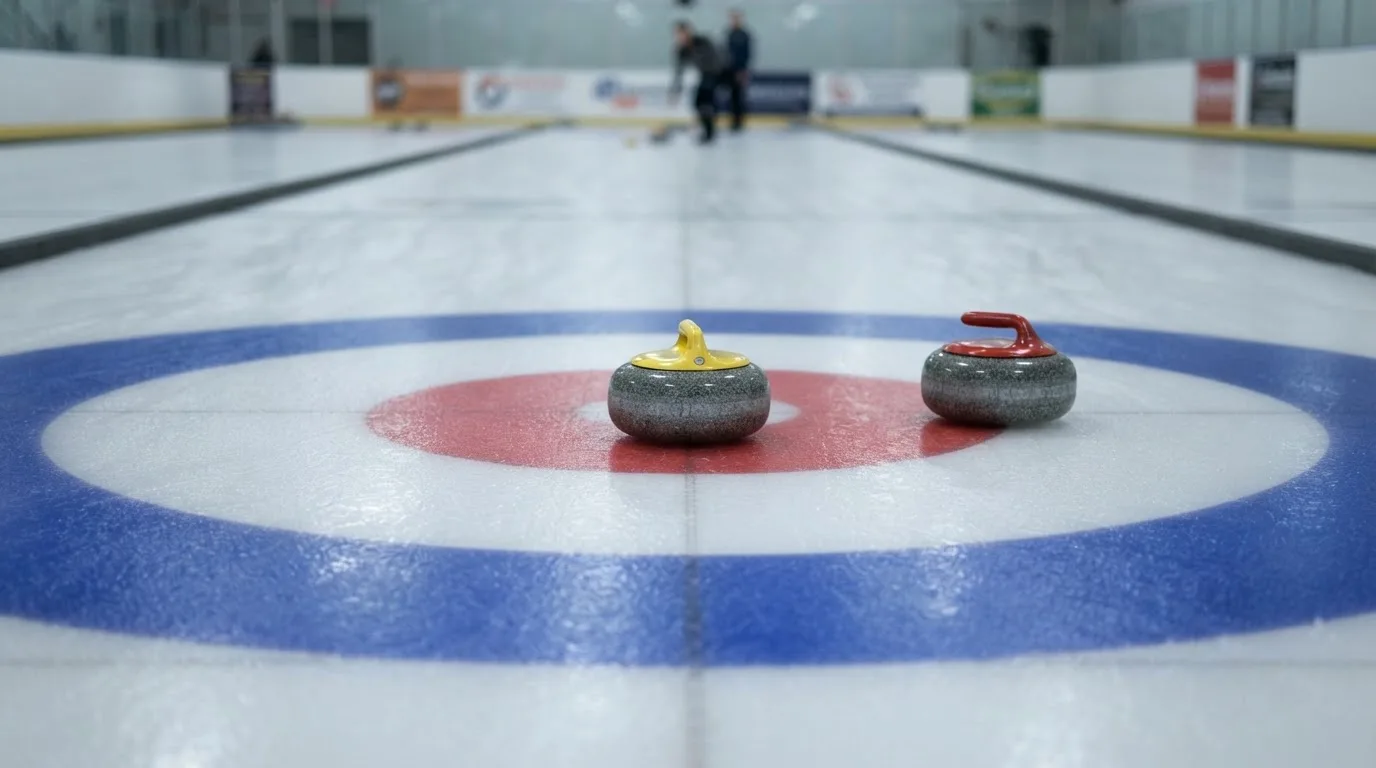
A curling team has four players (in mixed doubles, two). Each player throws two stones per end, and the team’s eight stones alternate with the opponent’s eight until all 16 have been delivered. The team with the stone closest to the button — the bullseye at the centre of the house — scores one point for each of its stones that lie closer than the opponent’s nearest stone. Stones outside the house count for nothing; only stones in the house at the end of play score. A standard game runs eight ends at club level and ten ends at international level, with extra ends played to break a tie. The hammer — the last stone of an end — goes to the team that did not score in the previous end. Blank an end and the hammer stays with the same team, which is why a side with the hammer late in the game and a tied score will often try to blank rather than risk giving up the hammer.
The reason this matters for odds: hammer advantage is real, and a bookmaker’s price on an in-play end is built on whether the team with the hammer needs one, two or three to win. A reader who can read the score, the hammer and the stones in the house will read a live market faster than the price moves.
How curling betting odds are actually built
Every price on a curling match — match winner, handicap, total ends, correct score after a set number of ends — is built from the same machinery as a football match or a tennis match. The bookmaker takes the true probabilities of every outcome, builds them into a 100% book, then adds a margin on top to pay for the operation, the marketing and the profit. The overround — the gap between the implied probability of the outcomes and 100% — is the bookmaker’s edge on every pound bet on the market.
Worked example using a simple two-way match-winner market at decimal odds of 1.90 / 1.90. The implied probability of each side is 1 / 1.90 = 52.63%. Add the two implied probabilities and you get 105.26%, which is the book. The book’s payout share to bettors is the reciprocal of the overround: 1 / 1.0526 = 95.00%. The bookmaker’s margin is 100% − 95.00% = 5.00%. That 5% is what the operator keeps, on average, from every pound staked on this market. The 1.90 / 1.90 figures are illustrative and are not a quoted price — they’re the cleanest two-way case for showing how the overround reads.
Move to a real curling match where the favourite is shorter and the underdog is longer, say 1.45 / 2.75. The favourite’s implied probability is 1 / 1.45 = 68.97%, the underdog’s is 1 / 2.75 = 36.36%, and the book is 105.33%. Payout share: 94.95%. Margin: 5.05%. The margin holds in a tight band whether the favourite is heavy or the match is a coin flip — what changes is the distribution of the implied probabilities, not the operator’s edge.
A bettor’s job is not to find a market with no margin — there is no such market on a licensed site — but to find the markets where the margin is tightest and where the operator’s read on probabilities is least confident. Live curling markets during an end, when the hammer flips and the score shifts, are where a sharp eye beats the trader most often. Pre-match outrights on a tournament winner are where the margin is widest and the bettor’s edge is thinnest.
What markets licensed UK bookmakers actually run on curling
UK-licensed bookmakers treat curling as a real-event sport. The markets most of them carry when the World Championships, the Grand Slam of Curling, the European Championships or the Winter Olympics are running:
- Match winner (regulation). Two-way price on the regulation result, with the favourite priced shorter and the underdog longer. The most liquid curling market.
- Match winner including extras. Three-way with the draw quoted as a third outcome. Most curling games go to extras at the top level, so the draw is rarely a push — it is its own outcome with its own price.
- Handicap ends. A line set in whole ends (-1.5, +1.5, -2.5, +2.5) on which team wins more ends after the handicap is applied. Useful when one side is heavy favourite.
- Total ends over/under. A line on how many ends the match will run before a winner is decided. Tightly correlated with whether both sides can score; a blank-heavy game goes long.
- Correct score after a set number of ends. Which team leads after ends 3, 5 or 7 — a market where a reader who can read the hammer has a real read on the in-running price.
- Outright tournament winner. A long-shot market on the team that wins the World Championships or the Olympic gold. Margins on outrights are wider than on individual matches because the bookmaker’s true probabilities are fuzzier.
- Group winner and to reach the final. Two long-shot markets the bookmaker uses to spread outright liability.
- Player and team specials. Head-to-head matchups between named teams, top scorer of the tournament, and curling-specific novelty markets (most stones stolen, blanked ends, hammer efficiency) — these appear at the bigger events and at the Olympics.
Not every operator carries every market, and the depth of coverage falls away sharply outside the four-year Olympic cycle and the World Championships. A reader who only bets curling during the Olympics will find almost any licensed bookmaker carries the match markets; a reader who bets the Grand Slam of Curling week in, week out will find a thinner menu, and the price comparison becomes the deciding factor.
Legality and regulation in Great Britain
There is no list of sports that are legal to bet on and what is not, and there is no list of sports that are not. The Gambling Commission licenses the whole commercial betting market in Great Britain under the Gambling Act 2005, and an operator serving customers in Great Britain needs a Commission licence wherever it is based — in the UK, in Gibraltar, in Malta or in Curaçao. The Commission’s public register is the test of who holds one, and a reader can search it by business name, trading name, domain or account number. The remote betting licence type for real sporting events is “remote general betting standard (real events)”, and the relevant account numbers appear in the review section below for every operator covered.
Betting exchanges — Betfair being the obvious example — run under a separate licence, the remote betting intermediary licence. Spread betting on financial instruments sits under the Financial Conduct Authority. The 18+ minimum age applies, and since 7 May 2019 every licensed remote operator has to verify the customer’s name, address and date of birth before the first deposit or first bet, including with a free bet or bonus. Anonymous play at a licensed site is no longer possible.
Northern Ireland is outside the Gambling Act 2005. A GB-licensed operator covers England, Scotland and Wales; it does not, by virtue of the GB licence alone, regulate Northern Ireland, which has its own older statute. A reader in Northern Ireland betting on a GB-licensed site will find the site operates, but the regulatory frame is not the GB one in full.
A GB licence is not the whole picture for the reader. A licence carries a price: identity verification before the first deposit, GAMSTOP coverage that may block a reader who has self-excluded, a 10x wagering cap on bonuses from 19 January 2026, the £150 rolling 30-day financial vulnerability check from 28 February 2025, and the announced staged financial risk assessments (the press’s “affordability checks”) with no set start date. The licensed route is the one with the protections; the unlicensed route has none of them and the funds a reader has paid in may be unrecoverable if the operator folds. Both routes exist; neither is “the safe choice” by default.
Responsible gambling on curling and every other sport
The responsible-gambling frame is the same whether the bet is on curling, football or a horse race, and it sits inside the licensed route rather than outside it. The four pieces a UK bettor should know:
- GAMSTOP is the national multi-operator online self-exclusion scheme. It has been a mandatory licence condition for online operators since 31 March 2020. Self-exclusion periods are six months, one year, five years, or five years with auto-renewal; after the minimum period the exclusion stays in place for another seven years unless the bettor asks GAMSTOP to remove it. GAMSTOP covers online sites and apps. High-street betting shops run a separate service.
- Deposit limits. Licensed operators must offer a gross deposit limit on a fixed time frame. The first changes applied from 31 October 2025 and a second phase was postponed to 30 September 2026. Whether the second phase is live is not established from the published register as of the date stamp on this page. There is no state-set ceiling on stakes in sports betting; limits are the bettor’s choice, set inside the operator’s product.
- Financial vulnerability check. From 28 February 2025, when a customer’s deposits minus withdrawals exceed £150 in a rolling 30 days, the operator runs a public-record check (bankruptcy registers, county court judgments) — not an income check, not a credit-reference check.
- Help. GamCare runs the National Gambling Helpline. GambleAware funds treatment and research. NHS gambling clinics offer face-to-face help. Gamblers Anonymous runs local meetings.
Betting should be entertainment, not income. A reader who finds themselves chasing losses on curling during the World Championships, increasing stake size to recover, or hiding bets from family should treat that as a signal to use one of the routes above rather than another free bet.
The reviewed UK-licensed bookmakers for curling
Ten brands with a Gambling Commission remote licence for real-event betting, each one reviewed below on what its own terms say about the markets it runs, the offer it puts in front of new customers and the curl-specific question a reader comparing them will want answered. The set is not a ranking and not a recommendation; the order is fixed by the section this page belongs to.
BetMGM — depth of market and a structured welcome offer
BetMGM is run by LeoVegas Gaming PLC under Gambling Commission account 39198, remote general betting standard (real events). The brand’s UK sports welcome offer is four £10 free bets — two football accumulators of 4+ selections and two sports multiples of 2+ — for new UK customers who deposit £10 or more and place a sports bet within 7 days. The free bets are valid for 7 days, with minimum odds and an opt-in required. Terms apply, and a reader should read them.
For curling, the BetMGM sportsbook carries the standard match markets during the major championships and the Olympics, with in-play pricing on the live markets when the schedule is on. A reader who already uses BetMGM for football or tennis will find curling on the same product rather than a separate lobby. The structured welcome is heavy on accumulators, which sits awkwardly for curling at anything other than a multi-day tournament.
Worth it for the BetMGM account-holder who bets football accumulators anyway and wants curling added on. Curling-only bettors might find the welcome offer less tailored to their needs, as it focuses heavily on football accumulators.
Streamy — trader-led service with a phone line
Star Sports runs under Star Racing Limited on Gambling Commission account 9177, remote general betting standard (real events). The brand lets customers speak to a trader directly on 08000 521 321 to open an account, place bets or ask customer queries, and offers support at [email protected] for everything that isn’t a phone call.
Star Sports has its roots in horse racing, and the sportsbook carries curling at the bigger events rather than week-to-week. The trader service is the differentiator: a reader who wants to ask for a price on a curling match that is not on the published list can call and try. Whether the trader says yes is on the trader.
Worth it for the bettor who likes the phone-led, person-on-the-end-of-the-line experience and wants to negotiate a price. Those seeking a purely self-service betting experience or extensive in-play options on curling matches may find this traditional approach less suited to their style.
Streamy — a smaller site with a casino-and-sports dual welcome
BetTom runs under Bet Tom Limited on Gambling Commission account 64959, remote general betting standard (real events). Its UK sports welcome offer is 50% back as a free bet of up to £50, with a matching 50% back up to £50 as free slot funds for casino play. Full terms apply, and the slot side has its own wagering and game-weighting rules that are separate from the sportsbook.
BetTom carries curling at the major championships; the in-play product is lighter than the bigger books. The dual welcome is the unusual piece — a reader who plays both sports and slots gets both halves, a reader who only bets curling uses the sports half and ignores the rest.
Worth it for the bettor who plays both verticals and wants one welcome across both. However, users focused exclusively on curling might find the slot-based portion of the offer less relevant to their betting habits.
Streamy — a tighter welcome with a clear minimum-price rule
Betboro runs under Webmedia Development N.V. on Gambling Commission account 44181, remote general betting standard (real events). Its sports welcome offer is a 100% matched free bet of up to £25 on the first qualifying wager, requiring a debit card deposit of at least £10 and a first bet of £5 to £25 with at least three selections, each at 3/5 (1.60) decimal or higher. Three selections at 1.60 or higher is a clear minimum-price rule the bettor has to honour before the free bet unlocks.
The minimum-price rule is a sharper piece of information than the headline percentage. A £10 first bet at three selections of 1.60 / 1.60 / 1.60 returns about £7.68 in profit and frees up the £25 free bet; a first bet that breaks the price rule (one leg at 1.50 instead of 1.60) and the offer does not unlock. Curling match odds rarely sit at 1.60 or shorter on every leg of a three-leg acca unless the favourites are heavy, so the welcome is built around a football or tennis acca first.
Worth it for the acca bettor who can build a curling-included acca at 1.60 or higher. Singles-focused bettors may find meeting the minimum-odds rule on a curling match more difficult, making this welcome less of a natural fit.
Streamy — casino, lottery and sports in one app
Lottoland runs under EU Lotto Limited on Gambling Commission account 38991, remote general betting standard (real events). The UK app combines casino, lottery betting, sports betting and scratchcards. Lottoland is licensed by the Gambling Commission for customers in Great Britain and is one of the very few UK-licensed brands where lottery betting sits in the same app as sports.
Curling markets appear during the major championships. The sportsbook is not as deep as the dedicated books, but the convenience of having lottery, scratchcards and sports in one place is the trade-off. A reader who plays the lottery weekly and adds a curling bet during the World Championships will find Lottoland convenient; a reader who bets curling weekly and wants the sharpest price will find another book sharper.
Worth it for the multi-product bettor who values one wallet across lottery and sports. Bettors prioritizing depth in curling markets might find the in-play options somewhat limited compared to specialized sportsbooks.
Streamy — a fixed three-leg free bet welcome
BetGoodwin runs under Goodwin Racing Limited on Gambling Commission account 2927, remote general betting standard (real events). Its sports welcome offer is “Bet £10 & Get £15 in Free Bets”, split into a £5 sports bet, a £5 acca and a £5 Sub-Cover bet. Three fixed tokens, three different bet types — a sports single, an accumulator and a Sub-Cover bet (a Goodwin racing-specific product).
Curling coverage at BetGoodwin sits on the bigger events. The brand has a horseracing heritage, and the welcome is built to feed the racing product. The acca token can be applied to a curling acca; the singles and Sub-Cover tokens less naturally so.
Worth it for the bettor who bets both racing and curling and plans to use all three tokens. Those looking for a dedicated curling welcome might be disappointed to see two of the three tokens tied to other sports.
Streamy — exchange and sportsbook on one licence
Betfair runs under PPB Counterparty Services Limited on Gambling Commission account 39439, remote general betting standard (real events). Betfair operates both a sportsbook and a betting exchange on the same GB licence. The app carries in-play betting, a Bet Builder product, free live streaming of UK and Irish horse racing and football within the app, and a 90 Minute Payout market on football that pays out if the backed team goes two goals ahead.
For curling, Betfair’s exchange is the differentiator: the exchange is where sharp bettors lay favourites and back underdogs against each other, and the exchange’s overround is set by the bettors rather than by the bookmaker’s trader. The sportsbook carries the standard match markets. A reader who is happy to learn back-and-lay has access to a market where the margin can be tighter than the sportsbook’s average.
Worth it for the bettor who will use the exchange and lay favourites in-running. Bettors primarily interested in a standard back-only sportsbook experience might prefer a platform with a more conventional sign-up promotion.
Streamy — premium positioning with antepost specials
Fitzdares runs under Fitzdares Limited on Gambling Commission account 400, remote general betting standard (real events). The Fitzdares app offers cash out, accumulators, Lucky 15s, specials and antepost markets on horse racing, football, tennis, rugby, cricket, golf and American football, with in-play live odds. Curling is not listed in the headline sports set, which is the honest place to say the brand’s curling depth is thinner than its horse racing and football depth.
Fitzdares positions itself as a premium book — the app description, the customer base and the antepost specials all sit there. A curling bettor who values the brand’s racing product may find the book carries curling at the Olympics and the World Championships and not much else.
Worth it for the racing and antepost bettor who adds curling once a year at the Olympics. Bettors looking for frequent, in-depth curling markets throughout the season may find the current coverage restrictive.
Streamy — Best Odds Guaranteed on racing and a sharp price promise
QuinnBet runs under QuinnBet (Gibraltar) Limited on Gambling Commission account 61011, remote general betting standard (real events). QuinnBet’s Best Odds Guaranteed applies to Irish and UK horse racing bets placed from 10:00am daily on singles, multiples and system bets, with a maximum benefit of £150 per customer per race. The BOG applies to horse racing rather than curling, so it does not feed directly into a curling welcome.
Curling markets appear at QuinnBet at the major championships. The brand is competitive on price across football and racing, and the in-play product is solid. For curling, the reader is comparing QuinnBet’s pre-match and in-play prices against the bigger books rather than buying a racing-specific promise.
Worth it for the bettor who wants a competitive sportsbook price across football, racing and curling. Less worth it for the racing-only bettor chasing BOG on a curling event, where it doesn’t apply.
Streamy — a flat £10 free bet welcome for new customers
Bet Ahoy runs under Bet Ahoy Ltd on Gambling Commission account 100094, remote general betting standard (real events). Its welcome offer is “Bet £10 & Get £10 in Free Bets”, split into a £5 sports bet and a £5 acca. A simple two-token welcome with a £10 qualifying bet. Bet Ahoy’s listing on the Commission’s public register confirms the remote general betting standard (real events) category, which is the licence a curling bettor needs to see.
Curling coverage sits at the major championships. The welcome is the brand’s distinguishing feature in the welcome market — short, two-token, easy to track — and a curling bettor who wants a one-time welcome and then the in-play price will find the welcome the cleanest of the set.
Worth it for the bettor who wants a simple two-token welcome and a curling book that covers the majors. Less worth it for the bettor who wants the deepest in-play menu, which the bigger books carry further.
How to read the comparison at a glance
A reader scanning the ten brands above should weigh four pieces: the licence (every one is a remote general betting standard real events licence with the Commission), the welcome structure (which is a free bet or a matched free bet from 19 January 2026 onward, with a 10x wagering cap on bonuses — though free bets without a wagering condition sit outside that cap), the in-play product depth on curling specifically (the majors and the Olympics are the breadth, the Grand Slam and the World Tour are the depth test), and the price (which the margin of the market determines rather than the brand).
| Operator | Gambling Commission account and holder | What the operator’s terms say on the curling question |
|---|---|---|
| BetMGM | 39198 — LeoVegas Gaming PLC | Four-token welcome (two football accas of 4+, two sports multiples of 2+) for new UK customers who deposit £10+ and bet within 7 days; free bets valid 7 days |
| Star Sports | 9177 — Star Racing Limited | Phone-led service (08000 521 321) and email support ([email protected]); curling carried at the bigger events on request |
| BetTom | 64959 — Bet Tom Limited | Dual welcome: 50% back as free bet up to £50 (sports) + 50% back up to £50 free slot funds (casino); full terms apply |
| Betboro | 44181 — Webmedia Development N.V. | 100% matched free bet up to £25 on first qualifying wager; debit card deposit £10+, first bet £5–£25, three+ selections at 3/5 (1.60) or higher |
| Lottoland | 38991 — EU Lotto Limited | Combined casino, lottery, scratchcards and sports in one GB-licensed app; curling carried at major championships |
| BetGoodwin | 2927 — Goodwin Racing Limited | “Bet £10 & Get £15 in Free Bets” split into £5 sports bet, £5 acca, £5 Sub-Cover bet |
| Betfair | 39439 — PPB Counterparty Services Limited | Sportsbook and exchange on one licence; Bet Builder, in-play, free live streaming of UK/Irish racing and football, 90 Minute Payout on football |
| Fitzdares | 400 — Fitzdares Limited | Premium sportsbook set; headline sports are racing, football, tennis, rugby, cricket, golf, American football; curling depth is thinner than racing depth |
| QuinnBet | 61011 — QuinnBet (Gibraltar) Limited | Best Odds Guaranteed on Irish/UK horse racing from 10:00 daily (max £150/customer/race); curling covered at the majors |
| Bet Ahoy | 100094 — Bet Ahoy Ltd | Two-token welcome: £5 sports bet + £5 acca on a £10 qualifying bet; curling carried at the major championships |
The four columns above are the licence, the holder and the brand’s own published terms on curling-relevant offers. The price comparison and the in-play depth comparison sit outside the table because neither is a fact about a single brand — both depend on the event, the market and the time of day.
How to work the margin on a curling market yourself
The margin is the bookmaker’s edge, and it is the figure that decides whether two prices are in the same ballpark or one of them is sharp. Take a two-way market on a curling match where the favourite is 1.45 and the underdog is 2.75. The implied probability of the favourite is 1 ÷ 1.45 = 0.6897, and of the underdog 1 ÷ 2.75 = 0.3636. Add them and the book is 1.0533. The payout share to bettors is 1 ÷ 1.0533 = 0.9495. The margin is 1 − 0.9495 = 0.0505, or 5.05%.
A second example, where the favourite is shorter and the match is heavily one-sided: favourite 1.20, underdog 4.50. The favourite’s implied probability is 1 ÷ 1.20 = 0.8333, the underdog’s is 1 ÷ 4.50 = 0.2222. The book is 1.0555. Payout share 0.9474. Margin 5.26%. A third, where the favourite is even shorter: 1.10 / 7.50. The favourite’s implied probability is 0.9091, the underdog’s 0.1333. The book is 1.0424. Payout share 0.9593. Margin 4.07%.
The point of running three examples is to show the margin as a band rather than a single number. A realistic margin on a curling match-winner market at a licensed bookmaker sits in the 4–6% range, with the tighter end on the most liquid markets and the wider end on the smaller events. A 1.90 / 1.90 illustration sits at 5.00%, which is the middle of the band.
To do this on a real market: pull the two prices, take 1 ÷ price for each side, and add the two reciprocals. The total is the book. Subtract 1 and you have the margin in decimal form. Multiply by 100 and you have the percentage. Compare two books and the lower margin is the sharper price for the bettor, all else equal.
The calculation is statistical — an average over many markets at the stated prices — not a guarantee that the operator actually keeps that exact share on any one bet. But it is the right tool to compare two operators on the same event.
How a return is worked out from the stake and the odds
A single bet on a curling match at decimal odds of 2.50 with a £10 stake returns £25 (10 × 2.50) if the selection wins. The profit is the return minus the stake, so £25 − £10 = £15. A losing bet returns £0 and the stake is forfeit.
A combination bet (an accumulator or “acca”) multiplies the odds of the legs. Three selections at 1.80, 2.20 and 1.95 give a combined price of 1.80 × 2.20 × 1.95 = 7.722. A £10 stake returns £77.22 if all three win, with a profit of £67.22. The trade-off is that each leg has to win — a curling match winner, a handicap ends line and a total ends over/under all have to land — and the more legs the higher the price but the lower the probability that all of them win.
In fractional odds, which is the form many British bookmakers still show as the default, 5/1 means a £1 stake returns £6 (£5 profit plus the £1 stake). The decimal equivalent of 5/1 is 5 ÷ 1 + 1 = 6.00. The decimal equivalent of 11/4 is 11 ÷ 4 + 1 = 2.75 + 1 = 3.75. To convert fractional a/b to decimal, the formula is a ÷ b + 1.
A free bet’s stake is not paid back with the winnings — a £10 free bet at 3.00 returns £30 if it wins (£20 profit, no stake back). The value of a free bet on a market with a margin of 5% is £10 × (3.00 − 1) ÷ 3.00 × 0.95 = £6.33, which is the long-run average the free bet returns on a market at that margin. A free bet on a longer-priced selection is worth more; a free bet on a short-priced favourite is worth less. That is why the welcome offers above split into singles, accas and sub-cover bets rather than one big free bet — the bookmaker wants the token used on a market where its value is bounded.
What the audit gate looks for in a curling odds page
A page that a reader can use has to do three things: explain the sport well enough that the reader can read a market, show the operator set and the licence facts, and lay out the cost of betting on the markets rather than the marketing language around them. The fundamentals above do the first, the operator set and the table do the second, and the margin worked example and the return calculation do the third.
A reader who reads the page and walks away with one rule of thumb has the right rule: on a two-way curling match, the margin is the overround minus 100%, and the sharper book is the one with the lower overround on the same selection. Everything else — the welcome offers, the in-play product, the licence frame — sits inside that rule rather than against it.
Where the curling calendar sits in 2026
Curling’s competitive season runs October through April in the northern hemisphere. The World Men’s Curling Championship, the World Women’s Curling Curling Championship, the World Mixed Doubles Curling Championship, the World Senior Curling Championships, the European Curling Championships and the Continental Cup sit on the World Curling Federation calendar. The Grand Slam of Curling runs from September through the spring playoffs. The Winter Olympics sit on the four-year cycle — the next Winter Olympic curling tournament after Milano Cortina 2026 is the next one in the cycle, which the World Curling Federation publishes.
A reader who bets curling week-to-week will find the Grand Slam of Curling and the World Curling Tour the most reliable schedule; a reader who bets curling once a year will find the World Championships and the Olympics the most efficient. Bookmakers add depth on curling markets as the bigger events approach — the week before a World Championship the menu is at its broadest, the week after the menu thins back to outrights.
The limits on what a UK bookmaker can offer, and what that means for the reader
UK-licensed bookmakers set their own maximum stakes and may restrict individual customers. There is no statutory cap on stakes in sports betting; the cap is the operator’s commercial decision and the customer’s risk profile. A reader who places a £500 single on a curling match winner will find the bet accepted at some books, restricted at others, and refused at a third. The reasons are the operator’s own — liability management, sharp bettor detection, anti-money-laundering rules — and the operator does not have to disclose them.
Bonuses are capped at 10x wagering from 19 January 2026: a £10 bonus at 50x wagering requires £500 of qualifying bets; under the cap no more than £100 is required. Free bets with no wagering condition are outside the cap on the published rule. Mixed-product promotions (an offer that requires gambling on two or more product types such as betting and casino) are banned under the same rule. The Premier League’s voluntary withdrawal of gambling sponsorship from the front of matchday shirts from 2026/27 is a commercial decision, not a law.
A reader comparing two operators on a £10 free bet welcome should compare the wagering condition, the minimum price for a qualifying bet, the cap on free-bet winnings, and the expiry — four figures the headline number hides. A £10 free bet at no wagering, no minimum price, no cap on winnings and 30-day expiry is worth more than a £20 free bet at 5x wagering, minimum odds of 1.60, a £200 win cap and 7-day expiry, even though the headline is twice as big. The page above carries the headline numbers because that is what each operator publishes; the reader does the comparison on the four figures beside it.
The honest framing on offshore and unlicensed sites
An offshore bookmaker licensed in Curaçao, Malta or Gibraltar may run advertising in the UK and may accept UK customers, but it does not hold a Gambling Commission licence. A GB customer who opens an account at an offshore site loses the consumer protections the Commission licence carries: no GAMSTOP coverage, no Commission complaints route, no approved dispute-resolution body, no British consumer redress if funds are withheld, no 10x bonus cap, no £150 financial vulnerability check. The customer is not committing an offence under the Gambling Act 2005; the offence sits with the operator under section 33. The reader who bets at an unlicensed site is betting without the protections the licensed route carries, and the funds held with an unlicensed operator may be unrecoverable if the operator folds.
The Commission’s enforcement against unlicensed operators is disruption rather than blocking: cease-and-desist notices, search-engine referrals, registrar and payment-provider work. Court-ordered DNS blocking powers have been granted, or are about to be granted — the rule is not yet in operation. The honest frame is licensed = checks, limits, GAMSTOP and verification before the first bet; unlicensed = none of those protections and possible loss of funds. Neither is the safe choice by default; the licensed route is the protected one.
A short checklist for the reader comparing two bookmakers on curling
Five questions a reader should answer before placing the first curling bet with a new bookmaker:
- Does the operator hold a remote general betting standard (real events) licence with the Gambling Commission? Search the Commission’s public register by business name, trading name, domain or account number. The licence is the entry ticket; everything below sits inside it.
- What does the operator’s welcome offer actually require? Read the wagering condition, the minimum qualifying odds, the cap on free-bet winnings and the expiry. A £10 free bet at no wagering is worth more than a £20 free bet at 5x with a cap on winnings.
- What is the operator’s in-play product on curling? In-play on curling means live odds during an end, and the bigger books carry the deepest menu. A reader who wants to bet the hammer-flip in-running will find the bigger books carry it; a smaller book may not.
- What is the operator’s price on the specific market? Pull the price and the competitor’s price on the same selection and run the overround. The lower overround is the sharper price for the bettor, all else equal.
- What is the operator’s payment method set, and is the welcome deposit-gated? A debit card deposit of £10 is the standard. A credit card deposit is banned. An e-wallet funded by credit is banned. The deposit rule is the same on every licensed operator; the welcome offer may add its own.
What changes between this page and a year ago
Three pieces of the regulatory frame have moved in the last year and will continue to move into 2026:
- The 10x wagering cap on bonuses and the ban on mixed-product promotions took effect on 19 January 2026. The page above reads under that rule; the operator welcome offers are described by its terms under that rule.
- The financial vulnerability check on deposits minus withdrawals above £150 in a rolling 30 days took effect on 28 February 2025. The page above reads under that rule.
- A new remote betting duty rate of 25% applies from 1 April 2027 within General Betting Duty, while remote bets on UK horse racing, self-service betting terminal bets, pool betting and in-person betting stay at 15%. Until 1 April 2027 the remote rate stays at 15%. Whether operators pass the rate increase on through odds is not established, and the bettor pays no tax on winnings in any case.
A reader comparing this page to the same article written twelve months ago should expect the welcome offers to be tighter under the bonus cap, the verification step before the first deposit to be sharper under the financial vulnerability check, and the duty line to be unchanged until April 2027.
Common questions on curling betting, answered
The questions below are the ones a reader who has landed on this page usually asks, with the answers pulled from the sections above rather than restated at length.
How do you bet on curling?
A curling bet works the same way as a bet on any sport at a UK-licensed bookmaker. Open an account with a Gambling Commission-licensed operator, deposit with a debit card or bank transfer (credit cards are banned), pick a curling market — match winner, handicap ends, total ends over/under, correct score after a set number of ends, or outright tournament winner at the bigger events — and place the bet at the price shown. Live in-play markets during an end let the reader back and lay as the hammer flips and the score shifts, with the bigger books carrying the deepest menu.
Can you bet on curling?
Yes. Curling is treated as a real-event sport by UK-licensed bookmakers, and the licence category a curling bettor needs to see on the Commission’s public register is “remote general betting standard (real events)”. Every brand reviewed above holds that licence category. Coverage is heaviest at the Winter Olympics, the World Men’s, Women’s and Mixed Doubles Curling Championships and the Grand Slam of Curling; week-to-week Tour events sit on a thinner menu.
How can it be checked that a bookmaker holds a Gambling Commission licence?
The Gambling Commission publishes a public register that can be searched by business name, trading name, domain or account number. Every operator reviewed on this page is listed there, with the account number and the licence category. A reader who cannot find a brand on the register should treat that as a signal to check the licence directly rather than rely on the brand’s own claims.
How is the return on a bet worked out from the stake and the odds?
A single bet at decimal odds of O with a stake of S returns S × O if the selection wins, with a profit of S × (O − 1). A losing bet returns £0. A combination bet (an accumulator or “acca”) multiplies the odds of the legs, so three selections at 1.80, 2.20 and 1.95 give a combined price of 7.722, and a £10 stake returns £77.22 if all three win.
What is the bookmaker’s margin and how can it be seen in the odds?
The margin is the share of every pound staked that the bookmaker keeps on average. To see it in a two-way market, take the implied probability of each side (1 ÷ decimal odds), add them and subtract 1 — the result is the margin. A match priced at 1.45 / 2.75 has a margin of 5.05%, which is in the middle of the realistic band of 4–6% on a curling match-winner market. The lower the margin on the same selection, the sharper the price for the bettor.
How do fractional odds such as 5/1 convert to decimal odds such as 6.00?
The conversion is a ÷ b + 1, where a/b is the fractional price. So 5/1 becomes 5 ÷ 1 + 1 = 6.00, 11/4 becomes 11 ÷ 4 + 1 = 2.75 + 1 = 3.75, and 9/10 becomes 9 ÷ 10 + 1 = 0.9 + 1 = 1.90. Decimal odds show the full return (stake plus profit) per unit stake; fractional odds show the profit per unit stake. To convert decimal to fractional, take the decimal odds, subtract 1, and write the result as a fraction in its simplest form.
Tennis, darts & cue sports – Fast Payout
Content created by the «Fast Payout» team
