
Boxing Betting Odds in the UK: Markets, Margins and the Numbers Behind the Punch
 Available in US
£20 in free bets for a £10 wager reads like a £10 profit before the ink is dry. The ink, when it arrives, usually carries a turnover requirement, an expiry window and a minimum price that quietly reclaims the headline. The same applies to a headline price on the favourite. A short price on a world-title favourite can be a fair reflection of how likely that outcome looks, or it can be a margin-loaded number dressed as a certainty, and these are not the same thing. The skill in boxing betting in the UK in 2026 is not picking the right corner: it is knowing which bookmaker’s odds you are reading, which market the price belongs to, and what the price has already absorbed. This page walks the buyer through the full landscape — the markets licensed bookmakers publish, the margin that sits inside every price, the live-betting options that change between rounds, and the welcome offers that govern how much of any free-bet headline a bettor actually keeps. Ten UK-licensed operators are reviewed from the same evidence base, and one calculation is run end to end so the margin of an even-money market lands as a number, not a slogan.

Snapshot as of 27 October 2026. Verified against the UK Gambling Commission’s public register and each operator’s own published terms.
The Sport Inside the Markets
Professional boxing bouts usually run ten to twelve rounds, with four-round fights common for fighters building a record. Each round lasts three minutes with a one-minute rest between rounds. A bout can be won by knockout, by technical knockout (a stoppage by the referee, doctor or corner), by a decision on the judges’ scorecards, or by disqualification for fouls. A draw occurs when the judges score the contest equal. The four sanctioning bodies that crown world champions are the WBA, the WBC, the IBF and the WBO, and a champion can hold one, several or none of those belts depending on which fights he or she has agreed to. None of this is betting jargon yet, but every one of those outcomes is a settleable market that a licensed bookmaker can price, from the winner outright to the method, the round of the stoppage and the judges’ verdict. The shape of the sport is the shape of the market list.
UK bettors can wager on professional world-title fights, regional titles, domestic promotions and the smaller club shows that fill the calendar. The market depth varies enormously between a heavy-handed pay-per-view main event and a four-round debut on a small hall show. The licensed bookmakers reviewed below publish odds on at least the headline bouts of each card, and the bigger brands extend coverage to undercards, female divisions and overseas promotions.
How Boxing Odds Land at a UK Bookmaker
In Great Britain there is no statutory list of permitted sports or markets: a bookmaker serving GB customers needs a Gambling Commission licence wherever it is based, but the menu of bets that licence covers is left to the operator’s own terms and to the Commission’s Licence Conditions and Codes of Practice. The Commission’s public register can be searched by business name, trading name, domain or account number, and that register is the whole test of who holds a licence. The odds published under that licence are then settled under the operator’s own house rules, which any serious punter should read for the specific market they intend to back.
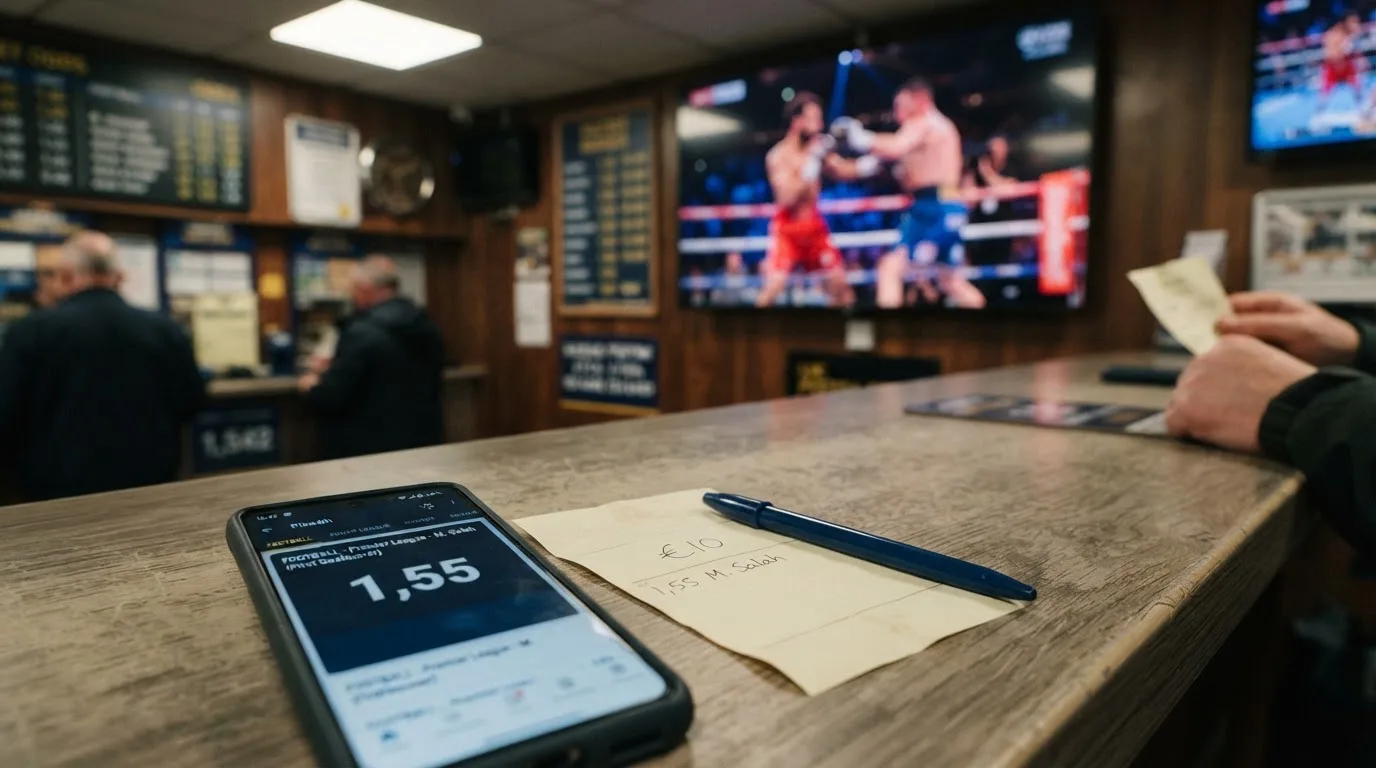
The price you see is not the probability of the outcome. It is the implied probability after the bookmaker’s margin has been folded in. That margin, also called the overround, is the difference between 100% and the sum of all implied probabilities on a market, and it is the only number that tells a punter which bookmaker is the cheap place to bet and which is the expensive one. Two bookmakers can both offer 1.91 on the same fighter to win, and one can be sharper than the other on the undercard — that is a margin question, not a brand question.
Odds in the UK are written fractionally by tradition (5/1, 11/4, evens) and decimally for anyone who wants the simpler arithmetic (6.00, 3.75, 2.00). The conversion is a ÷ b + 1, so 5/1 becomes 6.00 and 11/4 becomes 3.75. Decimal odds include the stake in the return — a winning £10 at 3.75 returns £37.50, not £27.50. Most UK betting apps and sites offer both formats side by side and let the customer switch.
The Margin That Lives Inside Every Boxing Price
Take an even-money bout priced at 1.91 / 1.91 across the two fighters. The implied probability of each side is 1 ÷ 1.91 = 0.5236, or roughly 52.36%. Add the two sides together and the total implied probability is 104.72%. The overround is 4.72%, which results in a bookmaker’s margin of 4.5% on that market. The punter is paid back as if the fight were a coin toss with a small handicap in the bookmaker’s favour, and the expected cost of every pound wagered on a market like this is the margin itself.

For a typical 12-round title fight with three priced outcomes (Fighter A, Fighter B, Draw), the margin runs higher than on the simple two-way winner market, because the bookmaker is pricing three outcomes and keeping more of every stake. For a method-of-victory market — KO/TKO, decision, draw — the same exercise repeats on each independent combination, and the margin is whatever it is. The point is not to memorise a number; the point is to know what to look for. A market margin between 3% and 6% on a two-outcome bout is competitive for this sport, and anything comfortably above that is worth checking against the next operator’s price before the slip is confirmed.
The exact arithmetic: a £10 stake at 1.91 on the favourite returns £19.10 if the bet wins, for a profit of £9.10. If that same market were priced without any margin at all — at exactly 2.00 on each side — the punter would receive £20 back, profit £10. The £0.90 shortfall on every £10 staked is the margin the operator kept. Scale that across the thousands of bets a boxing calendar produces over a year and it stops looking small.
The Markets a UK Bookmaker Publishes on a Boxing Card
The winner market (Fighter A vs Fighter B) is the entry-level bet and the most heavily priced one. Every licensed UK bookmaker lists it for every bout on a card, and the margin on a two-outcome market is the cheapest the operator offers on the bout.
Draw is the third outcome of the standard 1X2 market on a boxing bout. It’s priced separately and usually sized generously because draws are statistically rare: in elite men’s boxing, judges give equal scores in a small single-digit percentage of decisions. The draw price can be 8.00 or higher, which means a small stake carries the right to a meaningful payout if the fight really does end level.
Method of victory breaks the fight into knockout, technical knockout, decision or disqualification, sometimes with a sub-classification on which round the stoppage happens. The market deepens with each layer.
Round or group of rounds is a specialist market where the bet settles on which round the fight ends. A 12-round bout with 12 priced rounds (and “decision” as a 13th outcome) carries more margin than the simple winner market because each round is its own thin slice.
Fight to go the distance is the binary on whether the cards are read out.
Total rounds (over/under a given round line) is the boxing equivalent of the totals market that dominates American sports.
Each-way betting treats the outright winner market as two bets of equal stake: a win bet and a place bet, where “place” means each fighter is treated as if finishing in a paying position. The place terms vary by operator and by bout. Total stake doubles for an each-way wager.
Accumulators combine two or more selections into one price whose decimal odds multiply. Four fighters at 1.80 each produce a four-fold at 10.50, meaning a £10 stake returns £105. An accumulator insurance offer refunds the stake as a free bet if one leg of a multi-leg acca lets the punter down — useful in a sport where one punch can change a price.
Bet builders let the punter combine multiple markets from one event into a single price, typically Fighter A to win by knockout in rounds seven to nine, or Fighter A to win by decision and the fight to go over 8.5 rounds.
Betting exchange markets are a different engine: customers back and lay against each other rather than betting against the bookmaker. A back bet on Fighter A at 2.10 is matched by another customer laying Fighter A at 2.10, with the exchange taking a small commission on net winnings. The prices on an exchange are usually sharper than the equivalent bookmaker price because the margin that supports the bookmaker’s profit is gone, replaced by the smaller commission. Trade-off: liquidity. A world-title main event is fully liquid on a major exchange; an undercard fight on a midweek club show rarely is.
In-Play Boxing Betting and Cash Out
In-play boxing betting lets the customer back or lay once the bell has rung. The market updates through the fight, with prices reacting to momentum, cuts, knockdowns and the betting pattern of the wider market. In Great Britain the Commission licences in-play betting and the controls are the operator’s licence conditions and customer-protection duties — not a free-for-all, but not prohibited either.
The interesting feature is what happens between rounds. A corner cuts a fighter. A ringwalk goes longer than expected. The prices do not stop, but they tighten, and a bettor reading the rounds can find value the pre-fight market missed. The harder problem is execution: prices change in fractions of a second when a punch lands, and a £100 wager confirmed at one price can be honoured at the next if the bet had not crossed at the moment of the punch.
Cash out is the operator’s offer to settle a bet before the fight has finished at a price the operator quotes. A punter who backed Fighter A at 3.00 before the fight and now wants to bank a profit before the closing bell can press cash out and take whatever the operator is offering, which will be smaller than the full pre-fight price because the operator is taking a margin on the settlement. Used well it secures a profit on a market that has moved the wrong way; used unwisely it bleeds the long-term return.
Live streaming is offered by the larger UK-licensed brands, often gated behind a positive account balance or a recent bet. Streaming quality on a mobile handset is usually adequate for the bigger fights. A small hall show may not have a stream at all, in which case in-play betting on the fight still works through a text feed and a clock.
Strategy, Statistics and the Limits of Boxing Forecasts
Boxing is unusual among sports for how little data an outsider can buy. There are no publicly traded team statistics for a single fighter the way there are for a Premier League striker. The available inputs are a fighter’s record (wins, losses, draws, methods), recent opponents, the sanctioning body’s rankings, and the eye test on the fight itself. A bettor with no access to a boxer’s training camp footage and no read on a late injury is making decisions mostly on record and reputation.
The markets that survive this information gap are the simpler ones. The winner market is more efficient than the method-of-victory market, because more eyes have looked at it. The big favourites usually trade short for good reason, and a price of 1.20 on a defending champion does not need a deep dive — it is the public estimate of a very probable outcome, and beating it consistently requires a view the market does not have.
What no system can give the bettor is a forecast. Boxing betting tips are offered freely and expensively across the UK press and across aggregators, and they are opinions, not edge. The honest framing is that boxing is volatile in a way football and horse racing are not: one clean punch can change a fight, and a bettor’s model does not get to know about the punch until the punt is settled. A useful discipline is to back the price rather than the pick: if a fighter at 4.00 is the right price for what you believe his chances are, the bet stands whether your pick wins or loses. Picking favourites is the most common error and the costliest one in the long run, because the bookmaker’s margin does most of its work on short prices.
Responsible Gambling and the British Safeguard Stack
The UK operates a fuller stack of player safeguards than most jurisdictions, and the gambler who bets on boxing should know what is available before the first wager is placed. GAMSTOP is the national multi-operator online self-exclusion scheme and a mandatory licence condition for online operators, with periods of six months, one year, five years, or five years with auto-renewal; after the minimum period the exclusion stays in place for a further seven years unless the customer asks GAMSTOP to remove it. It covers online sites and apps; betting shops use a separate service.
A financial vulnerability check applies to licensed remote betting when a customer’s deposits minus withdrawals exceed £150 in a rolling 30-day period: it is a public-record check (for example bankruptcy or county court judgments), not an income check and not a credit reference check. Financial risk assessments have been announced in a staged plan with no start date, so the public framing should be “announced, staged, no start date” rather than “in force”.
Deposit limits are part of the safety stack under Remote Technical Standard 12: operators must offer a gross deposit limit on a fixed time frame, with phase one changes having applied since 31 October 2025 and a second phase postponed to 30 September 2026. Whether that second phase is live is not established in the public record. There is no state-set ceiling on stakes or deposits; limits are the customer’s own choice and a licensed operator will let the customer set, raise and lower them at will.
Help services: GamCare runs the National Gambling Helpline. GambleAware funds treatment and research. The NHS operates gambling clinics in several regions. Gamblers Anonymous runs peer-support meetings. A bettor who feels the wager is no longer entertainment has done the most useful part of the work by recognising the feeling, and the next useful part is picking up the phone.
Crypto, Anonymity and the Limits of Each in Great Britain
A British named-account rule and a state list of permitted payment methods are not established; a rule for or against cryptocurrency deposits at licensed operators is also not established. The practical reality is that licensed UK bookmakers verify identity before the first deposit, because that is a licence requirement, and that is incompatible with anonymous play. The crypto-friendly label that some bookmakers use refers to deposits in Bitcoin or another coin through a payment processor, not to the absence of identity checks. The funds arrive, the coins are converted, the customer’s name is on the account, and the winnings are paid to a named bank account.
The bettor who wants to use Bitcoin or another cryptocurrency at a UK-licensed bookmaker will usually find a small number of brands offering the option through a payment processor, with the box-tickers of the licence framework applied in full: age check, identity verification, source-of-funds question at higher spend. The order of operations is important. Deposits in crypto are the only practical way to keep a bank statement clean of gambling transactions; withdrawals in crypto are rarely offered, with withdrawals almost always in pounds to a UK bank.
Offshore brands that operate without a Gambling Commission licence will sometimes describe themselves as anonymous or crypto-native. The relevant trade-offs are covered elsewhere on this page, in the section on the unlicensed market and the protections the British licence confers.
Bonuses, Free Bets and What They Cost
Promotion rules in force since 19 January 2026 cap wagering requirements on bonuses at 10x (a £10 bonus at 50x needed £500 of bets; under the cap, no more than £100). Mixed-product promotions — an offer that requires gambling on two or more product types such as betting and casino together — are banned. Whether the cap applies to free bets with no wagering condition, and any cap on the money value of a bonus, are not established. The headline-to-cost gap on a welcome offer is wider than the marketing shows, and reading the terms is the only way to close it.
The arithmetic of a free bet matters more than the headline. A £20 free bet whose stake is not paid back on a win at odds of 3.00 returns £40 (the £20 stake is forfeit), for a profit of £20. The same wager with a 50% wagering requirement at minimum odds of 2.00 needs £100 of subsequent bets, with the gross expected cost of those bets being the average margin multiplied by the turnover. A punter who uses a free bet and never returns to the bookmaker keeps the full headline; a punter who uses a free bet and continues to bet on that site pays for it from the wagering load.
A welcome bonus is the cheapest kind of bonus a bookmaker offers because the customer is new and the operator wants the first deposit. After the first month, reload offers, acca insurance and price boosts take over, and each carries its own terms.
Mobile Apps and the Boxing Betting Experience on a Handset
The best betting apps for boxing in the UK are the ones where the in-play experience is the product, not an afterthought. A boxing fight updates in real time, and a customer who cannot place a bet inside three seconds of a knock-down has lost the price. The big UK-licensed brands publish sportsbook apps that handle boxing markets as a sub-section of their main A-Z sports menu, with the same in-play and cash-out infrastructure used for football and tennis.
The smaller brands reviewed below — DragonBet, Bet600, Hollywoodbets and others — publish apps with smaller download numbers but sometimes deeper coverage of niche markets such as Welsh boxing, club-show cards or women’s title fights. A bettor with a specific interest outside the world-title circuit is more likely to find a niche well-covered on a smaller app than buried on a major-brand homepage.
Browser betting on a mobile is a fallback rather than the planned experience. A pre-fight single bet on the winner market works perfectly well in a browser. An in-play wager where the price moves between taps needs the native app’s socket connection to the trading desk.
The Reviewed Bookmakers: What Each Holds and What Each Costs
The ten brands below all hold a Gambling Commission remote licence, verified through the Commission’s public register, and the column order in the table that follows reflects what the operator’s own terms state about boxing and betting in this market. Brands that share a licensee (Ladbrokes and Coral; Paddy Power and Betfair) are never presented as independent operators. No single brand is “the only” licensed one; a place in this list is a comparison, not a licence.
| Brand | Gambling Commission Remote Licence | What the operator’s own terms state on boxing and betting |
|---|---|---|
| BoyleSports | 039469-R-319383-025, Boylesports Enterprise | £20 in free bets for new UK customers who place a £10 qualifying bet, with separate Irish terms for €30 in free bets on a €10 wager |
| Hollywoodbets | 053028-R-330019-013, Hollywoodbets International UK Limited | Stake returned as a free bet of up to £30 on a first qualifying losing accumulator (stake £10+, three or more legs, odds 4/1 or greater, settled within seven days), one free bet per customer |
| Bet600 | 044731-R-323941-016, Tyche Tech Limited | Best Odds Guaranteed on horse racing — back at a better price if the starting price exceeds the early or show price at the off |
| Tote | 054779-R-331321-008, TDCO Limited | Pool-betting operator with a long British racing heritage, offering tote-style bets and fixed-odds markets |
| Unibet | 045322-R-324275-019, Platinum Gaming Limited | £40 in free bets on a £20 qualifying sports bet at minimum odds 2.0, expiring seven days after issue, for new GB customers depositing via debit card or instant bank transfer |
| Coral | 054743-R-330863-014, LC International Limited | £40 in free bets on a £20 qualifying sports bet at minimum odds 2.0, issued and expiring seven days after issue, for new GB customers who opt in |
| DragonBet | 064908-R-339041-003, DragonBet Ltd | Welsh-focused sportsbook covering football, rugby, racing, American football, in-play betting and bet builder markets |
| DAZN Bet | 048756-R-327274-019, DZBT Limited | Deposits from £5 by debit card, Apple Pay, Paysafecard, Trustly and Skrill, and from £20 by PayPal, with no processing fees |
| Matchbook | 039504-R-319407-024, Triplebet Limited | Betting exchange where customers wager against each other, with Bet Builder, multiples, in-play betting and live streaming of horse racing and greyhounds |
| Betfred | 039544-R-319290-010, Petfre (Gibraltar) Limited | Sports, casino and games app covering twenty-one sports and over two thousand casino-style games |
BoyleSports
A well-known Irish and UK sportsbook that publishes competitive prices on world-title fights and offers a £20-in-free-bets welcome for new UK customers. Its strength is the depth of the boxing card: championships, regional titles and the undercards are usually covered. The welcome terms specify a £10 qualifying bet; the terms around the free bet itself — its expiry window, whether the stake is returned with winnings, and any wagering requirement — need a close read at the time of claiming, because these shift.
The £20 headline for a £10 outlay is a competitive welcome. Whether it stays in the bettor’s pocket depends on how the free bet itself settles. A free bet whose stake is not returned on a win pays out only the profit; a free bet that returns stake and winnings pays out the headline in full. BoyleSports’ specific terms in this market are the ones to confirm before placing the qualifying bet, and the snapshot below is what the operator’s UK site stated at the time of writing.
For a bettor who wants depth on a boxing card and a strong welcome offer, BoyleSports is a reasonable first stop. For someone whose priority is the in-play experience on a major fight, the next brand below has more features built for that.
Hollywoodbets
A South African bookmaker with a growing UK footprint via its dedicated British site. The sports welcome offer for UK players is structured around accumulators — the stake comes back as a free bet of up to £30 if the first qualifying acca loses, with the qualifying bet being a £10+ accumulator of three or more legs at odds of 4/1 or greater, settled within seven days, one free bet per customer.
This is a niche-shaped welcome. It rewards the punter who builds accumulators rather than the punter who backs singles. For a boxing calendar that lends itself to accas — multiple fights on the same card are easy to combine — Hollywoodbets’ offer is well-aligned to the form. The cap on the free bet is £30 against a £10 stake, so the worst case is a £30 free bet, the best case is the bet winning outright.
Hollywoodbets in this market suits the acca builder more than the single-bet specialist.
Bet600
A newer UK-licensed brand operated by Tyche Tech Limited and best known for its Best Odds Guaranteed promotion on horse racing — the early or show price taken is upgraded to the bigger starting price if the SP is higher. The promotion applies to horse racing, not to boxing, but it makes Bet600 a credible starting point for a punt whose week also features the racing.
For a pure boxing focus, Bet600 is a smaller player than the world-title specialists, and the boxing market depth depends on the card. The real strength is in a punter’s racing-plus-boxing week, where BOG on the racing and the boxing menu sit on the same account.
Tote
A British institution that has run pool betting on British racing for decades and has expanded into fixed-odds sports betting. The tote model — paying out a dividend pool rather than a fixed price — is unique to Tote in the UK market. For a boxing punter, Tote offers fixed-odds markets alongside the pool options, and its terms are stable.
Tote’s appeal is the differentiated product rather than the headline price. A boxing punter who wants exposure to a different pool of bettors and a non-standard way of settling will find Tote worth a look. The base is lower than the big brand apps, so the smaller-market depth on a club show may be thinner than a major bookmaker’s undercard coverage.
Unibet
A Scandinavian-origin sportsbook operated in the UK by Platinum Gaming Limited, Gibraltar, with a UK Gambling Commission licence in place since the late 1990s. The current UK sports welcome offer is a £40-in-free-bets award for a £20 qualifying sports bet at minimum odds of 2.0 (1/1), with the free bets expiring within seven days of issue.
The £40-on-£20 welcome is one of the more generous in this market. The terms to read carefully are the minimum odds (1/1 evens is fine), the qualifying deposit method (debit card or instant bank transfer for new GB customers, which excludes some e-wallet deposits), and the seven-day expiry on the free bets. Unibet’s broader strength is depth on European boxing and coverage of female divisions. For an acca builder, Unibet is well suited.
Coral
A long-established British bookmaker operated in the UK by LC International Limited, with a sports welcome offer mirroring Unibet — £40 in free bets for a £20 qualifying sports bet at minimum odds of 2.0, £40 in free bets issued within seven days and expiring seven days after issue, for new GB customers who opt in.
The terms near-identical to Unibet makes Coral a direct comparator on welcome economics. The two brands compete head-to-head on boxing prices for major fights, with each having a slight edge on a different card. Coral’s broader product — its casino, its gaming, its loyalty scheme — is larger than Unibet’s in the UK, and Coral’s retail betting-shop heritage means in-play pricing infrastructure is mature.
For a punter weighing Coral against Unibet, the spread of the welcome terms and the price on the specific card decides it.
DragonBet
A Welsh-focused bookmaker operated by DragonBet Ltd, with a sportsbook app covering football, rugby, racing, American football, in-play betting and bet builder markets, and a notable focus on Welsh sport. For a boxer fighting out of Wales or for a Welsh-boxing-card punter, DragonBet’s market depth outpaces the majors.
For a generic boxing punt DragonBet is a smaller player than the world-title brands. Its strength is regional knowledge and a UK-licensed operation with a tighter product focus.
DAZN Bet
A sportsbook run by DZBT Limited and aligned with the DAZN streaming brand, with deposits starting at £5 by debit card, Apple Pay, Paysafecard, Trustly and Skrill and £20 by PayPal, no processing fees mentioned. The wider DAZN subscription offering overlaps with the live-streaming experience for major fights.
For a punter whose boxing viewing is DAZN-led, the betting side is a natural extension. For a punter whose boxing is on Sky Sports or TNT Sports, DAZN Bet’s edge is thinner.
Matchbook
A betting exchange operated by Triplebet Limited, where customers back and lay against each other rather than against a bookmaker, with Bet Builder, multiples, in-play betting and live streaming of horse racing and greyhounds. The exchange model means the prices are usually sharper than bookmaker equivalents on major fights, with a small commission deducted from net winnings.
The trade-off is liquidity. The biggest UK fights have active Matchbook markets with deep liquidity. Smaller cards have thinner books. A boxing exchange punter needs to know that a bet on a niche fight may sit unmatched for minutes or longer.
Betfred
A British institution operated in the UK by Petfre (Gibraltar) Limited, with a Betfred Sports, Casino and Games app covering twenty-one sports and over two thousand casino-style games. The sportsbook is the entry point for boxing, and the welcome package — which changes regularly — should be checked at sign-up.
Betfred’s strength is the size of the retail estate and the in-shop betting heritage, which translates into strong UK racing coverage and an in-play product built for British betting rhythms. For boxing, the headline price on major fights is competitive, with the welcome offer the deciding factor.
How to Check a Bookmaker’s UK Licence
Every UK-licensed online bookmaker appears on the Gambling Commission’s public register, searchable by business name, trading name, domain or account number. The register is the whole test of whether a brand holds a licence. A punter reading a market on a bookmaker’s app can take the licence number from the terms, search the register and confirm the licence category on the spot.
The licence types that matter for boxing and sports betting are remote general betting standard (real events), remote general betting standard (virtual events), remote general betting limited, remote pool betting and remote betting intermediary (the licence for betting exchanges). A remote general betting standard (real events) licence covers standard sports betting including boxing. A remote betting intermediary licence covers exchanges like Matchbook and Betfair. Pool betting on horse or dog racing is a separate licence category.
A licensed operator is also a GAMSTOP participant. A brand that does not appear on the GAMSTOP list is not licensed for online betting in Great Britain. Verifying the licence and the GAMSTOP participation before the first deposit is the first piece of safer gambling the customer does — and it is the one the customer controls directly.
The Offshore Option and the British Trade-Offs
A bookmaker operating without a Gambling Commission licence is offering its product to GB customers without the British consumer-protection stack. The trade-offs the unlicensed operator offers in return — looser bonus terms, the absence of identity checks, the acceptance of cryptocurrency deposits without fiat conversion — are real, and they are bought at the cost of the British safeguards.
A GB-licensed site verifies identity before the first deposit, because that is a licence requirement. It blocks credit-card deposits, because that has been an LCCP condition since 14 April 2020. It participates in GAMSTOP, because that is a mandatory licence condition for online operators. It caps bonus wagering at 10x, because that is the new promotion rule. It offers a deposit-limit setting under Remote Technical Standard 12. It runs vulnerability checks at moderate spend. If a punter has a complaint, they can complain to the licensed operator and escalate to an approved alternative dispute resolution provider; if the complaint is about a non-compliant practice, it can be raised with the Gambling Commission.
An offshore site offers none of these. The Commission’s enforcement is disruption — cease-and-desist notices, search-engine referrals, work with registrars, hosts and payment providers — and the court-order DNS blocking powers are recent or pending. The honest framing is that licensed means checks, limits, GAMSTOP, the bonus cap and the dispute path, with verification before the first bet; unlicensed means none of those protections and the risk of funds being withheld by an operator beyond the reach of British consumer law. Neither is the safe choice by default; one is the regulated choice in Great Britain, the other is its unregulated alternative.
FAQ
How do you bet on boxing in the UK?
Pick a licensed bookmaker from the Commission register, complete the identity verification, deposit with a debit card or bank transfer, find the boxing card on the sportsbook menu, choose a market (the winner market is the entry-level option), set a stake and confirm the bet. In-play betting works once the bout has started, and cash out is available on most markets through the major operators.
How does boxing betting work in the UK?
The markets are priced by the bookmaker as fractional or decimal odds that include the operator’s margin. A winning bet returns the stake multiplied by the decimal odds. Draws and method-of-victory outcomes are separate markets with their own prices, and each market carries its own margin. Punters pay no tax on winnings in Great Britain.
How can a bet be placed on boxing online?
On a smartphone, the boxing menu sits inside the sportsbook app under the boxing tab; on a desktop, the same menu sits under the A-Z sports list. Most modern UK sportsbook apps accept a debit card or bank-based payment and run an in-play feed for live fights. The bettor places the bet on the slip, confirms the stake and the price, and the bet is matched at the price shown.
How is it checked that a bookmaker holds a Gambling Commission licence?
Open the Commission’s public register, search by the brand name, the trading name or the website domain, and confirm the account number, the licence holder’s full corporate name and the licence categories. The register entry is the proof. A bookmaker that does not appear on the register does not hold a GB licence.
How is the return on a bet worked out from the stake and the odds?
Multiply the stake by the decimal odds. A £10 stake at decimal odds of 3.75 returns £37.50 in total, of which £27.50 is profit. A winning £10 single at fractional odds of 5/1 returns £60 in total, of which £50 is profit. For a combination bet the odds of each leg multiply together into one combined price, and the stake is multiplied by that price.
What is a bookmaker’s margin and how is it seen in the odds?
The margin is the percentage of every stake the bookmaker keeps on average across all outcomes of a market, and it appears in the odds as the gap between the sum of the implied probabilities and 100%. On an even-money bout priced at 1.91 / 1.91, the implied probabilities add to 104.72%, which results in a margin of 4.5% on the market. The lower the margin, the better the long-term value for the punter.
Combat & motorsport – Fast Payout
Content created by the «Fast Payout» team
