
Table Tennis Betting Tips: What Beats Guesswork
 Available in US
Current as of 27 October 2026 and cross-checked against the UK Gambling Commission’s public register.
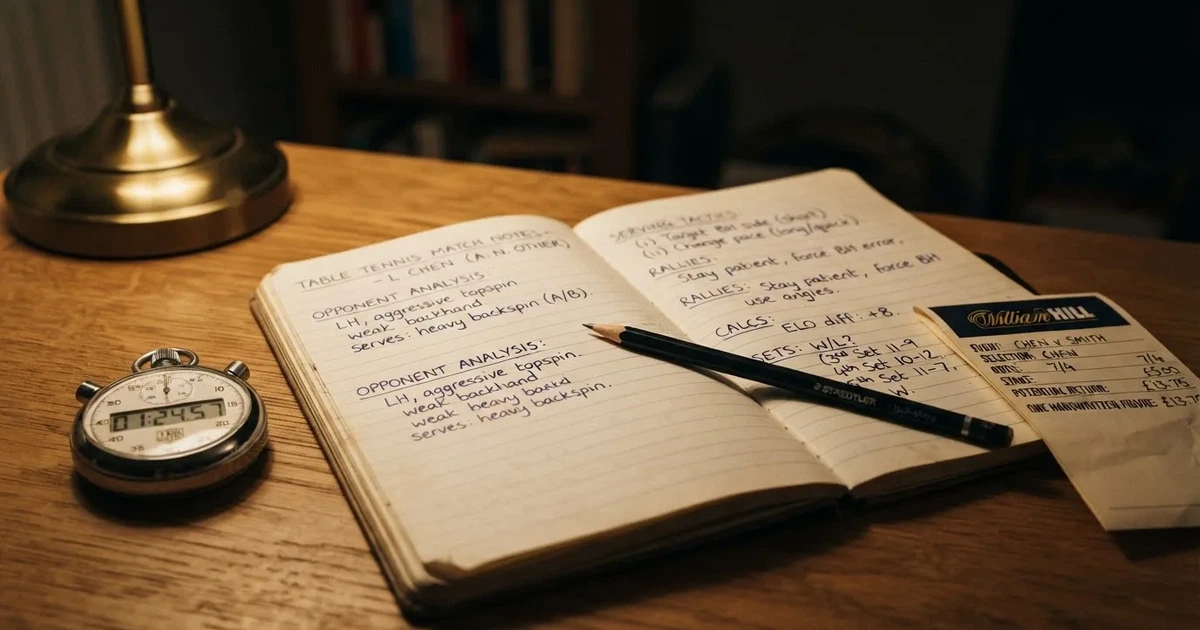
Table tennis is unusual among the sports a British bookmaker lists: one player serves two points, then the other, the game ends at eleven with a two-point cushion required past ten, and a full match is often best of five or seven games, finished in under an hour. That structure is what makes it so popular with in-play traders, and it is also what makes a “tip” so easy to fake. A tipster who tells a reader a winner gives them nothing the reader could not already have read on a results page an hour later. What the reader cannot do alone is weigh a tip against the margin baked into the price, judge whether the form is recent enough to mean anything, and decide whether the offer sitting on the account is worth clearing before the deadline expires. That is what this guide is for: not predictions, but the working method behind one, the state of the table tennis market in Great Britain, and the ten Gambling Commission-licensed bookmakers a UK punter will meet when they go looking.
What the sport actually looks like, and why it suits betting
A table tennis game is won by the first player to reach eleven points, with a two-point lead needed from ten-all; a match is the best of any odd number of games, and competition matches are typically best of five or seven. The table itself is 2.74 m long, 1.525 m wide and 76 cm high, with a 15.25 cm net and a 40 mm ball weighing 2.7 g. Service alternates every two points, and at ten-all each player serves one point in turn. The whole shape is short, sharp, and rich in momentum shifts, which is precisely why a market exists for it.

That brevity has consequences the betting slip does not always make obvious. A match that lasts forty-five minutes gives a trader plenty of points at which to lay a price, but it also means a two-game deficit can reverse inside a single game. The International Table Tennis Federation has run the sport since 1926 and it has been on the Olympic programme since 1988. The professional circuit runs year-round and an over-supply of fixtures is exactly what an in-play market wants. As a customer, the practical effect is that a table tennis market is rarely closed for long, and that something is almost always available to back or lay. That is opportunity and a warning at once: a market with continuous liquidity also has continuous temptation to bet when nothing has changed in the form book.
The bookmaker’s margin and why a “good tip” can still lose
Every decimal price a bookmaker publishes already contains an overround. Take an illustrative two-way market at 1.90 / 1.90, where a fair coin would price each side at 2.00: add the implied probabilities (1 ÷ 1.90 plus 1 ÷ 1.90) and you reach roughly 105 %, not 100 %. The extra 5 % is the margin — the slice of every unit staked the bookmaker keeps before a ball is hit. The matched-odds fair price is closer to 1.95 / 1.95, which would sum to exactly 100 %. Most table tennis markets a UK punter meets carry a margin somewhere between 4 % and 8 % on the outright winner, and a touch higher on handicap lines where the book is harder to balance.

That figure is the lens through which every tip should pass. If a tipster’s idea gives player A a 60 % chance of winning and the bookmaker prices player A at 1.90 (implying about 53 %), the tip carries value only because the reader’s estimate sits above the market’s. If the reader’s own estimate is 50 %, the same 1.90 price carries no edge regardless of how confident the pick felt when it was placed. The arithmetic is unglamorous and the discipline it asks for is dull, and that is the point: the punter who follows a tip without checking it against the implied probability is paying the margin to back the bookmaker’s doubt. Wager on prices whose implied probability is below your own, and walk past the rest. That rule is the same for every sport, but it matters more in table tennis, where the markets are thin and the form book is shallow.
Building a working tip in five honest steps
The word “tips” is a shorthand for a probability estimate, but it is not a prediction. A real tip is a process written down before the price is looked at. The steps below are the shortest working method for building one.
1. Read the form, and only the recent form. A table tennis player’s level moves faster than in almost any other sport, and a result from twelve months ago carries very little information. Look at the player’s last ten matches against opponents ranked in the same band, not the season’s headline number.
2. Check the head-to-head under the current scoring system. Players go through phases, and two players can be 5-2 against each other across a career yet 0-3 in the last year because one has changed coach or rubber. Surface and ball changes affect the head-to-head too. Bring only recent meetings into the estimate.
3. Cross-check the odds from at least three bookmakers. A price that is wildly out of line with the rest of the market is either the start of a move the trader has spotted or a trap. Either way, you want to know what the rest of the market thinks before you commit. The bookmaker with the smallest margin on this match is the one whose line most closely matches the underlying probability, and therefore the one whose price is the cheapest to take if you do want to back it.
4. Write down a probability, then convert it to a fair price. A fair price is 1 divided by your probability estimate. If your estimate for player A is 55 %, the fair decimal price is 1.82. Any actual price above 1.82 is value. Any actual price below is not, no matter how strong the form looks in isolation.
5. Stake in units, not pounds, and never re-stake a loss. A unit is between 1 % and 2 % of the bank for a standard play, and between 0.5 % and 1 % for a play you are less sure about. The bank is the figure you can afford to lose entirely, and it should sit apart from rent, bills and any other commitment. Most losing streaks end when the punter breaks the staking rule first, not when the form turns.
Five points, no surprises, no system that wins. A tip is a probabilistic estimate written down so that a future version of you can check it. The punter who skips a step is the punter who is paying the margin to feel busy.
What stake and odds actually pay back
Return is stake multiplied by the decimal odds, and the net profit is stake multiplied by odds minus one. On a £10 stake at 2.50 the return is £25 (profit £15); on a £10 stake at 1.50 the return is £15 (profit £5). On an accumulator the legs multiply into one price: two legs at 1.80 and 2.10 become a combined price of 3.78, so a £5 accumulator returns £18.90 if both legs win and zero if either loses. The maths has no opinion on which leg is more likely to let you down, and that is exactly why accumulators are how bookmakers earn their highest margins: each leg brings its own overround, and the combined overround compounds.
That compounding is the thing the accumulator pitch never names. Four legs at a 5 % margin each is not a 5 % margin on the four-fold; it is closer to a 19 % margin on the combined bet, because the implied probabilities no longer sum to anywhere near 100 %. A punter who backs the favourite on every leg is paying well above the true cost of the four singles. Accumulators are entertainment-priced as gambling, and that is the line the punter should hold when reading the page on the betting app.
Bonuses, free bets and what they actually cost
A bookmaker’s welcome offer sits at the top of every review, and almost every one of them is described in language that hides the cost. A £30 free bet is not £30 in cash; it is a stake the operator gives you, and if the bet wins the stake is not paid back with the winnings. A “100 % bonus” up to £100 means the operator matches your deposit up to £100, but the bonus itself is not yours to withdraw until it has been turned over a stated number of times at minimum prices, on minimum selections, inside a deadline. The wagering cap of 10x (a £10 bonus capped at 50x wagering being the regulatory ceiling) is one of the few binding numbers on the offer. What a £10 bonus at 10x actually costs in expected terms is a turnover of £100 multiplied by the margin of the market you clear it on: clear a 5 % market and the expected cost is £5, which is half the headline value before a ball is hit.
Free bets whose stake is not returned carry a different value from a cash bonus. The free-bet value is the free-bet amount multiplied by odds minus one, then divided by the odds, then multiplied by the payout share of the market. A £10 free bet on a 3.00 price on a market with a 95 % payout share is worth roughly £6.33 in expected terms. That is the upper bound of what the token is worth in punter currency, and it assumes the bet is placed at a price whose implied probability is below the bettor’s own estimate, which most offers tell the bettor nothing about. Promotion rules in force since 19 January 2026 cap wagering at 10x and ban mixed-product offers, so the era of “bet on football to get free spins” is closed. What remains is mostly clear on wagering and unclear on the value of the offer to a punter who already has a market in mind. As a rule, the punter who wants to compare offers does the maths on the wagering factor first and the headline amount second.
Live betting, cash out and the in-play shape of the sport
Table tennis is the second-most-popular live market behind football in many UK bookmakers, and that is because of the structure already described. A bookmaker that offers live tennis will offer live table tennis, and a bookmaker that offers table tennis will offer in-play pricing on most professional fixtures. The pitch is that the prices move with the score, which they do, and that the punter can read the game better than the trader, which a small number of punters genuinely can. The discipline is the same as pre-match: write down your probability first, take the price if it exceeds your fair odds, walk past if it does not. Live betting tightens that discipline because the prices move quickly and an offer to cash out arrives before the punter has done the maths. Cash out returns the bookmaker’s own estimate of what the bet is worth mid-match, and the bookmaker keeps a margin on that estimate as well. A cash out offered at £85 on a back bet whose true mid-match value is £90 is the same margin in a different shape; a punter who routinely accepts the cash-out price is paying the bookmaker’s mid-match overround without naming it as such.
The deeper trade-off is information. A punter watching the match knows what the bookmaker’s trader may not: the receiver’s grip is off, the server’s toss has dropped, the wind in the hall is moving the lighter player. Those signals are real, and at the highest level of the market a small number of punters can convert them into an edge. For most readers they cannot, and the in-play market simply charges them the overround more often than the pre-match one. Live table tennis is a market to use selectively, not one to use as a default.
The spread betting wrinkle from one UK-licensed name
One of the bookmakers in this guide, Spreadex, runs a separate spread betting product that is regulated by the Financial Conduct Authority on the financial side and by the Gambling Commission on the fixed-odds side. The difference is consequential: spread betting on a table tennis total is not a price against an outcome but a stake-per-point movement on a range, and losses on a spread bet can exceed the deposit that funded it. Spreadex’s own site carries that warning on its homepage. The licence structure means the same app handles two different products under two regulators, and the punter who opens a fixed-odds account to use the £60 free bets must check the product picker before placing a stake on what they think is a match result. The £60 free bets token is fixed-odds-only by default; the rest of the product is not. Most UK punters on Spreadex use the fixed-odds book and treat the spread side as a separate decision.
Odds formats and what a British punter reads
UK bookmakers display fractional odds by long custom and decimal odds by EU inheritance: 5/1 (six times the stake in return), 11/4 (3.75 in decimal), evens (1/1, 2.00 in decimal). The conversion is a divided by b plus one, so 11/4 becomes 11 ÷ 4 + 1 = 3.75. An odds-on price is shorter than evens, so 4/6 (1.67 in decimal) is “odds-on”. The starting price (SP) is the price the bookmaker settles the bet at when no early or show price was taken; best odds guaranteed (BOG) means the punter is paid at the higher of the price taken or the SP, and most major UK horse-racing bookmakers extend BOG across the day’s racing. The headline offers on a few bookmakers in this guide name BOG explicitly, and the punter who bets football and horse racing should know which version of the price they are accepting before placing the stake.
For table tennis, odds are usually published in both formats on the same page. The fractional form is what a long-standing UK punter reads fastest; the decimal form is what the implied probability is calculated from, because 1 divided by the decimal price is the implied probability. A punter who shops for the best price on a single selection is making sure the implied probability is as low as possible across the field, and that is how the margin is paid back to the punter rather than to the bookmaker.
What bet types apply to table tennis
The two-way winner market (player A or player B) is the centre of the menu; the match handicap (player A -1.5 games, player B +1.5 games) is the most common way to lengthen the price on the favourite and shorten it on the underdog. Total points over/under is offered on most professional fixtures, and set betting (correct score in games) is offered but compounded in overround. Each-way is a horse-racing convention and rarely applies to table tennis. Accumulators work across any of the above but, as the maths above shows, the more legs the higher the combined margin. Bet builders and same-game multiples on table tennis single matches are a more recent product and let a punter combine winner, handicap and total into one bet on one match. The combined overround is the same as an accumulator; the product is just packaged differently. The pricing on a Bet Builder is dynamic: as the punter adds legs the price adjusts, and the dynamic odds are the bookmaker’s own calculation of the combined probability, not the punter’s.
What a bet builder gives a punter is convenience, not value. A punter who wants the same combination as two separate singles should compare the Bet Builder price to the multiplied singles price: if the Bet Builder is higher, the singles are the cheaper option; if it is lower, the Bet Builder is the cheaper option; otherwise the difference is the bookmaker’s commission on the convenience.
Regulation in Great Britain and what a licence actually means
Any operator whose remote facilities are used in Great Britain needs a Gambling Commission licence, wherever the operator is based: that has been the law under sections 33 and 36 of the Gambling Act 2005 since the Gambling (Licensing and Advertising) Act 2014. A Curaçao, Maltese or Gibraltar licence is not a substitute for GB customers. The minimum age is 18, and identity verification (name, address, date of birth) happens before the first deposit and is required to claim a free bet or bonus as well as to place a stake. Credit cards have been banned for gambling in Great Britain since 14 April 2020, including when the credit card funds an e-wallet; debit cards and bank-based payments are not covered by the ban.
The Commission’s public register lists every licensed operator and is the whole test of who holds a licence. Quote no count without its access date, and name no single brand “the only” licensed one: the register lists far more brands than any article features, and a place in a comparison is a comparison, not a licence. Several brands can run under one licensee, and the punter who reads past the trading name is reading the wrong test. The ten operators listed below are the comparison set for this guide; the licensed set is much larger.
Since 31 March 2020 online operators have taken part in GAMSTOP, the national multi-operator self-exclusion scheme; periods are six months, one year, five years, or five years with auto-renewal, and after the minimum period an exclusion stays in place for a further seven years unless the customer asks GAMSTOP to remove it. From 30 August 2024 a financial vulnerability check applies to licensed remote betting when deposits minus withdrawals exceed £150 in a rolling 30 days; that check is a public-record one (bankruptcy, county court judgments), not an income check. Financial risk assessments (the so-called affordability checks) are announced in a staged plan with no start date as of the Commission’s article of 7 July 2026. Players will see deposit limits with a fixed time frame under RTS 12, with the first changes applying since 31 October 2025 and a second phase postponed to 30 September 2026. There is no state-set deposit or loss ceiling; limits are the customer’s choice on a licensed site, and that choice is what a player who wants to manage spend uses.
Betting duty is the operator’s tax on gross profits, currently 15 % under General Betting Duty. From 1 April 2027 a new remote betting rate of 25 % applies within it; UK horse racing, self-service betting terminals, pool betting and in-person betting stay at 15 %. The punter pays no tax on betting winnings in Great Britain; that is general information, not tax advice, and a professional gambler should ask HMRC or an adviser. Whether operators pass duty changes through odds is not established, and the punter should never read a duty change as a personal charge.
The unlicensed option and what it actually costs the punter
A GB licence is compulsory at the point of consumption. Providing gambling facilities in Great Britain without the licence the Act requires is an offence under section 33 of the Gambling Act 2005 (on summary conviction up to 51 weeks’ imprisonment, a fine up to level 5, or both; six months in Scotland); the offence is aimed at the operator, and the Commission has been given, or is about to receive, court-order DNS blocking powers. There is no offence aimed at a customer who bets on an unlicensed site in the statute this review found.
The cost to the customer is loss of protection, and it is real: no GAMSTOP coverage, no Commission complaints route, no approved dispute-resolution body, no British consumer redress if funds are withheld, not bound by the 10x bonus cap or the £150 vulnerability check. Honest framing: a licensed operator checks identity, sets deposit limits, takes part in GAMSTOP and applies the bonus cap; an unlicensed operator does none of those things, and the punter who funds an unlicensed account from a UK bank pays the protection gap with whatever the regulator cannot later recover. Enforcement is disruption, not blocking: cease-and-desist notices, search-engine referrals, work with registrars, hosts and payment providers; ISP blocking is not in operation on the regulator’s published order. A punter who values the British consumer protections already on the page reads the Commission’s register and stays on it.
Help and the line at which the offer should stop
A punter who feels the betting has stopped being a choice can use the safer-gambling tools on a licensed site: deposit limits with a fixed time frame, a Player Profile test (Unibet publishes one with its safer-gambling tools), product restrictions and self-exclusion. GAMSTOP self-exclusion covers every online operator that takes GB customers. GamCare runs the National Gambling Helpline; GambleAware and NHS gambling clinics offer longer-form support; Gamblers Anonymous runs peer-led meetings. The financial vulnerability check on a licensed site is a public-record one rather than an income one, and that is the regulator’s balance between protection and intrusion.
The honest line at which any offer should stop is the one a punter draws for themselves, and it is drawn before the next deposit, not during it. If the offer is being chased to recover a loss, the offer is the wrong reason to deposit. If a staking unit has crept above the 1 %–2 % bank the punter set at the start, the rule has slipped. If a single match is being bet on to settle the week, the offer has stopped being entertainment. Each of those is a sentence a punter can write for themselves before the next bet, and they all read truer at the desk than at the betting app.
Ten licensed bookmakers and what each one offers a table tennis punter
Each card below carries the same four columns: the bookmaker, the Gambling Commission remote licence number and the licence holder on the public register, and what the operator’s own published terms say about the features that touch table tennis. No brand is “the only” licensed one; the licensed set is much larger, and several of the brands below run under a parent group. The card you read is the card the operator publishes; the licence is the entry on the Commission’s public register; the offering is what each operator’s own terms and app store entry state, not what an aggregator claims.
| Brand | Gambling Commission licence and holder | What the operator’s own terms state on table tennis and adjacent features |
|---|---|---|
| Copybet | Account 53774 · Copybet UK Limited | Best Odds Guaranteed all day on UK and Irish racing; first-past-the-post payout on horse racing even if the winner is later disqualified; sports betting on football, tennis and the major US sports alongside racing |
| Bet600 | Account 44731 · Tyche Tech Limited | Best Odds Guaranteed on horse racing, paying at the SP if the starting price is bigger than the early or show price taken; football, tennis, American sports and racing coverage |
| Betfair Sportsbook | Account 39439 · PPB Counterparty Services Limited | In-play betting, Bet Builder, free live streaming of UK and Irish horse racing and football inside the app, and a 90 Minute Payout market; the wider Betfair exchange runs under a separate betting-intermediary licence |
| London Bet | Account 66162 · Thistle Bet Limited | Sports betting on football, tennis, horse racing, greyhounds, darts, golf, cricket, NFL, NBA, MLB and snooker, with Pragmatic Play casino slots and live in-play betting inside the same app |
| 888sport | Account 39028 · 888 UK Limited | Pre-match and in-play betting, Cash Out, Bet Builder, racing streams, BetFinder form tools, a live bet feed and daily boosted odds on football, tennis, horse racing and the major US sports |
| Bet Ahoy | Account 100094 · Bet Ahoy Ltd | 10 % Acca Bonus up to £1,000, Sub-Cover for player substitutions, Best Odds Guaranteed on UK and Irish horse and greyhound racing up to £100, and Double Result payout on UK and Irish racing |
| Fitzdares | Account 400 · Fitzdares Limited | Cash out, accumulators, Lucky 15s, specials and antepost markets on horse racing, football, tennis, rugby, cricket, golf and American football, with in-play live odds |
| BetVictor | Account 39576 · BV Gaming Limited | Best Odds Guaranteed on UK and Irish horse racing, enhanced live race streaming, BetFinder racing search and Smart Stats for football; the racing focus is the headline, with full multi-sport coverage behind it |
| NetBet Sport | Account 39170 · Netbet Enterprises Limited | Daily Boosts and Profit Boosts, free bet offers, a Bet Builder with instant dynamic odds, and sports stats for the major leagues; the price-boost pitch sits on top of a long-established book |
| Spreadex | Account 8835 · Spreadex Limited | £60 in free bets for a £10 fixed-odds qualifying bet (usable across fixed odds and spread betting; qualifying bet must be placed within 28 days); the spread side is FCA-regulated on the financial line and can see losses above the deposit |
A few of the entries above name racing features (BOG, first past the post, SP rules) alongside the table tennis product, because the racing features are what each operator’s own terms publish most prominently and because they are the offers a punter who opens an account for table tennis will meet on the way to the table tennis section. The cross-sell is a fact of the modern UK bookmaker app, and a punter who wants only the table tennis product can mute the racing offers in the app’s settings without losing the licence they opened it under.
Copybet
Copybet’s app offers Best Odds Guaranteed all day, every day, on UK and Irish racing, and pays first past the post on horse racing even if the winner is later disqualified — a useful customer-protection feature for the racing side. The bookmaker carries football, tennis and the major US sports alongside racing, so a punter who wants the table tennis product alongside the racing protection finds both on one licence. The trading name Copybet UK Limited is on the Commission’s public register under account 53774, which is the entry to quote when checking the licence. Copybet is a viable choice for a punter who wants BOG on racing and table tennis markets on a single licence, provided they are comfortable ignoring the racing-specific bonuses.
Bet600
Bet600 pays Best Odds Guaranteed on horse racing, settling at the SP if the starting price is bigger than the early or show price taken — the standard racing-floor rule, written into the GB App Store entry for the brand. Football, tennis, American sports and racing coverage sits under one licence. The licence holder on the Commission’s public register is Tyche Tech Limited under account 44731. The bookmaker carries a sharper in-play offering than the racing-floor pitch suggests, which is the practical interest for a table tennis punter who wants live odds. Bet600 is effective for a punter who prioritises BOG on racing but also needs a live table tennis book, without the need for extensive acca-insurance features.
Betfair Sportsbook
Betfair Sportsbook offers in-play betting, Bet Builder, free live streaming of UK and Irish horse racing and football inside the app, and a 90 Minute Payout market — the regulated-features list that any GB-licensed multi-sport book would put on its app store entry. The licence holder is PPB Counterparty Services Limited under account 39439; the wider Betfair exchange sits on a separate betting-intermediary licence, and the punter who wants exchange-side back and lay products gets them on the same parent group but a different licence number. The sportsbook is the side a punter wanting Bet Builder, in-play and live streaming on one licence is buying into. Betfair is best seen as a sportsbook option for the punter who values the 90 Minute Payout and live streaming on one licence, while treating the exchange as a separate, sophisticated tool.
London Bet
London Bet’s app combines sports betting on football, tennis, horse racing, greyhounds, darts, golf, cricket, NFL, NBA, MLB and snooker with Pragmatic Play casino slots and live in-play betting. The licence holder is Thistle Bet Limited under account 66162. The casino side lives under a separate Commission category and the punter who wants only sports betting can mute the casino in the app’s product settings. The multi-sport list is the practical pitch: a punter who wants darts, snooker and greyhounds on the same licence as the table tennis market finds them here. London Bet serves the punter who needs variety, such as darts and snooker alongside table tennis, as long as they are content with a site that integrates casino slots.
888sport
888sport offers pre-match and in-play betting, Cash Out, Bet Builder, racing streams, BetFinder form tools, a live bet feed and daily boosted odds — the full-feature list a punter would expect from a long-established multi-sport book. The licence holder is 888 UK Limited under account 39028. The price-boost daily product is the part of the offering that touches a table tennis punter most directly, since most price boosts run on Premier League football, horse racing and the major US sports, with table tennis boosted prices appearing around bigger tournaments. 888sport remains a standard-bearer for the punter who prefers a well-known GB name, though they should accept that the daily boost product is weighted toward football and racing rather than the table tennis match list.
Bet Ahoy
Bet Ahoy carries a 10 % Acca Bonus up to £1,000, Sub-Cover for player substitutions, Best Odds Guaranteed on UK and Irish horse and greyhound racing up to £100, and Double Result payout on UK and Irish racing — the racing-led feature list that defines a bookmaker in the racing-friendly segment of the GB market. The licence holder is Bet Ahoy Ltd under account 100094. Sub-Cover is the more distinctive name in the list: a substitution-protection feature for player markets, relevant to a punter who bets on individual player props as much as on match winners. For a punter who prioritises Sub-Cover and acca bonuses, Bet Ahoy provides a specific value, provided they understand that these racing-led incentives are the main feature of the site.
Fitzdares
Fitzdares offers cash out, accumulators, Lucky 15s, specials and antepost markets on horse racing, football, tennis, rugby, cricket, golf and American football, with in-play live odds. The licence holder is Fitzdares Limited under account 400. The antepost focus is the practical pitch: a punter who wants to take a futures price on a tournament winner months ahead finds the market on this book. Lucky 15s are a long-standing UK multiple-bet convention (four selections, fifteen bets across singles, doubles, trebles and the four-fold) and Fitzdares is one of the GB names that still promotes them. Fitzdares is the preferred destination for a punter who is interested in Lucky 15s and antepost markets, with table tennis availability serving as a secondary benefit on the same account.
BetVictor
BetVictor offers Best Odds Guaranteed on UK and Irish horse racing, enhanced live race streaming, a BetFinder feature for finding racing bets and Smart Stats for football — the racing-led product that has defined the brand for years. The licence holder is BV Gaming Limited under account 39576. Behind the racing pitch sits a full multi-sport book, and the table tennis market is among the in-play sports priced on the app. Smart Stats is the more distinctive name: a statistics overlay for football selections that the punter who bets on individual player props will use directly. BetVictor stands out as a robust choice for the punter who needs a reliable racing-protection environment alongside a live market on table tennis.
NetBet Sport
NetBet offers Daily Boosts and Profit Boosts, free bet offers, a Bet Builder with instant dynamic odds and sports stats for the major leagues. The licence holder is Netbet Enterprises Limited under account 39170. The instant-dynamic-odds Bet Builder is the practical point: a punter who builds a same-game multi on a single match sees the price adjust as legs are added, and NetBet publishes that product as a headline feature. The free bet line is a recurring slate, and the daily boost list runs to the same handful of sports as every other GB book. NetBet is a strong contender for the punter who values Bet Builder flexibility above all else, seeing the other daily promotions as supplementary to their match selection.
Spreadex
Spreadex’s new customer offer is £60 in free bets for a £10 fixed-odds qualifying bet, with the free bets usable across fixed odds and spread betting; the qualifying bet must be placed within 28 days of opening the account. The licence holder is Spreadex Limited under account 8835. The spread side is the headline difference: spread betting is FCA-regulated on the financial line and Commission-regulated on the fixed-odds side, and losses on a spread position can exceed the deposit that funded it. The punter who opens a fixed-odds account for the £60 free bets should check the product picker before placing any stake on what they assume is a match result. Worth it for the punter who wants the £60 fixed-odds free bets and treats the spread book as a separate, informed decision.
What the table tennis market itself looks like
Table tennis betting markets follow the calendar of the ITTF World Tour, the WTT (World Table Tennis) series, the Olympic cycle and the national leagues in the larger markets. Men’s and women’s singles each carry a moneyline winner market, with match handicap (game line) and total points offered on most professional fixtures. Set betting, where the punter names the exact score in games, is offered on most bookmakers but carries a heavy margin and should be treated as entertainment-priced. Each-way betting, a horse-racing convention, is generally not available on table tennis. On major finals the futures market runs weeks ahead, and on everyday WTT feeder events the menu shrinks to the two-way winner.
The interesting structural feature is match length. A best-of-five match is closed in well under an hour, which means the live market is dense and the cash-out valuations update continuously. It also means a punter who wants to watch a match and place one in-play bet can do so on a lunch break, and the bookmaker who prices the match can refresh the line several times across a session. The downside for the punter is the very thin liquidity on the smaller fixtures: a £500 bet on an early-round WTT match may be the entire book at that price, and the bookmaker will treat it as such. For most punters the practical advice is to bet on WTT Tour and ITTF World Tour main-draw matches, where the liquidity is real and the in-play pitch is more than a marketing line.
Frequently Asked Questions
How do you actually win at table tennis betting?
You do not, in the sense of a system. What you can do is build a probability estimate, find a price whose implied probability sits below that estimate, and stake 1 %–2 % of a fixed bank on it. Over hundreds of such bets the margin takes about 5 % of turnover, and the difference between a winning and a losing punter is whether their estimates sit above the implied probabilities more often than not. Any single bet can lose, and any given week can be a losing one.
How do you bet on table tennis from the UK?
Open an account with a Gambling Commission-licensed bookmaker, complete the identity verification, deposit by debit card or bank transfer (credit cards are banned for gambling in Great Britain), and find the table tennis section under the sport menu or the in-play tab. Pick a match, pick a market, place a stake and confirm the bet. The whole process is the same as betting on any other sport on the same app.
What is the difference between a value bet and a tip?
A tip is a name; a value bet is the price that name deserves. A tip that says player A wins is unaccompanied information; the value bet is the price at which the punter’s probability estimate for player A makes the bet profitable in the long run. Most tips on social media are the former and contain nothing about the latter.
Why is no tip ever certain?
Because the bookmaker’s margin sits inside every price, because form changes between the tip being written and the match being played, and because table tennis has more variance per game than larger-ball sports. A punter who treats any single tip as a certain winner is treating it as a tip; a punter who uses it as one input to a probability estimate is using it correctly.
What is the bookmaker’s margin and where does it show in the odds?
The margin is the slice of every unit staked the bookmaker keeps before a ball is hit. It shows in the sum of implied probabilities: add 1 divided by every decimal price in a market, and the sum exceeds 100 % by the margin. Two prices of 1.90 / 1.90 imply a margin of roughly 5 %; a market with two prices of 1.80 / 1.80 implies closer to 11 %. The punter pays the margin on every bet and can only beat it by finding prices whose own implied probability is below their own.
How is the return on a bet worked out from the stake and the odds?
The return is the stake multiplied by the decimal odds, and the profit is the return minus the stake. A £10 stake at decimal odds of 2.50 returns £25 (£15 profit); a £10 stake at 1.50 returns £15 (£5 profit); an accumulator of two legs at 1.80 and 2.10 has a combined price of 3.78, so a £5 accumulator returns £18.90 if both legs win. The same calculation is the basis for free-bet value, where the stake is not returned, and for the expected cost of clearing a bonus.
Tennis, darts & cue sports – Fast Payout
Content created by the «Fast Payout» team
