
Badminton betting tips: how a tip is read, what it costs and why no pick is ever certain
 Available in US
A “tip” in badminton looks like a confident forecast wrapped in a price. The forecast is one player’s probability of beating another on a given day; the price is the bookmaker’s view of the same question, with the bookmaker’s margin baked in. What sits between them — and what makes a tip worth following or ignoring — is the difference between those two numbers once the margin is stripped out. That difference is the only edge a tip can offer. The rest of this guide is about finding it, costing it and not mistaking it for certainty.

The data on this page is current as of 27 October 2026 and was checked against the United Kingdom Gambling Commission’s public register of remote operating licences, the Commission’s Licence Conditions and Codes of Practice, and HM Government policy materials on betting duty.
Bankroll, not bank balance: the discipline that turns tips into returns
Bankroll is the sum of money a punter sets aside for betting only. A tip is a stake against that bankroll, measured against the price, never against a deposit. When the stake is decided by gut feel or by excitement, the tip’s edge — if it has one — is spent before the bet is placed, and a long run of correct forecasts still ends in a busted bank. The alternative is a flat stake: the same amount on every selection, regardless of how confident the forecast feels. Flat staking does not raise the edge of a tip, but it stops the bankroll from swinging on a single loss and gives the margin-of-error rule something to work against.
The margin-of-error rule is the second half of the discipline. A badminton match between two players ranked close to each other has a wider margin of error than one between an established number one and a qualifier: injuries, form changes, the lane of the draw at a tournament, even the shuttle-feather batch. A punter who treats every fixture as if it carried the same risk is paying the bookmaker’s margin at full price on every bet. A punter who sizes the stake down on the harder reads, and up on the obvious ones, at least spends the margin where the edge is widest.
The third leg is the record. A column for each bet, the price, the reasoning, the result and the closing line price if it can be found later, is the only honest measure of whether a tipster — including the punter himself — is doing better than a coin toss with the bookmaker’s vig taken out. Without the column, the punter only remembers the winners; the bet book is the antidote.
None of this turns a tip into a winning one. It turns the act of following tips into an activity whose results can be read.
Bonus words, bonus cost: what a “free bet” actually pays back
The promotion page of an online bookmaker lists bet credits, free bets, acca insurance, price boosts and deposit matches. Each is a marketing word with a mechanical cost behind it. Reading the cost is the only way to know whether a promotion is better than placing the same stake without it.
A free bet is a stake the bookmaker credits a customer’s account with, paid out of winnings only and not from the stake. A £10 free bet at odds of 4.50 produces, on a win, £35 of withdrawable cash: the £10 stake is gone. The same £10 of the customer’s own money at the same odds produces a £45 return, of which £35 is profit and £10 is the stake returned. The free bet is, on a win, worth about 78% of its face value at that price — better at longer prices, worse at shorter ones. The headline number on the promotion page is the face value; the number that matters is the expected value, and that expected value is always below 100% on a free bet whose stake is not returned.
An accumulator insurance refund works in the other direction: if exactly one leg of an accumulator loses, the bookmaker refunds the stake as a free bet or as cash, depending on the terms. BoyleSports, for one, runs an acca insurance offer that requires opt-in, a minimum stake of £5, minimum odds of 1/2 per leg, pays a maximum refund of £20 as a free bet, and both the bet and the refund expire on the same day. A punter who reads only the headline “Money back if one leg lets you down” sees a parachute that the small print ties to several pegs. The cap on the refund, the per-leg minimum price and the within-a-day settlement window each cut the offer’s value further. Reading them takes two minutes and often shows that placing the acca without the offer and keeping any winnings intact was the cheaper choice.
A price boost raises the odds on one selection or one combination. The raised price is what the customer sees; the price the bookmaker would normally have offered — the closing line price — is the basis the boost should be measured against. A boost that moves the price from 3.50 to 4.00 sounds generous until the closing line settles at 3.75; the boost was real but small, and the headline framed it large. A boost from 3.50 to 5.00 against a closing line of 4.25 is a different order of magnitude and worth taking on a stake the punter can afford to lose.
A deposit match, where the bookmaker credits a bonus equal to a percentage of the customer’s first deposit, carries a wagering requirement. Under the Commission’s rule in force since 19 January 2026, no licensed remote bookmaker may set that requirement above 10x the bonus value. A £10 bonus at 50x turnover — £500 of qualifying bets before withdrawal — would now be unlawful at any operator serving customers in Great Britain; the cap is £100 of qualifying bets at 10x. The headline “100% bonus” is the figure to compare; the £100 of turnover the bookmaker can require is the figure that decides whether the bonus is worth claiming.
Each promotion has a deadline. A free bet credited on Monday and expired on Sunday costs a punter who bets only on weekends the entire bonus. Reading the expiry before claiming is faster than losing the bonus after.
Live betting and cash out: when the price moves, who pays for the move
In-play betting on badminton is offered by most licensed operators. The price on every update reflects the score and the bookmaker’s read of momentum. The court-side price moves in steps the punter does not see the rationale for: a backhand drop that looked clean from the back of the stands may look different on the operator’s trader screen, and the price that follows is the trader’s reaction, not the referee’s ruling. A tip that read well before the match begins may read very differently once the first game goes against the favourite.
Cash out is the bookmaker’s offer to close the bet early at a price the punter sees in real time. On a winning position the cash-out price is below what the bet would pay at full-time settlement, because the bookmaker is taking the certainty of paying out now and giving the punter less than full settlement in return. On a losing position the cash-out price is a partial recovery: the punter exits at a fraction of the original stake and the bet’s volatility goes away. A punter who cashes out every winning position early is converting an edge with a wide finish into one with a smaller finish, every time.
The sharper use of cash out is on positions the punter has lost confidence in, not the ones they have not. A £10 bet at odds of 6.00 on a player winning is, after that player takes the first game 21-14, sitting on a cash-out offer that reflects a probability much closer to 6.00 than to the implied one-sixth of the original price. Holding the bet to full settlement keeps the long price; cashing out locks in a smaller but real number. Holding it to full settlement, on a match where the second game has clearly turned, accepts the loss; cashing out caps it. The punter who decides on each position by what their notebook says about the selection, not by what the live ticker suggests, is the punter whose long-run numbers read sensibly.
In-play tennis has been a trader’s market for years and badminton is moving the same way. The spread of in-play markets at a single badminton match is thinner than at a tennis match of similar weight — the smaller betting base at badminton limits what the bookmaker is willing to offer — but the major tournaments now carry match winner, game winner, total points and handicap markets through to the final point. The bookmaker with the deepest in-play book on badminton will often offer the tightest prices too, because tighter prices reflect a more certain view of where the price will close. A punter who only bets pre-match is forgoing that view.
What a “value bet” is, and why no tip is ever certain
A value bet is a wager whose price is greater than the true probability of the outcome, with the bookmaker’s margin stripped out. The strip-out is the work the punter has to do. A bookmaker’s 1.85 is the market’s price for a coin toss, after the margin is added; the punter believes the coin toss is genuinely even; the price the punter would call fair is 2.00. The 1.85 is short of fair, so it is not a value bet. The same 1.85 against a player the punter believes has a 55% chance of winning, a probability whose fair price is 1.82, is a value bet because the price exceeds the punter’s fair number.
Form, statistics, head-to-heads, the draw at the tournament, the recent run of three-game matches versus two-game wins, the surfaces and conditions in the hall — all of these feed the probability estimate. None of them produce a number with a decimal place; each is a weight in the punter’s own ledger, and the ledger is the punter’s own. There is no published true probability of a badminton match for the punter to copy; even the BWF rankings and the BWF World Tour standings are not probabilities, they are rankings, and the gap between number three and number four in a ranking tells the punter nothing exact about who wins on a given day. The punter’s fair price is the punter’s estimate, not a market quote.
Why no tip is ever certain: a tip is a probability estimate and a probability is not a forecast. A 70% favourite loses three matches in ten on average; a 90% favourite loses once in ten. The punter who reads a tip as certainty bets the bank’s full stake on the price; the punter who reads it as a probability sizes the stake so that one loss in a row does not finish the bank. Form breaks, injuries happen, a shuttle breaks a string at 19-19, the favourite wins the toss but loses the deuce; the tip did not lie, the certainty was the punter’s own addition.
Forecasts published online as “tips” are not all the same product. Some are free and supported by affiliate revenue, where the tipster’s pay comes from clicks and sign-ups regardless of whether the tips win; some are paid and the tipster’s reputation depends on a published record over time; some are sold as part of a software package that claims to identify value automatically and prices its product on the claim. The published record — a tipster’s last one hundred bets, the strike rate, the average odds, the longest losing run — is the only check a punter can run, and only if the record covers both wins and losses. A tipster who publishes only the winners is publishing the same column a punter’s memory builds by default.
A tip is not a system, and a system is not a route to certainty. A system can be the punter’s own consistent rules — flat staking, only bet on tournaments where the BWF World Tour rankings are dense, only bet when the closing line offers more than a half-point of value over the punter’s fair price — and those rules are the discipline that turns intermittent tips into a trackable long run.
Reading the odds: what the bookmaker’s margin looks like in the line
A bookmaker’s margin, often confused with the overround, is the percentage of total stakes the bookmaker expects to keep as profit. The overround is the sum of the implied probabilities across all outcomes in a market, expressed as a percentage above 100%. For a two-way market priced at 1.90 and 1.90, the implied probabilities are 52.6% each, totaling 105.2%; the overround is 5.2%. The bookmaker’s margin, calculated as (sum-1)/sum, is 5.0%, meaning the payout share — the part of every pound that returns to customers — is 95.0%. A market whose margin sits at 2-3% is sharp; one whose margin sits at 8-10% is bookish. The difference is the bookmaker’s take per pound bet.
In a worked example with an illustrative market priced at decimal odds of 1.90 / 1.90 — used here as an example, not a quoted price — each outcome implies a probability of about 52.6%. The two outcomes together imply about 105.3% of the event. The margin is therefore roughly 5.3%, and the payout share to customers is roughly 94.7%. Over many bets at this market, every £100 staked returns about £94.70 to customers and keeps about £5.30 for the bookmaker. The narrower the margin, the more each pound bet returns, and the harder the bookmaker has to be to offer other markets at the same cost; that is the trade-off behind the breadth of a sportsbook’s menu, and the balance a comparison has to read carefully.
A badminton match winner market is rarely a true two-way line once a third outcome — a walkover, a retirement, an abandoned fixture — is accounted for. A market priced with three outcomes spreads the implied probabilities across them and the margin sits higher than a clean two-way number. A tournament outright with thirty-two entrants is many markets in a chain, and the margin compounds across each leg; a bookmaker’s overall margin on a thirty-two-runner outright is well above 30%, even though no single leg looks extravagant. The lessons for the punter: short markets are tighter, outrights are looser, and the difference is the cost the punter pays to bet on a bigger question.
A price boost from 3.50 to 4.00 against a base margin of, say, 6% lifts the price to one that implies about 27.5% on the boosted side and around 28-30% on the others, with the boost pulling the punter’s slice of the margin outward. Boost offers feel like free wins because the headline is a single number; the margin is still sitting across the rest of the market. Reading the rest of the line after a price boost, not just the boosted number, shows the full cost.
A bookmaker’s margin per sport and per market is the measure the punter should compare across operators. A bookmaker that prices Premier League football at 3% margin does not necessarily price badminton at the same level; an operator’s margin can move by event, by market and by the time of day, and a single tight number on one sport is not a guarantee. The wider picture at a bookmaker — the margin across its badminton lines over a season — is what a bet book tells the punter over time.
What may be bet on at a badminton match: selection and settling
The traditional match winner market at a badminton fixture is a two-way line on the player or pair who wins the match. Behind that headline market sits a list the punter builds up over several tournaments: total games in the match, total points in the match, handicap on games (the favourite concedes a game and a half at the quote), each-way betting on a named player reaching a round, and outright markets on the tournament itself.
Game handicap: a quote of -1.5 games on the favourite means the favourite must win the match 2-0 for the bet to win, with a -1.5 handicap applied. A quote of +1.5 on the underdog means the underdog must win at least one game, which they will do on any match that goes to a third game or that they win outright. The handicap market widens the price on the favourite and the price on the underdog relative to the match winner market, but the margin on the handicap market is typically higher than on the match winner; the punter’s cost per pound bet is higher.
Total points: a quote of over 84.5 total points means the cumulative score in both games must beat 84.5; the two games combined must therefore hit 85 or more. A men’s singles match between two players of similar standing often closes at 21-18, 21-19, a 79-point total that does not reach the line. A match between two aggressive baseliners may close at 21-16, 16-21, 21-18, a 92-point total that beats the line easily. The total points market rewards reading of playing style as much as form.
Each-way on a player: a stake split into two equal halves, one on the player to win and one on the player to reach a defined round (the place terms). The place terms vary by tournament and by bookmaker, and they are the second figure a punter checks; a 1/3 odds place on a sixteen-player draw at a Super 750 tournament pays very differently from a 1/4 odds place at a smaller event.
Accumulator betting on badminton: a bet combining several selections, each leg at its own price and the combined price the multiplication of all legs. A four-leg acca at 2.00, 2.10, 1.80 and 2.50 carries a combined price of 18.90 — £10 returns £189 if all four legs win. The combined price is the attractive number; the chance of all four winning is what gives the attractiveness a ceiling. A four-leg acca of average 65% favourites wins roughly 18% of the time, and the bookmaker’s margin on a four-leg acca compounds. BoyleSports’ acca insurance, which requires opt-in, a minimum stake of £5, minimum odds of 1/2 per leg and pays a maximum refund of £20 as a free bet with same-day settlement, refunds the stake only when exactly one leg loses, not when two or more do — a much rarer outcome than the headline suggests.
Bet builder at a badminton match: a single bet combining several markets on the same match — match winner, total games, total points, handicap. The combined price is the multiplication of the legs, and the bookmaker’s margin compounds across each leg. A bet builder’s price is rarely a genuine arbitrage with the standalone markets, which is exactly the comparison a punter runs before placing one.
Cash out as a settlement choice: a bet whose selection has already won but whose match is not yet over may be settled at the cash-out price the bookmaker offers, or held to full settlement. The choice is the punter’s, and the cost of holding to full settlement is the volatility already in the scoreline. A punter whose tipping record shows a long-run profit at full settlement, on this sport, with this bookmaker, should hold; the cash-out button is the choice for the punter whose record shows they cannot.
The BWF and the tournament calendar: fixtures, draws and what to read from them
The Badminton World Federation is the governing body for international badminton, founded in 1934 as the International Badminton Federation. The Federation runs the BWF World Tour, the BWF World Championships and the Olympic pathway, and its Member Associations run the national federations whose players a punter reads form against. The Federation’s own rankings are the best public read on form over the prior fifty-two weeks, with weight given to results in the past twelve months at the major events.
Tournaments on the BWF calendar fall into tiers that affect form reading. The BWF World Tour Super 750 and Super 1000 events attract the strongest fields and carry the most ranking points, with bigger prize funds and longer draws. Super 300 and Super 500 events sit a tier below. The BWF World Championships and the Olympic badminton event stand apart: the World Championships, first held in 1977, and the Olympic event, with badminton an official Summer Olympic sport since 1992 and mixed doubles added four years later.
The team events are a different reading problem. The Thomas Cup is the men’s team championship and the Uber Cup the women’s, both held every two years. The Sudirman Cup, a mixed team championship that began in 1989, sits alongside them on the same biennial calendar. A team event is decided over five matches across the disciplines — men’s singles, women’s singles, men’s doubles, women’s doubles and mixed doubles — and the strength-in-depth of a team matters as much as any individual form. Betting on a Thomas Cup tie as a single line overlooks the depth the team format rewards.
The All England Open Championships, first held in 1900, carry the most historical weight on the calendar and are sometimes referred to as the unofficial world championship. The format and seeding at the All England is one of the punter’s first reads on a major calendar year, because a defended champion who did not win a Super 1000 title in the run-up is a form question the bookmaker’s price often answers before the punter’s notebook does.
BWF World Rankings and BWF World Tour standings feed the seeding at each tournament, and seeding feeds the draw, and the draw feeds the price. A top seed at a twenty-player draw meets the qualifier from a wide half of the draw in the early rounds; a top seed at a thirty-two-player draw meets the lower-ranked winner of a deep qualifier group. Reading the draw at the start of the week is the cheapest read on whether the favourite’s price is generous; a favourable half of the draw is the most common reason a favourite’s outright price drifts shorter than expected before the first round.
The Olympic badminton event sits on a four-year cycle and the next edition is the one whose draw punter’s price-watch turns on. Mixed doubles was added four years after the singles and pairs were introduced, and the Olympic field is restricted by national federation quota rules, with each country sending up to two players or pairs per discipline. A bookmaker’s outright at the Olympic event is a margin-rich product by comparison to a match winner market, and the punter’s value case has to be sharper to clear the larger margin. A tournament outside the BWF World Tour — a national event, a continental championship, an exhibition — is offered by some operators and not by others, and the price the bookmaker shows on a non-BWF event is often a single trader running the book, not a market shared across many operators. The price is reasonable but the price is alone.
How the ten reviewed bookmakers compare: licence, terms and shape of the offer
The ten operators below all hold a Gambling Commission remote operating licence that authorises remote general betting on real events — the standard licence category for an online sportsbook serving customers in Great Britain. The licence number, the licence holder named on the Commission’s public register and the operator’s own statement of its product scope are the three rows of the comparison that follow. The licence is the legal permission; the terms are the shape the operator puts on the licence; the rest of the comparison is what each name stands for in the marketplace.
| Bookmaker | Gambling Commission remote licence (account) and licence holder | What the operator states about its offer |
|---|---|---|
| Ladbrokes | 054743-R-330863-014 (Commission account 54743) — LC International Limited | Odds boosts on horse racing and greyhound racing, Best Odds Guaranteed on UK and Irish horse races, in-play betting and acca boosts across the sportsbook |
| Copybet | 053774-R-330743-010 (Commission account 53774) — Copybet UK Limited | Best Odds Guaranteed on UK and Irish racing every day, with first past the post paid even if the winner is later disqualified |
| BoyleSports | 039469-R-319383-025 (Commission account 39469) — Boylesports Enterprise | Acca Insurance: opt-in required, minimum stake £5, minimum odds 1/2 per leg, maximum refund £20 as a free bet expiring after 7 days, bets placed and settled on the same day |
| BetTom | 064959-R-339314-003 (Commission account 64959) — Bet Tom Limited | Sports welcome offer states 50% back as a free bet up to £50 and a matching 50% back up to £50 as free slot funds for casino play, with full terms published on the operator’s site |
| Tote | 054779-R-331321-008 (Commission account 54779) — TDCO Limited | Best Odds Guaranteed on UK and Irish horse racing from 8 AM on the day of the race, on single and multiple bets, and not on ante-post, tote or pari-mutuel bets |
| Swifty Sports | 058957-R-334734-006 (Commission account 58957) — Swifty Global (UK) Ltd | Best Odds Guaranteed, Cash Out on horse racing and football markets, daily price boosts, in-play betting, live streaming and a Bet Builder listed as coming soon on the app |
| Fitzdares | 000400-R-103839-030 (Commission account 400) — Fitzdares Limited | Cash Out, accumulators, Lucky 15s, specials and ante-post markets on horse racing, football, tennis, rugby, cricket, golf and American football, with in-play live odds across the listed sports |
| Betmaster | 065699-R-339929-002 (Commission account 65699) — BM Solutions GB Ltd | The Malta-registered operator states it holds account number 65699 with the Gambling Commission |
| Bet600 | 044731-R-323941-016 (Commission account 44731) — Tyche Tech Limited | Best Odds Guaranteed on horse racing: where the starting price exceeds the early or show price taken, the bet is paid at the SP |
| bet365 | 055148-R-331498-002 (Commission account 55148) — Hillside (UK Sports) ENC | In-play betting and live streaming across a worldwide event calendar, with Bet Track, Match Live and a Live Golf Tracker for following bets in play |
Ladbrokes — for the punter who wants the broadest in-house menu
Ladbrokes’ public-facing offer centres on the horse racing and greyhound racing verticals, with odds boosts, Best Odds Guaranteed on UK and Irish racing and acca boosts sitting on top of the standard sportsbook. The licence holder on the Commission’s register is LC International Limited, the same operator that runs the Coral brand elsewhere under the same umbrella — a single licence covering two trading names is the structure the public register records. For the punter who wants a large in-play book on the day’s horse racing and a sportsbook that handles the major football, tennis and US sports at the same time, the breadth of the offer is the case for Ladbrokes. The thin spot, on the punter’s calendar, is badminton: the odds on BWF World Tour events sit on the site but the markets do not run as deep as football or horse racing, and a punter whose primary interest is badminton will not get the same in-play coverage as the headline brand names.
Copybet — for the punter who values racing-specific terms
Copybet’s headline is Best Odds Guaranteed on UK and Irish racing every day, with first past the post paid even if a winner is later disqualified. That second clause is the difference between Copybet and the other racing-led operators: the disqualification rule is rarer than the BOG offer itself and Copybet advertises it explicitly. The licence holder is Copybet UK Limited, a single-purpose operator rather than the multi-brand structure of the larger names. The depth of the offer is in racing; the breadth of the sportsbook is lighter than at the larger brands. For a punter whose betting life is racing-led and who values the disqualification rule, Copybet fits. For a punter who needs extensive in-play football and a deep badminton offering, the trade-off is the breadth the operator does not publish.
BoyleSports — for the punter who reads small print on the acca page
BoyleSports’ Acca Insurance is the offer that sits on the operator’s terms page. The headline reads “money back if one leg lets you down”; the small print sets opt-in, the £5 minimum stake, the 1/2 minimum odds per leg, the £20 maximum refund and the same-day settlement window. A punter who reads the offer as a paragraph of restrictions has already paid half the cost of any punter who does not. The licence holder is Boylesports Enterprise and the account number on the register is 39469, one of the longer-standing UK-licensed online operations. BoyleSports’ badminton offering is on the site but is not a strength the operator advertises; the punter looking for depth in BWF World Tour markets will read a thinner in-play book than at the larger generalists. BoyleSports is the operator for a punter whose accumulator habit is the betting life and whose discipline is reading the small print.
BetTom — for the punter attracted by a two-product welcome
BetTom’s stated sports welcome offer is 50% back as a free bet up to £50 with a matching 50% back up to £50 as free slot funds for casino play, under the Commission’s cap on cross-product promotions — a cap that became binding on 19 January 2026 and forbids requiring gambling on two or more product types as a condition of a single promotion. The fact that the operator has the two halves published under separate terms rather than as one joint offer is the visible sign of the rule. The licence holder is Bet Tom Limited. BetTom is the name a punter meets first at the welcome offer; the rest of the site is a smaller catalogue of sports and markets than the big names. For a punter who values a clear welcome split, and who understands that a free bet’s stake is not paid back on a win, the welcome offer is what BetTom stands on; the punter whose book is built on regulars across the calendar is not BetTom’s main case.
Tote — for the punter drawn to pool-style racing products
Tote runs under TDCO Limited and is the operator with the pool-betting heritage in British racing. The BOG offer on UK and Irish horse racing runs from 8 AM on the day of the race, on both single and multiple bets, and does not apply to ante-post, tote or pari-mutuel bets — the three exclusions being the areas the Tote’s pool product also covers. The BOG product and the pool product are different; BOG is the price guarantee, the pool product is the dividend structure. A punter drawn to the pool side of the Tote’s offering — the chance to back at the dividend the pool settles at — reads Tote for what it is, not for the BOG it shares with the rest of the market. The sportsbook’s breadth beyond racing is slimmer than the larger names, and the in-play badminton offering is on the site but not its strength.
Swifty Sports — for the punter who wants a newer app with a familiar feature set
Swifty Sports lists Best Odds Guaranteed, Cash Out on horse racing and football, daily price boosts, live streaming and in-play betting, with a Bet Builder flagged as coming soon on the app’s page. The licence holder is Swifty Global (UK) Ltd and the account number 58957 is one of the more recent entries on the register. The breadth of features listed matches a mature bookmaker; the age of the licence sets the running-in period a newer operation needs to settle into. For a punter who values a fresh-app experience and the full menu of features the bigger names offer, Swifty is a credible fit. The caveat is the running-in: the in-play book on a less-trafficked sport, and the depth of markets on a less-trafficked event, are thinner on a newer operation until liquidity builds, and the badminton in-play coverage reflects that.
Fitzdares — for the punter who wants premium-priced racing and a curated sportsbook
Fitzdares’ app lists cash out, accumulators, Lucky 15s, specials and ante-post markets on horse racing, football, tennis, rugby, cricket, golf and American football, with in-play live odds across the listed sports. The licence holder is Fitzdares Limited; account 400 is one of the longest-standing entries on the Commission’s register. The breadth of the listed sports is curated rather than exhaustive, and the operator positions itself as a premium-priced house rather than a discount one. The case for Fitzdares is a punter who wants a curated list of sports with the multi-leg bets and specials the operator highlights. The thin spot, for a punter whose primary interest is badminton, is the absence of badminton from the listed sports: the operator’s app page does not name badminton among its featured markets, and a punter looking for a deep badminton book does not find one here.
Betmaster — for the punter who checks the licence register closely
Betmaster is operated by BM Solutions GB Ltd, an operator registered in Malta and serving customers in Great Britain under Commission account 65699. The licence holder and the place of registration are not a contradiction: a remote bookmaker serving customers in Great Britain needs a Gambling Commission licence wherever it is based, and the Commission’s point-of-consumption rule since the Gambling (Licensing and Advertising) Act 2014 makes the Commission’s licence compulsory whether the operator sits in Malta, Gibraltar or the UK. A punter who reads the Commission’s register before depositing is doing the only check that establishes the licence. Betmaster’s case is the combination of a Maltese operating company and a GB licence; the punter’s case is whether the rest of the offer is on the page. The depth of the offer is something the punter reads directly from the operator.
Bet600 — for the punter who values the starting price rule
Bet600’s BOG offer is on horse racing: where the SP exceeds the early or show price taken, the bet is paid at the SP. The clause is the same BOG structure the racing-led operators offer; the depth of the sportsbook is on the app’s page. The licence holder is Tyche Tech Limited and account 44731 on the register. For a punter whose book is racing-led and who treats BOG as the headline offer, Bet600 is one of several credible names. The case for the punter beyond racing is not what Bet600 publishes; the badminton markets and the in-play depth on other sports are not strengths the operator highlights on its app page. The narrow focus is the operator’s identity, and the punter reads it before claiming a welcome.
bet365 — for the punter who wants the deepest in-play book
bet365’s public-facing offer centres on in-play betting and live streaming across a worldwide event calendar, with Bet Track, Match Live and a Live Golf Tracker for following bets in play. The licence holder is Hillside (UK Sports) ENC; account 55148 on the register covers the brand that has come to define the in-play sportsbook. The breadth of the live calendar is what bet365 stands for; the price discipline the operator keeps on the majors is what the punter compares. For a punter whose book is built on in-play across several sports — and whose badminton interest is one of those — the depth of bet365’s in-play book on BWF World Tour events is its case. The trade-off at scale is the marginal price on the smaller sports the operator runs the broadest book on; the breadth costs the margin, and the punter reads the price before placing the bet.
The ten operators above share one trait outside their own product pages: each holds a Gambling Commission remote licence in the standard real-events category, the licence is verifiable on the public register, and each is bound by the licence conditions and codes of practice the Commission enforces. None is “the only licensed one”; the Commission’s register lists many more, and a comparison covers only what the page features. The row a punter should read first is the licence row, because the licence is the legal permission; the rest of the table is the shape each operator puts on that permission.
FAQ
How does a badminton match winner market work?
A match winner market is a straightforward bet on which player or pair will win the fixture. In badminton, this is typically a two-way line, as draws are not possible. You are backing one side against the other, with odds reflecting the implied probability of their victory based on form, seeding and tournament conditions.
Why is in-play betting different from pre-match betting?
In-play betting allows you to place wagers after the match has started, with odds updating in real time to reflect the score and momentum. Unlike pre-match betting, where the price is fixed, in-play markets fluctuate rapidly based on game events, requiring you to react quickly to the changing on-court dynamics.
What is the difference between a free bet and cash?
A free bet is a stake provided by the bookmaker, where only the winnings are returned to you, not the stake itself. If you win with a £10 free bet at odds of 4.0, you receive £30 profit. With cash, you would receive the £30 profit plus your £10 stake back.
How do I calculate the bookmaker’s margin on a match?
To calculate the margin, first convert the fractional or decimal odds of each outcome into implied probabilities (1 divided by decimal odds). Sum these probabilities. If the total is above 100%, the difference represents the overround. The bookmaker’s margin is the percentage of the total stake that they effectively keep as profit.
What tools help me stay in control of my betting?
GB-licensed bookmakers provide safer-gambling tools, including deposit limits that cap how much you can add to your account over a set period. You can also use product restrictions to opt out of specific betting categories or register with GAMSTOP to self-exclude from all licensed online operators for an extended timeframe.
A badminton game is played to 21 points with rally point scoring, and a match is the best of three games. At 20-20 play continues until one side leads by two, and at 29-29 the next point wins. A two-game match (2-0 in games) is decided by a maximum of 42 points; a three-game match can stretch to as many as 90 points across the three games. The game point arithmetic runs through every total-points market on the site, and the punter who has not read the scoring rule will misread the line.

There are five disciplines: men’s singles, women’s singles, men’s doubles, women’s doubles and mixed doubles. The number of matches per tournament team event ties to the disciplines: a team event covers five rubbers, one per discipline, and a winning team takes three. The doubles disciplines carry a different reading challenge from singles — pairings change more often than individual form, and the ranking of a pair is not always the sum of the rankings of its parts, so form reading on doubles is its own work.
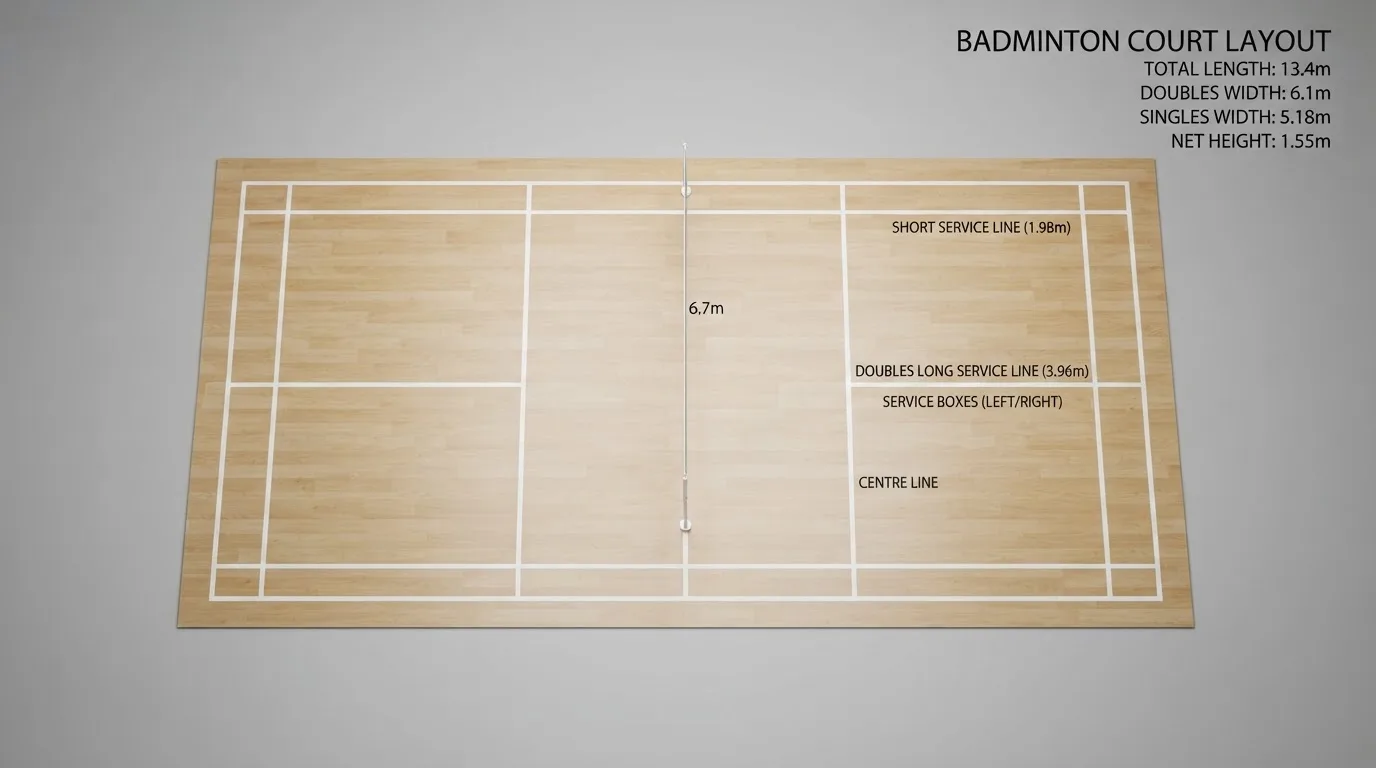
A badminton court is 13.4 metres long, 6.1 metres wide for doubles and 5.18 metres wide for singles; the net is 1.55 metres high at the edges and 1.524 metres at the centre. The lane and service-court configurations matter to a punter reading player profiles — taller players with long reach defend the rear court better, shorter players with sharp reflexes pick up the front court. None of this is a forecasting rule on its own; it is a piece of the form picture the punter holds alongside injury record and recent results.
The shuttle is a feathered projectile whose flight is unstable in a way a tennis ball is not. A dry hall helps the shuttle fly true; a humid hall drags it. The hall conditions at the All England Open, the BWF World Tour finals and the Olympic event are typically climate-controlled; at lower-tier events they are not. A punter reading a Super 300 event does not need to read the hall the way a punter reading a Super 1000 event does, but the absence of climate control is one of the things a player with a contact-heavy game dislikes, and a price-watch over the warm-up round can pick that up.
Legal framework for badminton betting in Great Britain
The Gambling Commission is the regulator for commercial gambling in Great Britain, sitting as a non-departmental public body sponsored by the Department for Culture, Media and Sport. The Commission’s authority runs from the Gambling Act 2005, which covers England, Scotland and Wales; Northern Ireland sits outside the Act under older legislation. A bookmaker serving customers in Great Britain needs a Commission licence whether it is based in the UK, in Malta, in Gibraltar or anywhere else — the Gambling (Licensing and Advertising) Act 2014 made the Commission’s licence compulsory at the point of consumption, not the point of supply. A Curaçao, Maltese or Gibraltar licence does not substitute, and the absence of a Commission licence is an offence under section 33 of the Act.
There is no state-set list of permitted bets. A bookmaker holds a licence in a category — remote general betting standard (real events) for the operators featured here — and offers markets under its own terms and under the Licence Conditions and Codes of Practice. In-play betting on badminton is offered by licensed operators and the controls on its terms are the operator’s, the LCCP’s and the Commission’s, not a separate statute. Esports are treated like any other event by the Commission; virtual events are a separate licence category; bets on politics, on television and on novelty markets are offered at many GB-licensed bookmakers and no statutory prohibition was found.
Betting exchanges operate under a separate licence category, the remote betting intermediary licence. A betting exchange is a market the customers make on each other; the operator takes a commission on net winnings, not a margin on the price. A betting exchange’s market on a badminton match winner sits at a tighter margin than a sportsbook’s market because the exchange’s take is the commission, and the punter comparing prices across a sportsbook and an exchange reads the commission line as the cost.
Identity verification is mandatory at a licensed site before a customer can deposit or gamble, in force since 7 May 2019, including with a free bet or a bonus. The age minimum is 18. Credit cards have been banned for gambling in Great Britain since 14 April 2020, including credit-card-funded e-wallet deposits; debit cards and bank-based payments are not in the ban. The customer who tries to deposit with a credit card at a licensed site is blocked by the operator’s own system, and the customer who tries to bet at all without first passing identity verification cannot place a bet.
A licensed remote operator’s safer-gambling tools include deposit limits (the customer can set their own, on a fixed time frame under RTS 12 — the Commission’s remote technical standards), self-exclusion and product restrictions, with referral to BeGambleAware, GamCare, GAMSTOP, Gambling Therapy and the British Gambling Commission. GAMSTOP is the national multi-operator online self-exclusion scheme, mandatory for online operators since 31 March 2020, with exclusion periods of six months, one year, five years, or five years with auto-renewal; a further seven years of exclusion applies after the minimum period unless the customer asks GAMSTOP to remove it. The financial vulnerability check under LCCP condition 3.4.4, in force since 30 August 2024, applies to a customer whose deposits minus withdrawals exceed £150 in a rolling 30 days (since 28 February 2025) and is a public-record check, not an income check and not a credit reference check. Financial risk assessments are announced, staged and have no start date; a customer is not yet asked to provide payslip evidence on the basis of a published threshold.
The player’s winnings are not taxed in Great Britain; General Betting Duty is the operator’s tax on gross profits, currently 15% and rising to 25% on remote bets (excluding UK horse racing and the listed categories) from 1 April 2027 under the policy paper of 26 November 2025. Whether operators pass the duty on through odds is not established; the figure a punter sees in the price is the only number a punter can use. A professional gambler should ask HMRC or a tax adviser.
The bookmaker on the Commission’s register is governed by the licence; the bookmaker off the register is governed by its own house rules and the laws of the place where it sits. The Commission’s enforcement tools are cease-and-desist notices, search-engine referrals and work with registrars, hosts and payment providers. The Commission has been given or is about to be given court-order DNS blocking powers; never write that ISP blocking is in operation. A punter who bets at an unlicensed site loses Commission oversight, GAMSTOP coverage, the approved dispute-resolution route and British consumer redress if funds are withheld, and is not bound by the 10x bonus wagering cap or the £150 vulnerability check. Neither licensed nor unlicensed is “the safe choice” by default.
Reading a tip after the price: how to use one without becoming one
A tip is a probability estimate plus a price. The estimate is the tipster’s; the price is the bookmaker’s. The decision a punter makes is whether the price exceeds the punter’s own estimate of the probability by enough to cover the cost of being wrong. The estimate is not published, so the punter’s edge has to come from reading form more carefully than the market did, on this fixture, at this price, on this day. Most tips will not offer that edge; a tip’s job is to be a useful input to the punter’s own estimate, not a substitute for it.
Staking the right amount on a tip is the second decision and the one the punter controls. A flat stake of 1-2% of bankroll on every selection is the discipline that turns intermittent tipping into a trackable long run; a percentage of bankroll that scales up after wins and down after losses (a modified Kelly approach) widens the bet on higher-confidence picks and shrinks it on lower-confidence ones. The maths of Kelly is not magic — it is the stake that maximises the geometric growth of the bankroll given a true estimate of probability — and on a probability that is wrong by two or three percentage points, it oversizes the stake. A flat stake or a fractional Kelly is the discipline a typical punter runs.
A tip whose price moves between the moment the tipster published and the moment the punter places the bet may have lost its value. The closing line price — the price the bookmaker settles at shortly before the match begins — is the book’s best estimate of true probability at the start of play. A tip that became available at a price of 4.00 and is still 4.00 just before the match starts has more value than a tip that became available at 4.00 and is now 3.50, because the market’s reading of the probability has shortened. A punter who follows the price after the tip is following the market’s read on the tip’s worth, which is one of the cheapest pieces of evidence available.
A tip is a starting read of a single fixture. It is not a system; a system is a discipline of staking, recording and reviewing that produces a trackable long run. It is not a route to certainty; the favourite at 1.10 still loses occasionally, the outsider at 12.00 still wins occasionally. Reading the price after the tip, staking as a percentage of bankroll and keeping the record are how a punter keeps the option of knowing how the tips went.
Check the licence, check the terms, check the bankroll
Three checks precede the first deposit at any bookmaker. The Commission’s public register confirms the licence; the operator’s terms page states the wagering requirement, the minimum price, the expiry and the cap on free-bet winnings for each promotion; and the bankroll statement confirms how much the punter can afford to stake against the bookmaker’s minimums and the operator’s deposit limits. Each check takes less than five minutes; running all three before the first deposit turns the betting activity from an impulse into a trackable one.
The Commission’s public register can be searched by business name, trading name, domain or account number, and the search result lists the licence categories, the licence holder and the trading names. A search of the account number on the licence table above returns the entry the operator has stated. A search of the operator’s domain may return a different entity if the licence holder is a parent company running several brands — a feature of the UK-licensed market worth checking once, before the punter assumes two names are two operators. A search of the business name typically returns the parent entity on the licence. None of these returns is a guarantee of quality; it is a guarantee of legal cover.
The terms page is the file the punter opens before claiming. The wagering requirement is the number of bets at the minimum price the punter has to place before a bonus becomes withdrawable. The minimum price is the price per selection that qualifies as a stake toward the wagering; legs at shorter prices do not count. The expiry is the time the bonus has to be turned over or it is forfeit. The cap on free-bet winnings is the maximum the punter can win from a free bet even at a long price; the cap is not in the headline, it is in the small print. Each of the four is a number the punter reads, not a marketing word.
The bankroll is the punter’s own number. A bookmaker’s deposit limit is the customer’s choice — the Commission sets no state-set ceiling — and the operator’s safer-gambling tools include deposit limits the punter can set on a fixed time frame under the Commission’s remote technical standards. A punter who sets a deposit limit and sticks to it is gambling within a bankroll the bankroll statement can support; a punter who changes the limit up after each deposit is gambling against the limit’s purpose.
The three checks are the cheapest parts of betting. Skipping them is the most expensive.
Safer-play tools a licensed bookmaker must offer, and how to use them
The safer-gambling tools at a GB-licensed remote bookmaker are not optional; they are conditions of the licence. The Commission’s remote technical standards and the Licence Conditions and Codes of Practice set out the minimum set the operator has to give each customer, and the Commission’s enforcement of those conditions is what makes the tools reliable rather than cosmetic.
Deposit limits are the customer’s own ceiling on the gross deposits they can place over a chosen time frame — daily, weekly or monthly. Setting a deposit limit is a one-way trip for the period: the punter can lower it at any time and the lower limit applies immediately; raising it takes a cooling-off period the operator has to enforce, typically 24 hours or longer. The punter’s bankroll sits under a ceiling the punter has set themselves, and the ceiling does what the ceiling says it does.
A real-time check on time spent and money deposited is on the account dashboard of every GB-licensed bookmaker. A session timer reminds the punter how long they have been logged in; a deposit and net-loss panel shows the punter their positions over a chosen period. The display is not a value judgement from the operator; it is a panel the punter can use to read their own activity.
Self-exclusion is the customer’s route out. GAMSTOP is the multi-operator online self-exclusion scheme and it covers every GB-licensed online bookmaker. A punter who registers with GAMSTOP is excluded from every site and app covered by the scheme for the period they choose — six months, one year, five years, or five years with auto-renewal — and the exclusion is enforced at the operator end, not just the punter end. A punter who tries to open a new account at a different licensed operator during the exclusion is blocked by the operator’s onboarding checks. The exclusion is the strongest of the safer-gambling tools because it removes the punter from the environment, not just from the offer.
Product restrictions let a punter opt out of one or more product categories — casino, slots, sports betting, poker — without a full self-exclusion. A punter who only wants to step back from the casino side but keep the sports betting side running uses product restrictions. The choice is the punter’s; the operator has to give it.
Help lines are public-facing and not sales-driven. GamCare runs the National Gambling Helpline; BeGambleAware runs information and signposting; the NHS gambling clinics provide treatment in several regions; Gamblers Anonymous runs peer support. The licensed operator’s help page links to them and the operator’s safer-gambling messaging is required to point to them, not to the operator’s own commercial offers.
The punter who uses the tools is the punter whose betting activity does not outrun their bankroll. The tools are part of the licence and part of the cost of the licence; the punter reads them and runs them as part of the routine.
Tennis, darts & cue sports – Fast Payout
Content created by the «Fast Payout» team
